





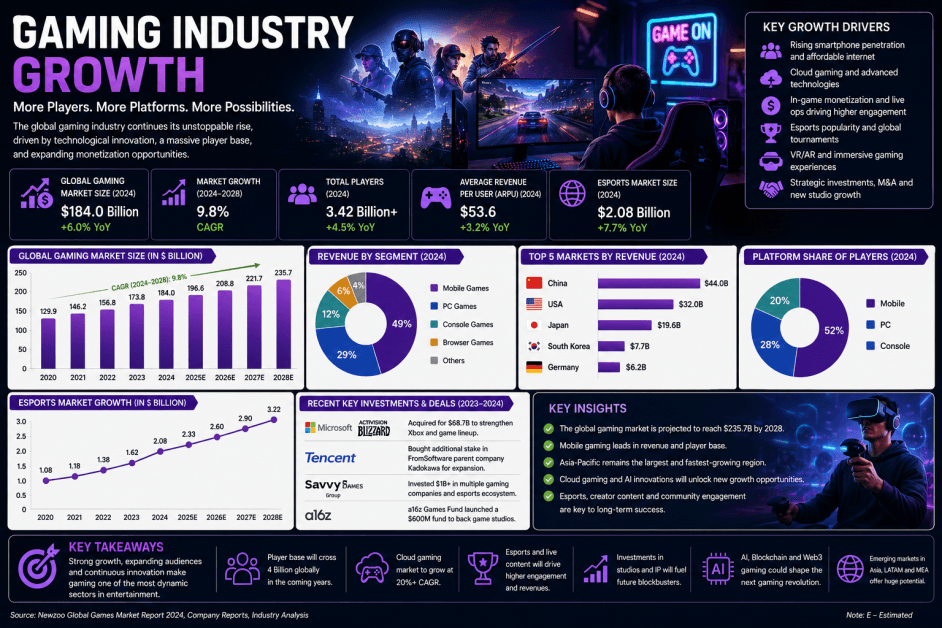
Gaming Industry Growth: Market Trends, Investment Opportunities, and the Future of Interactive Entertainment
The global gaming industry continues to experience strong growth as technological innovation, expanding internet access, smartphone adoption, and evolving consumer preferences reshape the interactive entertainment landscape. Game developers, publishers, technology companies, and investors are increasing investments in new content, cloud infrastructure, artificial intelligence (AI), and immersive gaming experiences to capitalize on growing global demand.
Gaming has evolved beyond traditional entertainment to become a major digital economy, generating revenue through game sales, subscriptions, in-game purchases, esports, advertising, and creator-driven content.
Gaming Market Continues to Expand
The gaming ecosystem now spans multiple segments, including:
-
Mobile gaming
-
PC gaming
-
Console gaming
-
Cloud gaming
-
Esports
-
Virtual reality (VR) gaming
-
Augmented reality (AR) gaming
-
Online multiplayer games
-
Casual gaming
-
Simulation and strategy games
The widespread availability of high-speed internet and connected devices has enabled gaming to reach audiences across all age groups and regions.
Key Growth Drivers
Mobile Gaming Expansion
Mobile gaming remains the largest segment of the global gaming market, supported by affordable smartphones, faster mobile networks, and a growing library of free-to-play titles. Improved app store ecosystems and digital payment options have further accelerated adoption.
Esports and Competitive Gaming
Professional gaming tournaments continue to attract large audiences, sponsorships, media rights deals, and advertising revenue. Esports organizations, tournament operators, and game publishers are investing in leagues, live events, and grassroots talent development.
Cloud Gaming
Cloud gaming services are reducing hardware barriers by allowing users to stream games directly over the internet. As broadband infrastructure improves, cloud-based gaming is expected to become more accessible across multiple devices.
Artificial Intelligence in Game Development
AI is increasingly used to improve game design, create intelligent non-player characters (NPCs), personalize gameplay, optimize testing, and enhance player engagement. Developers are also using AI to streamline content creation and automate certain production workflows.
Cross-Platform Gaming
Players increasingly expect to access games across smartphones, PCs, consoles, and smart TVs while maintaining synchronized progress and multiplayer connectivity.
Investment Trends
Investors continue to support growth across the gaming ecosystem through funding for:
-
Independent game studios
-
Mobile game developers
-
Esports organizations
-
Cloud gaming platforms
-
Gaming hardware
-
Game engines
-
Streaming technologies
-
AI-powered development tools
-
Creator platforms
-
Gaming analytics companies
Strategic acquisitions and partnerships remain common as established companies seek to expand their game portfolios and technological capabilities.
Technology Transforming Gaming
The industry is rapidly adopting technologies such as:
-
Artificial intelligence
-
Cloud computing
-
High-performance graphics processing
-
Virtual reality (VR)
-
Augmented reality (AR)
-
Real-time game engines
-
Motion capture
-
Data analytics
-
Machine learning
-
Cross-platform development tools
These innovations enable richer gameplay, faster development cycles, and improved player experiences.
Changing Consumer Preferences
Modern gamers increasingly look for:
-
High-quality graphics
-
Cross-platform compatibility
-
Live multiplayer experiences
-
Frequent content updates
-
Personalized gameplay
-
Strong online communities
-
Competitive esports opportunities
-
Subscription gaming services
-
Social gaming features
-
Secure digital transactions
These expectations are influencing how developers design, monetize, and support games over the long term.
Challenges Facing the Gaming Industry
Despite continued growth, the sector faces several challenges.
Rising Development Costs
Producing large-scale games requires significant investment in talent, technology, marketing, and ongoing content updates.
Cybersecurity Risks
Protecting player accounts, digital assets, and online services from cyber threats remains a priority.
Regulatory Developments
Gaming companies must comply with evolving regulations covering data privacy, consumer protection, online safety, and age-appropriate content.
Market Competition
Thousands of new games launch each year, making audience acquisition and long-term player retention increasingly competitive.
Monetization Balance
Developers continue to refine monetization strategies that generate sustainable revenue while maintaining a positive player experience.
Future Outlook
The gaming industry is expected to maintain robust long-term growth as technology and consumer behavior continue to evolve.
Key trends likely to shape the sector include:
-
Expansion of cloud gaming
-
Greater adoption of AI-powered development tools
-
Growth in mobile gaming
-
Wider use of VR and AR experiences
-
Continued expansion of esports
-
Subscription-based gaming services
-
Cross-platform ecosystems
-
Creator-driven gaming communities
-
Improved accessibility features
-
Stronger integration of social and interactive experiences
Companies that combine compelling content, innovative technology, and active player communities are expected to remain well positioned in the evolving gaming landscape.
Conclusion
The gaming industry continues to grow as advances in mobile technology, cloud computing, artificial intelligence, and digital connectivity transform interactive entertainment. Expanding investment, rising player engagement, and new business models are creating opportunities across game development, esports, streaming, and gaming technology.
While development costs, cybersecurity, and regulatory challenges remain important considerations, the long-term outlook for the industry remains positive. Continued innovation and global demand are expected to support sustained growth, making gaming one of the world's most dynamic digital entertainment sectors.
 Gaming Industry Growth: Global Market Trends, Investments, and Future Outlook FAQs
POST A COMMENT (0)
All Comments (0)
Replies (0)