





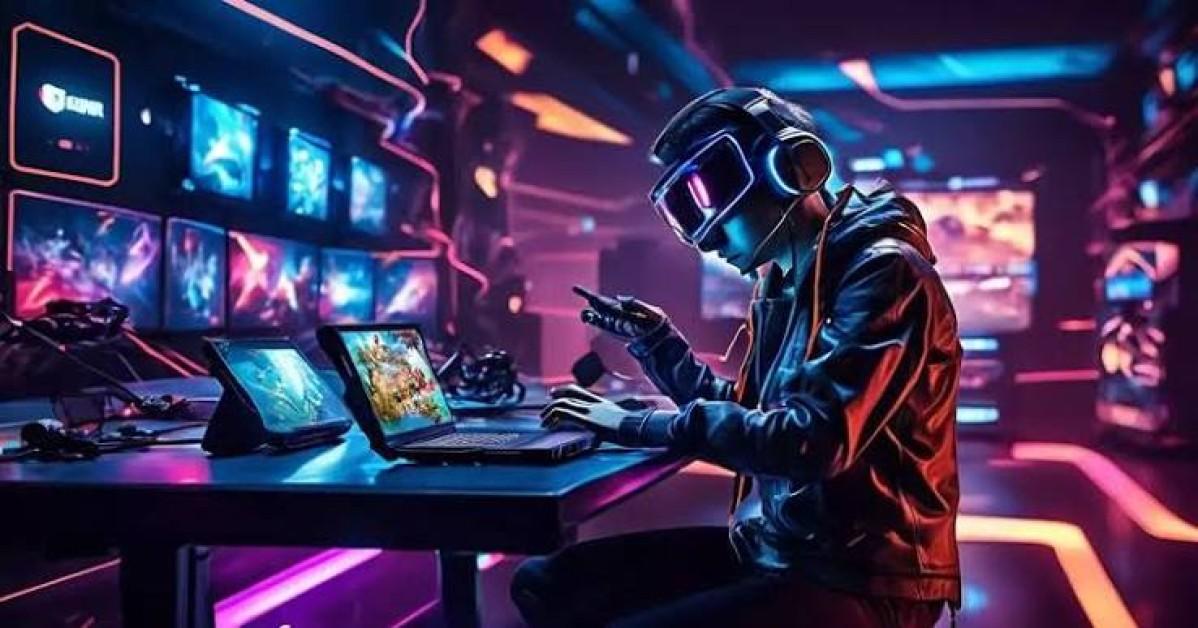
Gaming Companies Increase Investment in AI-Generated Characters and Automated Content Production
Gaming companies are increasing investment in AI-generated characters, dialogue, environments and automated production tools as publishers search for ways to reduce development costs and create more responsive game worlds. Major developers are experimenting with AI-powered non-player characters capable of generating dynamic conversations, while studios are also using generative systems for concept art, software testing, environmental assets and other repetitive production tasks. The shift could materially change game-development economics, with Morgan Stanley estimating AI-driven efficiencies could eventually reduce development costs by nearly 50% and unlock roughly $22 billion in annual industry profits.
AI Moves Deeper Into Game Development

The gaming industry's use of AI is expanding from isolated experiments into a broader production strategy.
Studios Automate Repetitive Development Work
Video games require enormous quantities of content.
Developers create environments, characters, dialogue, animations, sound effects, textures and software code.
Large titles can take several years and hundreds of millions of dollars to produce.
AI tools can automate parts of this workload.
Developers are increasingly using generative systems to create early concept art, assist programmers, generate dialogue alternatives and automate testing.
The technology can also help teams produce large numbers of background assets that would otherwise require substantial manual work.
The objective is generally not to automate the entire development process but to reduce time spent on repetitive tasks.
Nearly 90% of Developers Have Used AI Agents
AI adoption is already widespread across professional game development.
A Google Cloud survey published in 2025 found that 87% of videogame developers surveyed were using AI agents to automate or streamline parts of their work.
The industry's interest has continued into 2026 as publishers attempt to improve productivity following years of escalating development costs.
For large studios, even modest efficiency improvements can become financially significant when hundreds or thousands of employees work on one title.
AI-Generated Characters Become Major Experiment
The most visible application for players may be the emergence of AI-powered characters capable of responding dynamically.
Traditional NPCs Depend on Prewritten Dialogue
Non-player characters have historically relied on scripted dialogue.
A writer creates a collection of possible conversations.
Players trigger those responses through predetermined interactions.
This gives developers tight control over narrative quality but limits the number of possible conversations.
Once players have heard the available dialogue, characters begin repeating themselves.
AI systems create the possibility of much broader interaction.
A character can theoretically respond to questions that developers never explicitly anticipated.
AI NPCs Can Generate Conversations in Real Time
Large language models allow developers to give a character a defined personality, knowledge base and behavioural rules.
The model can then produce responses dynamically.
This creates the possibility of game worlds where background characters react more naturally to player behaviour.
Players could ask unusual questions.
Characters could remember previous encounters.
Different players could experience different conversations.
For role-playing and simulation games, this could significantly increase immersion.
Epic Games Expands AI Characters Inside Fortnite
One of the most prominent examples comes from Epic Games.
Fortnite Adds AI-Powered Personas
Epic has expanded AI-powered personas that creators can use within Fortnite experiences.
The initiative includes dozens of established Fortnite characters with defined voices and personalities.
Creators using Unreal Editor for Fortnite can incorporate these characters into their own islands and experiences.
The characters use large language models to produce conversations while remaining within predefined personality frameworks.
This gives independent Fortnite creators access to interactive character technology that previously would have required substantial technical resources.
Voice Actors Are Part of the System
Epic's approach also demonstrates how game companies are attempting to address voice-rights concerns.
The voices used for its AI personas are based on performances from professional actors who agreed to have their voices modelled for AI applications.
This is important because synthetic voice technology has become one of the most controversial areas of generative media.
Actors and unions have demanded greater control over how performances are used to train or operate synthetic characters.
Consent-based licensing could become an important business model for AI-generated game dialogue.
Dynamic NPCs Could Transform Open-World Games
AI-powered characters are particularly relevant to large game worlds.
Open Worlds Require Enormous Amounts of Dialogue
Modern open-world games can contain hundreds or thousands of characters.
Only a small number receive extensive writing.
Most background characters repeat limited dialogue or perform simple routines.
Expanding handcrafted conversations for every character would require enormous writing and voice-production budgets.
Generative systems offer another possibility.
Developers can write detailed personalities and rules for important characters while allowing AI to generate additional dialogue dynamically.
This could make virtual cities feel more responsive without requiring every sentence to be manually written.
Player Actions Could Produce Unique Reactions
A generated character could potentially react to events that occur during gameplay.
If the player damages a town, residents might discuss it.
If the player repeatedly helps a particular community, characters could remember those actions.
The same game could therefore develop differently for each player.
This would create a form of personalised storytelling that conventional scripted systems struggle to deliver at scale.
Automated Content Could Reduce Development Costs
Economic pressure is one of the strongest forces driving AI adoption.
AAA Games Have Become Extremely Expensive
Major videogames increasingly require budgets comparable with blockbuster films.
Development teams can contain hundreds or thousands of people.
Production takes years.
Marketing adds another substantial expense.
A commercial failure can therefore generate enormous losses.
Publishers are searching for ways to control these costs without reducing the scale consumers expect from premium games.
Automation provides one potential solution.
Morgan Stanley Sees $22 Billion Profit Opportunity
Morgan Stanley estimated in April 2026 that AI-driven cost reductions could eventually unlock approximately $22 billion in annual profits across the global gaming industry.
The bank projected that generative technology could reduce development costs by nearly 50% in some areas.
Potential savings come from environment creation, dialogue generation, software testing and other production tasks.
The actual impact will vary considerably between studios and game types.
Creative direction, game design and final quality control remain heavily dependent on human teams.
Large Publishers Could Gain Biggest Advantage
AI tools may not benefit every gaming company equally.
Scale Makes Automation More Valuable
A large publisher producing several major games can spread AI investments across multiple projects.
Internal models and production tools can be reused.
The company can train employees across dozens of studios.
Large proprietary libraries of artwork, animation, dialogue and game data can also provide valuable training resources.
This creates an advantage for companies with substantial intellectual property and existing production infrastructure.
Morgan Stanley identified companies including Tencent, Sony and Roblox as potentially well positioned to benefit from AI-driven efficiencies.
Established Franchises Provide Valuable Data
Large gaming companies own decades of intellectual property.
Characters, environments and gameplay assets from previous titles can potentially help build internal production systems.
A publisher developing the next instalment in a long-running franchise already possesses enormous quantities of reference material.
That can make automated content generation more consistent with the established visual and narrative identity.
Smaller studios may depend more heavily on generic third-party models.
AI Could Extend Life of Existing Games
The technology may also change how publishers manage successful franchises after release.
Live-Service Games Need Constant New Content
Games such as Fortnite, Roblox and other persistent online platforms need continuous updates.
Players expect new characters, environments, missions and events.
Producing this content manually creates large ongoing costs.
AI can potentially accelerate the production cycle.
Developers can generate initial assets or dialogue and then refine them before release.
This could allow companies to update games more frequently without increasing team sizes proportionately.
More Content Can Increase Monetisation
Long-running games generate revenue through digital items, battle passes and other recurring purchases.
New content gives players reasons to return.
Higher engagement creates more opportunities for monetisation.
AI could therefore influence both sides of the profit equation.
It can potentially lower production costs while increasing the amount of content available to players.
The economic value becomes particularly significant for franchises with millions of active users.
Automated Testing Offers Less Controversial AI Use
Not every application of AI involves replacing creative work.
Testing Games Requires Enormous Labour
Modern games contain complex software systems.
Developers need to identify crashes, broken quests and other bugs before release.
Human quality-assurance teams test thousands of different interactions.
AI agents can automate some of this process.
A software agent can repeatedly play sections of a game and search for unexpected behaviour.
It can perform actions much faster than human testers.
AI Can Search for Rare Problems
Some bugs occur only when a player performs a very specific sequence of actions.
Finding these manually can be difficult.
Automated agents can test enormous numbers of combinations.
This allows developers to identify problems earlier in production.
Human testers can then concentrate on issues involving gameplay experience and subjective quality that automated systems may struggle to evaluate.
Environment Generation Can Accelerate World Building
Large game environments require enormous amounts of visual production.
Background Assets Are Expensive to Produce
Artists create buildings, vegetation, furniture and thousands of other objects used to populate game worlds.
Many of these assets are important for atmosphere but are not central to the story.
Generative systems can help produce variations more rapidly.
An artist might create the core design language and then use AI-assisted tools to generate alternative textures or background objects.
Human artists still review and modify the results.
The workflow potentially allows smaller teams to create larger environments.
Procedural Generation Is Not Entirely New
Gaming has used algorithmic content generation for decades.
Procedural systems create maps, terrain and other elements according to predefined rules.
Generative AI extends this concept.
Instead of relying only on mathematical rules, models can learn from large datasets and generate more varied visual or narrative content.
The distinction is important because AI-driven generation can potentially produce assets that appear more handcrafted.
Smaller Studios Could Build Larger Games
Lower production costs could expand what independent developers are able to create.
Small Teams Gain Access to Advanced Capabilities
Historically, creating a large 3D game required substantial teams.
Independent studios often focused on smaller experiences because they lacked the resources of major publishers.
AI-assisted coding, art and testing could allow small teams to attempt more ambitious projects.
This reduces the financial barrier to entering the industry.
Developers who previously needed dozens of specialists may be able to prototype games using far fewer people.
Competition Could Become More Intense
Lower barriers also mean significantly more games can be produced.
The number of releases has already increased rapidly as accessible development tools expand.
That creates a discovery problem.
Players still have limited time.
Digital storefronts can become flooded with new titles.
Smaller production costs therefore do not guarantee commercial success.
Marketing, community development and brand recognition could become even more important.
Industry Faces Strong Backlash From Developers
AI adoption remains highly controversial among creative professionals.
Many Developers View Generative AI Negatively
Industry surveys have shown substantial scepticism among game-development workers.
Artists, writers and voice performers are particularly concerned that publishers could use generation tools to reduce employment.
The concern has grown after several years of widespread layoffs across the videogame industry.
When companies discuss AI alongside efficiency and cost reduction, employees naturally question whether automation will eliminate roles.
This creates significant cultural challenges for management.
Creative Quality Remains Major Concern
Some developers argue generated dialogue and artwork lack the intentionality required for strong games.
A memorable story depends on careful pacing and character development.
Every line can contribute to a larger narrative purpose.
Generated dialogue may produce individually convincing sentences while weakening broader storytelling consistency.
Studios therefore need to determine where automation improves production and where human craftsmanship remains essential.
Saber Interactive Highlights Industry Debate
Recent controversy around Saber Interactive demonstrates how sensitive AI use has become.
Game Includes AI-Generated Dialogue and Music
Saber acknowledged that an experimental mode in its upcoming driving game uses generated dialogue and music.
The company said the technology was used because the mode can involve an extremely large number of passenger scenarios.
Saber also stated that the core story remains human-written and disputed claims that writers were replaced by AI.
The situation nevertheless generated criticism among players and developers.
The controversy demonstrates that transparency around generated content is becoming important.
Platforms Require AI Disclosure
Steam requires developers to disclose certain uses of generative AI.
This allows customers to understand whether generated assets or live-generation systems are included in a game.
Disclosure rules could become increasingly common across distribution platforms.
Players may eventually expect clear labels explaining how AI was used during production.
This could influence purchasing decisions, particularly among audiences concerned about creative labour.
Voice Actors Demand Stronger Protections
Interactive AI characters create particularly complicated questions around performance rights.
Synthetic Voices Can Operate Indefinitely
A conventional voice actor records a defined set of lines.
A generative character can potentially produce new dialogue continuously using a synthetic version of the performer's voice.
This changes the economics of acting.
A performance can theoretically generate unlimited future lines without bringing the actor back into a recording studio.
Actors therefore want contracts specifying how voices can be modelled, how long they can be used and how compensation works.
Consent Could Become Industry Standard
Epic's use of actors who explicitly agreed to AI voice modelling offers one possible framework.
Studios can license a performance for particular synthetic uses.
The actor receives compensation and maintains contractual rights.
Clear consent can reduce the ethical and legal risks associated with voice cloning.
As AI NPCs expand, this type of agreement could become a normal part of videogame production contracts.
Copyright Creates Significant Legal Risk
Generated assets can raise questions about ownership and training data.
Studios Need Commercially Safe Models
A large publisher cannot afford to release a major game containing assets that expose it to copyright litigation.
Companies therefore need confidence about the origin of training material used by generative systems.
Some studios may build internal models trained only on assets they own.
Others may use commercial providers offering contractual protections.
The legal environment remains unsettled.
Developers will therefore continue treating generated content cautiously in high-value franchises.
Proprietary Data Could Become Competitive Advantage
Large publishers possess extensive libraries of original artwork, audio and code.
Training internal systems on this material can reduce external copyright risks.
It can also produce outputs more consistent with the company's established franchises.
This makes intellectual property increasingly valuable not only as content but also as training data.
Players May Resist Obviously Generated Games
Consumer acceptance will ultimately determine how aggressively publishers adopt the technology.
AI Label Can Affect Perception
Some players associate generative AI with low-quality or mass-produced content.
Games marketed too aggressively around automation can therefore face backlash.
Consumers paying premium prices expect carefully designed experiences.
If AI-generated characters appear repetitive or unreliable, the technology can weaken immersion rather than improve it.
Studios will need to focus on quality rather than simply maximising the quantity of generated content.
Invisible AI May Be More Successful
Many existing games already use forms of machine learning or procedural generation without players objecting.
The technology becomes controversial primarily when audiences believe it reduces artistic quality or replaces human creativity.
AI applications that improve testing or optimise background workflows may face much less resistance.
Publishers may therefore prioritise applications where the technology produces clear benefits without becoming the centre of the player experience.
AI NPCs Still Face Technical Limitations
Dynamic characters sound compelling, but operating them reliably is difficult.
Real-Time Generation Creates Cost
Large language models require computing resources.
A game with thousands of players simultaneously talking to AI characters could generate significant cloud costs.
Traditional scripted dialogue has almost no comparable runtime expense after development.
Publishers therefore need to ensure AI characters produce enough engagement to justify ongoing computing costs.
Running smaller models locally on gaming hardware could eventually reduce this problem.
Latency Can Break Immersion
Players expect game characters to respond quickly.
If an AI NPC takes several seconds to generate every answer, conversations can feel unnatural.
Developers need low-latency systems capable of producing responses almost immediately.
This becomes difficult when the model must simultaneously follow character rules and safety restrictions.
Hardware improvements and smaller specialised models may gradually address the challenge.
Developers Need Strong Guardrails
Generative characters can potentially say things developers never intended.
Players Will Deliberately Test Limits
Users frequently experiment with game systems.
An AI character will inevitably face prompts designed to make it behave unexpectedly.
The system could generate offensive or inappropriate dialogue.
For family-oriented games, this creates substantial brand risk.
Developers therefore need moderation and behavioural controls operating alongside the character model.
Narrative Consistency Is Equally Important
A character should not reveal information it is not supposed to know.
It should not contradict key story events.
It needs to remain consistent with the fictional world.
Developers therefore need systems controlling what information each character can access.
Successful AI NPCs will depend as much on these constraints as on the underlying language model.
AI Could Change Employment Mix Rather Than Eliminate Teams
Automation may alter which skills studios value.
Artists Could Spend More Time on Direction
If software generates rough assets, artists can focus on defining visual style and selecting final outputs.
Writers can design characters and narrative frameworks rather than manually creating every background conversation.
Programmers can supervise automated coding tools and solve more complex engineering problems.
This represents an augmentation scenario in which creative professionals remain central but use more powerful tools.
Some Roles Could Still Shrink
Cost reduction remains a major motivation for publishers.
Certain routine production roles may consequently face pressure.
Outsourced asset production and basic quality assurance could be particularly exposed.
The employment impact will depend on whether lower production costs lead companies to make more games or simply employ fewer people to produce the same number.
Both outcomes are plausible.
India’s Gaming Industry Could Benefit From Lower Production Costs
AI-assisted development could have particular relevance for emerging gaming markets.
Indian Studios Operate With Smaller Budgets
Many Indian game developers lack the enormous production budgets available to major US, Japanese or Chinese publishers.
Automation could narrow part of that resource gap.
Small teams can use assisted coding, asset creation and testing to develop more sophisticated products.
This could help Indian developers move beyond casual and mobile games toward larger PC and console experiences.
Local Languages Create AI Opportunity
India's linguistic diversity creates another potential application.
Games can use speech and text generation to support multiple Indian languages.
Dynamic translation could make international games more accessible.
Domestic developers could also build characters capable of interacting naturally in Hindi and regional languages.
This would expand the addressable audience for locally produced games.
Major Platforms Could Capture Significant Value
Game engines and distribution platforms occupy particularly advantageous positions.
Unreal and Roblox Can Provide AI Tools to Thousands of Creators
A platform does not need to develop every game itself to benefit from AI.
Epic can integrate generation technology into Unreal Engine and Fortnite creation tools.
Roblox can provide similar capabilities to millions of developers building experiences on its platform.
Every creator using those tools strengthens the ecosystem.
Platforms can therefore monetise AI indirectly through higher engagement and developer activity.
Data Gives Platforms Additional Advantage
Large gaming platforms observe enormous quantities of player behaviour.
They understand which experiences retain users.
This data can potentially help optimise AI-powered development and recommendation systems.
The combination of creation tools and distribution gives platform companies structural advantages that individual studios may struggle to reproduce.
AI Could Change Economics of Blockbuster Games
The most important long-term effect may be a shift in the risk profile of large game production.
Lower Costs Reduce Break-Even Requirements
A game costing $200 million needs enormous sales simply to recover development expenses.
If automation substantially reduces production costs, the break-even point declines.
Publishers could take greater creative risks.
They might also revive genres considered too expensive for their potential audience.
This could increase the diversity of commercially viable games.
Publishers Could Instead Produce More Content
Cost savings may also be reinvested rather than simply retained as profit.
Studios could create larger worlds.
Games could include more dialogue and side missions.
Live-service titles could receive more frequent updates.
The ultimate player benefit will depend on how publishers choose to deploy productivity gains.
Conclusion
Gaming companies' increasing investment in AI-generated characters and automated content production reflects both the enormous creative possibilities of generative technology and the industry's growing pressure to control development costs.
AI is already being used for concept development, environment creation, dialogue, coding assistance and software testing, while experiments such as Epic Games' AI-powered Fortnite personas demonstrate how dynamic characters could eventually become part of mainstream gameplay.
The financial opportunity is substantial. Morgan Stanley estimates AI-driven efficiencies could reduce some development costs dramatically and unlock roughly $22 billion in annual industry profits.
Yet adoption will not be frictionless. Copyright, voice rights, employment concerns, runtime costs, narrative consistency and player resistance remain significant obstacles.
The likely outcome is not fully automated game development. Instead, AI could become another layer of the production pipeline, allowing human developers to create larger and more responsive experiences while automating parts of the expensive repetitive work required to build modern games.
 Related News
POST A COMMENT (0)
All Comments (0)
Replies (0)