




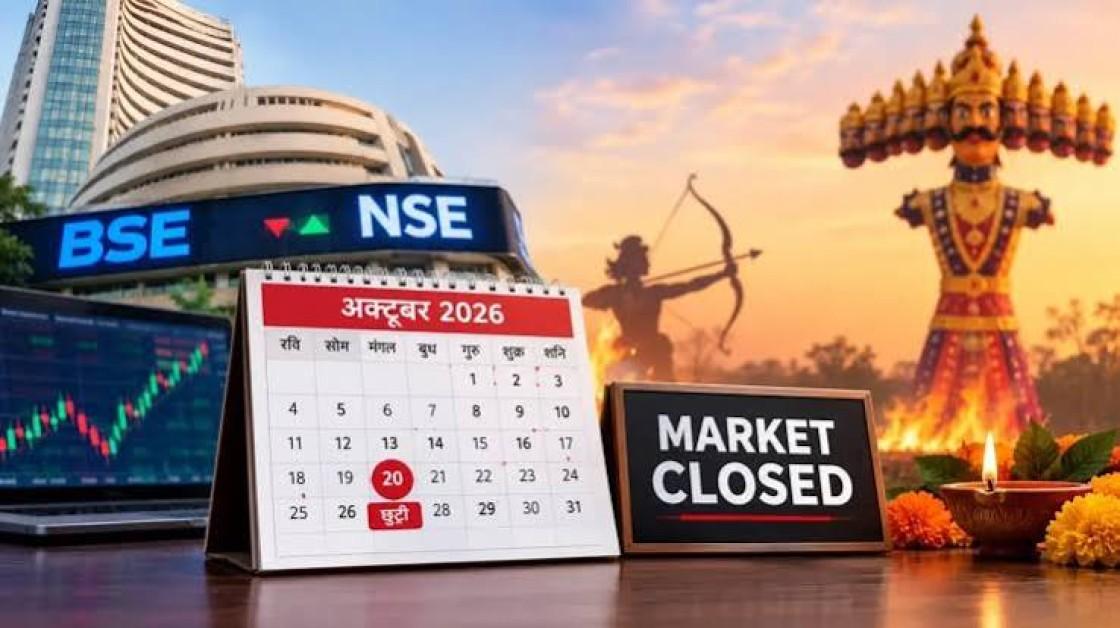
Indian Stock Markets Closed Today for Dussehra
The National Stock Exchange (NSE) and BSE remain closed on Tuesday, October 20, 2026, in observance of Dussehra, suspending regular trading across India's major equity and derivatives markets.
The closure is part of the exchanges' scheduled trading holiday calendar for 2026.
Investors will not be able to execute transactions in the regular equity market or trade equity derivatives during the holiday.
Trading in currency derivatives and securities lending and borrowing will also remain suspended.
Normal equity market operations are scheduled to resume on Wednesday, October 21, 2026.
The holiday follows the previous trading session on Monday, October 19, and creates a one-day interruption in the regular trading week.
While domestic equity markets remain closed, international financial markets continue operating according to their respective calendars.
Consequently, developments in global equities, commodities, currencies and corporate announcements could influence market sentiment when Indian exchanges reopen.
Investors will also monitor ongoing quarterly earnings announcements, institutional investment activity and broader economic developments ahead of Wednesday's trading session.
Key Details of the October 20 Stock Market Holiday
|
Particulars |
Details |
|---|---|
|
Market holiday |
Dussehra |
|
Date |
Tuesday, October 20, 2026 |
|
National Stock Exchange |
Closed |
|
BSE |
Closed |
|
Equity trading |
Suspended |
|
Equity futures and options |
Suspended |
|
Currency derivatives |
Suspended |
|
Securities lending and borrowing |
Suspended |
|
MCX morning session |
Closed |
|
MCX evening session |
Opens at 5:00 PM |
|
Next equity trading session |
Wednesday, October 21, 2026 |
|
Regular equity market hours |
9:15 AM–3:30 PM IST |
|
Next scheduled weekday market holiday |
November 10, 2026 |
The holiday affects the equity and derivatives markets for the entire day, while commodity trading follows a different schedule.
NSE and BSE Equity Trading Suspended for the Day

Both major Indian stock exchanges are observing a full trading holiday on October 20.
The NSE and BSE will not conduct their regular equity trading sessions.
This means investors cannot execute ordinary buy or sell transactions in listed shares through the exchanges during the holiday.
The closure also affects equity derivatives, including index and stock futures and options.
The Nifty 50 and Sensex will not record new regular-session trading values during the closure.
Market participants can continue reviewing portfolios, monitoring international developments and preparing orders for the next trading session, subject to their brokers' facilities.
However, any orders accepted by brokers outside market hours will be handled according to the relevant order type and broker rules.
The exchanges are scheduled to resume normal operations on October 21.
Equity Derivatives and Currency Markets Also Closed
The Dussehra holiday applies beyond the cash equity market.
Equity futures and options trading will remain suspended on both exchanges.
Currency derivatives trading will also be unavailable during the holiday.
The securities lending and borrowing segment will remain closed.
These closures affect investors and traders using derivatives for hedging, speculation and portfolio management.
Participants holding open derivatives positions will need to account for the interruption in trading.
Global financial developments can continue to influence the value of underlying assets even when Indian markets are closed.
However, domestic exchange-traded positions cannot be adjusted through the suspended trading sessions.
Investors should therefore consider the possibility of price adjustments when trading resumes.
Stock Market Trading Resumes on October 21
Regular trading on the NSE and BSE is scheduled to resume on Wednesday, October 21, 2026.
The normal equity market session runs from 9:15 AM to 3:30 PM Indian Standard Time.
The pre-opening process takes place before regular trading begins.
During the reopening session, investors will be able to respond to developments that occurred during the holiday.
These may include movements in overseas stock markets, changes in commodity prices and new corporate announcements.
Quarterly financial results could also influence individual stocks.
However, the direction of the market on Wednesday cannot be determined solely from the holiday schedule.
Opening prices will depend on market conditions, order flows and investor expectations.
October 20 Marks Second Exchange Holiday of the Month
The Dussehra closure is the second scheduled weekday stock market holiday in October 2026.
The exchanges previously remained closed on Friday, October 2, for Mahatma Gandhi Jayanti.
The October 20 holiday creates a shortened trading week.
After the holiday, regular trading is scheduled for Wednesday, Thursday and Friday, subject to any extraordinary exchange announcements.
Investors planning transactions or fund movements should account for the reduced number of trading and settlement days.
The holiday calendar is particularly relevant for traders managing short-term positions and investors expecting settlement of recent transactions.
MCX to Open for Evening Commodity Trading
Unlike the equity exchanges, the Multi Commodity Exchange of India (MCX) will operate a partial trading schedule on October 20.
The commodity exchange will remain closed during its morning session.
Trading is scheduled to resume at 5:00 PM IST.
The evening session will continue until 11:30 PM or 11:55 PM, depending on the applicable commodity contract.
This arrangement allows eligible commodity market participants to trade during the evening despite the equity market holiday.
Commodities such as gold, silver, crude oil and other eligible contracts may respond to international market developments.
However, investors should verify the trading schedule for their specific contracts.
The MCX evening session does not mean that NSE or BSE equity trading has resumed.
The markets operate under separate schedules.
Stock Market Holiday Affects Settlement of Recent Trades
The October 20 holiday also affects the settlement calendar.
Indian equities generally operate under a T+1 settlement framework, under which eligible trades are settled on the next working settlement day.
Because October 20 is a trading and settlement holiday, transactions executed on Monday, October 19, are scheduled to settle on Wednesday, October 21.
The intervening holiday is excluded from the settlement calculation.
This distinction matters for investors expecting securities or funds to become available following completed transactions.
Broker account balances may also reflect unsettled credits differently during the holiday.
The timing of withdrawals can depend on settlement status and broker-specific processing arrangements.
Investors should therefore distinguish between a completed market transaction and the subsequent settlement of securities or funds.
Nifty Weekly Options Expiry Adjusted for Holiday
The Dussehra holiday also affects contracts whose scheduled expiry falls on October 20.
Where an exchange-traded derivatives contract has an expiry date coinciding with a trading holiday, the exchange applies its prescribed expiry adjustment rules.
For the October 20 holiday, the relevant Nifty weekly expiry was advanced to Monday, October 19.
The adjustment allows expiry-related trading and settlement procedures to take place on an eligible trading day.
Such changes are important for derivatives traders because they can alter the time available to manage positions.
Investors should always verify the applicable expiry date for individual contracts.
Not every derivative instrument follows the same expiry schedule.
Investors Monitor Global Markets During Domestic Closure
Although Indian equity markets are closed, international exchanges may continue trading.
Developments in the United States, Europe and Asia can influence investor expectations ahead of the next domestic session.
Global equity market movements may affect sentiment toward Indian technology, banking, manufacturing and other sectors.
Changes in US Treasury yields and the dollar can also influence emerging-market investment flows.
Commodity prices remain relevant because India imports substantial quantities of crude oil and other industrial materials.
However, international market movements do not translate mechanically into identical changes in Indian equities.
Domestic economic conditions, company earnings and institutional investment activity also influence prices.
Investors will assess the combined effect of these factors when markets reopen.
Crude Oil Prices Remain Important for Indian Equities
International crude oil prices are among the indicators investors may monitor during the market holiday.
India is a major importer of crude oil, making domestic economic conditions sensitive to changes in global energy prices.
Higher oil prices can increase import costs and influence inflation expectations.
They may also affect operating expenses for businesses that rely heavily on fuel and transportation.
Companies in aviation, paints, chemicals and logistics can be exposed to changes in energy costs.
Oil exploration and production companies may respond differently because their earnings are linked to commodity prices and production conditions.
However, the effect varies by company and market environment.
Investors will evaluate oil price developments alongside currency movements and broader financial conditions.
Rupee and Foreign Investment Flows Remain in Focus
Foreign exchange movements can influence Indian equity market sentiment.
The rupee's value against the US dollar affects import costs, export competitiveness and the financial performance of companies with international operations.
Foreign portfolio investment flows are another important factor.
Changes in global risk appetite, interest rate expectations and currency conditions can influence foreign investor participation in Indian markets.
Domestic institutional investors also play a significant role in market liquidity.
The interaction between foreign and domestic flows can affect market direction.
However, the October 20 holiday itself does not determine the direction of institutional investment activity.
Market participants will evaluate the latest available information when trading resumes.
Quarterly Corporate Earnings Could Influence Wednesday's Session
The October trading period coincides with the release of financial results for the second quarter of FY2026–27.
Listed companies are reporting performance for the three months ended September 30, 2026.
Quarterly earnings can influence individual stock prices, particularly when results differ from investor expectations.
Important indicators include revenue growth, operating margins, net profit, management commentary and future business outlook.
Banking, technology, manufacturing and consumer-oriented companies may attract attention as investors assess sector performance.
Corporate announcements made during the market holiday may also be reflected in share prices when trading resumes.
However, positive financial results do not always lead to higher stock prices.
Market reactions depend on expectations, valuations and other available information.
Banking and Financial Stocks Remain Important Market Drivers
Banking and financial services companies carry substantial weight in India's benchmark equity indices.
Their performance can therefore influence the broader market.
Investors monitor bank earnings for changes in loan growth, deposits, net interest margins and asset quality.
Credit demand from businesses and households also provides information about economic activity.
Financial stocks can respond to interest rate expectations and regulatory developments.
However, sector movements depend on company-specific results as well as broader economic conditions.
The next trading session may reflect any new information released during the holiday.
Technology Stocks Face Global Demand Considerations
Indian IT services companies are sensitive to international technology spending, particularly in North America and Europe.
Investors assess quarterly results for revenue growth, deal bookings, operating margins and customer demand.
Artificial intelligence-related services have become an increasingly important area of industry investment.
However, the commercial impact of AI varies across companies and customers.
Global technology stock movements during the holiday could influence sentiment toward Indian IT shares.
Company-specific earnings announcements may also affect prices.
Investors will evaluate these developments when domestic markets reopen.
Investors Should Prepare for Possible Opening Volatility
A trading holiday can create a temporary gap between the last domestic market closing price and the next opening session.
During that period, new information may become available.
When trading resumes, investors and traders may adjust their positions to reflect changed expectations.
This can lead to price gaps or increased volatility in individual securities.
However, volatility is not guaranteed.
The extent of any movement depends on the significance of developments during the closure and the balance of market orders.
Investors using leveraged positions or derivatives should remain aware of the risks associated with price gaps.
Short-term trading decisions should take account of liquidity, position size and risk exposure.
Upcoming NSE and BSE Trading Holidays in 2026
Following the Dussehra closure, the exchange calendar includes several additional scheduled holidays.
|
Date |
Day |
Occasion |
|---|---|---|
|
November 8, 2026 |
Sunday |
Diwali Laxmi Pujan; special Muhurat trading scheduled |
|
November 10, 2026 |
Tuesday |
Diwali-Balipratipada |
|
November 24, 2026 |
Tuesday |
Prakash Gurpurb Sri Guru Nanak Dev |
|
December 25, 2026 |
Friday |
Christmas |
The November 8 Muhurat trading session is a special trading arrangement associated with Diwali.
Although it falls on a Sunday, the exchanges have scheduled a special session.
The exact session timings are to be communicated through the applicable exchange circular.
The remaining weekday holidays will suspend regular trading in the relevant market segments.
Investors should consult the latest exchange calendar for any changes.
Diwali Muhurat Trading Scheduled for November 8
The NSE and BSE have scheduled Muhurat trading for Sunday, November 8, 2026, on the occasion of Diwali Laxmi Pujan.
Muhurat trading is a special stock market session associated with the beginning of the traditional Hindu financial year.
The session is held outside the regular weekday trading schedule.
Its timing is determined and announced by the exchanges.
Investors may participate in eligible trading segments during the notified session.
However, the existence of a special session does not guarantee positive market performance.
Prices remain subject to demand, supply and market conditions.
The exchanges will communicate the relevant trading and settlement arrangements separately.
What Investors Should Watch on October 21
The next regular trading session will take place on Wednesday, October 21.
Investors will monitor international market performance during the holiday and any developments affecting the domestic economy.
Corporate earnings announcements will remain important for stock-specific movements.
Crude oil prices, currency movements and institutional flows may also influence market sentiment.
Derivatives traders will assess positioning and market liquidity following the holiday-adjusted expiry schedule.
Investors should also account for settlement of eligible transactions executed on October 19.
The reopening session will provide the first opportunity for regular NSE and BSE equity trading after Dussehra.
Conclusion
The NSE and BSE remain closed on Tuesday, October 20, 2026, in observance of Dussehra.
The holiday suspends regular trading in equities, equity derivatives, currency derivatives and other affected exchange segments.
Normal stock market trading is scheduled to resume on Wednesday, October 21.
The MCX will follow a different timetable, with its morning session closed and evening commodity trading beginning at 5:00 PM.
The holiday also affects settlement schedules, with eligible transactions executed on October 19 scheduled for settlement on October 21.
Investors preparing for the next trading session will monitor global market developments, commodity prices, corporate earnings and domestic financial conditions.
The reopening session will reflect any relevant developments that occurred while Indian equity exchanges were closed.
 NSE and BSE Closed Today, October 20, 2026, for Dussehra; Trading Resumes Wednesday FAQs

POST A COMMENT (0)
All Comments (0)
Replies (0)