





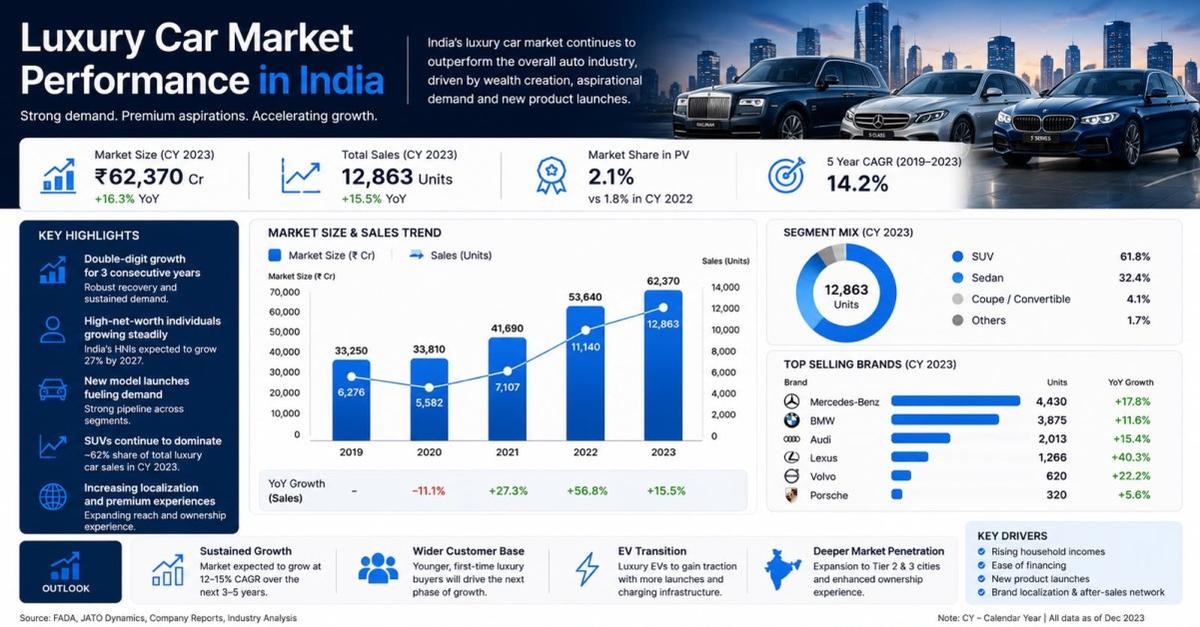
Luxury Car Market Performance in India: Growth Trends, Key Brands, and Industry Outlook
India's luxury automobile market continues to demonstrate resilience despite broader economic uncertainties. Rising disposable incomes, expanding entrepreneurial wealth, premiumization, and growing demand for electric vehicles (EVs) are driving sustained growth in the country's premium vehicle segment.
Although luxury vehicles account for a relatively small share of India's overall passenger vehicle market, the segment has been expanding steadily, supported by new product launches, improved financing options, and increasing demand from both metropolitan cities and emerging urban centers.
Luxury Car Market Shows Steady Momentum
India remains one of the fastest-growing luxury automobile markets among major emerging economies. Demand has been supported by affluent professionals, business owners, startup founders, corporate executives, and high-net-worth individuals seeking premium mobility solutions.
Automakers have responded by expanding their product portfolios across:
-
Luxury sedans
-
Premium SUVs
-
Electric luxury vehicles
-
Performance cars
-
Plug-in hybrid models
-
High-performance sports utility vehicles
SUVs continue to dominate the luxury segment as consumers increasingly prioritize versatility, advanced technology, and road presence.
Leading Luxury Car Brands in India
Several global manufacturers continue to compete aggressively in India's premium automobile market.
Mercedes-Benz
Mercedes-Benz remains one of the leading luxury car manufacturers in India, offering a broad portfolio that includes sedans, SUVs, electric vehicles, and performance models.
BMW
BMW continues to strengthen its presence through premium SUVs, executive sedans, luxury electric vehicles, and its high-performance M series.
Audi
Audi has expanded its SUV lineup while increasing its focus on connected technologies and electric mobility through its e-tron range.
Lexus
Lexus is growing its presence by emphasizing hybrid technology, luxury craftsmanship, reliability, and customer experience.
Volvo Cars
Volvo continues to focus on safety, electrification, and premium SUVs while expanding its electric vehicle portfolio.
Jaguar Land Rover (JLR)
Jaguar Land Rover remains a significant player in India's premium SUV and luxury performance vehicle market through its Range Rover, Defender, Discovery, and Jaguar brands.
Key Growth Drivers
Rising Affluent Population
India continues to see growth in high-income professionals, entrepreneurs, startup founders, and business owners, expanding the customer base for luxury automobiles.
Premiumization
Consumers are increasingly willing to invest in advanced technology, safety features, comfort, and premium ownership experiences.
Electric Vehicle Adoption
Luxury manufacturers are introducing battery-electric models as consumer interest in sustainable mobility and advanced automotive technology increases.
Improved Financing Options
Flexible financing, leasing, subscription models, and attractive ownership packages have made premium vehicles more accessible to eligible buyers.
Expanding Tier-2 and Tier-3 Markets
Luxury car demand is no longer concentrated solely in major metropolitan areas. Emerging cities are contributing a growing share of premium vehicle sales as wealth creation spreads across India.
Emerging Consumer Preferences
Luxury vehicle buyers are increasingly prioritizing:
-
Advanced driver assistance systems (ADAS)
-
Connected car technologies
-
Electric mobility
-
Premium interiors
-
Panoramic sunroofs
-
Large infotainment displays
-
AI-powered voice assistants
-
Over-the-air software updates
-
Personalized ownership experiences
-
Sustainable materials
The shift toward premium SUVs continues to reshape product strategies across nearly every luxury automaker operating in India.
Challenges Facing the Luxury Car Market
Despite strong demand, the industry continues to face several challenges.
High Import Duties
Import taxes and regulatory costs contribute to higher retail prices for many luxury vehicles.
Limited Charging Infrastructure
Although improving, public charging networks remain an important consideration for luxury EV adoption.
Global Supply Chain Risks
Semiconductor availability and component supply disruptions can affect production and deliveries.
Economic Uncertainty
Interest rates, inflation, and broader economic conditions may influence purchasing decisions in the premium segment.
Infrastructure Constraints
Road conditions and urban congestion can affect ownership experiences in some regions.
Electric Luxury Vehicles Gain Momentum
Luxury manufacturers are investing heavily in electrification by introducing new battery-electric and plug-in hybrid models.
Growing demand is being driven by:
-
Improved driving range
-
Faster charging technologies
-
Government support for EV infrastructure
-
Lower operating costs
-
Increasing environmental awareness
Premium electric SUVs are emerging as one of the fastest-growing categories within the luxury vehicle market.
Future Outlook
India's luxury automobile market is expected to maintain a positive long-term trajectory, supported by rising incomes, urbanization, technological innovation, and increasing consumer interest in premium mobility.
Future growth is likely to be shaped by:
-
Expansion of luxury EV portfolios
-
Greater localization of manufacturing
-
AI-powered in-car experiences
-
Connected mobility services
-
Advanced autonomous driving features
-
Digital retail and online vehicle purchasing
-
Subscription-based ownership models
Manufacturers are also expected to strengthen dealership networks, charging infrastructure partnerships, and after-sales services to support long-term customer engagement.
Conclusion
India's luxury car market continues to evolve as consumers increasingly seek premium technology, safety, performance, and sustainable mobility solutions. Strong demand for luxury SUVs, growing adoption of electric vehicles, and expanding interest from emerging cities are creating new opportunities for global automakers.
While challenges such as import duties, infrastructure limitations, and economic uncertainty remain, the long-term outlook for the luxury automobile segment remains positive. Continued investments in electrification, digital innovation, and customer experience are expected to support the market's growth over the coming years.
 Luxury Car Market Performance in India: Sales Trends and Future Outlook FAQs
POST A COMMENT (0)
All Comments (0)
Replies (0)