





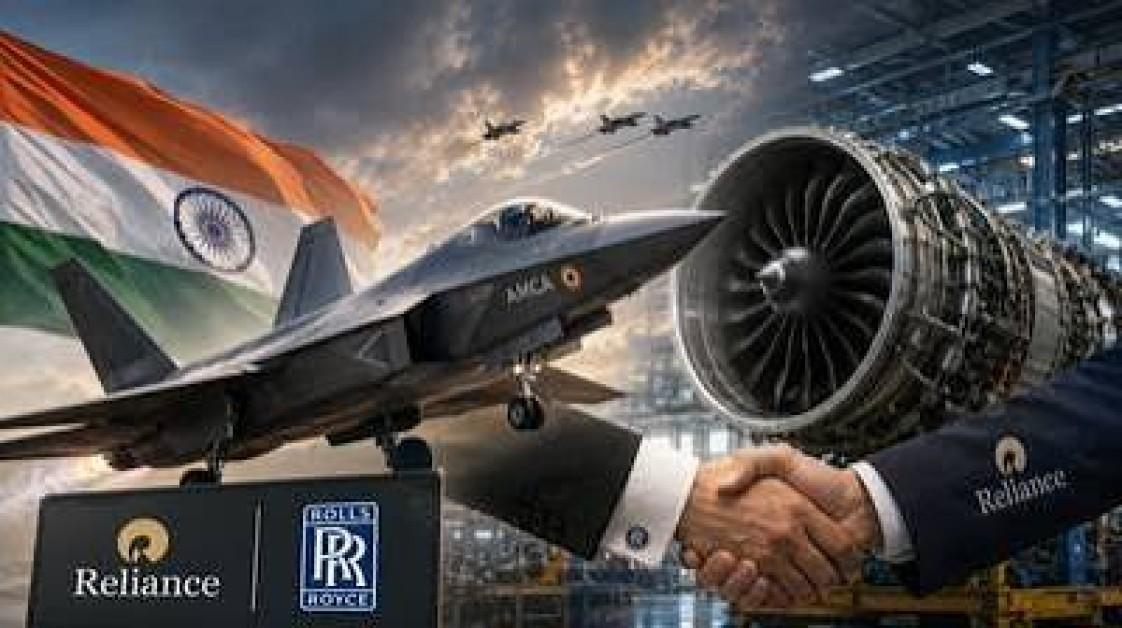
Reliance and Rolls-Royce Plan Partnership to Develop Indigenous Combat Engine for India’s AMCA Programme
Reliance Industries and British aerospace group Rolls-Royce have announced their strategic intent to collaborate on the design, development, manufacturing and delivery of a sovereign indigenous combat engine for India’s Advanced Medium Combat Aircraft programme. The proposed partnership represents a significant private-sector entry into one of India’s most strategically important aerospace technology programmes. The companies also plan to explore establishing a dedicated Aerospace Gas Turbine Complex in India, potentially creating domestic capabilities spanning advanced propulsion engineering, manufacturing and future engine development.
Reliance and Rolls-Royce Target India’s AMCA Engine Requirement

The partnership is focused on one of the most technologically challenging components of India’s fifth-generation fighter programme: the powerplant.
Companies Plan Joint Development in India
Reliance and Rolls-Royce intend to combine their respective industrial and aerospace capabilities to pursue the AMCA engine opportunity.
Rolls-Royce brings decades of experience developing military and civil aerospace propulsion systems, while Reliance offers large-scale industrial execution, manufacturing and investment capabilities.
The proposed collaboration is intended to go beyond simply assembling a foreign-designed engine in India.
The companies are positioning their proposal around indigenous development and the creation of sovereign capabilities within the country.
If selected for the programme, the partnership could support engineering, testing, manufacturing and eventual delivery of engines from India.
Such an arrangement would represent an important shift from traditional licensed production toward deeper participation in advanced propulsion technology.
Partnership Remains Subject to AMCA Engine Selection
The announcement represents strategic intent rather than confirmation that the Reliance-Rolls-Royce team has secured the AMCA engine programme.
India still needs to determine the final development and partnership structure for the indigenous high-thrust engine.
Rolls-Royce faces competition from other global aerospace companies interested in working with India.
France’s Safran has also been pursuing an opportunity to collaborate on a future fighter engine.
The eventual selection is likely to depend heavily on technology transfer, intellectual-property arrangements, development timelines, performance requirements, costs and the degree of sovereign control India receives.
For India, the objective extends beyond purchasing an engine. Developing the capability to design, manufacture, upgrade and support future combat engines domestically is the larger strategic goal.
AMCA Is Central to India’s Future Fighter Aircraft Strategy
The Advanced Medium Combat Aircraft is being developed as India’s next-generation stealth fighter and represents a major step beyond the current Tejas programme.
AMCA Is Designed as a Fifth-Generation Fighter
The AMCA is envisioned as a twin-engine, medium-weight stealth combat aircraft incorporating advanced sensors, avionics and weapons systems.
Low-observable design will be one of its defining characteristics.
The aircraft is expected to perform multiple missions, including air superiority and precision strike roles.
India plans to develop the aircraft domestically through the Aeronautical Development Agency and an industrial production ecosystem involving Indian companies.
The programme has strategic importance because the Indian Air Force needs to modernise its fighter fleet while gradually replacing older aircraft.
Building a domestically designed fifth-generation platform would reduce dependence on importing complete advanced fighters while developing valuable aerospace engineering expertise within India.
Initial AMCA Aircraft Will Use Existing Engines
The indigenous high-thrust engine is primarily associated with later versions of the AMCA rather than the earliest prototypes.
Initial AMCA development is expected to rely on an existing foreign engine solution.
A future AMCA variant would then transition toward the more powerful engine developed through the proposed indigenous programme.
This phased strategy allows aircraft development to proceed while India simultaneously undertakes the much longer and more technically challenging process of creating an advanced fighter engine.
Separating the timelines can reduce the risk that delays in engine development prevent progress on the entire aircraft programme.
However, successfully integrating the future indigenous engine will remain a critical long-term milestone.
Rolls-Royce Has Proposed a High-Thrust Fighter Engine
The British aerospace company has been actively positioning itself for India’s future combat-engine requirement.
Proposed Engine Would Deliver More Than 120 kN of Thrust
Rolls-Royce has proposed jointly developing a fighter engine capable of producing more than 120 kilonewtons of thrust.
High thrust is essential for the future AMCA because the aircraft must combine stealth characteristics with demanding performance requirements.
The engine also needs to support power-hungry onboard electronics and future systems while remaining compact and reliable.
Developing such a powerplant requires mastery of highly specialised technologies.
These include advanced turbine blades, high-temperature materials, combustion systems, compressors, thermal management and sophisticated digital engine controls.
Only a small group of countries currently possesses the complete technological capability required to independently design and manufacture modern high-performance fighter engines.
Rolls-Royce Has Presented an Ambitious Development Timeline
Rolls-Royce has indicated that its proposed development programme could deliver an engine core around 2030 if an agreement is concluded within the required timeframe.
The company has also outlined a potential first flight around 2034 and production later in the following years.
Actual schedules would depend on programme approval, engineering progress, testing and certification.
Combat-engine development is inherently complex.
New engines undergo extensive ground testing before they can safely enter flight trials, followed by additional development before operational production.
India will therefore need to evaluate not simply promised timelines but also the technical and financial risks associated with delivering a completely new powerplant.
Aerospace Gas Turbine Complex Could Build Domestic Capability
One of the most significant elements of the Reliance-Rolls-Royce proposal is the planned exploration of a dedicated aerospace propulsion facility in India.
Complex Could Become a Power and Propulsion Centre
The proposed Aerospace Gas Turbine Complex would be designed as a centre of excellence for power and propulsion technology.
Such an operation could potentially bring together engineering, manufacturing, testing and supply-chain capabilities required for advanced aerospace engines.
Creating this infrastructure domestically would have value beyond the AMCA programme.
Gas-turbine technologies can support future combat aircraft, unmanned systems and other aerospace applications.
India could also develop a deeper domestic supplier ecosystem around specialised materials, precision components and advanced manufacturing.
This broader industrial capability is strategically important because modern aircraft programmes require thousands of specialised components produced to extremely demanding tolerances.
Reliance Brings Large-Scale Industrial Execution
Reliance Industries is best known for its businesses across energy, petrochemicals, telecommunications and retail rather than fighter aircraft.
However, its industrial scale and ability to execute large capital-intensive projects could be relevant to the proposed aerospace partnership.
The collaboration would mark a significant expansion of Reliance’s role in advanced defence manufacturing.
Building aerospace engines requires different capabilities from conventional industrial manufacturing, making Rolls-Royce’s technical expertise central to the proposal.
The combination would effectively pair a global propulsion specialist with one of India’s largest private-sector industrial groups.
If successful, it could also demonstrate a larger role for private companies in India’s strategic aerospace programmes.
Engine Technology Remains a Major Indian Defence Challenge
India has made substantial progress in missiles, aircraft structures, avionics and other defence technologies, but advanced fighter engines remain particularly difficult.
Fighter Engines Require Extreme Engineering Capabilities
A modern fighter engine operates under extraordinarily demanding conditions.
Components inside the turbine must tolerate temperatures that can exceed the melting points of the underlying materials.
Engineers overcome this through advanced alloys, thermal coatings and sophisticated cooling technologies.
At the same time, the engine needs to remain lightweight while producing enormous thrust.
Reliability is equally important because an engine failure in a combat aircraft can have catastrophic consequences.
Manufacturing tolerances are exceptionally demanding.
These technological barriers explain why the global fighter-engine industry remains concentrated among a small number of companies.
Building genuine domestic capability therefore requires much more than establishing an assembly facility.
Indigenous Capability Would Reduce Strategic Dependence
India currently depends significantly on foreign-origin engines for its major fighter aircraft programmes.
The Tejas family, for example, relies on engines supplied by GE Aerospace.
Dependence on overseas suppliers can create vulnerabilities involving delivery schedules, export approvals and geopolitical developments.
Recent engine-supply delays affecting the Tejas programme have reinforced the strategic importance of strengthening domestic propulsion capabilities.
An indigenous engine would give India greater control over production, maintenance and future upgrades.
It could also reduce the risk that an aircraft manufacturing programme is constrained by the availability of imported powerplants.
Intellectual Property Could Be Critical to the Final Decision
Technology ownership is likely to become one of the most important factors in India's selection of an international engine partner.
India Wants More Than Licensed Manufacturing
Licensed production can create manufacturing expertise without necessarily transferring the underlying design knowledge.
India's objective for the AMCA engine is considerably more ambitious.
A genuine co-development programme could allow Indian engineers to participate directly in designing the engine and developing critical technologies.
Intellectual-property rights would influence India's ability to modify the engine independently and use technology developed through the programme in future platforms.
This makes the ownership structure strategically important.
A lower-cost proposal with restricted technology rights may ultimately provide less long-term value than a more expensive programme that creates genuine domestic design capabilities.
Rolls-Royce Has Emphasised Sovereign Capability
Rolls-Royce has publicly positioned its India proposal around co-development and sovereign capability.
The company has previously argued that India should move beyond “Make in India” toward deeper co-creation of advanced technologies.
Its existing Indian defence relationship extends back decades.
Rolls-Royce engines have powered multiple aircraft operated by the Indian military, while the company has worked with Hindustan Aeronautics on manufacturing and support.
The AMCA proposal would represent a substantially deeper technological partnership because the objective would be development of a new engine rather than licensed manufacture or maintenance of an established design.
Safran Competition Could Strengthen India’s Negotiating Position
Rolls-Royce is not the only international company pursuing India’s advanced fighter-engine programme.
Safran Has Also Proposed Joint Development
France’s Safran has been involved in discussions around developing a high-thrust engine with India.
Its proposal creates meaningful competition for the programme.
For India, having multiple global engine manufacturers competing can improve negotiating leverage.
Technology transfer, intellectual-property ownership, investment commitments and development schedules can all become differentiating factors.
India can evaluate which partnership offers the strongest foundation for long-term sovereign capability rather than focusing only on immediate engine requirements.
Competition could also encourage bidders to increase local manufacturing and engineering commitments.
Final Choice Will Shape India’s Aerospace Industry for Decades
Selecting a combat-engine partner is fundamentally different from purchasing a conventional defence platform.
The resulting technology could influence multiple generations of Indian aircraft.
Engine architecture developed for the AMCA could potentially support future fighters or other advanced aerospace platforms.
Engineering teams trained through the programme could also contribute to later indigenous propulsion projects.
The decision therefore has industrial consequences extending well beyond the number of AMCA aircraft ultimately produced.
India is effectively choosing how it wants to build a national ecosystem around one of the most difficult aerospace technologies.
Partnership Supports India’s Defence Manufacturing Ambitions
The Reliance-Rolls-Royce proposal also reflects a broader transformation in India's defence industrial strategy.
Private Companies Are Taking Larger Roles
Indian defence manufacturing was historically dominated by government-owned companies and research organisations.
Policy reforms have gradually increased opportunities for private businesses.
Companies including Tata, Larsen & Toubro, Mahindra and Bharat Forge have expanded their defence and aerospace operations.
A Reliance-led partnership for an advanced combat engine would represent another significant step in this transition.
Large private companies can bring capital, manufacturing management and supply-chain expertise.
Public research institutions remain critical for indigenous technology development, meaning future programmes could increasingly combine government laboratories, state-owned companies, private manufacturers and international technology partners.
Domestic Engine Manufacturing Could Create High-Value Jobs
Advanced aerospace manufacturing requires specialised engineers, metallurgists, technicians and production professionals.
Developing an indigenous engine ecosystem could therefore create high-value employment across several technical disciplines.
Universities and research institutions could also benefit from greater demand for aerospace and materials-science expertise.
Supplier development would extend the economic impact beyond the main engine manufacturer.
Precision machining, castings, forgings, electronics, sensors and specialised coatings could all generate opportunities for Indian companies.
Over time, these capabilities could potentially serve international aerospace supply chains as well.
Export Potential Could Become a Longer-Term Opportunity
Domestic ownership of propulsion technology could eventually strengthen India's defence-export ambitions.
Engine Independence Can Improve Export Flexibility
Aircraft using foreign engines can face restrictions when exported to third countries.
Export approval may be required from the country controlling the engine technology.
An Indian-controlled engine could potentially provide greater flexibility, subject to the specific intellectual-property and technology arrangements governing its development.
This could become important if India eventually seeks international customers for future AMCA derivatives or other aircraft using related propulsion technology.
A domestically controlled powerplant would increase the proportion of the aircraft's critical technology under Indian authority.
India Could Join a Small Group of Engine-Capable Nations
Successfully designing and producing an advanced fighter engine would represent a major technological achievement.
Only a limited number of countries currently possess mature capabilities in this field.
Developing such expertise could strengthen India's position within the global aerospace industry.
However, the programme would need to demonstrate more than a successful prototype.
India would need the ability to manufacture engines reliably at scale, maintain them throughout operational service and continuously improve the design.
Creating this complete lifecycle capability is the true measure of propulsion sovereignty.
Conclusion
The proposed Reliance and Rolls-Royce partnership for India’s AMCA combat engine represents a potentially important development in the country's pursuit of aerospace self-reliance. By combining Rolls-Royce's advanced propulsion expertise with Reliance Industries' manufacturing scale, the companies aim to offer India an indigenous high-thrust engine programme supported by a dedicated domestic aerospace gas turbine ecosystem.
The proposal remains part of a competitive selection process rather than a final AMCA engine award. India will need to evaluate technology transfer, intellectual-property rights, performance, development timelines and long-term strategic value before choosing its path.
If the programme ultimately delivers genuine domestic design and manufacturing capability, its importance could extend far beyond the AMCA itself. Mastering advanced combat-engine technology would address one of the most difficult remaining gaps in India's defence aerospace ecosystem and provide a foundation for future generations of indigenous aircraft.
 Reliance and Rolls-Royce Plan Indigenous AMCA Engine FAQs
POST A COMMENT (0)
All Comments (0)
Replies (0)