




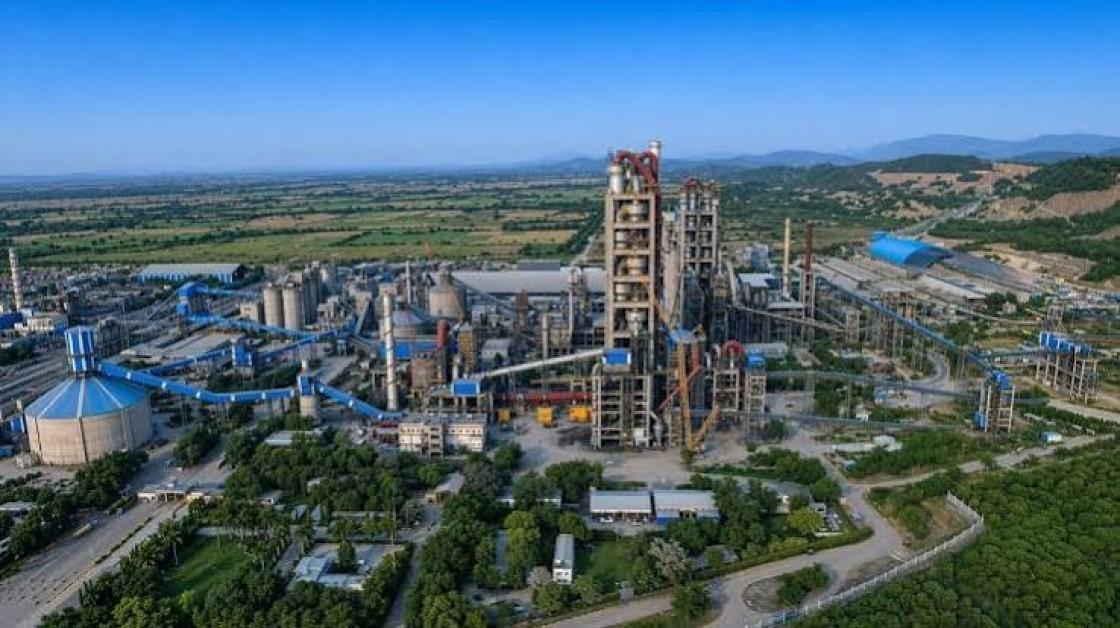
UltraTech Cement Expands Andhra Pradesh Manufacturing Capacity With ₹2,650 Crore Plant
UltraTech Cement, India's largest cement manufacturer by production capacity, has commissioned its ₹2,650 crore integrated cement plant at Petnikota in Andhra Pradesh's Nandyal district, strengthening its manufacturing presence in southern India.
The new Petnikota Cement Works facility has an annual clinkerisation capacity of 3.3 million tonnes and a cement dispatch capacity of 3.6 million tonnes.
Located in Petnikota village in Kolimigundla mandal of the Rayalaseema region, the project represents a major industrial investment in Andhra Pradesh.
The plant is designed to operate using green energy, supported by a 35-megawatt hybrid wind and solar power system with battery storage and a 20-megawatt waste heat recovery system.
It has also been designed to operate without groundwater extraction or a captive thermal power plant.
The facility is expected to generate approximately 650 direct jobs and another 2,000 indirect employment opportunities, supporting industrial and economic activity in the surrounding region.
The commissioning comes as UltraTech continues expanding its cement manufacturing capacity to meet demand from housing, infrastructure and construction projects.
The company has confirmed that its consolidated domestic grey cement capacity reached 204.7 million tonnes per annum as of September 30, 2026.
Including overseas operations, its global grey cement capacity stands at 210.1 million tonnes annually.
UltraTech Cement Petnikota Plant: Key Project Details
|
Indicator |
Details |
|---|---|
|
Company |
UltraTech Cement Limited |
|
Parent group |
Aditya Birla Group |
|
Project |
Petnikota Cement Works |
|
Location |
Petnikota, Nandyal district, Andhra Pradesh |
|
Region |
Rayalaseema |
|
Total investment |
Approximately ₹2,650 crore |
|
Cement dispatch capacity |
3.6 million tonnes per annum |
|
Clinkerisation capacity |
3.3 million tonnes per annum |
|
Construction commencement |
May 2025 |
|
Direct employment |
Approximately 650 jobs |
|
Indirect employment |
Approximately 2,000 jobs |
|
Hybrid wind and solar capacity |
35 MW |
|
Waste heat recovery capacity |
20 MW |
|
Energy strategy |
Designed for 100% green-energy operation |
|
Water strategy |
Designed for zero groundwater use |
|
Domestic grey cement capacity |
204.7 MTPA |
|
Global grey cement capacity |
210.1 MTPA |
|
Long-term capacity target |
More than 240 MTPA by March 2028 |
₹2,650 Crore Investment Strengthens Southern India Operations

The commissioning of Petnikota Cement Works marks another step in UltraTech Cement's capacity expansion programme.
The integrated facility combines clinker production and cement manufacturing operations at a single location.
Such facilities can improve operational coordination by reducing dependence on transporting clinker from distant manufacturing units.
The ₹2,650 crore investment includes modern production infrastructure, renewable energy systems and automated manufacturing technologies.
The new capacity is expected to strengthen UltraTech's ability to serve construction demand in Andhra Pradesh and neighbouring markets.
Southern India remains an important cement consumption region because of residential construction, industrial development and infrastructure investment.
However, the commercial contribution of the new plant will depend on capacity utilisation, cement prices, transportation costs and regional demand.
Plant Adds 3.6 Million Tonnes of Annual Cement Dispatch Capacity
The Petnikota facility has been designed with a cement dispatch capacity of 3.6 million tonnes per annum.
This represents the annual volume of cement the facility is equipped to dispatch under its designed operating conditions.
The plant also has a clinkerisation capacity of 3.3 million tonnes annually.
Clinker is an intermediate material produced during cement manufacturing.
It is subsequently ground with gypsum and, depending on the cement formulation, other materials to produce finished cement.
The distinction between clinkerisation and cement dispatch capacity is important.
Cement production can incorporate supplementary materials such as slag and fly ash, allowing finished cement output to differ from clinker production capacity.
The Petnikota project is expected to manufacture composite cement using such materials.
Petnikota Facility Located in Andhra Pradesh's Nandyal District
The new manufacturing facility is located in Petnikota village, Kolimigundla mandal, in Andhra Pradesh's Nandyal district.
The location forms part of the Rayalaseema region.
The project strengthens UltraTech's manufacturing presence in southern India.
Cement production is closely linked to the availability of raw materials and the economics of transporting finished products.
Because cement is a relatively heavy and transportation-intensive commodity, manufacturing location can influence delivered costs.
A strategically positioned plant can improve access to nearby construction markets.
The Petnikota facility may also support regional logistics and industrial services.
However, its competitive position will depend on transportation infrastructure, customer demand and the pricing environment.
Construction Began in May 2025
Construction of the Petnikota Cement Works project began in May 2025.
Andhra Pradesh government representatives highlighted the speed of project execution, describing the development as having been completed within approximately 14 months of the groundbreaking ceremony.
The timeline reflects the scale of coordination required for a large industrial manufacturing project.
Integrated cement plants involve substantial civil construction, equipment installation, power infrastructure and commissioning procedures.
The completion of the project adds operational manufacturing capacity to the state.
However, commissioning represents the beginning of commercial operations rather than an indication that the plant has already achieved full annual output.
Production and dispatch volumes will depend on the pace at which the facility increases utilisation.
Facility Expected to Create 2,650 Jobs
The Petnikota project is expected to support approximately 2,650 direct and indirect employment opportunities.
Of these, around 650 positions are expected to be direct jobs at the facility.
Another 2,000 employment opportunities are expected through related economic activities.
Cement manufacturing creates demand for skilled technical personnel, maintenance workers, logistics operators and industrial support services.
Indirect employment may arise through transportation, equipment maintenance, contracting and other local businesses.
The plant could therefore contribute to economic activity beyond its immediate manufacturing operations.
However, employment estimates represent anticipated opportunities associated with the project and should not be interpreted as a confirmed count of positions already filled.
Plant Designed to Operate on 100% Green Energy
One of the project's defining features is its renewable-energy-based design.
The Petnikota facility is equipped with a 35 MW hybrid wind and solar power system supported by battery storage.
It also incorporates a 20 MW waste heat recovery system.
The company has designed the plant to operate using green energy without a captive thermal power plant.
This approach reflects the cement industry's efforts to reduce dependence on conventional fossil-fuel-based electricity.
Electricity is an important operating cost in cement manufacturing.
Renewable power and waste heat recovery can help reduce exposure to conventional electricity prices.
However, the actual environmental and financial benefits will depend on operating conditions, energy availability and system utilisation.
35 MW Hybrid Wind and Solar System Supports Operations
The plant's 35 MW hybrid renewable energy system combines wind and solar generation.
The two technologies can provide electricity at different times depending on weather and operating conditions.
Battery storage is intended to support more flexible use of renewable electricity.
Hybrid systems can help industrial facilities manage variations in power generation.
For energy-intensive manufacturing operations, reliable electricity supply is essential.
The system forms an important component of the plant's sustainability strategy.
However, installed renewable capacity should not be confused with continuous electricity generation.
Actual output depends on weather, equipment performance and storage capacity.
The facility's ability to meet its electricity requirements through green sources will depend on these operational factors.
Waste Heat Recovery Adds 20 MW of Power Capacity
Petnikota Cement Works incorporates a 20 MW waste heat recovery system.
Waste heat recovery technology captures heat generated during industrial processes and uses it to produce electricity.
Cement manufacturing involves high-temperature operations, particularly during clinker production.
A portion of the heat generated can be recovered rather than released without further use.
The resulting electricity can reduce the amount of power required from other sources.
Waste heat recovery can therefore improve energy efficiency and reduce operating costs.
The technology is increasingly important in the cement industry because of its energy-intensive production processes.
At Petnikota, the system complements the renewable energy infrastructure.
Zero Groundwater Use Forms Part of Sustainability Strategy
The Petnikota plant has been designed to operate without extracting groundwater.
The facility incorporates water conservation and recycling measures intended to meet its operational requirements.
Water management is an important consideration for industrial projects, particularly in regions where groundwater resources may face pressure.
Cement plants use water for several purposes, including equipment cooling and environmental management.
Reducing groundwater dependence can help limit pressure on local water resources.
However, a zero-groundwater-use design does not necessarily mean that the plant requires no water.
Water may still be obtained from permitted alternative sources and managed through recycling systems.
The effectiveness of the strategy will depend on actual operations and water management performance.
Alternative Fuels and Composite Cement Support Resource Efficiency
The facility is designed to use selected waste materials as alternative fuels.
These include plastic and municipal waste suitable for industrial processing.
The plant is also expected to manufacture composite cement incorporating slag and fly ash.
Such materials can partially replace clinker in appropriate cement formulations.
Reducing the clinker content of cement can help lower the carbon intensity of finished products because clinker manufacturing is a major source of cement-sector emissions.
Alternative fuel use can also reduce dependence on conventional fossil fuels.
However, environmental benefits depend on the composition of materials, emissions controls and operating practices.
The facility's design reflects broader industry efforts to improve resource efficiency.
Electric Vehicles Introduced for Mining and Clinker Transport
The Petnikota project incorporates electric vehicles for selected mining and clinker transportation activities.
Electrification can reduce direct fuel consumption and associated local emissions.
Industrial transportation is an important part of cement manufacturing.
Raw materials and intermediate products must move between extraction, processing and production facilities.
Electric vehicles may provide operating advantages in suitable applications.
However, their economic performance depends on charging infrastructure, operating distances and equipment utilisation.
The use of electric vehicles forms part of the plant's broader effort to modernise industrial operations.
Automated Robotic Laboratory Improves Quality Control
The facility includes a fully automated robotic laboratory.
The laboratory is designed to support automatic sampling and material analysis.
Quality control is important in cement manufacturing because variations in raw materials and processing conditions can affect product consistency.
Automated systems can help provide timely information to production teams.
The facility also includes real-time process monitoring technologies.
These systems are intended to improve manufacturing efficiency and operational control.
However, automation does not eliminate the need for skilled technical supervision.
Plant personnel remain responsible for maintaining equipment, interpreting results and ensuring compliance with operating standards.
RFID Vehicle Tracking Supports Digital Logistics
Petnikota Cement Works incorporates radio-frequency identification-based vehicle tracking.
The technology can support the monitoring of vehicles moving through the facility.
The plant also includes unmanned weighbridges.
These systems are intended to streamline logistics and reduce manual processing requirements.
Cement plants handle substantial volumes of raw materials and finished products.
Efficient vehicle movement can help reduce delays and improve dispatch operations.
Digital logistics systems may also support more accurate operational records.
However, the benefits will depend on system integration and reliable implementation.
The use of these technologies demonstrates UltraTech's focus on automation alongside manufacturing expansion.
UltraTech Adds 4.6 MTPA Capacity During the September Quarter
The Petnikota plant formed part of a broader capacity addition during the second quarter of FY27.
UltraTech commissioned 3.6 MTPA of greenfield integrated capacity at Petnikota.
It also added 1.0 MTPA through debottlenecking at existing plants in Visakhapatnam, Patratu and Nathdwara.
The combined addition was 4.6 MTPA.
Debottlenecking involves improving existing production systems to increase output without constructing an entirely new plant.
These investments strengthened UltraTech's manufacturing presence across southern, eastern and northern India.
The additional capacity is intended to expand market reach and improve logistics efficiency.
Domestic Cement Capacity Reaches 204.7 MTPA
Following the capacity additions, UltraTech's consolidated domestic grey cement capacity reached 204.7 million tonnes per annum as of September 30, 2026.
The company also operates 5.4 MTPA of overseas grey cement capacity.
This brings its global grey cement capacity to 210.1 MTPA.
The scale of the company's manufacturing network provides a significant position in the Indian cement industry.
A large production footprint can support distribution across multiple markets.
However, capacity alone does not determine profitability.
Actual earnings depend on sales volumes, utilisation, product pricing, energy costs and transportation efficiency.
The Petnikota plant contributes to UltraTech's wider expansion strategy.
UltraTech Targets More Than 240 MTPA by March 2028
UltraTech has outlined plans to increase its global cement capacity to more than 240 MTPA by March 2028.
The company is pursuing an organic capital expenditure programme to support this objective.
Capacity expansion can help cement manufacturers prepare for future construction demand.
India's infrastructure and housing sectors are important sources of cement consumption.
However, large capacity additions require significant investment.
Manufacturers must also ensure that new plants achieve sufficient utilisation to support financial returns.
UltraTech's ability to execute projects efficiently will remain important.
The Petnikota commissioning represents progress toward its longer-term capacity target.
Q2 FY27 Revenue Rises 18.8%
UltraTech reported consolidated revenue from operations of approximately ₹23,295 crore for the quarter ended September 30, 2026.
This represented year-on-year growth of approximately 18.8%.
The increase reflected stronger cement sales volumes.
Domestic grey cement volumes rose 13.8% to 35.94 million tonnes.
The growth was supported by construction demand and a recovery in capital expenditure activity.
However, higher revenue did not translate into an equivalent improvement in profitability.
The company faced increased raw material and other operating costs.
These pressures highlight the importance of managing manufacturing expenses alongside capacity expansion.
Quarterly Net Profit Increases 21.3% to ₹1,494 Crore
UltraTech reported consolidated net profit of approximately ₹1,494 crore during the September quarter.
This represented a year-on-year increase of 21.3%.
However, the result was below market expectations of approximately ₹1,705 crore.
The difference reflected pressure from higher operating costs.
Raw material expenses increased significantly during the quarter.
Total expenses rose 17.8%, while raw material costs increased approximately 24%.
The financial performance demonstrates that cement manufacturers can experience strong volume growth while facing pressure on profitability.
Investors will therefore assess whether the company can offset higher costs through pricing, operational efficiency and improved utilisation.
Higher Raw Material Costs Remain an Industry Challenge
Cement manufacturing is sensitive to the cost of fuel, electricity, raw materials and transportation.
Changes in these expenses can affect operating margins.
UltraTech's September-quarter results reflected higher input costs.
The company reported operating EBITDA of approximately ₹974 per tonne, an increase of ₹60 per tonne from the corresponding period of the previous year.
However, profitability remained affected by cost pressures.
The Petnikota plant's renewable energy and waste heat recovery systems may help reduce exposure to some energy costs over time.
Nevertheless, the overall financial contribution will depend on production volumes and operating performance.
Cement Prices and Construction Demand Will Influence Returns
The financial success of new cement capacity depends partly on regional market conditions.
Cement prices are influenced by demand, competition and the availability of supply.
Infrastructure construction and housing development can support consumption.
However, pricing pressure may arise when capacity increases faster than demand.
UltraTech's additional manufacturing capacity could improve its ability to serve customers across different markets.
At the same time, the company must manage distribution costs and capacity utilisation.
The commercial contribution of Petnikota will depend on how effectively the plant integrates into UltraTech's distribution network.
Andhra Pradesh Gains a Major Industrial Investment
The commissioning of Petnikota Cement Works adds a significant manufacturing investment to Andhra Pradesh.
The project supports industrial activity in Nandyal district and the wider Rayalaseema region.
Large cement plants can generate demand for transportation, equipment maintenance and other supporting services.
They can also contribute to local economic activity through employment and supplier relationships.
The project may strengthen the state's position as a manufacturing destination.
However, the broader economic benefits will depend on sustained operations, local business participation and the development of supporting infrastructure.
Outlook for UltraTech Cement
UltraTech enters the remainder of FY27 with an expanded manufacturing network and a substantial capacity growth programme.
The Petnikota plant adds 3.6 MTPA of cement dispatch capacity.
Its renewable energy infrastructure and automated production systems are intended to support operational efficiency.
The company has also strengthened capacity at existing plants through debottlenecking.
However, the cement industry continues to face input-cost volatility and competitive pricing conditions.
Demand from housing and infrastructure will remain important.
UltraTech's ability to increase utilisation at new facilities while controlling costs will influence future profitability.
The company remains on track toward its stated capacity objective of more than 240 MTPA by March 2028.
Conclusion
UltraTech Cement has commissioned its ₹2,650 crore Petnikota Cement Works in Andhra Pradesh's Nandyal district, adding 3.6 million tonnes of annual cement dispatch capacity and 3.3 million tonnes of clinkerisation capacity.
The integrated facility is designed around renewable energy, water conservation and advanced manufacturing technologies.
Its infrastructure includes a 35 MW hybrid wind and solar system, 20 MW of waste heat recovery capacity and automated production and logistics systems.
The project is expected to generate approximately 650 direct jobs and 2,000 indirect employment opportunities.
The commissioning contributed to UltraTech's domestic grey cement capacity reaching 204.7 MTPA and global capacity reaching 210.1 MTPA.
The company is pursuing further expansion toward more than 240 MTPA by March 2028.
While the new facility strengthens UltraTech's manufacturing position, its financial contribution will depend on capacity utilisation, cement demand, energy costs and regional pricing conditions.
The Petnikota project represents a significant investment in India's cement industry and reflects the growing integration of renewable energy and digital technologies into large-scale industrial manufacturing.
 UltraTech Cement Opens ₹2,650 Crore Andhra Pradesh Plant With 3.6 MTPA Capacity FAQs

POST A COMMENT (0)
All Comments (0)
Replies (0)