




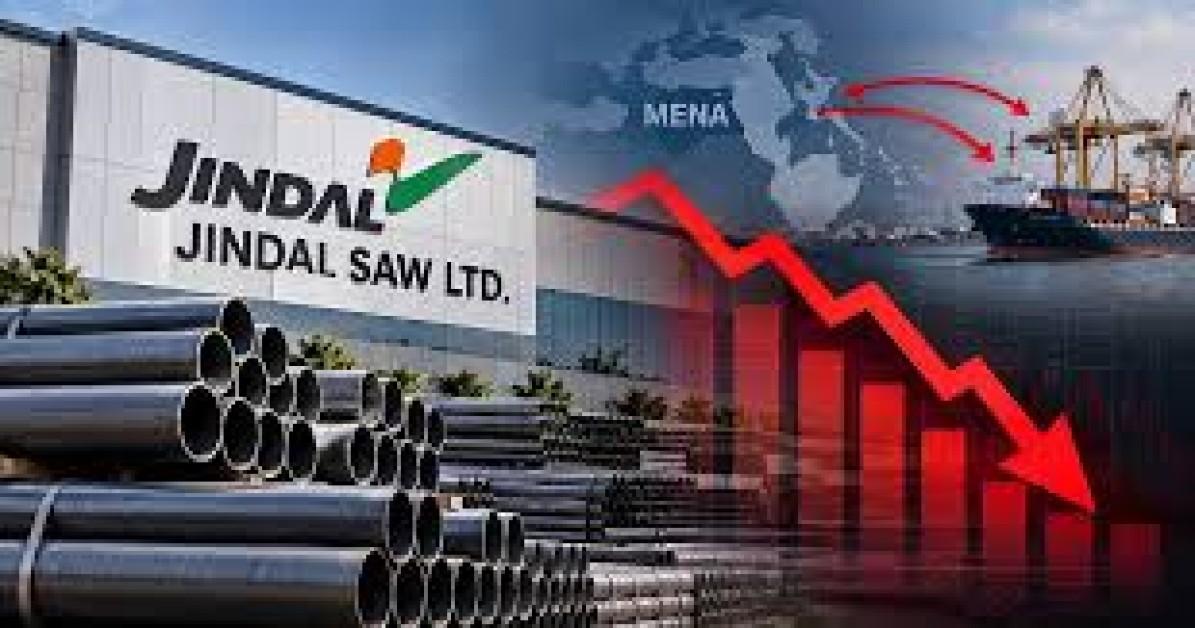
Jindal Saw's Quarterly Profit Declines Sharply as Operating Costs Rise
Jindal Saw Limited reported a 69.03% year-on-year decline in consolidated net profit attributable to shareholders to ₹47.04 crore for the second quarter of FY2026–27, despite recording growth in revenue from operations.
The steel pipe and industrial products manufacturer announced its unaudited financial results on October 16, 2026, for the quarter ended September 30.
Net profit attributable to owners of the company declined from ₹151.89 crore in the corresponding quarter of FY26, reflecting a sharp deterioration in operating profitability.
Consolidated revenue from operations increased 5.63% year-on-year to ₹4,471.79 crore from ₹4,233.60 crore.
However, total expenses rose at a faster pace of 10.13%, reaching ₹4,505.22 crore.
The increase in costs significantly affected earnings before interest, tax, depreciation and amortisation, or EBITDA.
EBITDA declined approximately 42% year-on-year to ₹261 crore, while the EBITDA margin contracted to approximately 5.8% from 10.7%.
The results highlight the pressure facing industrial manufacturers when production and operating costs increase faster than revenue.
Shares of Jindal Saw came under selling pressure on October 19 as investors assessed the company's weaker profitability and margin performance.
Jindal Saw Q2 FY27 Financial Highlights
|
Financial Indicator |
Q2 FY27 |
Q2 FY26 |
YoY Change |
|---|---|---|---|
|
Revenue from operations |
₹4,471.79 crore |
₹4,233.60 crore |
+5.63% |
|
Total income |
₹4,523.06 crore |
₹4,264.04 crore |
+6.07% |
|
Total expenses |
₹4,505.22 crore |
₹4,090.90 crore |
+10.13% |
|
EBITDA |
Approximately ₹261 crore |
Approximately ₹451 crore |
-42% |
|
EBITDA margin |
5.8% |
10.7% |
-490 basis points |
|
Profit before tax, after JV share |
₹14.42 crore |
₹182.57 crore |
-92.10% |
|
Consolidated profit after tax |
₹35.28 crore |
₹138.56 crore |
-74.54% |
|
Net profit attributable to shareholders |
₹47.04 crore |
₹151.89 crore |
-69.03% |
|
Earnings per share |
₹0.74 |
₹2.38 |
-68.91% |
The distinction between consolidated profit after tax and profit attributable to shareholders is important.
The widely reported ₹47 crore profit represents earnings attributable to owners of Jindal Saw. Total consolidated profit after tax, including the effect of non-controlling interests, stood at ₹35.28 crore.
Net Profit Falls 69% to ₹47.04 Crore

Jindal Saw's consolidated net profit attributable to shareholders declined by approximately ₹104.85 crore compared with the September 2025 quarter.
The decline occurred even though the company generated additional revenue.
This divergence indicates that higher business volumes or sales realisations did not translate into stronger profitability.
The company's operating costs increased substantially, reducing the earnings generated from each rupee of revenue.
The impact extended beyond operating profit to earnings before tax and final shareholder profit.
On a sequential basis, net profit attributable to shareholders declined 54.84% from approximately ₹104.18 crore in the June 2026 quarter.
The sharp quarter-on-quarter reduction indicates that profitability weakened during the September quarter rather than merely reflecting an unusually strong year-earlier comparison.
The results will place greater attention on the company's cost structure, product mix and ability to restore operating margins.
Revenue Rises 5.63% to ₹4,471.79 Crore
Jindal Saw reported consolidated revenue from operations of ₹4,471.79 crore during Q2 FY27.
This compared with ₹4,233.60 crore in Q2 FY26.
The increase of ₹238.19 crore represented growth of 5.63%.
Sequentially, revenue increased marginally from ₹4,452.31 crore in the April–June quarter.
The 0.44% quarter-on-quarter increase suggests that overall revenue remained relatively stable during the period.
Jindal Saw manufactures industrial pipe products used in energy transportation, water distribution and infrastructure projects.
Its portfolio includes submerged arc welded pipes, ductile iron pipes, seamless tubes and other industrial products.
Demand for these products is influenced by infrastructure investment, pipeline construction, industrial activity and project execution.
The latest revenue growth indicates that the company maintained sales activity during the quarter.
However, the financial results do not establish whether the increase came primarily from higher volumes, improved prices or changes in product mix.
That distinction will be important in assessing the sustainability of future growth.
EBITDA Declines Approximately 42%
The company's operating performance weakened considerably during the September quarter.
EBITDA declined to approximately ₹261 crore from around ₹451 crore a year earlier.
This represented a reduction of approximately 42%.
EBITDA measures earnings before financing costs, taxes, depreciation and amortisation.
It is commonly used to assess the profitability of industrial operations before accounting for financing structures and certain non-cash expenses.
The decline indicates that Jindal Saw generated substantially less operating profit despite higher revenue.
The company experienced a combination of rising expenses and weaker operating margins.
The reduction in EBITDA was much sharper than the movement in revenue.
This suggests that cost pressures had a significant impact on the profitability of its consolidated operations.
Restoring EBITDA growth will require improvement in cost management, pricing, operating efficiency or business mix.
EBITDA Margin Contracts by 490 Basis Points
Jindal Saw's EBITDA margin declined from approximately 10.7% in Q2 FY26 to 5.8% in Q2 FY27.
The contraction of approximately 490 basis points represents a significant deterioration in operating profitability.
Jindal Saw EBITDA margin comparison

The margin also declined from approximately 8.9% in the preceding quarter.
This sequential contraction indicates that cost pressure intensified during the September period.
An EBITDA margin of 5.8% means that the company generated approximately ₹5.80 in operating earnings before interest, taxes, depreciation and amortisation for every ₹100 of operating revenue.
A year earlier, the corresponding figure was approximately ₹10.70.
The reduction illustrates the scale of the profitability challenge.
For manufacturers operating in competitive markets, even relatively small changes in costs and selling prices can have substantial effects on earnings.
Total Expenses Increase 10.13%
Jindal Saw's consolidated expenses increased to ₹4,505.22 crore from ₹4,090.90 crore in the corresponding quarter of FY26.
The increase of approximately ₹414.32 crore significantly exceeded the ₹238.19 crore rise in revenue from operations.
This difference was a major contributor to weaker profitability.
The company's expenses include raw materials, employee costs, depreciation, finance charges and other operating expenditure.
Changes in input prices, manufacturing activity and inventory can affect the overall cost structure.
The September-quarter figures indicate that Jindal Saw was unable to fully offset its higher expenses through additional revenue.
Total expenses also increased from ₹4,327.74 crore in the June quarter.
The sequential increase of approximately 4.1% was considerably higher than the 0.44% rise in revenue.
This contributed to the quarter-on-quarter deterioration in operating margins.
Raw Material and Inventory Costs Affect Profitability
Raw material expenditure is an important component of steel pipe manufacturing.
Jindal Saw's consolidated cost of materials consumed stood at approximately ₹2,396.59 crore during the September quarter.
The company also reported changes in inventories and purchases of traded goods.
When these components are considered together, material-related expenditure increased substantially compared with the corresponding period of the previous year.
Steel pipe manufacturing depends on inputs such as steel, iron and other industrial materials.
Changes in raw material prices can influence production costs and working capital requirements.
However, the financial statements alone do not establish that commodity inflation was the sole cause of the margin contraction.
Product mix, inventory accounting, manufacturing utilisation and pricing arrangements may also influence profitability.
The company will need to manage these factors carefully to improve earnings.
Employee Expenses Rise to ₹438.93 Crore
Employee benefits expenditure increased to ₹438.93 crore during Q2 FY27.
This compared with approximately ₹416 crore a year earlier.
The increase reflects higher personnel-related expenditure across the consolidated business.
Employee costs are an important operating expense for industrial manufacturers with multiple production facilities.
Companies must balance staffing requirements with productivity and manufacturing efficiency.
The increase in employee expenditure was smaller than the overall rise in expenses.
Nevertheless, it contributed to the broader cost base.
Sustained profitability improvement will depend partly on the company's ability to increase output and revenue without a proportionate rise in operating expenses.
Other Expenses Decline but Fail to Offset Cost Pressure
Jindal Saw reported other expenses of approximately ₹936.19 crore during the September quarter.
This represented a decline from around ₹1,006 crore in the corresponding quarter of FY26.
The reduction indicates that the company achieved some savings across expenditure categories.
However, these savings were insufficient to offset higher costs elsewhere.
The company's overall expenses continued to rise faster than revenue.
This demonstrates that improvements in selected cost categories do not necessarily translate into stronger operating margins.
For Jindal Saw, the central challenge is managing its consolidated cost structure rather than relying on savings from individual expense categories.
Finance Costs Decline Year-on-Year
Jindal Saw's consolidated finance costs stood at approximately ₹125.45 crore in Q2 FY27.
This compared with around ₹152.9 crore in the year-earlier quarter.
The decline provided some relief to earnings.
Finance costs generally include interest and other expenses associated with borrowings.
Lower financing expenses can support profitability, particularly for capital-intensive manufacturing businesses.
However, finance costs increased sequentially from approximately ₹108 crore in Q1 FY27.
The quarter-on-quarter rise indicates that borrowing-related expenses remained a consideration.
Jindal Saw's operating margin contraction was substantial enough that lower year-on-year finance costs could not prevent the decline in overall profitability.
Investors will monitor the company's debt position, cash flows and funding requirements during subsequent quarters.
Depreciation and Amortisation Increase
Depreciation and amortisation expenses rose to approximately ₹168.96 crore from ₹155.5 crore a year earlier.
Depreciation reflects the allocation of capital asset costs over their useful lives.
It is particularly relevant for manufacturing businesses operating production facilities, machinery and industrial equipment.
Higher depreciation can reduce reported profit even when it does not involve an immediate cash outflow.
For Jindal Saw, depreciation increased while operating earnings declined.
This combination placed additional pressure on profit before tax.
The company will need to generate sufficient returns from its asset base to support long-term profitability.
Capital expenditure decisions and capacity utilisation will therefore remain important.
Profit Before Tax Falls More Than 92%
Jindal Saw's consolidated profit before tax, after accounting for its share of joint venture results, declined to ₹14.42 crore.
This compared with ₹182.57 crore in the corresponding quarter of FY26.
The reduction of 92.10% demonstrates the substantial impact of operating margin compression.
Sequentially, profit before tax declined from ₹142.87 crore in the June quarter.
The deterioration was significantly greater than the decline in revenue growth.
This indicates that profitability was affected by multiple expense categories rather than a collapse in sales.
The company also reported a tax credit during the quarter.
That credit helped support the final reported profit after tax.
Without the tax benefit, the decline in bottom-line earnings would have been more pronounced.
Tax Credit Supports Reported Net Profit
Jindal Saw recorded a consolidated tax credit of approximately ₹20.86 crore during the September quarter.
The credit included current and deferred tax components.
As a result, consolidated profit after tax stood at ₹35.28 crore, compared with profit before tax of ₹14.42 crore.
Tax credits can arise from adjustments in current or deferred tax positions.
However, their impact on reported earnings may not recur in future periods.
This makes operating profit and profit before tax important measures when evaluating the company's underlying financial performance.
The tax benefit helped reduce the immediate impact of weaker operating profitability on reported net income.
Nevertheless, it did not prevent the sharp decline in earnings attributable to shareholders.
Consolidated Profit After Tax Falls to ₹35.28 Crore
Jindal Saw's consolidated profit after tax, including the effect of non-controlling interests, declined to ₹35.28 crore from ₹138.56 crore a year earlier.
This represented a reduction of 74.54%.
The figure differs from the ₹47.04 crore profit attributable to owners of the company.
The difference arises because consolidated financial statements include the earnings attributable to non-controlling shareholders in subsidiaries.
During Q2 FY27, the non-controlling interest component represented a loss of approximately ₹11.75 crore.
Consequently, profit attributable to Jindal Saw's shareholders exceeded total consolidated profit after tax.
Understanding this distinction is important when comparing reported earnings across financial publications and company disclosures.
Both figures are valid but represent different accounting measures.
Standalone Operations Show a Different Earnings Trend
Jindal Saw's standalone financial performance differed from its consolidated results.
Standalone revenue from operations increased 13.40% year-on-year to ₹3,823.80 crore.
This compared with ₹3,371.85 crore in Q2 FY26.
Standalone profit after tax declined to ₹70.69 crore from ₹79.29 crore.
The decline was considerably smaller than the reduction in consolidated shareholder profit.
The difference indicates that subsidiaries, joint ventures and other consolidated operations contributed to the weakness in group-level profitability.
However, the available financial results do not establish the exact operational contribution of every business unit.
Investors should therefore examine both standalone and consolidated results when assessing the company's performance.
Consolidated financial statements provide the broader picture of earnings across the group.
Earnings Per Share Declines to ₹0.74
Jindal Saw reported consolidated earnings per share of ₹0.74 for the September quarter.
This compared with ₹2.38 in the corresponding quarter of the previous financial year.
The decline of approximately 69% was consistent with the reduction in profit attributable to shareholders.
EPS measures the profit attributable to each equity share.
It is widely used in equity valuation and financial performance analysis.
A sharp decline in EPS can affect valuation expectations, particularly when investors anticipate stable or improving profitability.
However, quarterly EPS should be assessed alongside longer-term earnings trends.
For Jindal Saw, the reduction reflects the deterioration in operating margins and consolidated profitability.
Future earnings performance will depend on the company's ability to restore stronger operating returns.
First-Half FY27 Revenue Rises but Profitability Weakens
Jindal Saw's results for the first six months of FY2026–27 show that profitability pressure extended beyond the September quarter.
Consolidated revenue from operations increased to ₹8,924.10 crore during April–September 2026.
This compared with ₹8,318.28 crore during the corresponding period of FY26.
Revenue therefore increased approximately 7.28%.
However, consolidated profit before tax declined to ₹157.29 crore from ₹556.87 crore.
Total consolidated profit after tax fell to ₹126.07 crore from ₹554.03 crore.
The figures indicate that revenue growth during the first half of the financial year did not translate into stronger earnings.
This suggests that the company's profitability challenge was not limited to a single reporting period.
Jindal Saw's First-Half FY27 Performance
|
Financial Indicator |
H1 FY27 |
H1 FY26 |
|---|---|---|
|
Revenue from operations |
₹8,924.10 crore |
₹8,318.28 crore |
|
Revenue growth |
+7.28% |
— |
|
Profit before tax |
₹157.29 crore |
₹556.87 crore |
|
Consolidated profit after tax |
₹126.07 crore |
₹554.03 crore |
|
Earnings per share |
₹2.37 |
₹9.04 |
The half-year figures reinforce the importance of margin recovery during the remaining quarters of FY27.
Jindal Saw Shares Decline Following Earnings Announcement
Jindal Saw shares came under selling pressure during early trading on October 19, 2026.
The stock opened at approximately ₹287 on the National Stock Exchange, compared with its previous closing price of ₹301.55.
It declined to an intraday low of ₹278.70 during early trading.
At that level, the stock was down approximately 7.6% from the previous close.
The market reaction reflected concerns about the sharp decline in earnings and operating margins.
Although revenue increased, investors appeared to place greater emphasis on the deterioration in profitability.
The stock's performance also demonstrated how quarterly earnings can influence market expectations for industrial companies.
However, intraday prices are subject to change, and early trading movements do not necessarily represent the final closing performance.
Industrial Pipe Manufacturing Remains Linked to Infrastructure Investment
Jindal Saw operates in industries closely connected to infrastructure and industrial investment.
The company manufactures products used in oil and gas transportation, water distribution and other industrial applications.
Submerged arc welded pipes are commonly used in large-diameter pipeline projects.
Ductile iron pipes are used in water supply and wastewater infrastructure.
Seamless tubes serve applications requiring specialised performance characteristics.
Demand for these products is influenced by government infrastructure programmes, energy transportation projects and industrial capital expenditure.
India's continued investment in infrastructure provides potential opportunities for manufacturers.
However, project demand does not automatically translate into higher profitability.
Pricing competition, input costs and execution efficiency remain important factors.
Oil and Gas Pipeline Demand Influences Business Outlook
Oil and gas infrastructure is an important market for steel pipe manufacturers.
Pipeline projects require specialised products capable of transporting crude oil, natural gas and other materials.
Investment in energy transportation infrastructure can create demand for large-diameter steel pipes.
However, project activity depends on capital expenditure decisions, regulatory approvals and energy market conditions.
Changes in international crude oil prices can also influence investment decisions by energy companies.
For Jindal Saw, maintaining competitiveness in the pipeline segment requires effective manufacturing operations and disciplined pricing.
The company must also manage working capital requirements associated with large infrastructure contracts.
Future demand conditions will depend on project execution and new order activity.
Water Infrastructure Provides Long-Term Demand Opportunities
Water distribution and sanitation projects represent another important market for Jindal Saw.
Ductile iron pipes are widely used in municipal water supply systems and other infrastructure networks.
Government investment in water infrastructure can support demand for these products.
Urban development and the need to improve water distribution systems also create potential opportunities.
However, project implementation can be affected by funding availability, procurement schedules and execution delays.
Manufacturers may experience fluctuations in deliveries and revenue recognition.
The profitability of these projects depends on contract terms, input costs and operational efficiency.
Jindal Saw's future performance will therefore be influenced by both infrastructure demand and its ability to execute orders profitably.
Margin Recovery Becomes the Central Financial Challenge
The most important issue emerging from Jindal Saw's quarterly results is the sharp reduction in operating margins.
Revenue growth of 5.63% was insufficient to offset the 10.13% increase in total expenses.
The resulting EBITDA margin contraction reduced profitability substantially.
For the company to restore earnings growth, operating costs will need to increase more slowly than revenue or selling prices and product mix will need to improve.
Higher manufacturing utilisation could also support profitability by spreading fixed costs across greater production volumes.
However, these outcomes will depend on market demand and operational execution.
The financial results do not provide a confirmed timetable for margin recovery.
Investors will therefore look for evidence of improvement in subsequent quarters.
Working Capital and Cash Flow Remain Important
Industrial manufacturing businesses often require substantial working capital.
Raw materials, inventories, production expenses and customer receivables can create significant funding requirements.
When operating margins decline, cash generation can come under pressure.
This can affect the ability to finance operations and capital expenditure.
For Jindal Saw, the relationship between revenue growth and cash flow will be important.
Higher sales do not necessarily result in stronger cash generation if inventory and receivables increase.
The company must also manage finance costs and investment requirements.
Investors will monitor future cash flow statements and balance-sheet disclosures for evidence of improved financial efficiency.
What Investors Should Monitor in the Coming Quarters
Jindal Saw's performance during the remainder of FY27 will depend on several factors.
The first is the movement in EBITDA margins.
A recovery from the September-quarter level of 5.8% would indicate improvement in operating profitability.
The second is raw material expenditure and manufacturing costs.
Changes in steel and other input costs could influence earnings.
Third, investors will monitor revenue growth and the composition of sales across different product categories.
Higher-margin products and stronger capacity utilisation could support profitability.
The fourth consideration is the performance of subsidiaries and joint ventures.
The difference between standalone and consolidated results indicates that group-level operations require particular attention.
Finally, debt levels, finance costs and operating cash flow will remain important for assessing financial stability.
Conclusion
Jindal Saw's Q2 FY2026–27 results highlight the challenges facing industrial manufacturers when operating expenses rise faster than revenue.
The company reported a 69.03% year-on-year decline in consolidated net profit attributable to shareholders to ₹47.04 crore.
Revenue from operations increased 5.63% to ₹4,471.79 crore, demonstrating that sales activity continued to expand.
However, total expenses rose 10.13%, significantly weakening operating profitability.
EBITDA declined approximately 42% to ₹261 crore, while the EBITDA margin contracted from 10.7% to 5.8%.
The deterioration also affected profit before tax and earnings per share.
The company's first-half financial performance showed a similar divergence between revenue growth and profitability.
Although infrastructure investment and pipeline demand provide potential long-term opportunities, Jindal Saw must improve cost efficiency and operating margins to convert sales growth into stronger earnings.
The company's financial performance during the remaining quarters of FY27 will depend on its ability to manage expenses, maintain demand and restore profitability across its consolidated operations.
 Jindal Saw Q2 FY27 Net Profit Falls 69% to ₹47 Crore as EBITDA Margin Drops to 5.8% FAQs

POST A COMMENT (0)
All Comments (0)
Replies (0)