




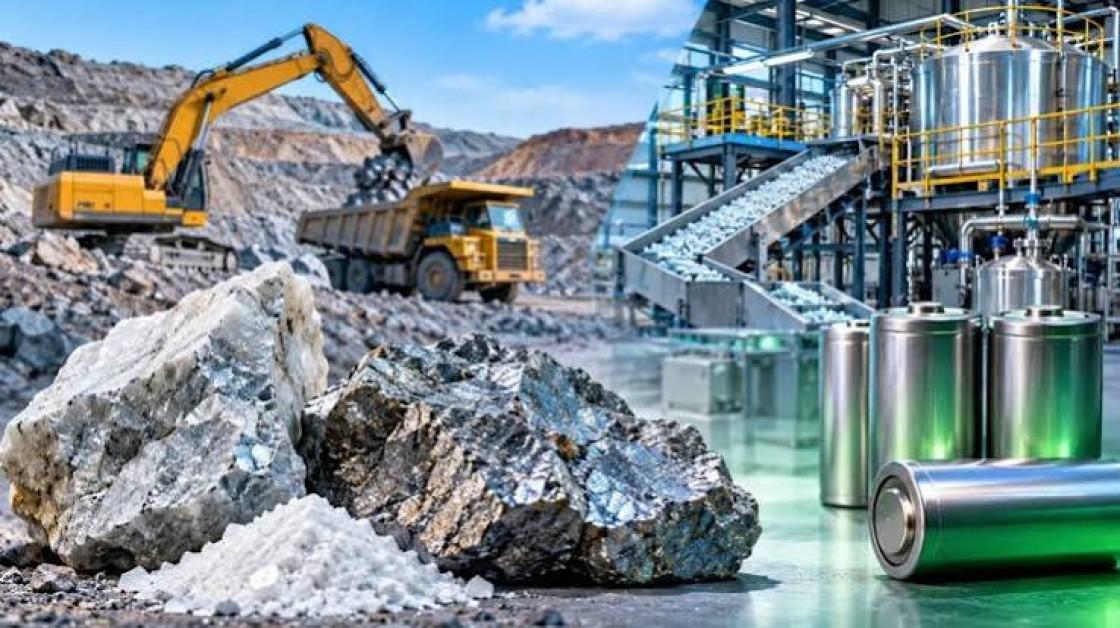
Union Cabinet Approves ₹2,814 Crore Critical Mineral Processing Scheme
The Union Cabinet, chaired by Prime Minister Narendra Modi, approved a ₹2,814 crore capital expenditure support scheme on November 4, 2026, to establish domestic lithium and nickel processing capacity, marking a significant step towards reducing India's dependence on imported refined critical minerals and supply chains dominated by China.
The five-year programme, titled the Capex Support Scheme to Promote Critical Mineral Processing, will operate from FY2026–27 to FY2030–31.
Under the scheme, the government will provide a capital subsidy equivalent to 30% of eligible investment for establishing four processing facilities: two for lithium and two for nickel.
Each lithium processing plant must have a minimum capacity of 30,000 tonnes, while each nickel facility must have a minimum capacity of 50,000 tonnes.
Financial assistance will be capped at ₹500 crore per lithium beneficiary and ₹900 crore per nickel beneficiary.
The initiative aims to convert lithium and nickel ores or intermediate products into high-purity compounds used in electric vehicles, battery energy storage systems, electronics, defence equipment and speciality steel.
Cobalt is also expected to be recovered as a by-product of nickel processing.
The approval comes as India seeks to strengthen its domestic manufacturing ecosystem and reduce exposure to international supply disruptions, mineral export restrictions and geopolitical uncertainty.
Key Highlights of India's ₹2,814 Crore Mineral Processing Scheme

|
Particulars |
Details |
|---|---|
|
Scheme name |
Capex Support Scheme to Promote Critical Mineral Processing |
|
Approved financial outlay |
₹2,814 crore |
|
Approval date |
November 4, 2026 |
|
Approving authority |
Union Cabinet |
|
Implementation period |
FY2026–27 to FY2030–31 |
|
Duration |
Five years |
|
Capital subsidy |
30% of eligible investment |
|
Total targeted facilities |
Four |
|
Lithium processing plants |
Two |
|
Nickel processing plants |
Two |
|
Minimum lithium capacity |
30,000 tonnes per plant |
|
Minimum nickel capacity |
50,000 tonnes per plant |
|
Maximum lithium subsidy |
₹500 crore per beneficiary |
|
Maximum nickel subsidy |
₹900 crore per beneficiary |
|
Beneficiary selection |
Technical qualification followed by financial bidding |
|
Incentive disbursement |
Three milestone-linked tranches |
The programme focuses on processing and refining rather than providing a general subsidy for mineral exploration or mining.
Why India Is Investing in Critical Mineral Processing
Critical minerals have become increasingly important to industrial competitiveness and economic security.
Lithium, nickel and cobalt are used in advanced batteries and other manufacturing applications.
Their availability influences the development of electric vehicles, renewable energy storage systems and strategic industrial technologies.
However, access to mineral resources does not automatically provide access to usable battery-grade materials.
Raw ores and intermediate products generally require specialised processing before manufacturers can use them.
India currently depends substantially on imports of refined intermediates and high-purity mineral compounds.
Its domestic processing infrastructure remains limited, particularly for commercial-scale lithium and nickel projects.
This creates a gap between India's manufacturing ambitions and its ability to supply essential raw materials domestically.
The new incentive scheme is designed to address that gap.
By supporting processing facilities within India, the government aims to increase domestic value addition and improve supply-chain resilience.
Reducing Dependence on China-Dominated Supply Chains
China occupies a dominant position in several global critical mineral processing industries.
Its established refining infrastructure and integrated manufacturing ecosystem give it an important role in international battery-material supply chains.
For India, dependence on overseas refining creates vulnerabilities.
Disruptions can arise from export restrictions, trade disputes, geopolitical tensions and logistical bottlenecks.
Even when raw minerals are available from alternative countries, limited refining capacity can constrain access to high-purity compounds.
The government's new programme aims to reduce these vulnerabilities by creating processing capacity within India.
However, the scheme will not immediately eliminate dependence on imported raw materials or foreign processing technologies.
India will still need reliable mineral supplies, suitable technical capabilities and commercially viable operating arrangements.
The strategic objective is to diversify supply chains and increase domestic control over an important stage of mineral production.
Four Processing Plants Planned Under the Scheme
The approved programme targets four processing facilities.
Two plants will focus on lithium, while two will process nickel.
The government has established minimum capacity requirements to encourage commercially meaningful projects.
Minimum processing capacity per facility
Minimum targeted capacity per plant, in thousand tonnes

The targeted plants are expected to process ores or intermediate materials into higher-purity products.
These compounds could support domestic battery manufacturing and other industrial applications.
However, the government has not identified the final beneficiaries in the Cabinet approval.
Actual project locations, investment amounts and commissioning schedules will depend on subsequent selection and implementation processes.
Lithium Processing Plants to Receive Up to ₹500 Crore Each
Lithium is an essential input for many rechargeable battery technologies.
It is used in electric vehicles, portable electronics and battery energy storage systems.
Under the approved programme, two lithium processing plants will be supported.
Each must have a minimum processing capacity of 30,000 tonnes.
The capital subsidy will cover 30% of eligible investment, subject to a maximum of ₹500 crore per beneficiary.
The incentive is intended to reduce the financial burden of establishing processing infrastructure.
Lithium refining requires specialised technologies and equipment.
Projects may also face challenges involving feedstock quality, energy requirements and chemical processing.
The government expects capital support to encourage investment in facilities capable of producing high-purity compounds.
However, commercial success will depend on operating costs, raw-material availability and customer demand.
Nickel Processing Plants Eligible for Up to ₹900 Crore Each
Nickel is used in several industrial applications, including battery materials and speciality steel.
Certain lithium-ion battery chemistries use nickel-containing cathodes to achieve desired energy-density characteristics.
The approved scheme will support two nickel processing plants.
Each facility must have a minimum capacity of 50,000 tonnes.
Capital assistance will cover 30% of eligible investment, subject to a ceiling of ₹900 crore per beneficiary.
The higher maximum support reflects the programme's differentiated incentive structure for nickel projects.
Nickel processing can involve complex metallurgical and chemical operations.
Project economics depend on the type of feedstock, processing technology and final product specifications.
The scheme aims to encourage domestic investment in these capabilities.
Cobalt Recovery Adds Strategic Value
An important feature of the scheme is the potential recovery of cobalt as a by-product of nickel processing.
Cobalt is used in certain rechargeable battery chemistries and industrial applications.
Recovering cobalt from suitable nickel-bearing materials could increase the value generated by domestic processing facilities.
It may also provide an additional source of critical mineral compounds.
However, cobalt recovery depends on the composition of the feedstock and the processing technology used.
Not every nickel processing operation will necessarily produce commercially significant quantities of cobalt.
The government's expectation therefore represents a potential benefit rather than a guaranteed output.
How the 30% Capital Subsidy Will Work
The government will provide financial assistance equivalent to 30% of eligible capital investment.
However, the subsidy will be subject to mineral-specific ceilings.
For lithium projects, the maximum support will be ₹500 crore per beneficiary.
For nickel projects, the maximum will be ₹900 crore.
The actual incentive will depend on eligible project expenditure and the amount of support requested during the selection process.
For example, a project with ₹1,000 crore of eligible investment would have a calculated 30% subsidy of ₹300 crore before applying any other relevant scheme conditions.
The government will not automatically provide the maximum available amount to every selected project.
The financial assistance is designed to reduce investment costs while encouraging bidders to minimise their dependence on public funding.
Financial Support Structure
|
Mineral |
Targeted Plants |
Subsidy Rate |
Maximum Support per Beneficiary |
|---|---|---|---|
|
Lithium |
2 |
30% |
₹500 crore |
|
Nickel |
2 |
30% |
₹900 crore |
The sum of the individual maximum subsidy ceilings is ₹2,800 crore. The approved overall scheme outlay is ₹2,814 crore; the Cabinet announcement does not separately itemise the difference.
Beneficiaries Will Be Selected Through Competitive Bidding
The scheme includes a two-stage beneficiary selection process.
The first stage will assess technical qualifications.
Applicants must demonstrate that they meet the relevant technical requirements before participating in financial bidding.
Only technically qualified applicants will proceed to the second stage.
Financial bids will then be evaluated using a least-cost criterion.
For each mineral, two beneficiaries will be selected based on the lowest capital expenditure support requested under the scheme.
This approach is intended to encourage competition and efficient use of public funds.
However, the final outcome will depend on the quality of applications and the commercial feasibility of proposed projects.
The approval does not itself establish that any particular company has received an incentive.
Incentives to Be Released in Three Tranches
The government will disburse financial assistance in three instalments linked to specified milestones.
Milestone-based payments can help align public expenditure with project implementation.
They may also reduce the risk of releasing substantial subsidies before meaningful progress has been achieved.
However, the precise milestones and payment conditions will depend on the scheme's detailed implementation requirements.
Project developers will need to plan financing around construction, equipment procurement and commissioning schedules.
The availability of milestone-linked incentives may improve project economics, but developers will still require sufficient funding to complete their investments.
Electric Vehicle Manufacturing Could Benefit
India's electric vehicle industry is among the sectors expected to benefit from improved domestic mineral processing.
Battery manufacturers require reliable supplies of high-purity materials.
Lithium compounds are used in multiple lithium-ion battery technologies, while nickel and cobalt are important for selected cathode chemistries.
Domestic processing could reduce dependence on imported refined inputs.
It may also create opportunities for closer integration between mineral processors, battery-material manufacturers and cell producers.
However, mineral refining is only one stage of the battery supply chain.
India will also need capabilities in cathode materials, anode materials, electrolytes and battery cell manufacturing.
The scheme could strengthen this ecosystem, but it will not independently establish a complete domestic battery supply chain.
Battery Energy Storage Systems Gain Strategic Importance
Battery energy storage systems are increasingly relevant to India's electricity infrastructure.
They can store electricity and release it when needed, helping manage differences between generation and demand.
Storage systems are particularly important for integrating variable renewable energy sources.
Lithium-ion batteries are widely used in such applications.
Developing domestic supplies of processed lithium compounds could support future battery manufacturing investment.
However, battery storage projects depend on several factors beyond mineral availability.
These include cell manufacturing costs, project financing, electricity market structures and technology selection.
The mineral processing scheme addresses an upstream supply-chain requirement rather than directly subsidising battery storage installations.
Electronics and Defence Industries May Also Benefit
Critical minerals are important beyond electric mobility.
Lithium and nickel compounds have applications across electronics, industrial equipment and advanced materials.
Nickel is also widely used in alloys and speciality steel.
Defence manufacturing requires reliable access to numerous strategic materials.
A more diversified domestic processing base could reduce exposure to external supply disruptions.
However, the benefits will depend on whether the facilities produce compounds meeting the technical specifications required by downstream industries.
High-purity material production requires strict quality controls.
Developing these capabilities could create opportunities for Indian manufacturers to participate in higher-value industrial supply chains.
India's Processing Gap Extends Beyond Mineral Exploration
India has been working to strengthen access to critical mineral resources through exploration, auctions and international cooperation.
However, securing mineral resources is only part of the challenge.
A mineral deposit must be extracted and processed before its contents become usable industrial inputs.
For lithium and nickel, refining can require substantial capital, specialised expertise and reliable feedstock supplies.
A country may therefore possess mineral resources or import ores while still depending on another country for refined compounds.
The newly approved programme specifically targets this processing gap.
Its significance lies in supporting domestic value addition rather than relying exclusively on upstream mineral access.
Relationship With the National Critical Minerals Mission
The scheme complements India's broader National Critical Minerals Mission.
The mission seeks to strengthen the country's capabilities across the critical mineral value chain.
Its priorities include exploration, mining, processing, recycling and international cooperation.
The new capital support programme focuses on commercial processing infrastructure.
This makes it relevant to the mission's objective of building a more resilient domestic mineral ecosystem.
However, the initiatives serve different functions.
Exploration identifies potential mineral resources.
Mining extracts those resources.
Processing converts raw or intermediate materials into usable products.
Recycling recovers minerals from existing products and waste streams.
A comprehensive supply chain requires coordination across these activities.
Critical Mineral Processing Parks Could Support Investment
The government is also working towards mineral-specific processing ecosystems in several states.
Gujarat, Andhra Pradesh, Maharashtra and Odisha have been identified in discussions concerning critical mineral processing parks.
The proposed approach involves developing infrastructure and industrial clusters suited to particular minerals.
Such facilities could provide access to utilities, logistics and supporting services.
Industrial clustering may help reduce operating costs and attract downstream manufacturers.
However, the Cabinet's ₹2,814 crore approval does not by itself confirm that the four subsidised plants will be located in these states.
Final locations will depend on the scheme's selection and project development processes.
Private-Sector Participation Will Be Essential
The government intends to encourage private investment in critical mineral processing.
The 30% capital subsidy is designed to improve the commercial attractiveness of projects that otherwise face high upfront costs.
However, government incentives alone cannot guarantee successful operations.
Investors must secure suitable processing technology, feedstock arrangements and customers.
They must also manage environmental compliance, infrastructure requirements and financing costs.
Companies with experience in metallurgical processing, mineral recovery and industrial chemicals may be well positioned to evaluate opportunities.
Nevertheless, no beneficiary should be considered selected until the government completes the prescribed bidding process.
Industry Welcomes Focus on Domestic Processing
Companies involved in India's critical mineral ecosystem have welcomed the government's emphasis on refining and processing capacity.
Industry representatives have highlighted the importance of developing domestic capabilities alongside efforts to secure mineral resources.
Attero and LOHUM, both active in the broader critical mineral and battery-material ecosystem, have supported the policy direction.
The response reflects recognition that processing infrastructure is an important part of supply-chain security.
However, expressions of industry support do not establish that these companies will receive subsidies.
Participation will depend on the scheme's eligibility conditions and competitive selection process.
Critical Mineral Recycling Provides a Complementary Supply Source
Recycling can play an important role in reducing dependence on newly mined minerals.
Used batteries and electronic waste contain recoverable metals.
Processing these materials can create secondary supplies of lithium, nickel, cobalt and other resources.
India has been developing policies and industrial capabilities to support critical mineral recycling.
The newly approved processing scheme complements these efforts.
Primary processing and recycling serve different but related functions.
Primary processing converts mined materials or intermediate products into refined compounds.
Recycling recovers materials from products that have already entered the economy.
Combining both approaches could improve long-term supply security.
However, the availability of recyclable material depends on collection systems and the volume of products reaching the end of their useful lives.
Environmental and Technical Challenges Remain
Critical mineral processing can involve significant environmental and technical requirements.
Facilities may use chemicals, energy and water during refining operations.
Waste management and pollution control are therefore important considerations.
Projects must comply with applicable environmental regulations and industrial standards.
Technology selection will also influence operating efficiency.
Some processing methods may be more suitable for particular ore types or intermediate materials.
India will need skilled personnel and reliable industrial infrastructure to operate the planned facilities.
The financial subsidy can reduce capital costs, but environmental compliance and technical performance will remain essential to long-term viability.
Raw-Material Access Could Determine Project Success
One of the principal challenges facing domestic mineral processors is access to suitable raw materials.
Processing plants require consistent feedstock supplies to operate efficiently.
India's domestic availability of commercially accessible lithium and nickel resources remains constrained.
As a result, some processing facilities may initially depend on imported ores or intermediate products.
This would still allow India to capture more refining value domestically.
However, it would not eliminate dependence on overseas raw-material suppliers.
International partnerships, diversified sourcing and domestic exploration will therefore remain important.
The effectiveness of the scheme will depend partly on how successfully project developers secure long-term feedstock arrangements.
Economic and Industrial Implications
|
Sector |
Potential Benefit |
Key Dependency |
|---|---|---|
|
Electric vehicles |
Improved access to battery materials |
Domestic cell and cathode manufacturing |
|
Battery energy storage |
Stronger upstream supply chain |
Storage project demand |
|
Electronics |
Access to selected refined compounds |
Product specifications and quality |
|
Defence |
Greater strategic material security |
Reliable domestic production |
|
Speciality steel |
Improved nickel-related supply options |
Industrial demand and pricing |
|
Mineral processing |
New capital investment |
Technology and feedstock |
|
Recycling |
Complementary material recovery |
Collection and recovery infrastructure |
|
Industrial logistics |
Demand for transport and handling |
Project construction and operations |
The scale of these benefits will depend on project execution and downstream industrial development.
What the Scheme Means for Investors
The approval creates a potential opportunity for companies involved in mineral processing, industrial engineering, chemicals and related infrastructure.
However, the policy does not identify the final beneficiaries.
Investors should therefore avoid assuming that any listed company will automatically receive financial assistance.
The eventual commercial impact will depend on eligibility, competitive bidding and project economics.
Important considerations include capital expenditure, processing technology, operating costs and access to raw materials.
Companies may also require substantial additional financing despite the subsidy.
The policy could support long-term industrial investment, but immediate revenue or earnings benefits should not be assumed.
Implementation Milestones to Monitor
|
Milestone |
Significance |
|---|---|
|
Detailed scheme guidelines |
Clarify eligibility and technical requirements |
|
Application process |
Opens participation to prospective developers |
|
Technical qualification |
Identifies eligible bidders |
|
Financial bidding |
Determines subsidy requests |
|
Beneficiary selection |
Confirms approved projects |
|
Project financing |
Establishes funding arrangements |
|
Construction and equipment procurement |
Converts approvals into physical investment |
|
Commissioning |
Enables processing operations |
|
Commercial production |
Determines actual supply contribution |
|
Milestone verification |
Governs incentive disbursement |
The government has approved the programme, but the targeted processing capacity will materialise only after successful implementation.
Outlook for India's Critical Mineral Industry
The ₹2,814 crore scheme represents a significant policy intervention in India's critical mineral processing industry.
It addresses a stage of the supply chain that has become increasingly important for industrial competitiveness.
The programme could encourage investment in refining facilities and support domestic production of high-purity mineral compounds.
However, implementation will require coordination between government agencies, technology providers, project developers and downstream manufacturers.
Reliable feedstock supplies and commercially competitive operating costs will be essential.
India will also need to continue expanding exploration, recycling and international mineral partnerships.
The next important developments will be the publication of detailed scheme guidelines, selection of beneficiaries and commencement of project construction.
Conclusion
India's Union Cabinet has approved a ₹2,814 crore capital expenditure support scheme to strengthen domestic lithium and nickel processing over five years from FY2026–27 to FY2030–31.
The programme will provide a 30% capital subsidy for four processing facilities, including two lithium plants and two nickel plants.
Each lithium facility must have a minimum capacity of 30,000 tonnes, while each nickel plant must have a minimum capacity of 50,000 tonnes.
The government has capped support at ₹500 crore per lithium beneficiary and ₹900 crore per nickel beneficiary.
The initiative aims to reduce India's dependence on imported refined minerals and strengthen supply chains serving electric vehicles, energy storage, electronics, defence and speciality steel.
It also addresses vulnerabilities arising from the concentration of critical mineral processing capacity in countries such as China.
However, the programme's success will depend on competitive project selection, reliable raw-material access, suitable technologies and timely commissioning.
For India's industrial economy, the scheme marks a shift towards building domestic capabilities in mineral processing rather than relying solely on access to raw mineral resources.
 India Approves ₹2,814 Crore Lithium and Nickel Processing Scheme FAQs

POST A COMMENT (0)
All Comments (0)
Replies (0)