




India and Poland Strengthen Technology and Investment Engagement
India and Poland are exploring expanded cooperation in artificial intelligence, semiconductors, critical minerals, data centres and cybersecurity as both countries seek to strengthen their strategic economic partnership and develop more resilient industrial supply chains.
The discussions took place during Minister of State for Commerce and Industry and Electronics and Information Technology Jitin Prasada's official visit to Poland on November 2–3, 2026.
Prasada travelled with a business delegation representing 12 Indian companies and held meetings with senior Polish government officials and industry representatives.
The engagements focused on expanding bilateral trade, attracting investment, encouraging technology transfer and identifying opportunities for joint industrial development.
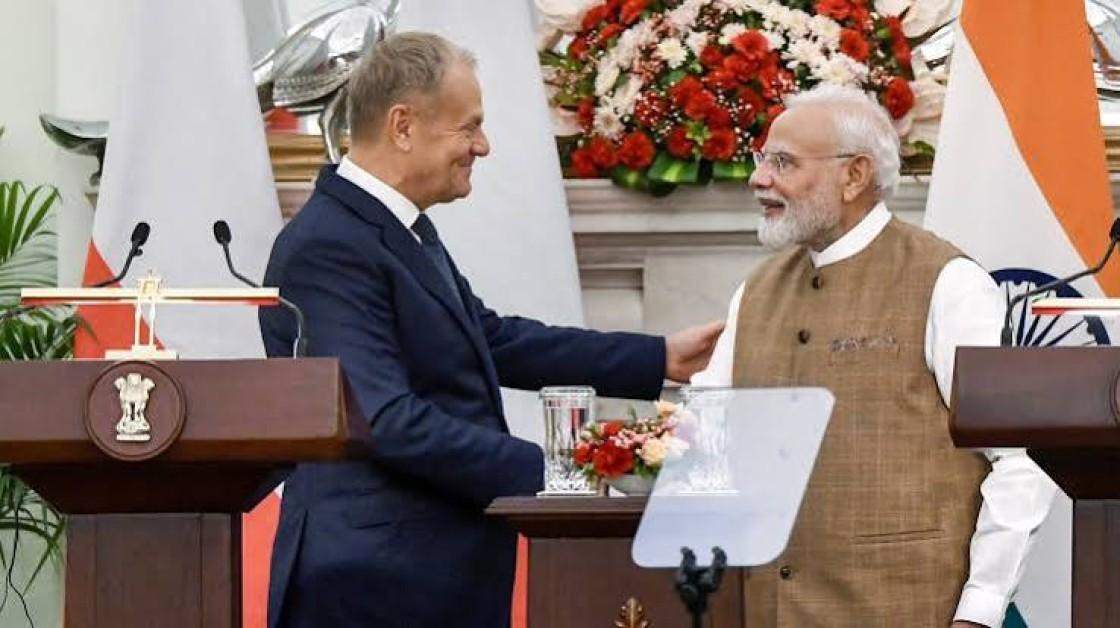
The visit followed Polish Prime Minister Donald Tusk's October 2026 visit to India, during which both countries reaffirmed their strategic partnership and set a target of doubling bilateral trade by 2030.
The latest discussions also come as India and the European Union prepare for the proposed implementation of their Free Trade Agreement, which could create additional opportunities for Indian and Polish businesses.
While the talks identified several potential areas of cooperation, they did not announce completed investment agreements or specific semiconductor manufacturing projects.
Key Highlights of India–Poland Economic Discussions

|
Particulars |
Details |
|---|---|
|
Indian representative |
Jitin Prasada |
|
Official visit |
November 2–3, 2026 |
|
Location |
Warsaw, Poland |
|
Indian business delegation |
12 companies |
|
Main technology sectors |
AI, semiconductors, data centres and cybersecurity |
|
Strategic resource focus |
Critical minerals |
|
Industrial priorities |
Co-development, co-production and technology transfer |
|
Trade framework |
India–EU Free Trade Agreement |
|
Business engagement |
India–Poland Business Forum |
|
Bilateral partnership |
Strategic Partnership established in 2024 |
|
Bilateral trade objective |
Double trade by 2030 |
|
Key initiatives |
Make in India, startup partnerships and supply-chain diversification |
The discussions reflect a broader effort to move India–Poland economic relations beyond conventional trade towards advanced technology and industrial collaboration.
Jitin Prasada Meets Poland's Deputy Prime Minister on Emerging Technologies
During his visit, Prasada met Poland's Deputy Prime Minister and Minister of Digital Affairs, Krzysztof Gawkowski.
The meeting focused on expanding cooperation in emerging technologies.
Artificial intelligence, semiconductor development, data centres and cybersecurity were among the principal areas discussed.
Both countries recognise the growing importance of digital infrastructure and advanced computing capabilities for economic competitiveness.
India has been expanding its semiconductor and AI ecosystems through government programmes, private investment and technology partnerships.
Poland has an established technology services industry and a growing role within Europe's digital economy.
Closer cooperation could create opportunities for joint research, software development, technical training and commercial partnerships.
However, the discussions remain exploratory, and specific implementation arrangements will require further negotiations.
Artificial Intelligence Emerges as a Priority Sector
Artificial intelligence has become an important area of international economic cooperation.
Governments and businesses are investing in AI applications to improve productivity, automate selected processes and develop new digital services.
India and Poland are exploring how their respective technology ecosystems could support collaborative development.
Potential opportunities include AI research, enterprise software, industrial automation and public-sector digital services.
Indian technology companies could benefit from partnerships with Polish research institutions and businesses.
Polish companies may gain access to India's large technology workforce and expanding domestic market.
However, successful AI cooperation will require attention to data protection, intellectual property, cybersecurity and regulatory compliance.
Both countries will also need to identify commercially viable projects that provide measurable economic benefits.
Semiconductor Cooperation Could Support Supply-Chain Diversification
Semiconductors were a major focus of the bilateral discussions.
The global semiconductor industry is strategically important because chips are used in electronics, automobiles, telecommunications equipment, industrial machinery and advanced computing systems.
India has been seeking to expand domestic semiconductor manufacturing and related capabilities.
Poland offers potential partnerships through its industrial, engineering and research ecosystem.
Cooperation could involve semiconductor design, research, testing, specialised components and technical skills.
However, semiconductor manufacturing requires substantial capital investment, specialised infrastructure and reliable supply chains.
The latest meetings did not establish a confirmed joint fabrication facility or a specific investment commitment.
The commercial significance of the discussions will depend on whether businesses subsequently announce projects, partnerships or technology agreements.
Critical Minerals Become a Strategic Area of Cooperation
Critical minerals featured prominently in Prasada's meeting with Poland's Deputy Minister for Economic Development and Technology, Michał Baranowski.
These minerals are important inputs for industries such as electronics, electric vehicles, renewable energy, defence equipment and advanced manufacturing.
Governments worldwide are seeking to diversify access to strategic raw materials.
Supply-chain concentration can create vulnerabilities when production or processing is concentrated in a limited number of countries.
India and Poland are exploring opportunities involving mineral resources, processing technologies and industrial partnerships.
Their October 2026 joint statement also highlighted cooperation in battery recycling and rare-earth refining.
A memorandum of understanding covering geology, mining and critical minerals remains under negotiation.
The discussions therefore represent potential cooperation rather than a completed minerals supply agreement.
Critical Minerals and Their Industrial Importance
|
Mineral Category |
Potential Industrial Applications |
|---|---|
|
Lithium |
Batteries and energy storage |
|
Cobalt |
Selected battery chemistries and industrial applications |
|
Nickel |
Batteries and specialised alloys |
|
Rare-earth elements |
Permanent magnets, electronics and defence systems |
|
Graphite |
Battery anodes and industrial materials |
|
Copper |
Electrical equipment, power networks and electronics |
|
Gallium |
Selected semiconductor applications |
|
Germanium |
Optical systems and semiconductor technologies |
The table illustrates why secure access to minerals and processing capabilities has become an important consideration for advanced manufacturing economies.
Make in India Creates Opportunities for Polish Investment
Prasada highlighted opportunities under the Make in India initiative during his discussions with Polish officials.
The programme seeks to strengthen domestic manufacturing and attract investment.
For Polish companies, India offers a large consumer market and opportunities across industrial sectors.
Potential areas of cooperation include machinery, electronics, engineering equipment, defence manufacturing and advanced technologies.
India is also encouraging international partnerships involving local production and technology development.
However, investment decisions depend on commercial viability, regulatory requirements and the availability of infrastructure.
The government discussions are intended to encourage business engagement rather than guarantee investment outcomes.
Companies from both countries will need to evaluate specific opportunities before committing capital.
India Emphasises Co-Development and Co-Production
A significant theme of the visit was the importance of developing technology jointly.
Prasada emphasised co-development, co-production and technology transfer as potential foundations for stronger industrial partnerships.
These arrangements differ from conventional import-export relationships.
Co-development involves organisations working together to create products or technologies.
Co-production involves manufacturing activities shared between participating companies or countries.
Technology transfer may provide access to technical knowledge, processes or intellectual property under agreed conditions.
Such partnerships can help develop domestic industrial capabilities.
However, their success depends on commercial agreements, intellectual property protections and operational execution.
The latest discussions did not specify binding commitments in these areas.
India–EU Free Trade Agreement Could Expand Opportunities
The proposed India–European Union Free Trade Agreement was another major topic during Prasada's visit.
India and the EU concluded negotiations on the agreement in January 2026.
The agreement is undergoing legal review and related procedures before signing and ratification.
Its entry into force remains subject to the completion of those processes.
Prasada discussed the agreement's potential implications with Ignacy Niemczycki, Secretary of State in Poland's Ministry of Foreign Affairs.
Both sides examined how improved market access could support trade and investment.
Poland's position within the European Union makes it an important potential partner for Indian companies seeking to expand into Central and Eastern Europe.
However, businesses will benefit from preferential trade arrangements only when the relevant provisions become legally effective.
Poland Could Serve as a Gateway to European Markets
Poland's geographic position and industrial infrastructure make it an important commercial market within the European Union.
Indian companies may consider Poland as a location for distribution, manufacturing partnerships and regional operations.
The country provides access to European supply chains and business networks.
For Indian exporters, stronger relationships with Polish companies could create opportunities in engineering goods, pharmaceuticals, technology services and other industries.
Polish businesses may also use partnerships with Indian companies to expand into South Asian markets.
However, market entry involves regulatory compliance, distribution costs and commercial competition.
The proposed India–EU trade agreement could improve conditions for certain sectors once implemented.
India–Poland Bilateral Trade Targeted to Double by 2030
India and Poland agreed in October 2026 to pursue a doubling of bilateral trade by 2030.
The target reflects the countries' intention to expand economic engagement.
According to Polish government information, bilateral trade reached approximately €5.6 billion in 2025.
Machinery and equipment represented a significant portion of trade, alongside chemical products.
The 2030 objective will require sustained growth in commercial exchanges.
Technology partnerships, industrial investment and improved market access could contribute to that expansion.
However, the trade target is an ambition rather than a guaranteed outcome.
Progress will depend on business activity, economic conditions and the implementation of agreed measures.
India–Poland Trade and Cooperation Framework
|
Indicator |
Status |
|---|---|
|
Strategic Partnership |
Established in August 2024 |
|
Action Plan |
2024–2028 |
|
Bilateral trade in 2025 |
Approximately €5.6 billion |
|
Trade target |
Double by 2030 |
|
India–EU FTA negotiations |
Concluded in January 2026 |
|
FTA implementation |
Pending legal and ratification processes |
|
AI cooperation |
Under discussion |
|
Semiconductor cooperation |
Under discussion |
|
Critical minerals MoU |
Under negotiation |
|
Startup partnerships |
Identified as a priority |
|
Industrial co-production |
Potential area for future agreements |
The framework provides a basis for cooperation, but the economic impact will depend on subsequent implementation.
India–Poland Business Forum Brings Companies Together
Prasada addressed the India–Poland Business Forum in Warsaw on November 3.
The event was organised at the Polish National Chamber of Commerce.
The forum brought together business representatives interested in expanding commercial engagement.
Prasada encouraged companies to identify new investment opportunities and develop stronger partnerships.
He also highlighted the potential benefits of the India–EU Free Trade Agreement.
Business forums can help companies establish contacts and identify potential projects.
However, discussions and expressions of interest do not necessarily result in completed transactions.
The next stage will involve commercial negotiations and project development.
Indian Delegation Includes 12 Companies
Prasada travelled with representatives from 12 Indian companies.
The delegation's participation reflected the importance of direct business engagement.
Government discussions can establish policy priorities, but private-sector investment ultimately depends on commercial decisions.
Companies must evaluate demand, production costs, regulations and potential partners.
The delegation also provided an opportunity for Indian businesses to interact with Polish officials and industry representatives.
Such engagement can help identify practical barriers to trade and investment.
However, the participating companies' individual investment commitments were not detailed in the reported announcement.
Meetings With Polish Technology and Defence Companies
During the visit, Prasada visited Transition Technologies and WB Electronics.
Transition Technologies operates in information technology and software engineering.
WB Electronics is a Polish defence technology company.
Both businesses have commercial interests in India.
The visits provided opportunities to discuss industrial and technology collaboration.
Software engineering partnerships could support digital transformation and advanced industrial applications.
Defence technology cooperation may involve specialised systems and engineering capabilities.
However, no specific new commercial contract was announced as a direct result of these visits.
The engagements demonstrate the range of sectors being considered within the broader strategic partnership.
Startup Partnerships Gain Importance
Startup cooperation was another priority during the meetings.
India has a large entrepreneurial ecosystem spanning software, financial technology, healthcare, manufacturing and digital services.
Poland also has technology startups and research-based businesses operating within European markets.
Closer engagement could support joint innovation and market expansion.
Potential initiatives include startup exchanges, technology demonstrations and business networking.
During the October leadership summit, both countries also discussed establishing an India–Poland Startup Bridge.
Such arrangements could help smaller companies identify international partners.
However, the commercial impact will depend on programme design, participation and access to financing.
Agri-Tech and Food Processing Offer Additional Opportunities
Prasada's meeting with Ignacy Niemczycki also covered agricultural technology and food processing.
Both sectors offer opportunities for trade and technical collaboration.
Agricultural technology can include precision farming, digital monitoring and machinery.
Food processing involves production, preservation, packaging and distribution.
India has a large agricultural economy and a growing food-processing industry.
Poland has established food manufacturing and agricultural capabilities.
Partnerships could support technology exchange and market access.
However, agricultural and food trade is subject to quality standards, sanitary requirements and other regulations.
Companies will need to address these requirements when developing commercial relationships.
Small and Medium Enterprises Receive Policy Attention
Both countries highlighted the importance of creating opportunities for SMEs.
Smaller businesses often face greater challenges entering international markets.
These include limited financing, regulatory complexity and difficulty finding reliable commercial partners.
Government-supported business forums and trade facilitation can help reduce some barriers.
The India–EU Free Trade Agreement may also create opportunities for eligible businesses once implemented.
However, SMEs will need to understand applicable product standards, customs procedures and market requirements.
Support for smaller companies could help diversify bilateral trade beyond large industrial businesses.
Supply-Chain Resilience Becomes a Shared Objective
Supply-chain resilience was an important theme in the broader India–Poland strategic discussions.
Advanced manufacturing industries depend on access to components, raw materials and specialised technologies.
Disruptions can affect production schedules and costs.
India and Poland are examining ways to diversify industrial partnerships.
Semiconductors and critical minerals are particularly relevant because they are essential to several high-growth industries.
Closer cooperation could support alternative sourcing and technical capabilities.
However, resilient supply chains require more than diplomatic agreements.
They depend on infrastructure, commercial contracts, logistics and reliable production capacity.
Cybersecurity Cooperation Supports Digital Transformation
Cybersecurity was included in Prasada's discussions with Poland's Deputy Prime Minister.
As governments and businesses expand digital operations, cybersecurity becomes increasingly important.
Potential cooperation could involve information sharing, technical research and workforce development.
Organisations using AI and cloud computing must also protect sensitive data.
Cross-border technology partnerships may require agreed security standards and compliance procedures.
The India–Poland Action Plan for 2024–2028 already identifies cybersecurity as an area of cooperation.
The latest discussions could provide opportunities to develop more practical engagement.
However, specific new cybersecurity agreements were not announced during the visit.
Data Centres and Digital Infrastructure Offer Investment Potential
Data centres were another focus of the bilateral technology discussions.
These facilities support cloud computing, enterprise software and AI applications.
Demand for advanced computing infrastructure has increased as businesses adopt AI technologies.
India and Poland could explore opportunities involving data centre engineering, software services and infrastructure technologies.
However, data centre development requires reliable electricity, connectivity and substantial investment.
Environmental and regulatory considerations also influence project feasibility.
The latest discussions identified data centres as a potential cooperation area.
They did not announce a specific bilateral data centre project or investment amount.
Opportunities for Indian Industries
|
Indian Industry |
Potential Opportunity |
|---|---|
|
Information technology |
Software development and AI collaboration |
|
Semiconductors |
Research, design and industrial partnerships |
|
Mining and minerals |
Processing technologies and supply-chain cooperation |
|
Electronics manufacturing |
Component sourcing and technical collaboration |
|
Defence |
Engineering and potential co-production |
|
Pharmaceuticals |
Trade and commercial expansion |
|
Food processing |
Technology exchange and market access |
|
Startups |
Innovation partnerships and European market entry |
|
Cybersecurity |
Research and technical cooperation |
|
Logistics |
Supply-chain and distribution partnerships |
|
Advanced manufacturing |
Machinery and industrial technology |
|
Clean energy |
Battery recycling and related technologies |
These opportunities remain dependent on specific commercial agreements and regulatory requirements.
Implications for Poland's Economy
For Poland, stronger economic ties with India could support trade diversification and investment.
India offers a large market for industrial goods, technology and specialised services.
Polish businesses may identify opportunities in advanced manufacturing, engineering and digital technologies.
The partnership could also help Polish companies expand their international commercial networks.
However, businesses must evaluate competitive conditions and investment requirements.
The proposed India–EU Free Trade Agreement may improve access for certain products and services.
The actual benefits will depend on its final provisions and implementation.
Poland's role within European supply chains could make it an important partner for Indian companies.
Implications for Indian Investors and Businesses
The latest discussions indicate potential opportunities across several sectors.
Technology companies may explore joint development projects.
Manufacturers could evaluate partnerships involving machinery and specialised components.
Mining and materials businesses may assess opportunities in processing and recycling technologies.
However, investors should distinguish diplomatic discussions from confirmed commercial transactions.
No specific investment amount or completed semiconductor project was announced during the November visit.
The financial impact will depend on subsequent agreements, project approvals and business execution.
Companies will also need to consider regulatory and geopolitical risks.
Challenges to Implementing India–Poland Cooperation
Several factors could influence the success of the proposed cooperation.
Advanced technology partnerships require intellectual property protections and regulatory clarity.
Semiconductor projects involve substantial capital expenditure and technical complexity.
Critical mineral supply chains depend on resource availability, processing capabilities and commercial agreements.
Cross-border investment can also be affected by currency movements and economic conditions.
The India–EU Free Trade Agreement remains subject to formal implementation procedures.
Businesses therefore face uncertainty about the timing of potential trade benefits.
Government engagement can create opportunities, but sustained commercial cooperation requires practical execution.
Key Developments to Monitor
|
Development |
Why It Matters |
|---|---|
|
India–EU FTA signing and ratification |
Determines preferential trade arrangements |
|
Critical minerals MoU |
Could formalise cooperation |
|
Semiconductor partnerships |
May support technology and industrial development |
|
AI research initiatives |
Could strengthen innovation capabilities |
|
Data centre projects |
May expand digital infrastructure cooperation |
|
Startup Bridge initiatives |
Could connect entrepreneurial ecosystems |
|
Technology transfer agreements |
May support domestic manufacturing capabilities |
|
Business investment announcements |
Indicate commercial implementation |
|
Bilateral trade growth |
Measures progress towards 2030 target |
|
SME participation |
Reflects broader economic engagement |
|
Cybersecurity cooperation |
Supports secure digital development |
|
Joint industrial projects |
Measures practical partnership outcomes |
These indicators will help determine whether the diplomatic momentum translates into measurable economic activity.
Outlook for India–Poland Economic Relations
India and Poland enter the next phase of their strategic partnership with an expanded focus on advanced technology and industrial cooperation.
The October 2026 leadership summit established broader priorities.
Prasada's November visit provided an opportunity to explore those priorities with Polish government officials and businesses.
Artificial intelligence, semiconductors and critical minerals are likely to remain important areas of discussion.
The proposed India–EU Free Trade Agreement could create additional commercial opportunities after implementation.
However, the timing and scale of future investment remain uncertain.
The next stage will depend on formal agreements, private-sector partnerships and the development of commercially viable projects.
Progress towards the bilateral trade-doubling target will provide one measure of the partnership's effectiveness.
Conclusion
India and Poland explored expanded cooperation in artificial intelligence, semiconductors, critical minerals, data centres and cybersecurity during Minister of State Jitin Prasada's November 2–3, 2026 visit to Warsaw.
The discussions involved senior Polish government officials and a delegation of 12 Indian companies.
Both countries examined opportunities for technology transfer, co-development, co-production and stronger investment partnerships.
The engagements followed the October 2026 visit of Polish Prime Minister Donald Tusk to India, during which the countries reaffirmed their strategic partnership and established a target of doubling bilateral trade by 2030.
The proposed India–EU Free Trade Agreement provides an additional framework for expanding commercial relations, although its implementation remains subject to formal procedures.
For India, the partnership could support advanced manufacturing, technology development and supply-chain diversification.
For Poland, closer engagement offers opportunities to expand business with one of the world's major emerging economies.
The immediate outcome is a broader agenda for cooperation rather than confirmed investment projects.
The long-term significance will depend on whether the two countries convert diplomatic discussions into formal agreements, industrial partnerships and sustained trade growth.
 India and Poland Expand Talks on AI, Chips and Critical Minerals FAQs

POST A COMMENT (0)
All Comments (0)
Replies (0)