





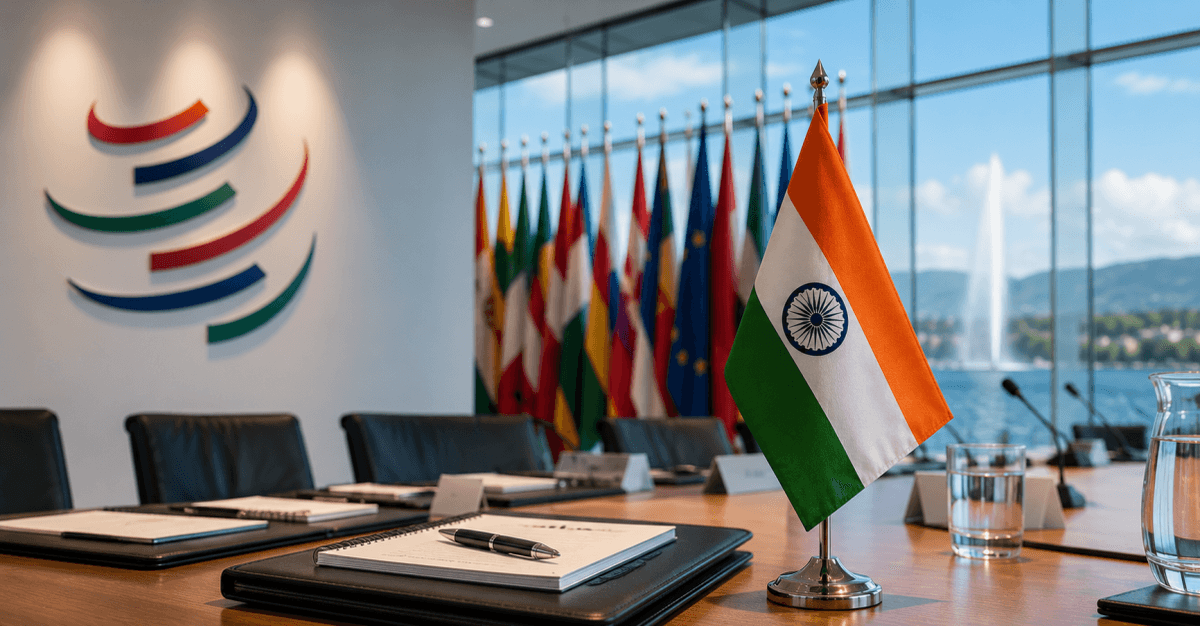
WTO Trade Policy Review of India Begins in Geneva Today as Global Focus Turns to Trade Reforms
India's eighth Trade Policy Review (TPR) at the World Trade Organization (WTO) begins today in Geneva, Switzerland, marking an important milestone in the country's engagement with the global multilateral trading system. Conducted under the WTO's Trade Policy Review Mechanism (TPRM), the review provides member countries with an opportunity to examine India's trade policies, regulatory framework, market access measures, and overall trade performance.
The review comes at a time when global trade is navigating economic uncertainty, geopolitical tensions, supply chain diversification, digital commerce expansion, and changing tariff policies. For India, the review offers a platform to present its economic reforms, manufacturing initiatives, export strategies, digital trade policies, and investment-friendly measures while addressing questions from WTO members regarding its trade regime.
India's delegation is being led by Commerce Secretary Rajesh Agarwal. The review is scheduled to take place on 21 July and 23 July 2026, covering India's trade policy developments during the period from 1 January 2021 to 31 December 2025. India undergoes this review approximately once every five years under WTO procedures.
What Is the WTO Trade Policy Review?
The Trade Policy Review Mechanism is one of the WTO's transparency tools designed to improve understanding of members' trade policies and encourage greater predictability in international trade.
Unlike a dispute settlement process, the Trade Policy Review does not determine whether a country has violated WTO rules. Instead, it allows WTO members to evaluate trade-related developments, discuss policy changes, seek clarifications, and exchange views on trade practices.
The review is based on two principal documents:
-
A policy statement prepared by the Government of India.
-
An independent assessment prepared by the WTO Secretariat.
These reports form the basis for discussions among WTO members during the review sessions.
Why This Review Matters for India
India has emerged as one of the world's fastest-growing major economies and a key participant in global supply chains. Its trade policies influence businesses across manufacturing, services, agriculture, technology, pharmaceuticals, automobiles, textiles, and digital commerce.
The review offers India an opportunity to showcase policy reforms aimed at improving the ease of doing business, strengthening domestic manufacturing, expanding exports, and attracting foreign investment.
At the same time, WTO members are expected to examine areas such as tariff structures, import regulations, export incentives, digital trade policies, customs procedures, and market access.
Reports indicate that WTO members have submitted around 900 questions ahead of the review, highlighting strong international interest in India's evolving trade framework. India also announced that it has joined the WTO Agreement on Fisheries Subsidies ahead of the review, a significant development in multilateral trade cooperation.
Key Issues Expected During the Review
Several policy areas are expected to receive attention during the discussions.
Trade Facilitation
Members are likely to review India's efforts to simplify customs procedures, improve logistics, reduce transaction costs, and strengthen cross-border trade infrastructure.
Manufacturing and Industrial Policy
India's manufacturing initiatives, production-linked incentive (PLI) schemes, and industrial development strategies may feature prominently in discussions as countries assess their impact on investment and trade.
Agricultural Policies
Agriculture remains an important area within WTO negotiations. Members may seek greater clarity regarding domestic support measures, food security programmes, and agricultural market access.
Services Trade
India is a major exporter of IT services, consulting, financial services, engineering, healthcare, and professional services. The review provides an opportunity to highlight the country's growing role in global services trade.
Digital Trade and E-Commerce
As digital commerce expands rapidly, discussions may include India's digital economy, cross-border data flows, online trade, fintech development, and digital infrastructure.
Importance for Businesses
Although the Trade Policy Review is primarily an intergovernmental process, its outcomes are closely watched by businesses, investors, exporters, and multinational companies.
Greater policy transparency can improve investor confidence by providing a clearer understanding of India's trade environment and regulatory direction.
Industries likely to monitor the review include:
-
Manufacturing
-
Pharmaceuticals
-
Information technology
-
Electronics
-
Textiles
-
Agriculture
-
Automobile manufacturing
-
Renewable energy
-
Logistics
-
Digital commerce
Companies engaged in international trade often use WTO reviews to assess future policy trends and identify emerging business opportunities.
India's Position in Global Trade
India has continued expanding its presence in global trade through export diversification, infrastructure investment, digital transformation, and manufacturing growth.
Recent policy initiatives have focused on:
-
Improving logistics efficiency
-
Strengthening export competitiveness
-
Expanding manufacturing capacity
-
Encouraging foreign direct investment
-
Developing digital infrastructure
-
Supporting small and medium enterprises
-
Enhancing customs modernisation
-
Promoting sustainable economic growth
These developments are expected to form an important part of India's presentation during the review.
Global Context
The review takes place during a period of significant changes in the international trading system.
Global businesses continue adjusting to:
-
Supply chain diversification
-
Trade tensions among major economies
-
Digital transformation
-
Sustainability requirements
-
Energy transition
-
Inflationary pressures
-
Regional trade agreements
-
Evolving investment patterns
Against this backdrop, India's role as a large consumer market, manufacturing hub, and services exporter has become increasingly important in international trade discussions.
Possible Outcomes
While the Trade Policy Review does not produce legally binding decisions, it can influence international perceptions of India's trade environment.
Potential outcomes include:
-
Greater transparency regarding trade policies
-
Improved understanding among WTO members
-
Constructive policy dialogue
-
Enhanced investor confidence
-
Stronger international trade engagement
-
Identification of future reform opportunities
-
Better communication of India's economic priorities
The discussions may also provide valuable insights for policymakers as India continues negotiating bilateral and regional trade agreements alongside its participation in the multilateral trading system.
What Businesses Should Watch
Business leaders, exporters, and investors are likely to focus on several developments emerging from the review:
-
India's policy responses to WTO member questions
-
Trade facilitation measures
-
Manufacturing competitiveness
-
Digital trade initiatives
-
Export promotion strategies
-
Investment climate
-
Customs reforms
-
Market access developments
-
Services trade opportunities
-
Sustainability-related trade initiatives
These factors could influence business planning and international investment decisions over the medium term.
Outlook
India's eighth WTO Trade Policy Review comes at a pivotal moment for global commerce. As international trade evolves amid technological innovation, geopolitical shifts, and changing supply chains, India's policies will continue to play a significant role in shaping regional and global economic activity.
The review is expected to reinforce India's commitment to engaging with the multilateral trading system while providing WTO members with greater clarity on its trade priorities, regulatory reforms, and long-term economic strategy. With discussions extending over two sessions in Geneva, businesses and policymakers worldwide will closely monitor the proceedings for signals about India's future trade direction and its expanding role in the global economy.
 WTO Trade Policy Review of India Begins in Geneva: Key Business Insights FAQs
POST A COMMENT (0)
All Comments (0)
Replies (0)