





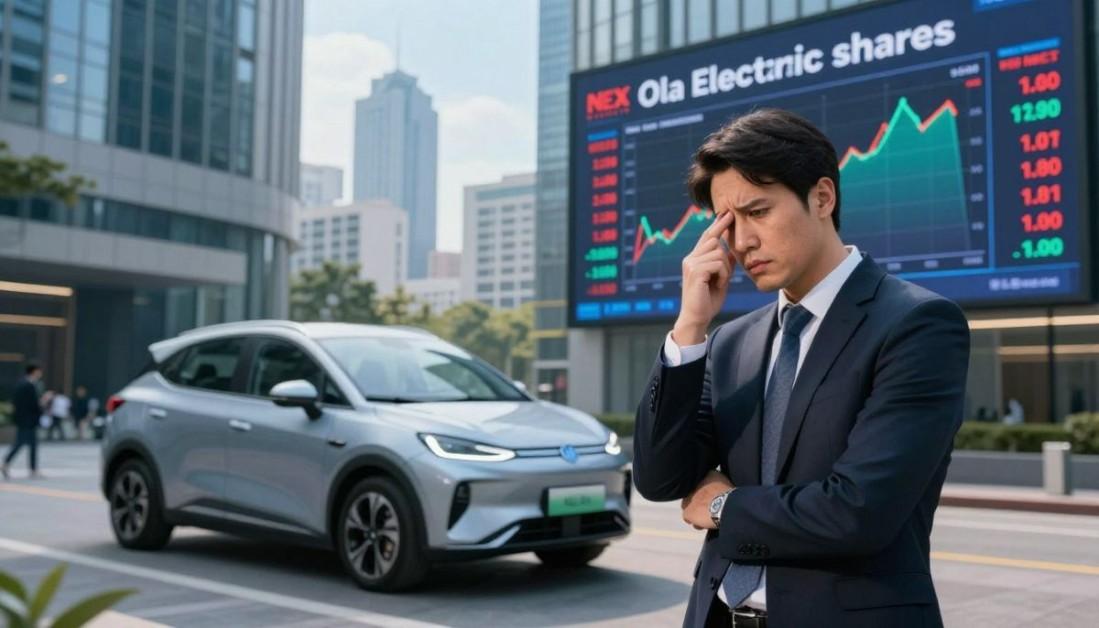
The recent sale of 4.2 crore shares by Bhavish Aggarwal, the founder of Ola Electric, has garnered significant attention in the financial markets. This move has coincided with the stock hitting new lows, raising questions among investors and analysts alike.
The sale of ola electric shares by Aggarwal has led to a fluctuation in the stock price, impacting market sentiment. As the news spread, investors began to scrutinize the reasons behind Aggarwal's decision to sell stock, speculating on the potential implications for Ola Electric's future performance.
Key Takeaways
- Bhavish Aggarwal sells 4.2 crore Ola Electric shares.
- The sale coincides with Ola Electric stock hitting lows.
- Market sentiment is impacted by the significant share sale.
- Investors are speculating on the reasons behind Aggarwal's decision.
- The move may have implications for Ola Electric's future performance.
The Major Share Selloff: What Happened
In a significant move, Bhavish Aggarwal, Ola Electric's founder, sold 4.2 crore shares, raising questions about the EV stock's recent plunge. This transaction has been a focal point for investors and analysts trying to understand the dynamics affecting Ola Electric's stock performance.
Details of the 4.2 Crore Share Transaction
The sale of 4.2 crore shares by Bhavish Aggarwal was a substantial transaction that has garnered significant attention. To understand its implications, it's crucial to delve into the specifics of the deal.
Timeline of the Sale Process
The sale process was executed over a specific period, with regulatory filings indicating the dates and volumes of shares sold. According to official disclosures, the transaction was completed in a structured manner.
Regulatory Disclosures and Filings
Ola Electric and Bhavish Aggarwal made the necessary regulatory disclosures, providing insights into the share sale. These filings are crucial for understanding the compliance and transparency aspects of the transaction.
Timing and Market Conditions of the Sale
The timing of the share sale coincided with certain market conditions that may have influenced the transaction. Understanding these conditions is vital to grasping the reasons behind the sale.
Stock Price at Time of Sale
At the time of the sale, Ola Electric's stock price was experiencing fluctuations. The average price at which the shares were sold has been disclosed in regulatory filings.
Market Volatility Factors
Several factors contributed to the market volatility surrounding Ola Electric's stock. These included broader market trends, sector-specific news, and company-specific announcements.
As noted by a market analyst, "The sale of such a large number of shares can impact the stock price, especially if the market is already volatile."
"The EV sector is highly competitive, and significant share sales by promoters can be perceived as a sign of confidence or lack thereof."
| Date | Stock Price | Volume Sold |
|---|---|---|
| 01/09/2023 | 120 | 1.4 Cr |
| 02/09/2023 | 118 | 1.4 Cr |
| 03/09/2023 | 122 | 1.4 Cr |
Ola Electric Bhavish Aggarwal Sells 4.2Cr Shares: Breaking Down the Numbers
The recent sale of 4.2 crore shares by Bhavish Aggarwal, Ola Electric's CEO, has sent shockwaves through the market. This significant transaction has raised questions about the company's valuation and Aggarwal's confidence in the company's future prospects.
Financial Value of the Transaction
The sale of 4.2 crore shares is not just a significant transaction in terms of volume; it also represents a substantial financial value. To understand the implications, we need to break down the total monetary worth of the shares sold.
Total Monetary Worth of Shares Sold
Assuming the average sale price of Ola Electric's shares during the transaction period was around ₹100, the total monetary worth of the shares sold can be calculated as follows: 4,20,00,000 shares * ₹100 = ₹420 crores.
Comparison to Previous Insider Sales
To put this transaction into perspective, let's compare it to previous insider sales. Historically, insider sales have been relatively small, but this transaction is significantly larger. The table below summarizes some key insider sales transactions in the recent past.
| Date | Number of Shares Sold | Total Value (₹ crores) |
|---|---|---|
| 2022 | 50,00,000 | 50 |
| 2023 | 1,00,00,000 | 100 |
| Recent Sale | 4,20,00,000 | 420 |
Percentage of Aggarwal's Total Stake Sold
Bhavish Aggarwal's decision to sell 4.2 crore shares also raises questions about his remaining stake in Ola Electric. Let's examine the percentage of his total stake that was sold.
Remaining Ownership Structure
After selling 4.2 crore shares, Aggarwal's remaining stake in Ola Electric is expected to be around 10%. This significant reduction in his holding could potentially impact the company's ownership structure.
Changes in Voting Rights and Control
With a reduced stake, Aggarwal's voting rights and control over Ola Electric may also be affected. The exact impact will depend on the distribution of the remaining shares. The table below outlines the potential changes in voting rights.
| Shareholder | Pre-Sale Stake (%) | Post-Sale Stake (%) |
|---|---|---|
| Bhavish Aggarwal | 15 | 10 |
| Other Promoters | 20 | 20 |
| Institutional Investors | 40 | 45 |
| Public | 25 | 25 |
Ola Electric's Recent Stock Performance
As Ola Electric navigates the challenges of the EV market, its stock performance has become a topic of interest. The company's stock price has experienced significant fluctuations, influenced by various market and company-specific factors.
Stock Price Trajectory Before the Sale
The stock price trajectory of Ola Electric in the months leading up to the share sale by Bhavish Aggarwal was marked by volatility. Several factors contributed to this trend.
Six-Month Price Analysis
Over the six months preceding the sale, Ola Electric's stock price showed a mixed trend, with periods of both growth and decline. The stock initially gained due to positive market sentiment towards EVs but later faced downward pressure.
Key Events Affecting Stock Value
Key events such as announcements of new EV models and changes in government policies significantly impacted Ola Electric's stock value. These events contributed to the stock's volatility.
Market Reaction Following the Announcement
Following the announcement of Bhavish Aggarwal's share sale, Ola Electric's stock experienced an immediate reaction. The market's response was reflected in both the stock price movement and trading volume.
Immediate Price Movement
The immediate price movement after the announcement was negative, with the stock price dropping due to investor concerns about the implications of the share sale.
Trading Volume Analysis
Trading volume analysis revealed a significant increase in activity following the announcement, indicating heightened investor interest and reaction to the news.
Bhavish Aggarwal: The Man Behind Ola Electric
Bhavish Aggarwal's entrepreneurial path has been instrumental in shaping Ola Electric's success. As the founder, Aggarwal has been at the forefront of India's electric vehicle revolution, driving innovation and growth.
Aggarwal's Entrepreneurial Journey
Aggarwal's journey began with Ola Cabs, which he co-founded in 2010. His vision for Ola Cabs was not just to provide transportation but to revolutionize the way people moved around cities.
From Ola Cabs to Electric Vehicles
Ola Cabs laid the groundwork for Ola Electric, allowing Aggarwal to leverage his experience in the mobility sector to transition into electric vehicles. This strategic shift was driven by Aggarwal's foresight into the potential of EVs in reducing urban pollution.
Leadership Style and Business Philosophy
Aggarwal's leadership is characterized by his emphasis on innovation and customer-centric solutions. His business philosophy revolves around creating scalable, sustainable businesses that can make a significant impact.
His Vision for Ola Electric and the EV Industry
Aggarwal envisions Ola Electric playing a pivotal role in India's transition to electric mobility. His vision is not limited to the success of Ola Electric but extends to the broader adoption of EVs across the country.
Public Statements on India's EV Future
In various public statements, Aggarwal has highlighted the importance of government support and technological innovation in driving the EV revolution in India. He has emphasized the need for a robust charging infrastructure and incentives for EV adoption.
Comparison with Global EV Leaders
While Ola Electric is a significant player in India's EV market, Aggarwal has also drawn comparisons with global EV leaders like Tesla. He has noted the importance of learning from international best practices while also innovating to suit the Indian market's unique needs.
Potential Reasons Behind the Share Sale
The sudden sale of 4.2 crore shares by Bhavish Aggarwal has left investors and analysts wondering about the motivations behind this significant transaction. To understand the potential reasons, it's essential to examine both official statements and market interpretations.
Official Statements from Aggarwal and Ola Electric
Ola Electric and Bhavish Aggarwal have released official statements regarding the share sale. Analyzing these communications can provide insights into their perspective on the transaction.
Corporate Communications Analysis
The official statements from Ola Electric have been characterized by their transparency regarding the share sale. The company has maintained a consistent narrative, emphasizing that the sale is part of Aggarwal's personal financial planning.
Timing of Announcements
The timing of the announcements surrounding the share sale has been noteworthy. The sale was announced during a period of market volatility, which has been a point of discussion among investors.
Analyst Speculations and Market Interpretations
Financial analysts and industry experts have offered various interpretations regarding the share sale. Their insights provide a broader understanding of the potential implications.
Financial Analyst Perspectives
Some financial analysts view the share sale as a sign of Aggarwal's confidence in Ola Electric's future valuation. They speculate that the sale could be part of a diversification strategy.
Industry Expert Opinions
Industry experts have pointed out that the sale might be related to Ola Electric's current business challenges, including production and delivery issues. They suggest that Aggarwal's decision could be a response to the company's operational hurdles.
| Perspective | View on Share Sale | Implications |
|---|---|---|
| Official Statement | Part of personal financial planning | No significant impact on company's future |
| Financial Analysts | Confidence in future valuation | Potential diversification strategy |
| Industry Experts | Response to business challenges | Operational hurdles may impact future |
The sale of 4.2 crore shares by Bhavish Aggarwal is a complex event with multiple interpretations. While official statements provide one narrative, analyst speculations and industry expert opinions offer alternative viewpoints.
Ola Electric's Current Business Challenges
Ola Electric's journey in the Indian EV market has not been without its challenges, with production and delivery issues being major concerns. As the company continues to expand its presence, it is encountering various business hurdles that need to be addressed to ensure sustained growth.
Production and Delivery Issues
Ola Electric is facing significant production and delivery issues that are impacting its ability to meet customer demand. Manufacturing capacity problems are a major contributor to these issues.
Manufacturing Capacity Problems
The company has struggled to ramp up its manufacturing capacity to meet the growing demand for its electric vehicles. This has resulted in delays in delivery and impacted customer satisfaction.
Customer Complaints and Service Issues
In addition to manufacturing capacity problems, Ola Electric is also dealing with customer complaints and service issues. There have been reports of poor after-sales service and delays in resolving customer grievances.
Competition in the Indian EV Market
The Indian EV market is becoming increasingly competitive, with both domestic and international players vying for market share. Ola Electric faces significant competition from other players in the market.
Domestic Competitors' Market Share
Domestic competitors such as Ather Energy and TVS Motor Company are gaining traction in the Indian EV market, posing a challenge to Ola Electric's market share.
International Brands Entering India
Furthermore, international brands such as Tesla are also entering the Indian market, which is expected to further intensify competition.
"The entry of international brands like Tesla into the Indian EV market will drive innovation and competition, ultimately benefiting consumers."

Financial Health of Ola Electric: A Closer Look
Ola Electric's financial performance has been a subject of discussion, particularly in light of the recent EV stock plunge. As the company navigates the competitive electric vehicle market, its financial health is under scrutiny.
Recent Quarterly Results
The latest quarterly results provide insight into Ola Electric's current financial standing. Revenue growth has been a key focus area.
Revenue Growth Patterns
Ola Electric has reported a significant increase in revenue, driven by the growing demand for electric vehicles in India. The company's revenue growth patterns indicate a strong upward trajectory, with a notable surge in sales during the last quarter.
Profitability Metrics
Despite the revenue growth, profitability remains a challenge. Ola Electric's profitability metrics show a mixed picture, with the company still in the process of scaling its operations to achieve economies of scale.
Debt Position and Cash Reserves
Ola Electric's debt position and cash reserves are critical indicators of its financial health. The company's ability to manage its debt and maintain sufficient cash reserves is essential for its long-term sustainability.
Current Debt Obligations
As of the latest financial reports, Ola Electric's debt obligations stand at a significant level. The company's current debt obligations are being managed through a combination of cash reserves and planned fundraising efforts.
Burn Rate and Runway Analysis
Ola Electric's burn rate and runway analysis indicate that the company has a considerable runway ahead, supported by its current cash reserves. However, the burn rate remains a concern, necessitating careful financial management.
As the EV market continues to evolve, Ola Electric's financial health will be closely watched by investors and analysts. The company's ability to navigate the challenges and capitalize on the opportunities will be crucial in determining its future success.
Impact on Investor Confidence and Future Funding
The recent insider sale by Bhavish Aggarwal has triggered a mixed reaction among institutional investors, with some expressing confidence in Ola Electric's long-term potential. As the news broke, the market reacted cautiously, weighing the implications of this significant transaction.
Institutional Investor Reactions
Institutional investors have been closely monitoring the situation, with some major investment firms maintaining their positions in Ola Electric.
Major Investment Firms' Positions
Firms like ICICI Prudential and Franklin Templeton have chosen to maintain their stakes in Ola Electric, indicating a continued belief in the company's growth prospects.
Changes in Institutional Ownership
However, there have been some changes in institutional ownership, with some investors reducing their holdings in response to the share sale. This shift reflects the uncertainty surrounding Ola Electric's future valuation.
Implications for Upcoming Funding Rounds
The sale has raised concerns about Ola Electric's valuation for future funding rounds. Investors are now closely examining the company's financial health and growth prospects.
Valuation Concerns for Future Investments
The market is concerned that Ola Electric's valuation may be impacted, potentially affecting future investments. Investors are scrutinizing the company's financials and business strategy.
Alternative Funding Strategies
In response, Ola Electric may need to explore alternative funding strategies, such as debt financing or strategic partnerships, to support its growth plans.

The Broader Indian EV Market Context
The Indian EV market is rapidly evolving, driven by government initiatives, technological advancements, and changing consumer preferences. This growth is crucial in understanding the challenges and opportunities faced by companies like Ola Electric.
Current State of the EV Industry in India
The Indian electric vehicle industry is witnessing significant growth, with various segments contributing to its expansion. Key aspects include:
- Increasing adoption of electric two-wheelers and three-wheelers
- Growing demand for electric cars and luxury EVs
- Expanding charging infrastructure across major cities
Growth Trends and Adoption Rates
The adoption rate of electric vehicles in India is increasing steadily, driven by rising fuel costs, environmental concerns, and government incentives. Key growth trends include:
- Rising sales of electric two-wheelers
- Increasing investments in EV charging infrastructure
Infrastructure Development Status
India is making significant strides in developing its EV infrastructure. Key developments include:
- Expansion of public charging stations
- Private investments in charging networks
- Government initiatives for faster adoption
Government Policies and Support for Electric Vehicles
The Indian government has been proactive in promoting the adoption of electric vehicles through various policies and incentives.
FAME Subsidies and Incentives
The Faster Adoption and Manufacturing of Hybrid and Electric Vehicles (FAME) scheme has been instrumental in promoting EV adoption. Key benefits include:
- Subsidies for electric two-wheelers and three-wheelers
- Incentives for manufacturers to set up local production
State-Level EV Policies
Several Indian states have introduced their own EV policies to complement the central government's initiatives. Notable examples include:
- Delhi's EV policy focusing on public transportation
- Maharashtra's incentives for EV manufacturers
- Karnataka's comprehensive EV policy
Conclusion: What This Means for Ola Electric's Future
Ola Electric's stock price has been under scrutiny following Bhavish Aggarwal's decision to sell 4.2 crore shares. The transaction has raised questions about the company's future prospects and the potential impact on its stock performance.
The ola electric price drop has been a significant concern for investors, and Aggarwal's sale of a substantial number of shares has contributed to the downward trend. As the company's founder, Aggarwal's actions are closely watched by the market, and his decision to sell a large block of shares has been interpreted in various ways.
While the exact reasons behind bhavish aggarwal sells stock are not entirely clear, the transaction has sparked speculation about Ola Electric's financial health and its ability to navigate the competitive Indian EV market. As the company continues to face challenges, investors will be watching closely to see how it responds to the current market conditions.
Ola Electric's future will depend on its ability to address production and delivery issues, as well as its capacity to compete effectively in the rapidly evolving EV landscape. The company's financial performance and its ability to secure future funding will be critical factors in determining its success.
 Bhavish Aggarwal Sells 4.2 Cr Ola Electric Shares FAQs
POST A COMMENT (0)
All Comments (0)
Replies (0)