





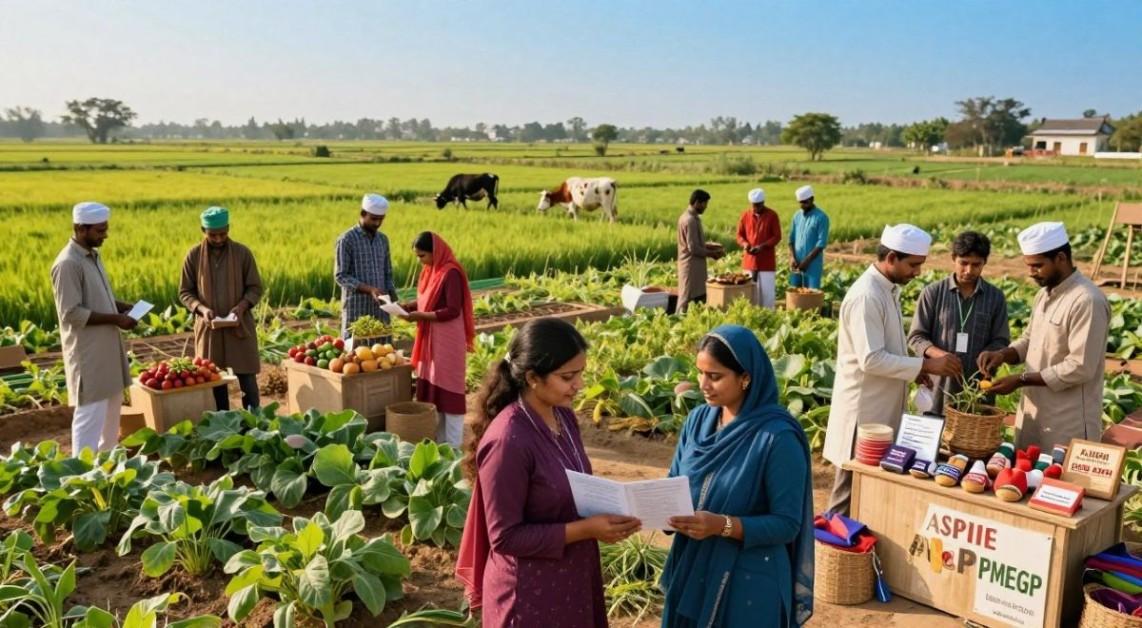
The government's initiatives to promote entrepreneurship in rural areas have shown significant progress. The ASPIRE scheme has been instrumental in empowering rural communities by providing training and support to individuals.
This initiative has enabled 1.16 lakh individuals to venture into rural businesses, contributing to the region's economic growth. Furthermore, the Prime Minister's Employment Generation Programme (PMEGP) has been supporting women entrepreneurs, providing them with a substantial subsidy.
These programs are crucial components of the government's efforts to foster rural development and promote economic growth in rural areas.
Key Takeaways
- The ASPIRE scheme has trained 1.16 lakh individuals for rural ventures.
- PMEGP supports women entrepreneurs with a 35% subsidy.
- The initiatives aim to promote entrepreneurship in rural areas.
- Rural development is a key focus of the government's economic growth strategy.
- The programs have contributed significantly to the region's economic growth.
Overview of Rural Entrepreneurship Initiatives in India
Rural entrepreneurship in India is witnessing a significant surge, driven by government initiatives aimed at promoting economic growth in rural areas. This development is crucial for creating employment opportunities and improving the quality of life in rural communities.
Current State of Rural Entrepreneurship
The current state of rural entrepreneurship is characterized by a growing number of small businesses and self-help groups. These ventures are primarily focused on agriculture, handicrafts, and local services, contributing to the local economy. However, rural entrepreneurs face challenges such as limited access to capital, technology, and markets.
Government's Focus on Rural Development
The Indian government has been actively promoting rural development through various schemes, including ASPIRE and PMEGP. These programs are designed to provide small business training and government grants to aspiring entrepreneurs, enabling them to start and sustain their ventures. By focusing on rural development, the government aims to bridge the urban-rural divide and foster inclusive economic growth.
ASPIRE Scheme: A Comprehensive Analysis
The ASPIRE scheme has emerged as a pivotal initiative in fostering rural entrepreneurship across India. Launched by the Ministry of Micro, Small and Medium Enterprises, ASPIRE aims to promote entrepreneurship in rural areas through training and financial assistance.
Origin and Objectives of ASPIRE
The ASPIRE scheme was initiated to address the growing need for entrepreneurship development in rural India. Its primary objectives include promoting entrepreneurship, creating employment opportunities, and empowering women in rural areas. By providing training and financial assistance, ASPIRE enables rural entrepreneurs to start and grow their businesses.
Implementation Framework
The implementation framework of ASPIRE involves a multi-stakeholder approach, including government agencies, financial institutions, and industry partners. The scheme provides financial assistance to rural entrepreneurs, enabling them to access the necessary resources for business growth. This framework ensures that the benefits of the scheme reach the target audience effectively.
Key Stakeholders and Partners
Key stakeholders and partners of ASPIRE include government ministries, financial institutions, industry associations, and NGOs. These partners play a crucial role in the successful implementation of the scheme, providing support in areas such as training, mentorship, and financial assistance.
| Stakeholder | Role |
|---|---|
| Government Ministries | Policy formulation and funding |
| Financial Institutions | Providing financial assistance |
| Industry Associations | Mentorship and industry insights |
| NGOs | Training and support |
ASPIRE trained 1.16L for rural ventures; PMEGP aids 39% women w/ 35% subsidy
The ASPIRE initiative has made significant strides in empowering rural communities through comprehensive training programs. The scheme's focus on skill development has enabled a large number of individuals to start their own ventures.
Training Methodology and Curriculum
The ASPIRE scheme employs a multi-faceted training methodology that includes both theoretical and practical components. The curriculum is designed to equip trainees with the necessary skills to succeed in their chosen ventures. The training covers various aspects such as business planning, financial management, and marketing strategies.
Geographical Distribution of Beneficiaries
The ASPIRE scheme has a wide geographical reach, with beneficiaries spread across various states in India. The program is particularly focused on areas with high potential for rural entrepreneurship. The geographical distribution is as follows:
| State | Number of Beneficiaries |
|---|---|
| Uttar Pradesh | 20,000 |
| Bihar | 15,000 |
| Maharashtra | 18,000 |
Skill Development Outcomes
The ASPIRE scheme has achieved significant skill development outcomes, with a large percentage of trainees successfully starting their own businesses. The program's focus on practical training has enabled beneficiaries to gain hands-on experience in their chosen fields. As a result, the scheme has contributed to the growth of rural entrepreneurship and job creation.
The combination of comprehensive training and financial support through schemes like PMEGP, which offers a 35% subsidy, has been instrumental in promoting women entrepreneurs in rural areas. The ASPIRE scheme's training methodology and curriculum have played a crucial role in empowering rural communities.
Eligibility Criteria and Application Process for ASPIRE
The ASPIRE scheme offers comprehensive training for rural entrepreneurs, enabling them to establish successful ventures. To benefit from this initiative, individuals must meet specific eligibility criteria and follow a structured application process.
Who Can Apply for ASPIRE Training
The ASPIRE scheme is designed for individuals interested in pursuing rural entrepreneurship. Eligibility criteria include being a resident of India, having a viable business idea, and demonstrating a willingness to undergo training. The scheme is particularly beneficial for those looking to acquire small business training and leverage government grants to promote rural development.

| Eligibility Criteria | Description |
|---|---|
| Residency | Must be a resident of India |
| Business Idea | Must have a viable business idea |
| Training Willingness | Must be willing to undergo training |
Step-by-Step Application Procedure
To apply for ASPIRE training, follow these steps:
- Visit the official ASPIRE website or nearest KVIC/KVIB office.
- Fill out the application form with required details.
- Submit the application along with necessary documents.
- Attend the selection process, which may include interviews or written tests.
- Upon selection, undergo the training program.
By following this process, individuals can successfully apply for ASPIRE training and take the first step towards establishing a thriving rural enterprise.
Prime Minister's Employment Generation Programme (PMEGP): Structure and Benefits
The Prime Minister's Employment Generation Programme (PMEGP) has emerged as a vital initiative for fostering entrepreneurship in rural India. This program is designed to provide financial assistance to rural entrepreneurs, enabling them to start and grow their businesses.
Evolution of PMEGP
PMEGP was launched to address the growing need for employment opportunities in rural areas. It has its roots in the earlier schemes like REGP (Rural Employment Generation Programme) and PMRY (Prime Minister's Rozgar Yojana), which were merged to create a more comprehensive program. Over the years, PMEGP has evolved to cater to the changing needs of rural entrepreneurs, providing them with the necessary support to establish and expand their ventures.
Operational Framework
The operational framework of PMEGP involves a multi-tiered structure that includes various government agencies and financial institutions. Financial assistance is provided through subsidies and loans at favorable interest rates, making it easier for entrepreneurs to access capital. The program also offers training and skill development initiatives to equip beneficiaries with the necessary skills.
Implementing Agencies
PMEGP is implemented through a network of agencies, including Kavachandra Khadi and Village Industries Commission (KVIC), state-level Khadi and Village Industries Boards (KVIBs), and other government bodies. These agencies play a crucial role in identifying beneficiaries, disbursing funds, and monitoring the progress of the projects.
| Implementing Agency | Role |
|---|---|
| KVIC | National-level implementation and monitoring |
| KVIBs | State-level implementation and beneficiary identification |
| Other Government Bodies | Providing support and resources to beneficiaries |
As stated by the Ministry of Micro, Small and Medium Enterprises, "PMEGP is a crucial initiative for promoting entrepreneurship and employment generation in rural areas." The program has been instrumental in empowering women and promoting rural development.
Subsidy Structure and Financial Assistance Under PMEGP
The PMEGP subsidy program is designed to empower rural entrepreneurs by offering substantial financial aid. This program is crucial in supporting individuals who wish to start or expand their businesses in rural areas.
35% Subsidy Mechanism
The PMEGP provides a 35% subsidy to beneficiaries, which significantly reduces the financial burden on entrepreneurs. This subsidy is a government grant aimed at promoting rural employment and economic growth.
The subsidy mechanism under PMEGP is designed to be straightforward, ensuring that beneficiaries can easily access the financial assistance they need. The program's operational framework is geared towards making the subsidy process as efficient as possible.
Category-wise Subsidy Distribution
The subsidy distribution under PMEGP varies across different categories of beneficiaries. The program is designed to be inclusive, providing financial assistance to a wide range of entrepreneurs.
| Category | Subsidy Percentage | Beneficiary Type |
|---|---|---|
| General | 35% | Open category beneficiaries |
| SC/ST/OBC | 35% | Reserved category beneficiaries |
| Women Entrepreneurs | 35% | Women starting or expanding businesses |

The category-wise subsidy distribution ensures that all eligible beneficiaries receive the necessary financial assistance to pursue their entrepreneurial ventures.
Women Entrepreneurship Support Through PMEGP
The Prime Minister's Employment Generation Programme (PMEGP) has been instrumental in promoting women entrepreneurship in rural India. As part of its broader initiative to foster economic growth and employment, PMEGP has been supporting women entrepreneurs, with a significant impact on rural development.
39% Women Beneficiaries: Analysis
A notable achievement of PMEGP is that 39% of its beneficiaries are women, indicating a strong focus on women empowerment. This statistic underscores the program's effectiveness in reaching and supporting women entrepreneurs in rural areas. The analysis of this data reveals that women are increasingly participating in business ventures, contributing to the local economy.
Special Provisions for Women Entrepreneurs
PMEGP offers special provisions for women entrepreneurs, including a higher subsidy on projects. This encourages more women to take up entrepreneurial ventures, promoting economic independence. The program's framework is designed to be inclusive, providing women with the necessary resources and support to succeed in their business endeavors.
Success Stories of Women Entrepreneurs
Several women entrepreneurs have benefited from PMEGP, achieving significant success in their ventures. For instance, a woman from a rural village started a handicraft business with the help of PMEGP funding, creating employment opportunities for other women in her community. Such success stories highlight the positive impact of PMEGP on women empowerment and rural development.
Economic Impact of ASPIRE and PMEGP on Rural India
The economic impact of ASPIRE and PMEGP on rural India has been profound, with significant job creation and income generation. These initiatives have been instrumental in promoting rural development by providing small business training and financial assistance.
Job Creation and Income Generation
The ASPIRE scheme has trained 1.16 lakh individuals for rural ventures, while PMEGP has supported 39% women beneficiaries with a 35% subsidy. This has led to a substantial increase in job creation and income generation in rural areas.
| Scheme | Beneficiaries | Subsidy Percentage |
|---|---|---|
| ASPIRE | 1.16 lakh | - |
| PMEGP | 39% women | 35% |
Reduction in Rural-Urban Migration
By creating employment opportunities in rural areas, these schemes have contributed to a reduction in rural-urban migration. This not only improves the quality of life for rural residents but also helps in balancing regional development.
The combined efforts of ASPIRE and PMEGP are pivotal in driving rural development and empowering rural communities. By providing the necessary training and financial support, these initiatives are helping to create a more sustainable and equitable economic environment in rural India.
Comparative Analysis with International Rural Development Programs
Many countries have launched programs to boost rural entrepreneurship, providing valuable lessons for India's ASPIRE and PMEGP schemes. These international initiatives share similar objectives, such as promoting economic growth and reducing rural-urban disparities.
Similar Initiatives in Developing Countries
Countries like Bangladesh, Kenya, and Brazil have implemented programs to support rural entrepreneurship. For instance, Bangladesh's Rural Development Project has successfully enhanced rural livelihoods through microfinance and skill development. Similarly, Kenya's Youth Empowerment Project focuses on vocational training and entrepreneurship support for young people in rural areas.
Lessons and Best Practices
A comparative analysis reveals that effective rural development programs often combine government grants with subsidy programs. "Government support is crucial for the success of rural entrepreneurship initiatives." As noted by the World Bank,
"Rural development programs that integrate financial support with capacity building tend to have higher success rates."
India's ASPIRE and PMEGP can benefit from these insights by enhancing their training methodologies and financial assistance structures.
By studying international best practices, India can refine its rural development strategies, ultimately leading to more sustainable and inclusive growth.
Challenges and Future Roadmap for Rural Entrepreneurship Schemes
The journey of rural entrepreneurship schemes like ASPIRE and PMEGP is not without its obstacles. As these initiatives continue to support rural ventures, they must navigate various challenges to achieve their full potential.
Implementation Hurdles
One of the primary challenges faced by ASPIRE and PMEGP is the implementation hurdle. With ASPIRE having trained 1.16 lakh individuals for rural ventures, the scale of operation is vast, and ensuring uniform quality of training across different regions can be difficult. Additionally, bureaucratic processes can sometimes slow down the implementation of these schemes.
Access to Markets and Technology
Another significant challenge is providing rural entrepreneurs with access to markets and technology. Many rural businesses struggle to reach wider markets due to infrastructure limitations. Moreover, the adoption of technology can be slow in rural areas, hindering the growth of businesses.
Planned Enhancements and Expansions
To address these challenges, the government plans to enhance the existing infrastructure and expand the scope of these schemes. This includes increasing financial assistance to women entrepreneurs under PMEGP, which currently supports 39% of women beneficiaries with a 35% subsidy. Enhancements in technology access and market linkages are also on the agenda.
Conclusion
The ASPIRE scheme and Prime Minister's Employment Generation Programme (PMEGP) have been instrumental in promoting rural entrepreneurship and women empowerment in India. By providing training, financial assistance, and subsidy support, these initiatives have contributed significantly to the overall development of rural communities.
The success of these programs is evident in the number of beneficiaries, with 1.16 lakh individuals trained under ASPIRE and 39% of PMEGP beneficiaries being women. The 35% subsidy provided under PMEGP has been a significant incentive for rural entrepreneurs, enabling them to establish and grow their businesses.
As the government continues to promote rural development, it is essential to build on the successes of these programs and address the challenges faced by rural entrepreneurs. By doing so, we can further empower rural communities and promote women empowerment, ultimately contributing to the country's economic growth and development.
 Related News
POST A COMMENT (0)
All Comments (0)
Replies (0)