




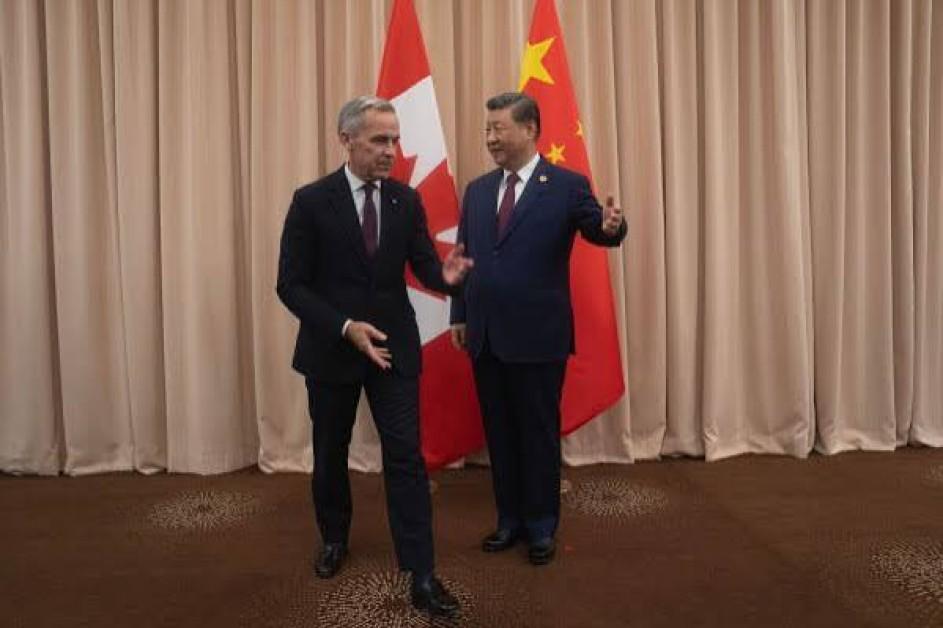
Canada and China Seek Deeper Economic Cooperation During Carney-Xi Meeting
Canadian Prime Minister Mark Carney is scheduled to meet Chinese President Xi Jinping in Shenzhen on Tuesday, November 17, 2026, for high-level discussions aimed at expanding economic cooperation in agriculture, energy and financial services.
The meeting comes as Ottawa seeks to diversify its international trade relationships, strengthen access to Asian markets and reduce its economic dependence on the United States.
Carney arrived in Shenzhen on November 16 ahead of the Asia-Pacific Economic Cooperation (APEC) leaders' gathering, following visits to other countries in Europe and Asia.
The discussions are expected to focus on food security, conventional and clean energy, financial services and potential Chinese investment in Canada's automotive manufacturing sector.
The two leaders are also expected to address broader international economic developments and China's role in the evolving global order.
The meeting represents another step in efforts to stabilise Canada-China relations after years of diplomatic disagreements and trade restrictions.
It follows Carney's January 2026 visit to Beijing, during which Canada and China announced a new strategic partnership and agreed to improve cooperation across several economic sectors.
However, the latest discussions are taking place against a complicated geopolitical backdrop.
Canada remains closely integrated with the United States through trade, investment and manufacturing supply chains, while relations between Washington and Beijing continue to influence global commerce.
Carney's government is attempting to expand commercial opportunities with China while maintaining national security safeguards and protecting Canadian industries.
The outcome of the meeting could influence agricultural exports, energy trade, financial cooperation and future investment arrangements between the two economies.
Canada-China High-Level Talks: Key Details

|
Particulars |
Details |
|---|---|
|
Canadian leader |
Prime Minister Mark Carney |
|
Chinese leader |
President Xi Jinping |
|
Meeting date |
November 17, 2026 |
|
Location |
Shenzhen, China |
|
International event |
APEC Leaders' Meeting |
|
Principal trade priorities |
Food, energy and financial services |
|
Additional focus |
Automotive investment and economic cooperation |
|
Previous major meeting |
January 16, 2026, Beijing |
|
Bilateral merchandise trade in 2025 |
C$125.6 billion |
|
Canadian exports to China in 2025 |
C$35.1 billion |
|
Canadian imports from China in 2025 |
C$90.5 billion |
|
Canada's export growth objective |
Increase exports to China by 50% by 2030 |
|
Status |
High-level discussions scheduled; new agreements not yet confirmed |
The meeting is expected to build on earlier understandings rather than begin negotiations from an entirely new position.
No new agreement arising from the November 17 discussions had been confirmed in the reporting available before the scheduled meeting.
Mark Carney Seeks to Expand Canada's Trade Beyond the United States
Trade diversification is a central objective of Carney's international economic strategy.
The United States remains Canada's largest trading partner and a major destination for Canadian exports.
The two countries maintain deeply integrated supply chains, particularly in automobiles, energy, manufacturing and agriculture.
However, US tariffs and trade policy uncertainty have encouraged Ottawa to pursue additional commercial relationships.
Why Canada Is Diversifying Trade
Heavy dependence on one export market can expose businesses to changes in tariffs, regulations and economic conditions.
Diversifying export destinations can provide companies with access to additional customers.
It may also help reduce the impact of disruptions affecting a particular trading partner.
Carney has established a broader objective of doubling Canadian exports to markets outside the United States by 2035.
Expanding commercial relations with China forms one component of that strategy.
China's Economic Importance
China is Canada's second-largest single-country merchandise trading partner.
Its large consumer market and industrial economy create potential demand for Canadian agricultural products, energy and other commodities.
China is also an important supplier of manufactured goods and clean energy technologies.
However, trade opportunities must be considered alongside regulatory, security and geopolitical concerns.
Canada-China Trade Reached C$125.6 Billion in 2025
The scale of existing bilateral commerce provides a foundation for the latest negotiations.
Canada-China merchandise trade totalled approximately C$125.6 billion in 2025.
Canadian exports accounted for C$35.1 billion, while imports from China reached C$90.5 billion.
Canada-China merchandise trade in 2025
Canadian exports to China
C$35.1B
Canadian imports from China
C$90.5B

The figures indicate that Canada imported substantially more merchandise from China than it exported.
The merchandise trade deficit was approximately C$55.4 billion.
However, a bilateral trade deficit alone does not establish whether the trading relationship is beneficial or harmful.
Trade flows reflect differences in production, consumer demand, supply chains and economic specialisation.
Target to Increase Exports by 2030
Carney's government has identified a goal of increasing Canadian exports to China by 50% by 2030.
Achieving that objective would require growth across several sectors.
Agriculture and energy are among the most immediate areas of opportunity.
Financial services and investment cooperation could also contribute to the broader economic relationship.
Agriculture and Food Security Become Major Negotiation Priorities
Agricultural trade is expected to feature prominently in the Carney-Xi discussions.
Canada is an important exporter of grains, oilseeds, meat and seafood.
China is a major international market for agricultural commodities.
Trade restrictions and tariffs have affected Canadian agricultural exports in recent years.
The two governments have made progress in reducing some of these barriers.
Canola Trade Recovers Following Tariff Changes
Canadian canola exports have benefited from improved market access following Carney's January visit.
China reduced tariffs on Canadian canola seed and extended relief on several other agricultural products.
Canada exported approximately 2.8 million metric tonnes of canola seed to China during the first part of 2026 covered by the latest reporting.
The recovery is significant because earlier restrictions had disrupted sales.
Why Canola Matters
Canola is an important crop for Canadian farmers.
Its seeds are processed into vegetable oil and protein-rich meal used in animal feed.
China's agricultural and food processing industries create substantial demand for these products.
Improved market access can support Canadian exporters and agricultural supply chains.
However, actual export volumes depend on crop production, international prices and commercial demand.
Canadian Pork Producers Seek Lower Chinese Tariffs
Canadian pork exporters are another group closely watching the talks.
China continues to impose a 25% tariff on certain Canadian pork and related products.
Canadian agricultural businesses hope the discussions will lead to further tariff reductions.
Potential Benefits for Pork Exporters
Lower tariffs could make Canadian pork more competitive in the Chinese market.
This may create opportunities for producers, processors and exporters.
However, improved market access would not automatically guarantee higher sales.
Demand, sanitary requirements, logistics and competition from other exporting countries would continue to influence trade.
No new pork tariff agreement had been confirmed ahead of the November 17 meeting.
Seafood and Other Agricultural Products Remain in Focus
China has extended tariff relief for several Canadian agricultural and seafood products.
These include canola meal, lobsters, crabs and peas.
The extensions provide greater certainty for exporters operating in these categories.
Why Tariff Relief Matters
Import tariffs increase the cost of foreign products in the destination market.
Reducing tariffs can improve competitiveness.
For agricultural exporters, predictable trade conditions are particularly important because production and shipment planning often occur months in advance.
However, tariff relief does not eliminate all potential trade barriers.
Exporters must continue complying with applicable product standards, inspections and customs procedures.
Energy Cooperation Could Become a Major Growth Area
Energy is another important focus of the Canada-China discussions.
Canada possesses substantial conventional energy resources, including crude oil and natural gas.
It is also developing clean energy technologies and related infrastructure.
China is one of the world's largest energy consumers.
This creates potential opportunities for Canadian energy exporters.
Canadian Crude Oil Exports to China Increase
Canadian crude oil shipments to China increased approximately 37% during 2026, according to calculations based on shipping and market data.
The growth reflects stronger commercial links between Canadian energy producers and Chinese buyers.
Canada's expanded access to Pacific export infrastructure has helped support shipments to Asian markets.
Why Asian Energy Markets Matter
Canada has historically exported most of its crude oil to the United States.
Greater access to Asian markets provides additional destinations for Canadian production.
This can help producers diversify customers.
However, export growth depends on transportation capacity, international oil prices and buyer demand.
Clean Energy Technology Cooperation Also on the Agenda
The two countries are expected to discuss opportunities involving clean energy technologies.
Canada has resources and industrial capabilities relevant to energy development.
China is a major manufacturer of renewable energy equipment, batteries and electric vehicles.
Potential cooperation could involve technology, equipment and investment.
Areas of Possible Collaboration
Renewable electricity
China manufactures substantial quantities of solar and wind equipment.
Battery technology
Chinese companies have extensive manufacturing capabilities in batteries and related materials.
Critical minerals
Canada possesses mineral resources used in batteries and other advanced technologies.
Energy infrastructure
Investment may support selected electricity and energy projects.
Industrial manufacturing
Joint ventures could involve the production of clean energy equipment.
However, these are potential areas of cooperation rather than confirmed new agreements from the November meeting.
Canadian authorities are expected to maintain scrutiny of investments involving strategically sensitive assets.
Financial Services Cooperation Could Expand Bilateral Investment
Financial services represent the third major sector identified for discussion.
Canada has a developed banking, insurance and investment management industry.
China's financial markets and large economy offer potential opportunities for international institutions.
The January 2026 strategic partnership included plans to strengthen economic and financial dialogue.
Economic and Financial Strategic Dialogue
The two governments have identified the revitalisation of bilateral financial discussions as part of their cooperation framework.
Such dialogue can provide a mechanism for addressing financial market issues and economic policy coordination.
Potential Areas of Discussion
Financial services cooperation could involve institutional investment, banking relationships and financial market access.
It may also include regulatory discussions and mechanisms supporting cross-border business.
However, specific market access commitments have not been confirmed for the November 17 talks.
Why Financial Cooperation Matters
Trade and investment depend on financial infrastructure.
Companies require payment services, financing arrangements and risk management tools.
Greater regulatory clarity can support cross-border transactions.
Nevertheless, financial cooperation must operate within applicable banking, investment and national security regulations.
Chinese Investment in Canada's Automotive Industry Emerges as Sensitive Issue
Automotive manufacturing is expected to be another important subject.
Canada and China reached an arrangement earlier in 2026 allowing a limited number of Chinese-made electric vehicles to enter the Canadian market at reduced tariffs.
The arrangement established an initial annual quota of 49,000 vehicles.
Eligible imports are subject to a tariff rate of 6.1%.
The quota is expected to increase to 70,000 vehicles over five years.
Why the Agreement Matters
The arrangement creates a limited opening for Chinese electric vehicle manufacturers.
Companies including BYD, Geely and Chery have explored opportunities in the Canadian market.
However, importing vehicles is different from establishing manufacturing operations in Canada.
Potential Joint Ventures
Carney has expressed interest in attracting automotive investment that creates Canadian jobs.
His government has indicated that new manufacturing arrangements should meet Canadian labour standards and support domestic supply chains.
This includes attention to local sourcing and critical minerals.
No major new Chinese automotive manufacturing agreement had been confirmed ahead of the latest meeting.
US Tariffs Increase Pressure on Canada's Automotive Industry
The discussions with China are taking place amid continuing trade tensions between Canada and the United States.
The North American automotive industry has historically operated through highly integrated supply chains.
Vehicle components frequently cross borders during manufacturing.
US tariffs have disrupted parts of this system.
US Tariff Threats
The Trump administration has threatened to increase tariffs on Canadian automobiles and related products to 50% from 25% beginning January 1, 2027.
The possibility has created uncertainty for Canadian manufacturers and workers.
Canada's Search for Alternative Partners
Carney has indicated that Canada would prefer to maintain an integrated North American automotive industry.
However, Ottawa is also considering opportunities with European and Asian partners.
This approach reflects efforts to preserve manufacturing activity while adapting to changing trade conditions.
Why Chinese Investment Is Controversial
Chinese automotive investment could create manufacturing opportunities.
However, it also raises concerns involving competition, supply chain dependence, technology and national security.
Canadian policymakers must consider these issues alongside potential economic benefits.
Canada-China Relations Have Improved Since January 2026
The November meeting builds on a broader diplomatic effort that began earlier in the year.
Carney visited Beijing in January 2026, becoming the first Canadian prime minister to visit China in nearly a decade.
During that visit, the two countries announced a new strategic partnership.
The partnership identified several areas for cooperation.
Five Pillars of the Strategic Partnership
|
Pillar |
Principal focus |
|---|---|
|
Energy |
Conventional and clean energy cooperation |
|
Economic and trade cooperation |
Market access and commercial relationships |
|
Public safety and security |
Selected security and law enforcement issues |
|
Multilateralism |
International institutions and global cooperation |
|
Culture and people-to-people ties |
Education, tourism and cultural exchanges |
The partnership also included memorandums of understanding covering energy, food safety and other areas.
The November discussions provide an opportunity to review progress and identify additional priorities.
National Security Concerns Remain an Important Constraint
Despite improving economic relations, Canada-China ties continue to face significant political and security challenges.
Canadian officials have raised concerns about foreign interference and other national security matters.
Human rights organisations have also criticised aspects of China's policies.
China has rejected allegations that it seeks to interfere in Canada's domestic affairs.
Economic Cooperation and Security Safeguards
Carney has argued that engaging with China does not mean endorsing all of its policies.
His government has emphasised the importance of establishing boundaries around sensitive sectors.
These may include advanced technologies, critical infrastructure and strategic resources.
Investment Screening
Foreign investment in certain industries may be subject to national security review.
Such procedures are intended to assess potential risks associated with ownership or control of sensitive assets.
The scope and outcome of any review depend on the investment and applicable law.
Balancing Competing Priorities
Canada faces the challenge of expanding trade opportunities while protecting security interests.
The November meeting may provide greater clarity about how Ottawa intends to manage these competing objectives.
APEC Summit Provides a Wider Economic Platform
The Carney-Xi meeting is taking place alongside the Asia-Pacific Economic Cooperation leaders' gathering in Shenzhen.
APEC brings together 21 economies from the Asia-Pacific region.
The forum promotes trade, investment and economic cooperation.
Why APEC Matters
APEC economies account for a substantial share of global trade and economic output.
The forum provides opportunities for leaders to discuss trade barriers, supply chains and economic integration.
It also creates opportunities for bilateral meetings outside the main summit agenda.
Canada's Broader Asia Strategy
Carney's visit forms part of a wider effort to strengthen Canada's commercial relationships in Asia.
The government has pursued trade discussions with Southeast Asian countries.
It has also worked to expand investment partnerships and export opportunities.
The China meeting is one element of this broader regional strategy.
Implications for Canadian Farmers and Agricultural Businesses
Agriculture is among the sectors most directly affected by the trade discussions.
Canadian farmers and food processors depend on access to international markets.
China's large consumer and industrial markets create opportunities for agricultural exports.
Potential Benefits
Improved market access could support export volumes.
Lower tariffs may improve competitiveness.
More predictable trade arrangements could assist production and investment planning.
Continuing Risks
Agricultural exports remain exposed to changes in trade policy.
Commodity prices, weather conditions and logistics also influence profitability.
Even if tariffs are reduced, exporters must meet applicable regulatory requirements.
The outcome of the talks will therefore be important for agricultural businesses, but its financial impact cannot yet be quantified.
Implications for Canadian Energy Companies
Energy producers may benefit from stronger commercial ties with China.
The increase in Canadian crude shipments during 2026 demonstrates existing demand.
Greater access to Asian markets could support customer diversification.
However, energy exports depend on market prices, transportation capacity and contractual arrangements.
Clean Energy Opportunities
Canadian companies involved in renewable energy and critical minerals may also monitor the talks.
Potential cooperation could create opportunities for investment and industrial partnerships.
However, national security screening and regulatory requirements will remain important considerations.
Implications for Financial Institutions and Investors
Canadian financial institutions may seek opportunities associated with greater trade and investment activity.
These could include financing international transactions and supporting corporate investment.
However, market access and regulatory requirements will determine the scope of commercial opportunities.
Investor Considerations
Investors will monitor whether the discussions lead to specific agreements.
Potentially relevant sectors include agriculture, energy, automobiles and financial services.
However, high-level diplomatic meetings do not automatically translate into immediate revenue or earnings.
The financial impact depends on the terms and implementation of any agreements.
What the Talks Mean for Global Trade
The Canada-China meeting reflects broader changes in international trade relationships.
Countries are increasingly seeking to diversify supply chains and reduce dependence on individual markets.
Trade policy uncertainty has encouraged governments to explore additional economic partnerships.
Diversification Versus Dependence
Expanding trade with China could reduce Canada's reliance on the United States in certain sectors.
However, greater exposure to China could create different economic and geopolitical risks.
The challenge is to develop a balanced portfolio of international relationships.
Supply Chain Implications
Agricultural commodities, energy products and manufactured goods depend on international transportation and logistics.
Changes in tariffs and investment policies can influence supply chain decisions.
Global Investment
Improved diplomatic relations can support investor confidence.
However, commercial investment depends on financial returns, regulatory certainty and market conditions.
What Happens Next After the Carney-Xi Meeting?
The immediate focus will be on any official statements or agreements announced following the November 17 discussions.
Investors and businesses will look for developments in agricultural tariffs, energy cooperation and financial services.
The automotive sector will also be closely watched.
Key Areas to Monitor
|
Area |
Potential development |
|---|---|
|
Agriculture |
Further tariff reductions or market access measures |
|
Canola |
Continued export recovery |
|
Pork |
Possible discussions on the existing 25% tariff |
|
Energy |
Expanded crude oil and clean energy cooperation |
|
Financial services |
Progress on bilateral financial dialogue |
|
Automotive industry |
Potential investment and manufacturing partnerships |
|
Trade diversification |
Additional export opportunities |
|
National security |
Safeguards for sensitive investments |
The outcome will depend on whether the two governments reach concrete understandings and establish implementation arrangements.
No new agreements should be treated as final until officially announced.
Conclusion
Canadian Prime Minister Mark Carney's scheduled meeting with Chinese President Xi Jinping on November 17, 2026, represents another step in efforts to strengthen economic relations between Canada and China.
The discussions are expected to focus on agriculture, food security, conventional and clean energy, financial services and potential automotive investment.
The meeting builds on the strategic partnership announced during Carney's January visit to Beijing.
With bilateral merchandise trade reaching C$125.6 billion in 2025, the two countries already maintain substantial commercial ties.
Canada is seeking to expand exports to China while reducing its reliance on the United States amid continuing trade uncertainty.
Agricultural exporters are particularly interested in further tariff relief, while energy producers see opportunities to increase shipments to Asian markets.
Financial services and automotive manufacturing could also become areas of expanded cooperation.
However, national security concerns, investment restrictions and geopolitical differences remain important constraints.
The significance of the meeting will ultimately depend on whether the discussions produce specific, implementable agreements.
For Canadian businesses, the talks highlight potential opportunities in one of the world's largest markets, alongside the importance of managing trade and regulatory risks.
 Canada-China Trade Talks: Carney, Xi Discuss Food, Energy and Finance Cooperation FAQs

POST A COMMENT (0)
All Comments (0)
Replies (0)