





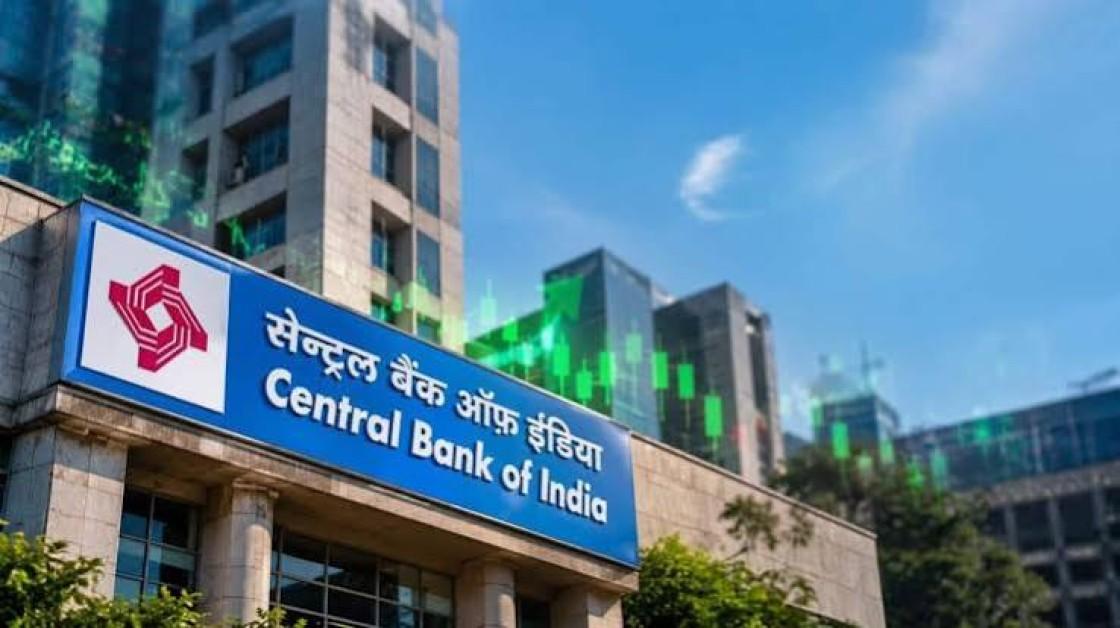
Central Bank of India Posts Strong September-Quarter Earnings
State-owned Central Bank of India reported a 21.1% year-on-year increase in standalone net profit to ₹1,469 crore for the second quarter of FY2026–27, supported by strong credit growth, higher net interest income and improved operating efficiency.
The Mumbai-headquartered public-sector lender announced its financial results on October 17, 2026, for the quarter ended September 30.
Net profit increased from ₹1,213 crore in the corresponding quarter of the previous financial year. On a sequential basis, profit rose approximately 11% from ₹1,324 crore in the April–June quarter.
Net interest income, the difference between interest earned and interest paid, increased 26.3% year-on-year to ₹4,146 crore from ₹3,283 crore.
The bank's operating profit rose approximately 27% to ₹2,268 crore, reflecting stronger core banking income despite a decline in treasury-related earnings.
Asset quality also improved, with the gross non-performing asset ratio declining to 2.39% and the net NPA ratio falling to 0.31%.
The results highlight Central Bank of India's improving lending performance as public-sector banks continue to expand their credit portfolios and strengthen profitability.
However, higher provisions, declining low-cost deposit concentration and rapid credit expansion remain important factors for investors to monitor.
Central Bank of India Q2 FY27 Financial Highlights
|
Financial Indicator |
Q2 FY27 |
Q2 FY26 |
YoY Change |
|---|---|---|---|
|
Net profit |
₹1,469 crore |
₹1,213 crore |
+21.1% |
|
Net interest income |
₹4,146 crore |
₹3,283 crore |
+26.3% |
|
Operating profit |
₹2,268 crore |
₹1,786 crore |
+27.0% |
|
Interest income |
₹10,357 crore |
₹8,744 crore |
+18.5% |
|
Interest expenses |
₹6,211 crore |
Approximately ₹5,463 crore |
+13.7% |
|
Non-interest income |
₹1,380 crore |
₹1,469 crore |
-6.1% |
|
Net interest margin |
3.01% |
2.89% |
+12 basis points |
|
Gross NPA ratio |
2.39% |
3.01% |
Improved |
|
Net NPA ratio |
0.31% |
0.48% |
Improved |
The results demonstrate that growth in core lending income more than offset weakness in non-interest revenue.
Net Profit Increases 21.1% to ₹1,469 Crore

Central Bank of India's net profit increased by approximately ₹256 crore compared with the corresponding quarter of FY2025–26.
The improvement was primarily driven by higher interest earnings from an expanding loan portfolio.
Profitability also benefited from improved operating efficiency and a reduction in the proportion of stressed assets.
On a quarter-on-quarter basis, net profit increased 10.95% from ₹1,324 crore.
For the first six months of FY2026–27, the bank reported cumulative net profit of ₹2,793 crore.
This represented growth of 17.25% from ₹2,382 crore during the corresponding period of the previous financial year.
The half-year performance indicates that earnings growth has continued beyond a single reporting quarter.
However, profitability remains sensitive to credit costs, funding expenses and the performance of the bank's investment portfolio.
Net Interest Income Jumps 26.3%
Net interest income emerged as the strongest contributor to Central Bank of India's quarterly performance.
NII increased from ₹3,283 crore in Q2 FY26 to ₹4,146 crore in Q2 FY27.
The ₹863 crore increase reflected strong loan growth and improved management of interest expenses.
Sequentially, NII rose 5.9% from ₹3,914 crore in the June quarter.
The bank's total interest income increased 18.45% year-on-year to ₹10,357 crore.
Interest earned on advances rose 27.6% to ₹7,231 crore.
Meanwhile, interest expenses increased at a slower pace of 13.7% to ₹6,211 crore.
The difference between income and expense growth helped strengthen net interest earnings.
This is particularly important for banks because recurring interest income is generally more predictable than treasury gains and certain other revenue sources.
The results indicate that Central Bank of India's expanding lending operations are making a larger contribution to overall profitability.
Net Interest Margin Improves to 3.01%
Central Bank of India's net interest margin improved to 3.01% from 2.89% in the year-earlier quarter.
The 12-basis-point improvement indicates that the bank generated stronger net interest income relative to its interest-earning assets.
Net interest margin is a critical measure of banking profitability.
It reflects the difference between the yield generated on loans and investments and the cost of funding those assets.
The bank's cost of deposits declined to 4.60% from 4.88% a year earlier.
This reduction helped offset pressure on lending yields.
The yield on advances declined by 49 basis points to 7.87%.
Despite the reduction in lending yields, the bank maintained margin expansion because of its lower funding costs and growing loan portfolio.
The development suggests improved balance-sheet management.
However, sustaining margins will depend on future deposit pricing, interest rate movements and the competitive lending environment.
Global Advances Surge Nearly 30%
Central Bank of India reported substantial expansion in its lending portfolio during the September quarter.
Global advances increased 29.83% year-on-year to approximately ₹3.81 lakh crore.
The bank had reported advances of around ₹2.93 lakh crore in the corresponding period of the previous year.
The increase reflects stronger credit demand across corporate lending, retail banking, agriculture and micro, small and medium enterprises.
Loan growth significantly exceeded deposit growth during the quarter.
This contributed to higher interest income and stronger operating performance.
However, rapid credit expansion requires careful management of funding and asset quality.
Banks must ensure that lending growth is supported by appropriate underwriting standards and sufficient capital.
The sustainability of Central Bank of India's earnings momentum will depend partly on whether it can maintain loan growth without increasing credit risk.
Corporate Lending Expands 42.05%
Corporate advances were a major contributor to the bank's overall loan growth.
The corporate loan portfolio increased 42.05% year-on-year to approximately ₹1.19 lakh crore.
The expansion indicates stronger lending activity involving larger businesses and institutional borrowers.
Corporate credit demand is influenced by working capital requirements, investment plans and refinancing activity.
An increase in corporate advances can support interest income because of the relatively large size of individual facilities.
However, corporate lending can also create concentration risks.
Banks must evaluate borrowers' cash flows, repayment capacity and exposure to specific industries.
Central Bank of India's continued expansion in this segment will therefore require disciplined credit assessment.
The bank's asset quality indicators suggest that its existing portfolio remains relatively well controlled, although future performance will depend on the quality of new lending.
Retail, Agriculture and MSME Lending Grows 21.11%
The bank's retail, agriculture and MSME portfolio recorded growth of 21.11% year-on-year.
Combined advances across these categories reached approximately ₹2.54 lakh crore.
Retail loans increased 24.49%, reflecting stronger demand for consumer and household financing.
Agricultural advances grew approximately 19.9%, while MSME lending expanded around 17.4%.
These segments are important because they diversify the bank's loan portfolio across different customer groups.
Retail lending provides exposure to household credit demand.
Agricultural financing supports farmers and rural businesses.
MSME lending serves smaller enterprises involved in manufacturing, trade and services.
However, each segment has distinct credit risks.
Agricultural lending can be influenced by weather conditions and farm incomes, while MSME borrowers may be sensitive to economic fluctuations and working capital pressures.
The bank will need to maintain credit discipline as these portfolios expand.
Housing and Automobile Loans Support Retail Growth
Central Bank of India's retail lending portfolio benefited from demand for housing and automobile financing.
Housing loans increased 13.07% year-on-year.
Automobile loans grew 13.09%.
These categories contribute to the bank's secured retail lending portfolio.
Housing finance is supported by residential property demand, household income growth and access to credit.
Automobile financing depends on vehicle purchases, consumer confidence and financing costs.
Growth in these segments can help banks diversify their earnings.
However, lending profitability depends on interest rates, funding costs and credit quality.
The bank's retail performance indicates that household borrowing demand remained supportive during the September quarter.
Deposits Rise 14.41% to ₹5.09 Lakh Crore
Central Bank of India's global deposits increased 14.41% year-on-year to approximately ₹5.09 lakh crore.
The growth demonstrates continued expansion in the bank's funding base.
Deposits are important because they provide the primary funding source for commercial bank lending.
A stable deposit base supports liquidity and reduces dependence on more expensive wholesale borrowing.
However, the bank's loan portfolio expanded considerably faster than deposits.
This increased the proportion of deposits deployed toward lending.
The credit-deposit ratio rose to 75.02% from 66.20% a year earlier.
A higher ratio can improve interest income when additional lending is profitable.
However, it also reduces the proportion of deposits available to support future loan growth without additional funding.
Maintaining a healthy balance between advances and deposits will therefore be an important management priority.
CASA Ratio Declines Despite Deposit Growth
The bank's current account and savings account ratio declined to 44.65% from 46.83% a year earlier.
This represented a reduction of 218 basis points.
CASA deposits are important because they generally provide banks with relatively low-cost funding.
A higher CASA ratio can help protect net interest margins.
Although Central Bank of India's CASA deposits increased approximately 9.2% year-on-year to ₹2.27 lakh crore, their share of total deposits declined.
This indicates that other deposit categories expanded at a faster pace.
The reduction creates a potential challenge for future funding costs.
If the bank relies increasingly on higher-cost term deposits, its interest expenses could rise.
However, the September-quarter results showed that the overall cost of deposits declined.
The bank will need to maintain that advantage while expanding its funding base.
Operating Profit Rises 27% to ₹2,268 Crore
Central Bank of India's operating profit increased approximately 27% year-on-year to ₹2,268 crore.
The bank had reported operating profit of ₹1,786 crore in the corresponding quarter of FY26.
Sequentially, operating profit increased 3.75% from ₹2,186 crore.
The improvement was driven mainly by higher net interest income.
Strong lending growth helped compensate for weaker non-interest earnings.
Operating profit is an important measure because it reflects the earnings generated before provisions and taxes.
Higher operating profit provides banks with additional capacity to absorb credit costs.
However, operating profitability must be assessed alongside asset quality and capital requirements.
Central Bank of India's latest performance indicates that its core banking operations strengthened during the quarter.
Non-Interest Income Declines 6.1%
Despite stronger interest earnings, Central Bank of India's non-interest income declined during the September quarter.
Other income fell 6.06% year-on-year to ₹1,380 crore from ₹1,469 crore.
The reduction was primarily associated with weaker treasury income and lower recoveries.
Treasury income declined 31.2% to ₹128 crore from ₹186 crore.
Profit from the sale of investments fell approximately 30% to ₹133 crore.
The bank also recorded a revaluation loss of ₹87 crore on investments, compared with a loss of ₹51 crore a year earlier.
Recoveries from written-off accounts and other receipts declined 8.2% to ₹617 crore.
However, fee-based income increased 3.9% to ₹635 crore.
The figures show that the bank's earnings growth was primarily supported by core lending activities rather than investment-related gains.
Operating Efficiency Improves as Cost-to-Income Ratio Falls
Central Bank of India reported an improvement in operating efficiency during the quarter.
Its cost-to-income ratio declined to 58.95% from 62.42% a year earlier.
The improvement indicates that operating income grew faster than expenses.
Total operating expenses increased 9.8% year-on-year to ₹3,258 crore.
Staff expenses rose 9.5% to ₹2,072 crore.
Other operating expenses increased 10.5% to ₹1,186 crore.
Despite these increases, stronger net interest income helped reduce the proportion of revenue consumed by operating costs.
A lower cost-to-income ratio generally supports profitability.
However, the bank's ratio remains above its full-year objective of bringing the measure below 56%.
Further efficiency improvements will therefore be important.
Technology investment, branch productivity and cost management could influence future performance.
Gross NPA Ratio Improves to 2.39%
Central Bank of India's asset quality improved during the September quarter.
The gross non-performing asset ratio declined to 2.39% from 3.01% a year earlier.
It also improved from 2.60% at the end of June 2026.
Gross non-performing assets represent loans where borrowers have failed to meet repayment obligations according to regulatory criteria.
A lower gross NPA ratio generally indicates an improvement in the quality of the loan portfolio.
However, the absolute value of gross NPAs stood at ₹9,109 crore as of September 30.
This was higher than the ₹8,827 crore reported a year earlier but lower than ₹9,225 crore in June.
The distinction is important.
The decline in the NPA ratio reflects both changes in stressed loans and the expansion of the overall lending portfolio.
Investors should therefore examine absolute NPA amounts alongside percentage ratios.
Net NPA Ratio Falls to 0.31%
The bank's net non-performing asset ratio declined to 0.31% from 0.48% a year earlier.
It also improved from 0.49% in the June quarter.
Net NPAs represent stressed loans after accounting for relevant provisions.
The decline indicates that Central Bank of India has strengthened its coverage of impaired assets.
In absolute terms, net NPAs fell to approximately ₹1,146 crore from ₹1,364 crore a year earlier.
The improvement reduces the proportion of the loan portfolio exposed to unprovided credit losses.
It also supports confidence in the bank's balance-sheet quality.
However, maintaining low net NPAs will depend on continued recoveries, disciplined lending and effective monitoring of borrowers.
Provision Coverage Ratio Strengthens to 97.16%
Central Bank of India's provision coverage ratio increased to 97.16% at the end of September.
This compared with 96.88% a year earlier and 95.86% in the preceding quarter.
The provision coverage ratio indicates the extent to which a bank has provided for its non-performing assets.
A higher ratio generally suggests stronger financial protection against losses from stressed loans.
The improvement reflects the bank's continued focus on asset quality.
However, provisioning requirements can change as new loans become stressed or existing borrowers experience financial difficulties.
The bank must therefore maintain adequate reserves while expanding its lending portfolio.
The high provision coverage ratio provides a measure of resilience, but it does not eliminate future credit risk.
Fresh Slippages Decline During the Quarter
The bank reported fresh slippages of ₹734 crore during the September quarter.
This was lower than the ₹939 crore recorded in the June quarter.
Fresh slippages refer to loans that newly become non-performing during a reporting period.
A reduction can indicate improved repayment performance among borrowers.
The quarterly slippage ratio stood at 0.24% on a non-annualised basis.
This represented an improvement of six basis points from the year-earlier period.
However, the bank's annualised credit cost increased to 0.53%.
The increase suggests that provisioning expenses remain an important consideration.
Investors will monitor whether the reduction in fresh slippages continues during the second half of FY27.
Provisions Rise 39.4% Despite Better Asset Quality
Central Bank of India's provisions and contingencies, including income tax, increased 39.4% year-on-year to ₹799 crore.
The corresponding figure was ₹573 crore in Q2 FY26.
However, provisions declined 7.3% sequentially from ₹862 crore.
Provisions for non-performing assets increased to ₹490 crore from ₹143 crore a year earlier.
Provisions on standard assets also rose to ₹379 crore from ₹30 crore.
These increases were partly offset by a write-back of ₹336 crore relating to investments, including security receipts.
The bank's tax provision declined to ₹236 crore from ₹259 crore.
The figures demonstrate that stronger operating profit was important in supporting net earnings growth.
Although asset quality ratios improved, higher provisioning requirements limited the increase in bottom-line profitability.
Capital Adequacy Ratio Stands at 17.68%
Central Bank of India's capital adequacy ratio stood at 17.68% at the end of September 2026.
This was higher than the 17.34% reported a year earlier but lower than 18.28% in June.
The bank's Common Equity Tier-I capital ratio increased to 15.97% from 14.98% a year earlier.
CET1 capital represents a bank's highest-quality regulatory capital.
It provides a buffer against unexpected losses and supports future lending growth.
The improvement in the year-on-year CET1 ratio indicates a stronger core capital position.
However, rapid loan expansion increases risk-weighted assets and can place pressure on capital ratios.
Central Bank of India will need to balance credit growth with capital generation and regulatory requirements.
The latest figures indicate that the bank maintains a substantial capital buffer, although the sequential decline warrants monitoring.
Liquidity Ratios Moderate as Lending Expands
Central Bank of India's liquidity indicators declined from their year-earlier levels.
The average liquidity coverage ratio stood at 155.17%, compared with 241.96% a year earlier.
The net stable funding ratio declined to 126.38% from 150.47%.
Both ratios remained above the generally applicable regulatory minimum of 100%.
However, the reductions indicate that the bank is deploying more of its available funding into lending and other activities.
This is consistent with the sharp increase in advances and the higher credit-deposit ratio.
Liquidity management will remain important as the bank expands its loan portfolio.
The bank must ensure that sufficient funding is available to meet deposit withdrawals and other obligations.
Maintaining stable deposits and adequate liquid assets will therefore be essential to supporting continued growth.
Total Global Business Reaches ₹8.90 Lakh Crore
Central Bank of India's total global business increased 20.54% year-on-year to approximately ₹8.90 lakh crore.
The figure combines the bank's advances and deposits.
The increase reflects expansion across both lending and deposit-taking operations.
The bank's advances grew substantially faster than deposits, indicating strong credit demand.
However, the difference between the two growth rates also highlights the importance of maintaining a stable funding base.
The bank's business expansion supports higher interest income and opportunities for fee-based revenue.
It also increases the need for risk management, technology infrastructure and capital planning.
Sustainable growth will depend on the quality and profitability of new business rather than volume expansion alone.
Return on Assets Improves to 1.03%
Central Bank of India's return on assets increased to 1.03% from 1.01% a year earlier.
Return on assets measures how efficiently a bank generates profit from its asset base.
An improvement indicates stronger profitability relative to the size of the balance sheet.
The increase is notable because the bank expanded its loan portfolio significantly during the period.
Maintaining return on assets while growing advances can indicate effective earnings management.
However, future performance will depend on net interest margins, operating costs and credit provisions.
Investors will monitor whether the bank can sustain a return on assets above 1% as its balance sheet continues to expand.
Results Highlight Improving Performance Among PSU Banks
Central Bank of India's September-quarter results reflect broader improvements across parts of India's public-sector banking industry.
Government-owned banks have strengthened profitability in recent years through lower stressed assets, better recoveries and expanding loan portfolios.
The latest results demonstrate how stronger credit growth can support net interest income and operating profit.
However, the banking sector continues to face challenges involving deposit mobilisation and funding costs.
Competition for deposits can influence margins, particularly when lending expands rapidly.
Public-sector lenders must also maintain adequate capital and manage risks across corporate, retail and agricultural lending.
Central Bank of India's performance indicates progress in these areas, although higher provisions and declining CASA concentration remain important considerations.
What Investors Should Monitor in the Coming Quarters
Central Bank of India's financial performance during the second half of FY27 will depend on several factors.
The first is the sustainability of its nearly 30% loan growth.
Continued expansion could support interest income, but the bank must ensure that credit quality remains stable.
The second is deposit growth.
A stronger deposit base will be important for supporting lending without increasing funding costs.
Net interest margins will also remain a key indicator.
The bank's ability to maintain a margin near or above 3% will influence profitability.
Asset quality is another important consideration.
Investors will monitor fresh slippages, recoveries, provisions and the movement in gross and net NPAs.
Operating efficiency and capital adequacy will also influence the bank's ability to expand sustainably.
The September-quarter results provide a strong earnings base, but future performance will depend on maintaining the balance between growth, profitability and financial stability.
Conclusion
Central Bank of India's Q2 FY2026–27 results demonstrate strong earnings momentum, supported by expanding lending operations and improving operating efficiency.
The public-sector lender reported a 21.1% year-on-year increase in net profit to ₹1,469 crore.
Net interest income rose 26.3% to ₹4,146 crore, while operating profit increased approximately 27% to ₹2,268 crore.
Global advances expanded nearly 30% to ₹3.81 lakh crore, reflecting strong demand across corporate, retail, agricultural and MSME lending.
Asset quality improved, with the gross NPA ratio declining to 2.39% and the net NPA ratio falling to 0.31%.
The bank also maintained a capital adequacy ratio of 17.68%, supporting its continued lending activities.
However, higher provisions, weaker treasury income and a decline in the CASA ratio remain important challenges.
The bank's rapid loan expansion will also require careful management of liquidity, funding and credit risk.
Central Bank of India's ability to sustain profitability while maintaining asset quality will be central to its performance during the remainder of FY27.
 Central Bank of India Q2 FY27 Profit Rises 21.1% to ₹1,469 Crore as NII Jumps 26.3% FAQs

POST A COMMENT (0)
All Comments (0)
Replies (0)