India's Growth Faces Fresh Risks from Weak Monsoon and Rising Energy Costs
The world's fastest-growing major economy is running into two headwinds at once — a 43% rain deficit and elevated, volatile oil prices — that together threaten inflation, the rupee, and GDP.
By Naina, 25th June 2026
India's growth is facing fresh risks as a weak monsoon and rising energy costs converge to threaten the economy's momentum. With monsoon rains running about 43 percent below normal and crude oil prices elevated and volatile after months of Middle East tension, the world's fastest-growing major economy confronts twin supply-side shocks. Each alone would test policymakers; together they raise the danger of higher inflation, a weaker rupee, a wider trade gap, and slower expansion. After a year of robust growth, India now must navigate a more hostile mix of domestic weather and global energy pressures.
The stakes are significant. India expanded at one of its fastest rates in recent years through the last fiscal year, with inflation unusually low, giving it a strong base. But that resilience rests on cheap food and energy, both now under threat. A deficient monsoon strikes rural demand and food prices, while costly imported oil squeezes the import bill and the currency. The combination leaves the Reserve Bank of India with little room to manoeuvre. Here is how these twin risks could play out and what could cushion the blow.
The Twin Threat
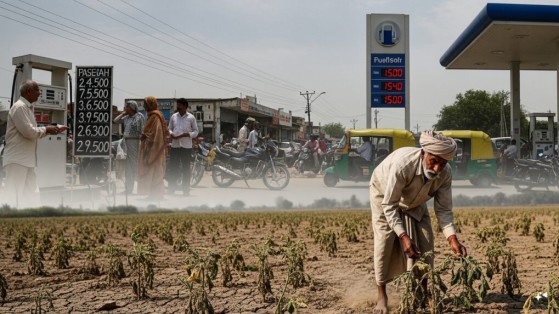
India's economy is being tested on two fronts at once. The first is a weak monsoon, with rainfall about 43 percent below normal and the weather office forecasting a below-normal season, threatening crops, rural incomes, and food prices. The second is energy, where India's heavy reliance on imported oil leaves it exposed to elevated and volatile crude prices. Both are classic supply-side shocks that raise costs without boosting demand, and both feed inflation while dragging on growth. Facing them simultaneously is what makes the current moment particularly challenging for policymakers.
The Growth at Stake
The backdrop is one of genuine strength. India remained the world's fastest-growing major economy in the last fiscal year, expanding at around 7.6 percent with headline inflation near record lows. For the current year, the Reserve Bank projects growth close to 6.9 percent, though it has acknowledged the risks are tilted to the downside. That is the prize now at risk. Economists warn that a sustained oil shock alone could shave several tenths of a percentage point off growth, and a weak monsoon would compound the drag through weaker rural consumption.
The Monsoon Risk
The monsoon remains India's single largest domestic swing factor. With more than half the country's farmland dependent on rain and agriculture employing close to half the workforce, a deficient season hits both output and the incomes of hundreds of millions. Weaker rural demand ripples through sales of everything from consumer goods to vehicles, denting a key engine of growth. The more immediate threat is to food prices, where shortfalls in vegetables, pulses, and edible oils can lift inflation quickly. Early sowing has held up, but July's rains will decide the outcome.
The Energy Cost Risk
Energy is the external mirror of that domestic risk. India imports the overwhelming majority of its crude oil, leaving it acutely sensitive to global prices. The Indian crude basket traded above $100 a barrel earlier in the year as conflict in the Middle East drove up a risk premium, and while a recent easing of tensions has brought some relief, prices remain elevated and volatile by recent standards. Because energy feeds into transport, manufacturing, and farming costs, expensive oil pushes up prices across the economy and squeezes corporate margins in fuel-intensive sectors like aviation.
The Import Bill and Rupee
The clearest channel is the external account. Every $10-per-barrel rise in crude is estimated to add $13 to $14 billion to India's annual import bill and to widen the current account deficit by roughly 0.3 to 0.5 percent of GDP. That extra demand for dollars weakens the rupee, which earlier this year slipped to record lows against the dollar, with some analysts warning of further depreciation. A weaker rupee then makes each subsequent barrel costlier in local terms, creating a self-reinforcing cycle that is hard to break without intervention or slower demand.
The Inflation Squeeze
Inflation is where the two risks combine most dangerously. Food carries heavy weight in India's consumer price index, so a poor monsoon can lift headline inflation on its own, while a 10 percent rise in crude can add a further 20 to 30 basis points to consumer prices and far more to wholesale inflation. The Reserve Bank has projected inflation near 4.6 percent for the year but flagged that risks are tilted upward, citing global fuel and commodity prices, wage spillovers, and currency volatility. Together, food and fuel could push inflation uncomfortably higher.
The RBI's Dilemma
This puts the central bank in a bind. Supply-driven inflation from failed crops or costly oil cannot be cured by raising interest rates, since higher rates do not make food or fuel cheaper. Yet if those price pressures seep into wages and broader expectations, the Reserve Bank may be forced to tighten, restraining investment and consumption just as the rural economy is already strained. Having held its policy rate steady, the bank faces a textbook squeeze: act against inflation and risk growth, or protect growth and risk entrenched inflation. Neither choice is comfortable.
The Cushions and Responses
India is not without defences. Comfortable stocks of rice and wheat, healthy reservoir levels, and a strategic petroleum reserve provide buffers against the worst supply disruptions. The government has diversified crude sourcing, including discounted Russian oil, and is expanding refining capacity, while contingency plans steer farmers toward hardier crops. Strong domestic demand, sustained public capital spending, and a large services sector continue to support growth. Both shocks have also sharpened the case for accelerating India's energy transition and domestic food resilience, turning near-term pressure into longer-term strategy.
The Road Ahead
India's growth story remains fundamentally strong, but the combination of a weak monsoon and rising energy costs is a genuine test of its resilience. The outcome hinges on factors largely outside policymakers' control: whether the monsoon revives in July, and whether oil prices stay contained as Middle East tensions ease. If both break favourably, India can absorb the shock and hold its place as the fastest-growing major economy. If they do not, growth could slow, inflation could harden, and the rupee could weaken further. The next several weeks of rain and crude prices will tell the tale. This is analysis, not investment advice.
Frequently Asked Questions
What are the main risks to India's growth right now?
Two simultaneous supply-side shocks: a weak monsoon, with rainfall about 43 percent below normal, threatening crops and rural demand, and elevated, volatile crude oil prices that raise India's import costs and feed inflation.
How does a weak monsoon affect growth?
It hits crop output and rural incomes, weakening demand for goods and services across the economy, and pushes up food prices, which carry heavy weight in inflation and can dampen consumption further.
Why do energy costs matter so much for India?
India imports the bulk of its crude oil, so every $10-per-barrel rise adds an estimated $13-14 billion to the import bill, widens the current account deficit, weakens the rupee, and raises inflation across fuel-dependent sectors.
How do these risks affect the RBI?
They create a policy dilemma. Supply-driven inflation cannot be fixed by raising rates, but if it spreads to wages and expectations, the RBI may have to tighten, restraining growth at a difficult time. It has held rates steady for now.
What could cushion the impact?
Comfortable food grain stocks, healthy reservoirs, a strategic oil reserve, diversified crude sourcing, strong domestic demand, public capital spending, and a large services sector all provide buffers against the twin shocks.