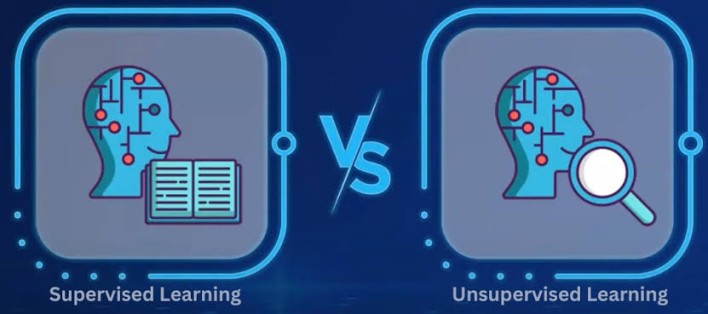
Supervised vs Unsupervised Learning: Understanding the Key Differences
Machine Learning has become a core technology behind modern Artificial Intelligence, enabling systems to learn from data and improve decision-making. Among the most widely used Machine Learning techniques are Supervised Learning and Unsupervised Learning. While both methods analyze data to uncover valuable insights, they differ significantly in how they learn, the type of data they require, and the problems they solve. Understanding these differences helps businesses, developers, and data scientists choose the right approach for specific applications.
What Is Supervised Learning?
Supervised Learning is a Machine Learning approach in which algorithms are trained using labeled data. Each training example includes both the input data and the correct output, allowing the model to learn the relationship between them and make accurate predictions on new data.
How Supervised Learning Works
The model learns by analyzing historical labeled datasets and adjusting its parameters until it can accurately predict outcomes. Once trained, it can classify data or forecast future results with high accuracy.
Common Applications of Supervised Learning
Supervised Learning is widely used in spam email detection, fraud detection, medical diagnosis, credit scoring, image classification, speech recognition, demand forecasting, and recommendation systems.
What Is Unsupervised Learning?
Unsupervised Learning is a Machine Learning technique that analyzes unlabeled data to identify hidden patterns, relationships, or structures without predefined outcomes.
How Unsupervised Learning Works
Instead of learning from labeled examples, the algorithm explores datasets independently to group similar data points, detect anomalies, or discover meaningful relationships that may not be immediately visible.
Common Applications of Unsupervised Learning
Businesses use Unsupervised Learning for customer segmentation, market basket analysis, anomaly detection, recommendation engines, pattern recognition, and data clustering.
Supervised vs Unsupervised Learning: Key Differences
Type of Data
Supervised Learning requires labeled datasets where the expected output is already known. Unsupervised Learning works with unlabeled data and identifies patterns without predefined answers.
Learning Objective
Supervised Learning focuses on prediction and classification tasks, while Unsupervised Learning aims to discover hidden structures, similarities, or clusters within data.
Output
The output of Supervised Learning is a prediction or classification based on learned examples. In contrast, Unsupervised Learning produces clusters, associations, or insights without predetermined labels.
Complexity and Use Cases
Supervised Learning is commonly applied when historical labeled data is available, whereas Unsupervised Learning is ideal for exploratory data analysis and discovering previously unknown relationships.
Benefits and Challenges
Benefits of Supervised Learning
Supervised Learning delivers high prediction accuracy, supports automation, improves decision-making, and is highly effective for classification and forecasting tasks.
Benefits of Unsupervised Learning
Unsupervised Learning helps organizations uncover hidden trends, understand customer behavior, identify anomalies, and generate insights without requiring labeled datasets.
Challenges
Supervised Learning depends on large volumes of accurately labeled data, which can be expensive and time-consuming to prepare. Unsupervised Learning may produce results that require human interpretation and validation before they can be applied effectively.
Future Outlook
As Artificial Intelligence continues to evolve, both Supervised and Unsupervised Learning will remain essential components of Machine Learning. Advances in computing power, data availability, and AI algorithms are expected to improve the accuracy, scalability, and business applications of both approaches. Many modern AI systems increasingly combine multiple learning techniques to solve complex real-world challenges more efficiently.
Conclusion
Supervised Learning and Unsupervised Learning play complementary roles in the field of Machine Learning. Supervised Learning excels at prediction and classification using labeled data, while Unsupervised Learning uncovers hidden patterns within unlabeled datasets. Understanding their differences enables organizations to select the most effective approach for solving business problems, improving operational efficiency, and driving innovation through data-driven decision-making.