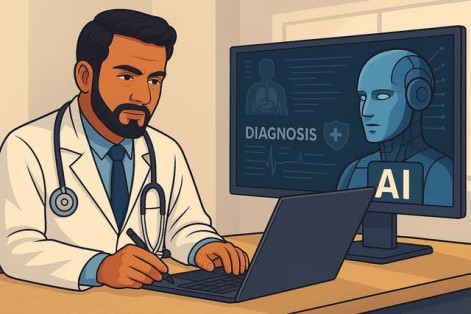
AI for Doctors: How Artificial Intelligence Is Transforming Modern Healthcare
Artificial Intelligence (AI) is rapidly transforming healthcare by helping doctors analyze medical data, improve diagnostic accuracy, reduce administrative workload, and support better patient care. Rather than replacing physicians, AI acts as a clinical support tool that assists with information analysis, documentation, and decision-making while allowing healthcare professionals to focus more on their patients.
From interpreting medical images to summarizing patient records and supporting treatment planning, AI is becoming an increasingly valuable part of modern healthcare.
What Is AI in Healthcare?

AI in healthcare refers to the use of artificial intelligence technologies to assist medical professionals with tasks such as data analysis, disease detection, clinical documentation, workflow automation, and decision support.
AI systems can analyze large volumes of medical information, recognize patterns, and generate insights that help doctors make more informed clinical decisions.
How AI Helps Doctors
AI supports physicians in many areas of medical practice.
1. Diagnostic Support
AI can analyze patient symptoms, laboratory results, and medical histories to highlight possible conditions for further evaluation.
It serves as a decision-support tool rather than making a final diagnosis, which remains the responsibility of qualified healthcare professionals.
2. Medical Imaging Analysis
AI can assist radiologists and other specialists by analyzing:
- X-rays
- CT scans
- MRI scans
- Ultrasound images
- Mammograms
- Retinal images
These systems can help identify patterns that may warrant closer review by a physician.
3. Clinical Documentation
Doctors spend significant time completing medical records.
AI can help by:
- Summarizing clinical notes
- Drafting documentation
- Organizing patient histories
- Transcribing consultations (where permitted)
- Preparing discharge summaries
Healthcare professionals should review all AI-generated documentation for accuracy.
4. Treatment Planning Support
AI can help organize clinical information, summarize medical literature, and identify relevant treatment guidelines to support physician decision-making.
Treatment decisions should always be based on professional medical judgment and the individual patient's condition.
5. Medication Safety
AI systems can assist by identifying potential:
- Drug interactions
- Duplicate medications
- Allergy risks
- Dosage inconsistencies
These alerts help reduce medication-related errors.
6. Predictive Analytics
AI can analyze historical and real-time data to help estimate the likelihood of certain outcomes, such as hospital readmission or disease progression.
These predictions support clinical planning but are not guarantees.
7. Administrative Assistance
AI can automate routine administrative tasks, including:
- Appointment scheduling
- Patient communication
- Insurance documentation
- Billing support
- Report generation
This reduces paperwork and improves workflow efficiency.
8. Medical Research Support
AI helps researchers and clinicians by:
- Searching medical literature
- Summarizing research papers
- Identifying clinical trial information
- Analyzing large biomedical datasets
This accelerates evidence gathering and scientific discovery.
Benefits of AI for Doctors
AI offers several important advantages.
Faster Information Analysis
AI can process large volumes of medical data quickly, helping clinicians review information more efficiently.
Improved Workflow Efficiency
Automation reduces administrative workload, allowing doctors to spend more time with patients.
Decision Support
AI can surface relevant information, clinical guidelines, and potential findings to support medical decision-making.
Enhanced Medical Imaging
AI can help prioritize or highlight imaging findings for further review by specialists.
Better Resource Management
Healthcare organizations can use AI to optimize scheduling, staffing, and operational efficiency.
Challenges of AI in Healthcare
Despite its potential, AI presents important challenges.
Accuracy and Validation
AI-generated recommendations may be incomplete or incorrect and must always be reviewed by qualified healthcare professionals.
Patient Privacy
Healthcare organizations must protect sensitive patient information and comply with applicable privacy laws and regulations.
Bias
AI systems can reflect biases present in training data, potentially affecting performance across different patient populations.
Regulatory Compliance
Medical AI systems often require regulatory oversight, validation, and continuous monitoring before clinical deployment.
Best Practices for Doctors Using AI
Healthcare professionals should follow these recommendations.
Use AI as a Support Tool
AI should complement—not replace—clinical expertise and professional judgment.
Verify AI Outputs
Review AI-generated analyses, documentation, and recommendations before relying on them in patient care.
Protect Patient Data
Use AI systems that follow appropriate privacy, security, and institutional requirements.
Stay Informed
Keep up with advances in AI technologies, medical guidelines, and regulatory developments.
Communicate Clearly with Patients
Explain how AI is being used when appropriate and ensure patients understand that healthcare decisions remain under physician oversight.
Common Applications of AI in Healthcare
AI is increasingly used for:
- Medical imaging analysis
- Clinical documentation
- Virtual health assistants
- Predictive analytics
- Drug discovery
- Remote patient monitoring
- Hospital workflow optimization
- Precision medicine
- Clinical decision support
- Medical research
Future of AI in Healthcare
Artificial Intelligence is expected to play an even larger role in healthcare through personalized medicine, robotic-assisted surgery, advanced diagnostic tools, predictive disease modeling, remote monitoring, digital pathology, and AI-assisted drug discovery. Future healthcare systems are likely to combine AI with wearable devices, genomics, and telemedicine to deliver more personalized, preventive, and data-driven care while maintaining the central role of healthcare professionals.
Conclusion
Artificial Intelligence is transforming healthcare by helping doctors analyze medical information, improve workflow efficiency, support diagnosis, enhance medical imaging, and reduce administrative burdens. While AI provides valuable clinical support, it is not a substitute for medical expertise, patient communication, or professional judgment. When implemented responsibly, AI can help doctors deliver more efficient, informed, and patient-centered healthcare.