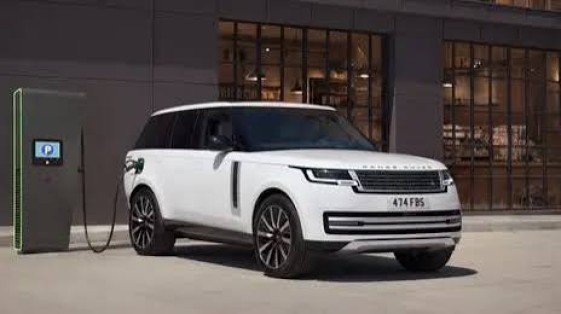
Range Rover Electric Opens for Bookings in India With Up to 600-Km WLTP Driving Range
JLR has opened bookings for the Range Rover Electric in India, bringing battery-electric propulsion to its flagship luxury SUV for the first time as the company expands its premium electric-vehicle portfolio in one of its key growth markets.
The Range Rover Electric combines the familiar design, luxury positioning and all-terrain capabilities of the flagship SUV with a dual-motor electric powertrain producing up to:
405 kW, or approximately 550 PS,
and:
850 Nm of torque.
At the centre of the electric SUV is a large:
118.5-kWh usable lithium-ion battery
built around an 800-volt electrical architecture.
JLR claims a maximum driving range of:
up to 600 kilometres on the WLTP cycle,
along with an estimated real-world range of up to:
535 kilometres.
The vehicle also supports DC fast charging at up to 350 kW, allowing the battery to charge from 10% to 80% in approximately 22 minutes under suitable conditions.
The Range Rover Electric will arrive in India as a fully imported model, with pricing to be announced separately.
Range Rover Electric Bookings Open in India

Indian customers can now place orders for the first fully electric Range Rover.
The order book includes several configurations across standard- and long-wheelbase body styles.
For India, customers can book the standard-wheelbase:
Autobiography
and:
First Edition.
The long-wheelbase range includes:
SV,
SV Ultra,
and:
SV Black.
This gives JLR the ability to target different sections of India's ultra-luxury SUV market while retaining the high degree of specification and personalisation traditionally associated with Range Rover.
Booking Amount Set at ₹10 Lakh
Customers in India can reserve the Range Rover Electric with a booking amount of:
₹10 lakh.
The opening of bookings marks the beginning of the model's commercial introduction in the country.
JLR has not yet announced final India pricing.
Because the vehicle will initially arrive as a completely built-up import, it will sit at the upper end of India's premium electric-vehicle market.
Its positioning will therefore focus less on mass-market EV economics and more on:
luxury,
performance,
technology,
refinement,
and all-terrain capability.
First Fully Electric Range Rover Marks Major Milestone
The Range Rover Electric represents a major change for one of the world's most recognisable luxury SUV nameplates.
Range Rover has historically relied on:
petrol engines,
diesel engines,
mild hybrids,
and plug-in hybrid powertrains.
The new model introduces a completely battery-electric drivetrain while attempting to retain the attributes that define the brand.
JLR describes the development philosophy as creating:
a Range Rover first and an electric vehicle second.
That approach is visible in the vehicle's design.
Rather than creating a radically different electric model, JLR has retained the familiar Range Rover silhouette while making aerodynamic and engineering changes to improve efficiency.
118.5-kWh Battery Powers Range Rover Electric
The Range Rover Electric uses a:
118.5-kWh usable lithium-ion battery.
The double-stacked battery contains:
344 prismatic cells.
Its architecture is designed to maximise energy density while packaging a very large battery within the Range Rover platform.
Battery capacity is especially important for a vehicle of this size.
Large luxury SUVs require significant energy because of their:
weight,
frontal area,
performance,
climate-control requirements,
and all-wheel-drive systems.
JLR has therefore equipped the model with one of the larger batteries currently available in a production luxury EV.
Range Rover Electric Offers Up to 600-Km WLTP Range
The headline driving-range figure is:
up to 600 kilometres on the WLTP cycle.
JLR also estimates a real-world driving range of approximately:
535 kilometres.
Actual range will vary according to:
driving speed,
weather,
temperature,
wheel specification,
terrain,
traffic,
and climate-control use.
Nevertheless, a real-world estimate above 500 kilometres addresses one of the most important concerns for buyers considering a large luxury electric SUV.
Long Range Is Particularly Important in India
Range becomes especially relevant for premium EV adoption in India because high-speed public charging infrastructure remains unevenly distributed.
Owners in major metropolitan regions may have access to extensive charging options.
Long-distance travel can still require greater planning.
A vehicle capable of covering several hundred kilometres between charging stops can reduce that dependence.
For luxury customers who frequently travel between major cities or use their vehicles for longer leisure journeys, battery range can become an important purchase consideration.
800-Volt Architecture Enables Rapid Charging
The Range Rover Electric uses an:
800-volt electrical architecture.
Higher-voltage systems can support faster charging while managing electrical current more efficiently.
This architecture is increasingly becoming a feature of high-performance and premium electric vehicles.
The Range Rover Electric can accept DC charging at rates of up to:
350 kW.
When connected to a compatible high-power charger, JLR says the battery can charge from:
10% to 80% in approximately 22 minutes.
Ten-Minute Charge Can Add Up to 220 Km
JLR also claims that a:
10-minute charging session
at the vehicle's maximum supported rate can add approximately:
220 kilometres of WLTP range.
That level of charging performance is designed to make long-distance travel more practical.
Instead of waiting for a complete recharge, drivers can add substantial range during a relatively short stop.
However, achieving the maximum charging speed requires compatible high-power charging infrastructure.
The availability of 350-kW public chargers will therefore influence how frequently Indian customers can experience the vehicle's maximum charging capability.
Dual Electric Motors Deliver 405 kW
The Range Rover Electric uses two permanent-magnet electric motors.
Each motor is rated at:
260 kW.
Combined system output is electronically managed at approximately:
405 kW, or around 550 PS.
Peak torque reaches:
850 Nm.
Electric motors can deliver torque almost immediately, giving large EVs rapid acceleration despite their considerable weight.
JLR has calibrated the system to deliver performance comparable with the V8-powered Range Rover experience while adding the smoothness and near-silent operation associated with electric propulsion.
Range Rover Electric Accelerates to 100 Km/h in 4.5 Seconds
The standard-wheelbase Range Rover Electric can accelerate from:
0 to 100 km/h in approximately 4.5 seconds.
The long-wheelbase version requires approximately:
4.7 seconds.
Those figures place the vehicle firmly within performance-SUV territory.
The electric drivetrain also allows rapid overtaking acceleration.
JLR claims the standard-wheelbase version can accelerate from:
80 km/h to 120 km/h in approximately 2.7 seconds.
Top speed is rated at approximately:
200 km/h.
Electric Powertrain Designed for Greater Refinement
Performance is only one part of the Range Rover proposition.
Refinement has historically been central to the brand.
Electric propulsion can strengthen this characteristic because the drivetrain eliminates:
engine vibration,
gear changes,
and much of the mechanical noise associated with combustion engines.
That creates a quieter cabin.
For an ultra-luxury SUV, reduced noise can become a significant advantage.
JLR has therefore positioned electrification as a way of enhancing Range Rover's traditional refinement rather than simply reducing tailpipe emissions.
Range Rover Retains All-Wheel-Drive Capability
Electrification has not eliminated the vehicle's traditional focus on off-road performance.
The dual-motor layout provides electric all-wheel drive.
JLR has developed new control systems capable of managing torque significantly faster than a conventional mechanical drivetrain.
The Range Rover Electric uses:
Integrated Traction Management
and:
Intelligent Driveline Dynamics.
These systems coordinate motor output and traction across different surfaces.
Traction System Responds in 50 Milliseconds
JLR says Integrated Traction Management can respond within:
50 milliseconds.
According to the company, this is up to:
100 times faster
than the equivalent response of a combustion-engine system.
Electric motors provide extremely precise torque control.
Rather than waiting for an engine, gearbox and mechanical driveline to respond, software can adjust motor output almost instantaneously.
This can improve traction on:
mud,
sand,
snow,
rocks,
and slippery surfaces.
Intelligent Driveline Dynamics Manages Rear Torque
The Intelligent Driveline Dynamics system can vary rear torque distribution from:
100% to zero
depending on traction requirements.
This gives the vehicle greater flexibility in managing wheel slip.
Precise motor control is one of the areas where electrification can potentially improve off-road performance.
Traditional four-wheel-drive systems rely heavily on:
differentials,
brakes,
gearboxes,
and mechanical torque distribution.
Electric drivetrains can increasingly manage many of these functions through software.
Range Rover Electric Can Wade Through 900 Mm of Water
The electric Range Rover retains an impressive maximum wading depth of:
900 mm.
Maintaining this capability required extensive waterproofing and engineering around:
the battery,
electric motors,
high-voltage components,
and electrical connections.
The figure demonstrates JLR's intention to ensure the electric version remains capable of tackling demanding terrain.
For most owners, such capability may rarely be required.
However, it remains an important part of Range Rover's brand identity.
Single-Pedal Driving Works Off-Road
The Range Rover Electric also introduces single-pedal driving.
The system allows drivers to control acceleration and much of the vehicle's deceleration using the accelerator pedal.
Regenerative braking slows the vehicle when the driver lifts off.
JLR has adapted the technology for off-road use.
The company says the vehicle can pull away on steep inclines and use single-pedal control while tackling difficult terrain.
Electric Range Rover Can Climb 45-Degree Slopes
JLR says the Range Rover Electric can complete rolling climbs on slopes of up to:
45 degrees.
The electric drivetrain's precise low-speed torque control can be particularly valuable during steep off-road driving.
Combustion vehicles need to coordinate:
engine speed,
gear selection,
braking,
and throttle.
An electric motor can deliver carefully controlled torque from extremely low speeds.
This characteristic makes EV technology potentially well suited to demanding off-road environments.
Lower Centre of Gravity Could Improve Handling
The battery is positioned low within the vehicle.
This helps reduce the Range Rover Electric's centre of gravity.
A lower centre of gravity can improve:
cornering stability,
body control,
and overall handling.
Large SUVs naturally have high body structures.
Positioning substantial battery mass beneath the passenger compartment can therefore partially offset some of the handling challenges associated with vehicle height.
The Range Rover Electric also uses twin-chamber air suspension to balance ride comfort and control.
Range Rover Electric Underwent Extensive Testing
JLR says the electric SUV completed physical testing equivalent to approximately:
38 journeys around the world.
Engineers also carried out more than:
250,000 hours of virtual testing.
The programme was more extensive than that undertaken for any previous Range Rover.
Testing electric vehicles requires validation across a wide range of conditions.
Battery performance can be affected by:
extreme heat,
extreme cold,
high-speed driving,
charging patterns,
terrain,
and sustained heavy loads.
Development Covered Extreme Climates
Range Rover Electric prototypes have been tested in environments ranging from frozen Arctic conditions to extremely hot desert climates.
This is particularly important for India.
Vehicles sold in the country may encounter:
high summer temperatures,
monsoon conditions,
mountain roads,
urban congestion,
and significant variations in road quality.
Thermal management becomes especially important for large EV batteries in hot environments.
The battery must remain within an appropriate temperature range during both driving and fast charging.
ThermAssist Technology Manages Battery and Cabin Heat
The Range Rover Electric introduces JLR's:
ThermAssist
heat-management technology.
Thermal management is a critical component of modern electric vehicles.
The system must regulate temperatures across:
the battery,
electric motors,
power electronics,
and passenger cabin.
Efficient heat management can improve:
range,
charging performance,
battery durability,
and passenger comfort.
JLR's work in this area is among the technologies for which the new electric Range Rover has generated patent applications.
Around 300 Patent Applications Filed
JLR expects the Range Rover Electric to become the most patented Range Rover developed so far.
Approximately:
300 patent applications
have been filed around technologies associated with the vehicle.
These cover areas including:
thermal management,
electric propulsion,
battery systems,
and vehicle-control technology.
The scale of intellectual-property development illustrates the engineering effort required to electrify an existing ultra-luxury vehicle without compromising its traditional capabilities.
Battery and Motors Designed by Range Rover
JLR has developed significant parts of the electric powertrain internally.
The battery and electric motors have been designed by Range Rover and are manufactured at JLR's:
Electric Propulsion Manufacturing Centre in the UK.
Greater control over key electric-vehicle components can provide several strategic advantages.
It allows the company to optimise:
performance,
software,
packaging,
thermal management,
and vehicle integration
around the specific requirements of its products.
Range Rover Electric Will Be Built at Solihull
The electric Range Rover will be manufactured at JLR's historic:
Solihull facility in the United Kingdom.
Range Rover production has been associated with Solihull since 1970.
The electric model will share a flexible vehicle architecture with other Range Rover powertrains.
This allows JLR to manufacture:
internal-combustion,
mild-hybrid,
plug-in hybrid,
and battery-electric
versions using related production infrastructure.
Flexible Propulsion Strategy Reduces Transition Risk
JLR's approach differs from manufacturers moving immediately toward EV-only vehicle architectures across their entire product range.
Range Rover customers will continue to have multiple propulsion choices.
This gives the company flexibility as electric-vehicle adoption develops at different speeds across global markets.
India is a good example.
Premium EV adoption is growing, but combustion-engine and hybrid luxury vehicles continue to represent a significant share of demand.
A flexible strategy allows JLR to respond to changing customer preferences.
First Edition Gets Curated Specification
The Range Rover Electric First Edition receives a specially curated specification.
Customers can choose from exterior colours including:
Belgravia Green,
Santorini Black,
and:
Varesine Blue.
The cabin introduces materials including:
Light Cloud Ultrafabrics
and:
Kvadrat textiles.
The First Edition provides JLR with a high-specification launch model aimed at early adopters seeking exclusivity alongside the new electric drivetrain.
Bespoke Programme Offers Further Personalisation
Range Rover's Bespoke commissioning service will also support the electric model.
Customers can personalise areas including:
paint colours,
materials,
interior combinations,
finishes,
and embroidery.
Personalisation has become an increasingly important source of revenue for ultra-luxury carmakers.
High-net-worth customers frequently spend substantially beyond the vehicle's base price to create individual specifications.
The Range Rover Electric allows JLR to extend that business model into its electric portfolio.
India Pricing Yet to Be Announced
JLR has not yet disclosed the final India price for the Range Rover Electric.
The vehicle will be imported as a completely built unit.
That means import duties and other taxes will contribute significantly to its final retail positioning.
In the UK, the Range Rover Electric starts from approximately:
£154,070 on the road.
Direct conversion of overseas pricing does not provide an accurate estimate of the final Indian price because of differences in:
taxes,
duties,
specifications,
and market positioning.
Luxury EV Market in India Is Expanding
The Range Rover Electric enters an Indian luxury-EV market that has expanded considerably.
Premium manufacturers now offer electric vehicles across:
sedans,
SUVs,
performance cars,
and luxury flagships.
High-income customers are increasingly willing to consider electric vehicles when they offer:
long range,
fast charging,
premium interiors,
strong performance,
and brand appeal.
For this customer segment, the EV decision is increasingly becoming about product experience rather than simply running costs.
Range Rover Brings Different Proposition to Luxury EV Market
Range Rover's advantage is its distinctive combination of:
luxury,
road presence,
off-road capability,
and brand heritage.
Many premium EVs focus heavily on:
aerodynamics,
technology,
and on-road efficiency.
The Range Rover Electric is attempting to maintain serious all-terrain capability alongside those attributes.
That could appeal to existing Range Rover customers who want to move into an EV without fundamentally changing the type of vehicle they drive.
Long Range Could Address Premium EV Anxiety
Driving range remains one of the most closely watched EV specifications in India.
The Range Rover Electric's maximum WLTP figure of approximately:
600 km
places it among the longer-range luxury electric SUVs.
Its estimated real-world figure of up to 535 km could make many intercity journeys possible without intermediate charging.
However, actual performance will depend heavily on driving conditions.
High speeds, extreme temperatures and aggressive acceleration can materially reduce EV range.
Charging Infrastructure Remains Critical
A 350-kW charging capability is technologically impressive, but charging speed ultimately depends on the charger available.
India's public charging network is expanding rapidly, but ultra-high-power chargers remain much less common than lower-capacity DC charging stations.
Range Rover Electric owners may therefore use a combination of:
home charging,
destination charging,
and public DC fast charging.
Premium hotels, luxury retail destinations and major highway corridors could become increasingly important parts of the charging ecosystem for high-end EV owners.
Range Rover Electric Signals JLR's Broader Transformation
The model is strategically important beyond its immediate sales potential.
Range Rover is one of JLR's most valuable global brands.
Electrifying its flagship model demonstrates how the company intends to transition its highest-value products into the battery-electric era.
The challenge is to preserve the characteristics customers associate with Range Rover while changing one of the vehicle's most fundamental components:
its powertrain.
The Electric represents the first major test of that strategy.
Conclusion
The opening of Range Rover Electric bookings in India marks a significant milestone for JLR as its flagship luxury SUV enters the battery-electric era without abandoning the performance, refinement and all-terrain capability associated with the Range Rover name.
The electric SUV combines a 118.5-kWh usable battery with an 800-volt architecture, delivering up to 600 km of WLTP range and an estimated real-world range of up to 535 km.
Its dual-motor all-wheel-drive system produces approximately 405 kW and 850 Nm, enabling 0-100 km/h acceleration in as little as 4.5 seconds.
Support for 350-kW DC charging allows a 10-80% recharge in approximately 22 minutes under suitable conditions, while JLR says a 10-minute charge can add up to 220 km of WLTP range.
Importantly, electrification has not removed the vehicle's traditional off-road focus. The Range Rover Electric retains up to 900 mm of wading capability, sophisticated traction management and the ability to tackle slopes of up to 45 degrees.
Bookings are now open in India, including for Autobiography, First Edition and long-wheelbase SV derivatives, while final pricing remains to be announced.
For JLR, the Range Rover Electric is more than another luxury EV launch. It represents an attempt to demonstrate that one of the world's most established luxury SUV identities can transition to electric propulsion without sacrificing the characteristics that created that identity in the first place.