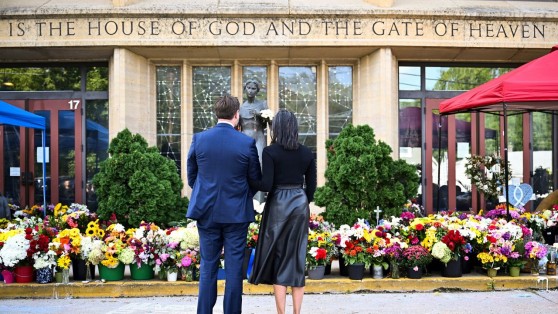
Vice President JD Vance, accompanied by the Second Lady, made a solemn visit to Minneapolis in the aftermath of the tragic school shooting that has left the city and the nation in mourning. The visit, marked by somber reflection and quiet tributes, highlighted the administration’s commitment to standing with victims’ families, survivors, and the broader community as they begin the long process of healing. Against the backdrop of ongoing media coverage and an outpouring of national grief, Vance’s presence underscored the federal government’s role not only in policy response but also in offering solidarity during moments of immense loss.
The Vice President and Second Lady arrived at the school grounds under heightened security, where they laid flowers at a growing memorial of candles, handwritten notes, and photographs of the young victims. The silence was heavy as community members, parents, and students gathered to witness the tribute. Vance paused before addressing the press, ensuring that the emphasis of the visit remained on honoring those who lost their lives and recognizing the resilience of survivors and their families. The Second Lady, who has long been involved in education and child welfare advocacy, was seen consoling grieving parents and speaking quietly with children who survived the attack.
In his brief remarks, Vance described the tragedy as “a wound on the soul of the nation” and pledged that the administration would work tirelessly to ensure schools become safe spaces once again. He noted the bravery of teachers, first responders, and law enforcement officers who acted swiftly during the crisis, emphasizing that their actions saved lives even in the face of horror. His words resonated with many who have been searching for both comfort and accountability in the aftermath of the shooting.
The Minneapolis community has been struggling to come to terms with the devastating incident, which unfolded in a matter of minutes but left a lasting impact on countless lives. Families of victims are grappling with unimaginable grief, while survivors face emotional scars that may linger for years. Vigils and memorial services have sprung up across the city, uniting people in mourning but also sparking conversations about school safety, mental health, and the broader issue of gun violence in the United States.
Vance’s visit comes at a time when national attention remains sharply focused on the Minneapolis tragedy, with news outlets continuing to provide round-the-clock coverage. This has amplified public pressure on lawmakers to deliver meaningful solutions to the recurring problem of school shootings. While political debates often diverge on the specifics of gun reform, mental health investment, and law enforcement protocols, the Vice President stressed the importance of bipartisan cooperation in finding answers. “This is not about politics,” he said. “This is about protecting our children, our teachers, and the future of our communities.”
For the families directly affected, the Vice President’s presence provided a sense of acknowledgment from the highest levels of government. Many parents have expressed frustration in the past that such tragedies often fade from the national spotlight without meaningful follow-up. By visiting the site and engaging directly with families, Vance sought to assure the community that their pain will not be forgotten. The Second Lady’s empathetic approach also resonated, with several parents later commenting that her quiet listening and gentle reassurances carried a profound weight during such a difficult moment.
The visit also highlighted the role of schools as more than just places of learning—they are community hubs where children grow, build friendships, and feel secure. The violation of that sense of security through violence leaves not just physical but psychological scars. Educators in Minneapolis have spoken out about the urgent need for resources to support trauma counseling, strengthen security measures, and provide platforms for students to process their grief. Vance echoed these concerns, noting that “healing does not happen overnight” and that long-term support will be essential.
Beyond Minneapolis, the tragedy has reignited nationwide conversations about America’s struggle with gun violence. Advocates for reform argue that without significant legislative change, such visits, though meaningful, will not prevent future tragedies. Opponents of stricter gun laws emphasize the need for enhanced school security and mental health interventions. As the debate continues, communities across the country are watching closely to see whether the Minneapolis tragedy becomes a catalyst for meaningful action.
For now, however, the focus remains on mourning the lives lost and supporting those left behind. The Vice President’s visit, while symbolic, carried a weight that transcended political lines. It was a reminder that the highest offices of government can and should stand with citizens during their darkest hours. As Minneapolis moves forward, the words and gestures offered by JD Vance and the Second Lady may provide a measure of comfort, even as the road to healing remains long and uncertain.