Jawaharlal Nehru's Legacy in Water Diplomacy: The Indus Waters Treaty and Its Long-Term Impact
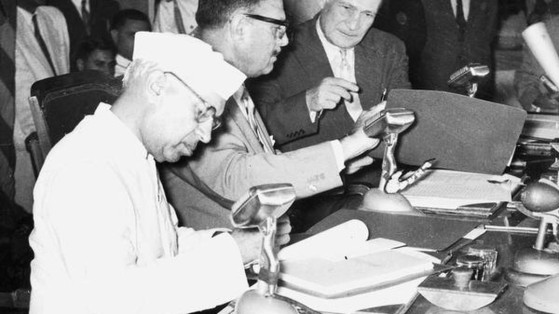
In 1960, the Indus Waters Treaty (IWT) was signed by Jawaharlal Nehru, India’s first Prime Minister, and Ayub Khan, the President of Pakistan. This landmark agreement, which governs the distribution of the waters of the Indus River system, has proven to be one of the most significant diplomatic achievements in South Asia. Nehru’s approach to this treaty exemplifies his visionary leadership in managing regional disputes through cooperation, compromise, and diplomacy. The treaty, while marking a moment of peace, has had a profound long-term impact on the Indo-Pakistani relationship, shaping the discourse on water diplomacy and regional cooperation for generations.
Nehru's Approach to Diplomacy and the Need for the Treaty
In the aftermath of Partition in 1947, the division of India and Pakistan created substantial conflicts over shared resources, particularly the waters of the Indus River system, which flows from the Indian territories into Pakistan. By the early 1950s, both countries had begun to recognize that unilateral control over such a crucial resource could lead to instability and potential conflict. Nehru, understanding the importance of peace in an already volatile subcontinent, pushed for a cooperative solution, seeking to ensure that both nations had fair access to water resources.
At the time, India and Pakistan were on the brink of war over issues like Kashmir and refugee crises, yet Nehru understood that water was an issue that could not afford to escalate into another conflict. The Indus Waters Treaty thus became an instrument of diplomacy, where India’s commitment to peace and Pakistan’s need for water were balanced. Nehru saw this as an opportunity not just for conflict resolution, but also to establish a diplomatic framework for future cooperation.
The Decision-Making Process Behind the Treaty
Nehru’s decision-making process for the Indus Waters Treaty reflected his diplomatic skill and his focus on the long-term vision. He was determined to find a solution that avoided further bloodshed and instead emphasized peaceful cooperation. The treaty was backed by technical experts and international mediation—chiefly from the World Bank—which provided a neutral platform for negotiations between India and Pakistan. While Nehru faced immense pressure from within India to take a hard stance on water control, he instead chose to move forward with compromise, providing Pakistan with access to the western rivers of the Indus system.
This pragmatic decision was a testament to Nehru’s belief in cooperative security—that even amid historical conflicts, nations could find pathways to peaceful coexistence. His ability to keep the larger picture in mind, placing greater emphasis on regional stability than on short-term national interests, set the tone for the treaty’s eventual success.
The Treaty’s Long-Term Impact on Indo-Pakistani Relations
While the Indus Waters Treaty has been hailed as a success in terms of peaceful cooperation, it has not been without its challenges. Over the decades, both India and Pakistan have had moments of tension, with India sometimes accused of restricting water flow during conflicts, and Pakistan blaming India for violating the terms of the agreement. Despite these challenges, the treaty has stood as a diplomatic cornerstone in Indo-Pakistani relations, largely preventing water-related warfare and allowing both countries to continue working within its framework.
The 1965 Indo-Pakistani War and the 1971 conflict tested the treaty’s resilience, but Nehru’s foresight in creating a neutral system of water management has allowed it to survive through periods of deep political and military tension. As a result, the Indus Waters Treaty became one of the few areas where India and Pakistan managed to engage in meaningful cooperation, even amid their rivalry.
Moreover, Nehru’s legacy is evident in the way the treaty continues to serve as a model for water-sharing agreements worldwide. The treaty remains one of the few instances where international mediation, technical cooperation, and long-term diplomacy have successfully resolved a contentious issue over a shared natural resource.
Challenges and Controversies: The Treaty’s Future
Despite Nehru’s visionary leadership, the treaty has faced ongoing challenges. India’s growing population, environmental concerns, and changing geopolitical dynamics have put pressure on the Indus River system, which provides water to millions in both India and Pakistan. In recent years, India’s suspension of the Indus Waters Treaty has been discussed as part of the larger context of Indo-Pakistani tensions, especially following cross-border terrorism incidents.
Nehru’s legacy in water diplomacy, however, lies in his belief that cooperation is always preferable to conflict. Even in today’s volatile geopolitical climate, the treaty remains a testament to his commitment to peaceful conflict resolution and his understanding of the vital importance of shared resources.
Conclusion: A Visionary’s Lasting Legacy
Jawaharlal Nehru’s handling of the Indus Waters Treaty highlights his ability to think beyond immediate political and military pressures and look toward a future of regional stability. His decision to prioritize diplomacy and compromise over unilateral action created a framework that has allowed India and Pakistan to manage one of the most sensitive issues in their relationship for over six decades. Nehru’s legacy in water diplomacy continues to serve as a guiding principle for both nations, as well as a model for the world.
Through the Indus Waters Treaty, Nehru not only demonstrated his commitment to peace but also left a powerful imprint on South Asian diplomacy that continues to shape the political landscape of the region to this day.