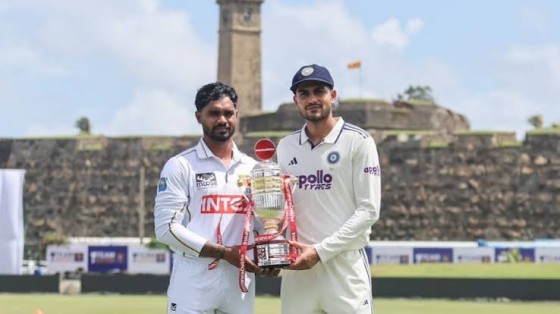
India–Sri Lanka Test Series Begins With Opening Match at Galle
India and Sri Lanka have begun their two-match Test series at the Galle International Stadium on Saturday, August 15, with both teams seeking valuable World Test Championship points. India captain Shubman Gill won the toss and elected to bat first in conditions expected to increasingly favour spin as the match progresses. The opening contest is also a landmark occasion for Indian cricket, marking India's 600th Test match, while Galle is hosting its 50th Test.
India Begins Galle Test With Batting Advantage

India made a positive start after choosing to bat first, attempting to establish a substantial first-innings total before conditions become more challenging later in the match.
Shubman Gill Elects to Bat First
Captain Shubman Gill chose to bat after winning the toss, reflecting the importance of first-innings runs at Galle.
The venue has traditionally developed into a demanding surface for batters as Test matches progress, with spin often becoming increasingly influential.
India therefore entered the opening day looking to maximise relatively favourable early batting conditions.
Yashasvi Jaiswal and KL Rahul provided the visitors with a productive start before a running mix-up resulted in Jaiswal being dismissed for 32.
Rahul then combined with Devdutt Padikkal to rebuild the innings and put India in a strong position.
The partnership allowed India to maintain control despite losing an established opener during the morning session.
Rahul and Padikkal Put India in Control
KL Rahul and Devdutt Padikkal produced an assured partnership as India strengthened its first-innings position.
Both batters reached half-centuries and negotiated Sri Lanka's combination of pace and spin effectively.
India advanced to 197 for one by tea, giving the visitors a commanding platform on the opening day.
Rahul's experience provided stability while Padikkal demonstrated confidence against the Sri Lankan attack.
Their partnership was particularly important because establishing a large first-innings total can significantly influence Test matches at Galle.
As the pitch deteriorates, batting against spin can become increasingly difficult, making early runs particularly valuable.
India Plays Landmark 600th Test Match
The opening Test carries additional historical significance for Indian cricket.
India Reaches Major Test Cricket Milestone
The Galle match represents India's 600th appearance in Test cricket.
India played its first Test against England at Lord's in 1932 and has since developed into one of the most influential teams in international cricket.
The milestone reflects the country's long evolution in the format.
India has progressed from an emerging Test nation into a team capable of competing consistently both at home and overseas.
Its cricket economy has also transformed dramatically, with India now occupying a central position in the commercial structure of the international game.
Playing the 600th Test against another major Asian cricket nation adds further significance to the occasion.
Galle Also Celebrates Its 50th Test
The match is simultaneously the 50th Test staged at the Galle International Stadium.
Galle has developed a distinctive identity within international cricket because of its coastal setting and spin-friendly conditions.
The ground has hosted several memorable performances and remains one of Sri Lanka's most important Test venues.
Its playing surface frequently creates matches in which spinners become increasingly influential from the middle stages onward.
Reaching the 50-Test milestone reinforces Galle's importance within Sri Lankan cricket.
The combination of India's 600th Test and Galle's 50th creates an unusual double milestone for the opening match of the series.
World Test Championship Points Raise the Stakes
The two-match series forms part of the World Test Championship, making the results important beyond the immediate bilateral contest.
Both Teams Need Strong Series Results
India and Sri Lanka entered the series needing victories to strengthen their positions in the World Test Championship standings.
A short two-match series leaves relatively little margin for error.
A defeat in the opening Test can place substantial pressure on the losing team because only one match remains to recover.
This increases the strategic importance of the Galle encounter.
Both teams must balance the need to pursue victory with the risks associated with aggressive Test cricket.
For India, winning overseas Test matches remains particularly valuable because conditions in Sri Lanka differ significantly from those encountered at home.
Sri Lanka, meanwhile, will view home conditions as an opportunity to collect crucial championship points.
A 2–0 Result Could Significantly Improve Prospects
The structure of the World Test Championship rewards teams for accumulating a strong percentage of available points across their scheduled series.
Both India and Sri Lanka therefore have substantial incentives to pursue a decisive series victory.
A 2–0 result would significantly strengthen the winning team's campaign.
The situation also increases the importance of weather.
Rain interruptions can reduce the amount of time available to force a result, particularly in conditions where teams may otherwise expect spin to produce opportunities later in the match.
With showers affecting the opening day in Galle, both teams must manage time carefully if further interruptions occur.
India's Team Selection Focuses Heavily on Spin
India has selected an attack designed specifically for Sri Lankan conditions.
Three Left-Arm Spinners Feature in India's XI
India entered the opening Test with Ravindra Jadeja, Kuldeep Yadav and Manav Suthar forming its spin attack.
The selection gives captain Shubman Gill multiple options as the pitch begins to offer greater assistance to slow bowling.
Jadeja brings extensive experience as both a frontline spinner and lower-order batter.
Kuldeep provides wrist-spin variation capable of challenging batters even when conditions are relatively good for batting.
Suthar adds another left-arm spin option and gives India considerable depth in a department likely to become increasingly important as the match progresses.
The selection indicates India's expectation that spin will play a decisive role at Galle.
Siraj and Prasidh Lead the Pace Attack
Mohammed Siraj and Prasidh Krishna were selected as India's two specialist fast bowlers.
Their role is likely to be particularly important with the new ball and during periods when weather creates additional assistance for seam movement.
Fast bowlers can also play an important role on abrasive surfaces by using reverse swing later in the innings.
India's combination of two seamers and three frontline spin options gives Gill considerable flexibility.
The balance allows the captain to adjust according to pitch behaviour, weather and the match situation.
India will hope its bowlers can exploit the surface effectively after the batting unit establishes a competitive first-innings total.
India Enters Series Without Jasprit Bumrah
The visitors are competing in Sri Lanka without several players who might otherwise have featured prominently.
Bumrah's Absence Changes India's Bowling Structure
Jasprit Bumrah is unavailable for the series because of injury, removing India's most experienced fast-bowling match-winner from the attack.
His absence increases responsibility on Siraj and Prasidh.
However, Sri Lankan conditions potentially reduce some of the impact because spin is expected to play a major role across the series.
India's depth will nevertheless be tested.
Overseas Test series frequently require bowlers to adapt quickly to unfamiliar conditions, and Gill will need to manage his attack carefully.
The absence of Bumrah also creates opportunities for other bowlers to establish themselves within India's evolving Test setup.
Sai Sudharsan Also Misses the Series
Sai Sudharsan was also ruled out, with Sarfaraz Khan joining India's squad as his replacement.
Squad changes have created opportunities for India's wider group of batters.
Padikkal's strong start in Galle illustrates the value of India's batting depth.
India's Test side is undergoing a gradual transition, making performances from younger and less-established players increasingly important.
Success in challenging overseas conditions can significantly strengthen a player's position within the long-term Test setup.
The Sri Lanka series therefore carries importance both for India's World Test Championship campaign and for the development of its next generation of Test players.
Sri Lanka Relies on Home Conditions
Sri Lanka enters the series with the advantage of familiarity with Galle and the characteristics of Test cricket on the island.
Spin Attack Expected to Become Increasingly Important
Sri Lanka's bowlers will expect conditions to provide greater assistance as the Test progresses.
The home side included multiple spin options and handed a Test debut to off-spinner Keshara Nuwantha.
Playing against India's experienced batters presents a demanding introduction to Test cricket.
India traditionally produces players comfortable against spin, meaning Sri Lanka's slow bowlers must combine accuracy with variation rather than relying entirely on the pitch.
If the surface begins deteriorating, however, Sri Lanka's spinners could become significantly more dangerous.
The hosts' immediate objective will be preventing India from building an imposing first-innings total.
Dhananjaya de Silva Leads Sri Lanka
Sri Lanka is captained by Dhananjaya de Silva, with Kamindu Mendis serving as vice-captain.
The hosts will rely heavily on their experienced batters to respond effectively when their first innings begins.
Home advantage remains important in Test cricket because players are familiar with local surfaces, weather and match rhythms.
Sri Lanka has historically been particularly competitive at Galle.
India therefore faces a substantial challenge despite its positive start.
The home side's ability to recover from India's strong opening day will depend heavily on creating breakthroughs before the visitors convert their promising position into a match-defining first-innings score.
Galle Conditions Could Shape the Entire Test
Few Test venues are as closely associated with spin bowling as Galle.
Pitch Usually Becomes Harder for Batters
Galle surfaces can provide reasonable batting conditions early before becoming increasingly challenging.
As the pitch wears, footmarks and surface deterioration can create additional turn and unpredictable bounce.
This makes first-innings totals especially important.
Teams batting first generally attempt to build enough runs to place pressure on opponents before conditions deteriorate significantly.
India's decision to bat therefore followed conventional strategic logic for the venue.
The challenge will be converting a strong start into a sufficiently large total.
Losing several wickets quickly could bring Sri Lanka back into the contest before the pitch becomes significantly more difficult.
Rain Could Complicate Match Strategy
Weather has already affected the opening day, with rain delaying the resumption after lunch.
Further interruptions could influence how aggressively both teams approach their innings.
Lost playing time can make forcing a result more difficult, particularly if substantial portions of multiple days are affected.
Captains may therefore need to adjust declarations, scoring rates and bowling strategies depending on the weather.
Rain can also change pitch behaviour by introducing moisture and altering the balance between pace and spin.
Both teams will need to adapt quickly as conditions evolve throughout the five-day contest.
Two-Test Series Moves to Colombo After Galle
The opening match begins a compact series that will conclude later this month.
Second Test Will Be Played at SSC
After the Galle encounter, India and Sri Lanka will travel to Colombo for the second and final Test.
The match is scheduled to begin on August 23 at the Sinhalese Sports Club.
With only two Tests in the series, the result at Galle will have an immediate impact on the overall contest.
Victory in the opener would guarantee that the winning team cannot lose the series.
A draw would make the Colombo match a direct opportunity for either side to secure the series.
This compact structure increases the importance of every session.
Series Carries Sporting and Commercial Importance
India-Sri Lanka cricket has a long history across international formats and remains commercially important within Asian cricket.
India's enormous broadcast and digital audience makes its overseas tours significant for broadcasters, sponsors and host cricket boards.
Test cricket does not generate the same short-term commercial intensity as major T20 competitions, but high-profile bilateral series remain valuable components of international cricket schedules.
The World Test Championship has added further context by connecting individual bilateral contests to a larger global competition.
The Galle series therefore combines sporting history, championship significance and commercial relevance.
Conclusion
The opening Test at Galle begins an important two-match contest between India and Sri Lanka, with World Test Championship points and significant cricketing milestones adding to the stakes. India has made a strong start after Shubman Gill won the toss and elected to bat, with KL Rahul and Devdutt Padikkal establishing a commanding platform during the first day.
India's 600th Test and Galle's 50th Test give the match additional historical significance, while the venue's spin-friendly characteristics ensure the contest could change rapidly as the surface deteriorates.
With both teams needing championship points and only two matches available, the opening Test could prove decisive in shaping the series and their respective World Test Championship campaigns.