




India's Record Rice Production Creates Growing Pressure on Government Finances
India's rapidly expanding rice production has created a growing fiscal challenge as government expenditure on food subsidies has more than doubled over the past decade, raising concerns about the sustainability of agricultural support policies and the management of surplus grain.
The country's federal food subsidy bill reached ₹2.28 lakh crore ($24.1 billion) in the 2025–26 financial year, with rice accounting for more than two-thirds of the expenditure.
The increase comes as India's rice production has climbed approximately 50% over the past decade to a record 154 million tonnes in 2025–26, substantially exceeding estimated domestic consumption of 107 million tonnes.
A November 18, 2026, review of government communications and interviews with agricultural officials and scientists revealed growing concern within the central government over the financial cost of supporting rice production far beyond domestic consumption requirements.
India's agricultural policies, originally designed to prevent food shortages and ensure national food security, have helped transform the country into the world's dominant rice exporter.
However, rising procurement costs, expanding government stocks, limited storage capacity and increasing international competition are creating new economic challenges.
The government now faces the task of maintaining food security and protecting farmer incomes while containing expenditure and encouraging a more balanced agricultural production system.
Key Figures Behind India's Rising Rice Subsidy Burden

|
Indicator |
Latest Figure |
|---|---|
|
Federal food subsidy bill, FY2025–26 |
₹2.28 lakh crore |
|
Growth over the past decade |
More than doubled |
|
Rice share of food subsidies |
More than two-thirds |
|
Rice production, 2025–26 |
154 million tonnes |
|
Production growth over 10 years |
Approximately 50% |
|
Estimated domestic consumption |
107 million tonnes |
|
Production above annual consumption |
Approximately 47 million tonnes |
|
Rice exports, 2025 |
22.3 million tonnes |
|
India's share of global rice trade |
Approximately 40% |
|
Government rice stocks, October 1 |
55.47 million tonnes |
|
Stock level relative to target |
More than four times |
|
Planned additional storage capacity |
13.1 million tonnes |
|
Oilseed and pulse imports, 2025 |
$22.7 billion |
|
Rice export earnings, 2025 |
Approximately $12 billion |
The figures illustrate how India's agricultural production success has created financial and logistical pressures that were less significant when the country faced recurring food shortages.
Food Subsidy Bill More Than Doubles in a Decade
India's food subsidy expenditure has increased substantially as the government continues purchasing and distributing large quantities of grain.
The federal food subsidy bill reached ₹2.28 lakh crore during FY2025–26, more than twice its level a decade earlier.
Rice accounts for over two-thirds of this expenditure, making it the largest component of the food subsidy programme.
The subsidy system supports government procurement, grain storage, transportation and distribution through public food security programmes.
Under the existing framework, the government purchases rice through procurement arrangements linked to the Minimum Support Price (MSP) for paddy.
It subsequently distributes grain to eligible households through public food programmes.
The financial cost includes the difference between the government's economic cost of acquiring and distributing grain and the amount recovered through sales or distribution.
As procurement volumes and operating expenses increase, the fiscal burden can expand even when domestic consumption grows more slowly.
The central concern is that government expenditure is supporting an agricultural production system that increasingly generates more rice than the country requires for domestic consumption and food security reserves.
Rice Production Reaches Record 154 Million Tonnes
India's rice production has increased dramatically over the past decade.
National output reached approximately 154 million tonnes in 2025–26, representing growth of around 50% compared with a decade earlier.
This expansion reflects improvements in agricultural technology, higher-yielding crop varieties, irrigation development and government procurement incentives.
The production increase has strengthened India's food security position.
It has also enabled the country to become a major supplier to international rice markets.
However, domestic rice consumption is estimated at approximately 107 million tonnes annually.
The difference between annual production and domestic consumption is around 47 million tonnes.
This does not mean the entire amount is available for immediate export.
Grain must also be allocated to stock replenishment, seed requirements, processing losses and other uses.
Nevertheless, the scale of the production-consumption gap demonstrates why government rice inventories have continued expanding.
2025–26 estimates, million tonnes

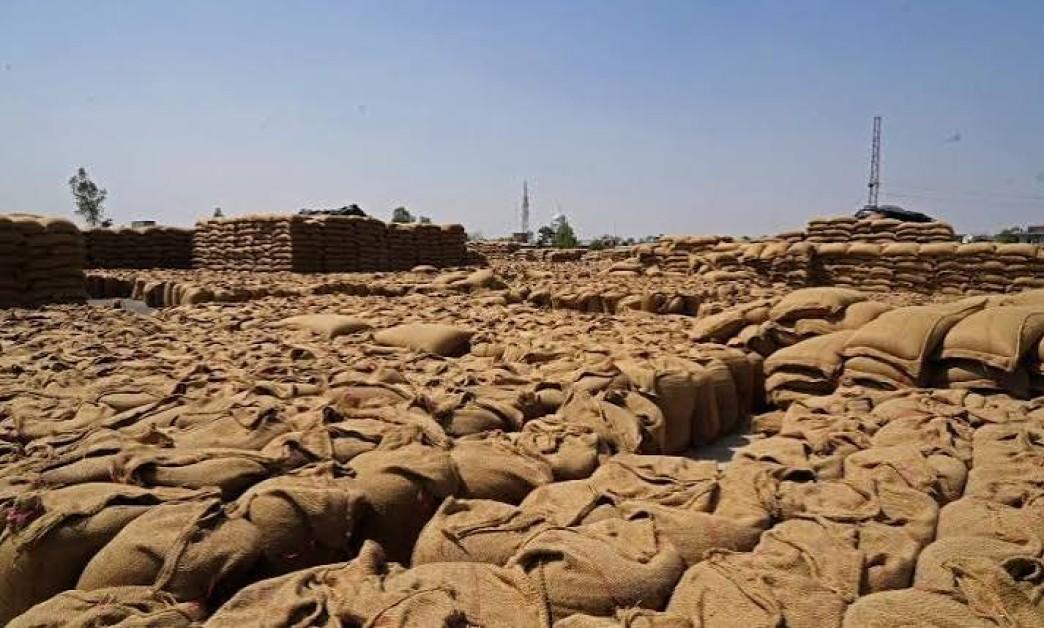
Government Rice Stocks Reach Record 55.47 Million Tonnes
India's government-held rice inventories reached approximately 55.47 million tonnes on October 1, 2026.
The stock level was more than four times the applicable government target.
The accumulation reflects the continuing gap between procurement and the quantity of grain released through domestic distribution and other channels.
Large inventories provide an important buffer against crop failures, unexpected demand and disruptions to food supplies.
However, maintaining stocks substantially above operational requirements can increase costs.
The government must finance procurement, arrange storage, manage transportation and maintain grain quality.
Storage facilities also require investment in infrastructure and operational management.
When procurement continues faster than grain can be distributed or moved, warehouses and milling facilities may experience congestion.
This can delay the movement of newly harvested grain and create difficulties for farmers and millers.
The situation has become particularly challenging in major rice-producing states.
Government Plans 13.1 Million Tonnes of Additional Storage Capacity
The central government is planning to add approximately 13.1 million tonnes of grain storage capacity to address increasing pressure on existing infrastructure.
A September 2026 government document identified growing imbalances between grain procurement and the quantity being moved out of storage.
Regional differences in production and consumption have added to the challenge.
Some states produce substantial quantities of rice but have limited local demand.
The government must therefore transport grain to other regions or allocate it to alternative uses.
Additional storage capacity could help reduce congestion and improve inventory management.
However, constructing warehouses and related infrastructure requires capital expenditure.
Storage expansion also addresses the consequences of surplus production rather than the underlying incentives encouraging farmers to produce additional rice.
Policymakers therefore face a broader question about whether procurement, crop planning and distribution systems should be adjusted alongside infrastructure investment.
Punjab's Rice Storage Crisis Highlights Procurement Challenges
Punjab has emerged as an important example of the logistical pressures created by large government rice stocks.
The state is a major contributor to India's public grain procurement system.
However, existing storage facilities have struggled to accommodate the growing quantity of rice.
Punjab Chief Minister Bhagwant Mann wrote to the central government on September 29, requesting the movement of approximately 600,000 tonnes of previously procured rice to warehouses outside the state.
The request reflected concerns that insufficient storage space could delay procurement of the new harvest.
Such delays can create difficulties for farmers who depend on government procurement arrangements.
Rice millers may also face operational problems when government agencies are unable to collect grain that has already been processed.
The situation illustrates how surplus stocks can create challenges even when agricultural production remains strong.
Efficient movement of grain is therefore becoming as important as procurement capacity.
Minimum Support Price Encourages Continued Rice Cultivation
India's rice production system is strongly influenced by the Minimum Support Price framework.
The central government announces an MSP for paddy based on considerations including production costs and agricultural policy objectives.
The support price provides farmers with a degree of income certainty when government procurement is available.
This has been particularly important in states where rice is purchased extensively through public procurement arrangements.
Farmers can make planting decisions with greater confidence when they expect an established buyer and a predictable price.
However, these incentives can also encourage continued cultivation even when national production exceeds domestic requirements.
The financial challenge becomes more complicated when procurement prices increase while grain inventories remain high.
The government may then face rising expenditure without a corresponding increase in domestic consumption.
The MSP system therefore serves an important income-support function but can also influence crop choices and public spending.
State Government Bonuses Add to Rice Production Incentives
Several rice-producing states provide additional payments above the central government's MSP.
These payments are commonly described as bonuses.
State bonuses can increase the financial attractiveness of rice cultivation relative to other crops.
However, the central government has expressed concern that such incentives may encourage production beyond national requirements.
A review of government communications found that the federal food ministry had approached the finance ministry three times over the previous two years seeking action on state-level rice bonuses.
The Department of Expenditure also wrote to states on January 9, 2026, urging them to align agricultural incentives with national priorities.
The communication highlighted the need to encourage cultivation of other crops and reduce pressure on groundwater resources.
However, changing state-level incentives remains difficult.
Farmers depend on predictable agricultural incomes, while state governments must consider local economic conditions and the political consequences of reducing support.
Centre-State Differences Complicate Agricultural Subsidy Reform
The growing rice subsidy burden has created differences between the central government and major agricultural states.
The central government is responsible for a substantial share of food procurement and subsidy expenditure.
State governments, meanwhile, seek to support farmer incomes and maintain agricultural activity.
These priorities do not always align.
A state may encourage higher rice production through additional incentives, while the central government faces the resulting procurement and storage costs.
Officials have expressed frustration over continued requests to purchase more rice despite already elevated government stocks.
The issue highlights a structural challenge in agricultural policy.
Decisions about crop incentives are influenced by both central and state governments, but the financial consequences may be distributed unevenly.
A coordinated approach would require agreement on production priorities, procurement arrangements and alternatives for farmers.
Rice Subsidies Raise Questions About Fiscal Sustainability
The rising cost of rice support has broader implications for India's public finances.
Government spending must be allocated across several priorities, including infrastructure, healthcare, education, defence and social welfare.
Food subsidies remain important because they support vulnerable households and help maintain access to essential grains.
However, rising expenditure can reduce the fiscal space available for other programmes.
The challenge is particularly significant when subsidy costs increase faster than the underlying need for additional grain.
Large procurement volumes also create working-capital requirements and storage expenses.
These costs may continue accumulating when government inventories remain substantially above target levels.
The concern is not that food security spending is inherently unnecessary.
Rather, policymakers must determine whether the same food security objectives can be achieved more efficiently.
Improving procurement planning, reducing storage losses and encouraging balanced crop production could help contain expenditure without weakening essential food support.
India's Rice Exports Double to 22.3 Million Tonnes
India's rice exports have expanded significantly alongside domestic production.
Shipments reached approximately 22.3 million tonnes in 2025, roughly double the level recorded a decade earlier.
India now accounts for approximately 40% of global rice trade.
This dominant position allows Indian exporters to supply a wide range of international markets.
Large export volumes also help absorb some of the surplus created by domestic production.
However, exports do not automatically eliminate the fiscal costs associated with the agricultural support system.
When production is supported through government procurement, fertiliser subsidies and other incentives, the broader public expenditure associated with the industry can remain substantial.
Agricultural economist Ashok Gulati has argued that India's subsidy-supported rice surplus effectively benefits foreign consumers when exports are sold at prices below those of competing suppliers.
This is an economic interpretation of the subsidy system, rather than a finding that every exported shipment directly receives a government export subsidy.
Low Indian Rice Prices Create International Trade Tensions
India's expanding rice exports have increased competition in international markets.
Indian rice has recently traded at a substantial discount to supplies from competing exporters.
In mid-November 2026, Indian rice was selling at approximately $110 per tonne below benchmark Thai rice.
The Thai benchmark was trading around $497 per tonne.
Lower prices can benefit importing countries by reducing food costs.
However, competing exporters may face reduced market share or pressure to lower their own prices.
The United States, Thailand and other rice-producing countries have raised concerns about the effects of India's subsidy-supported production and export volumes.
US agricultural authorities have previously questioned India's rice subsidy policies.
India has rejected allegations of unfair dumping in relation to its premium basmati exports to the United States.
The dispute illustrates how domestic agricultural support policies can influence international trade relationships.
India Faces a Trade Imbalance Between Rice and Other Crops
One of the most important concerns surrounding India's rice production system is its effect on the cultivation of other crops.
While India produces substantially more rice than it consumes, it remains dependent on imports of certain oilseeds and pulses.
Imports of these products cost approximately $22.7 billion in 2025.
That amount represented an increase of around 120% over the previous decade.
By comparison, rice exports generated approximately $12 billion in 2025.
These figures highlight a potential imbalance in agricultural production priorities.
Government incentives have helped India become a major rice exporter, while domestic production of other essential crops has not kept pace with demand.
However, the import and export figures are not directly equivalent measures of subsidy costs or economic returns.
They reflect different products, markets and supply-chain conditions.
The broader policy question is whether agricultural incentives should encourage greater production of crops that India currently imports.
Crop Diversification Could Reduce Import Dependence
Agricultural economists have recommended encouraging farmers to diversify beyond rice.
Potential alternatives include pulses, oilseeds and other crops suited to local soil, climate and water conditions.
Greater domestic production of these crops could help reduce import dependence.
It may also create opportunities for farmers to diversify income sources.
However, crop diversification requires more than changes to MSP or bonus payments.
Farmers need access to suitable seeds, reliable buyers, storage infrastructure and processing facilities.
Market prices must also provide commercially attractive returns.
In regions with established rice procurement systems, farmers may be reluctant to switch crops without comparable income certainty.
A successful diversification strategy would therefore require coordinated investment in agricultural markets and infrastructure.
The objective would be to improve the balance between national food requirements, farmer incomes and resource sustainability.
Rising Fertiliser Subsidies Add to the Financial Burden
The fiscal costs associated with rice production extend beyond the food subsidy programme.
Rice cultivation requires substantial quantities of agricultural inputs, including fertilisers.
Government support for fertiliser prices helps reduce production costs for farmers.
However, this creates additional expenditure for the public sector.
India's fertiliser subsidy bill is expected to exceed ₹3 lakh crore in 2026–27, according to estimates cited by the fertiliser ministry.
That would represent approximately four times the level recorded a decade earlier.
The fertiliser subsidy covers multiple crops and cannot be attributed entirely to rice production.
Nevertheless, the scale of expenditure demonstrates the broader fiscal implications of agricultural input support.
High levels of rice cultivation can contribute to fertiliser demand, particularly when production continues expanding.
The combined costs of procurement, food distribution, fertiliser support and storage infrastructure therefore provide a more complete picture of the financial burden associated with agricultural production.
Water-Intensive Rice Cultivation Raises Environmental Concerns
Rice cultivation is relatively water-intensive compared with several alternative crops.
In major producing regions, irrigation demand can place substantial pressure on groundwater resources.
Punjab and Haryana have long faced concerns about groundwater depletion associated with intensive agricultural activity.
The expansion of rice cultivation into other regions has also increased the importance of water management.
The central government's January 2026 communication to states specifically highlighted the pressure created by water-intensive rice cultivation.
Agricultural policymakers must therefore consider environmental sustainability alongside fiscal expenditure.
Continued expansion of rice production may increase irrigation demand and create additional long-term resource challenges.
Crop diversification, improved irrigation methods and the development of climate-resilient varieties could help reduce these pressures.
However, the suitability of different approaches varies by region.
Swarna-SUB1 Rice Variety Transforms Production in Eastern India
Scientific innovation has played an important role in India's rice production expansion.
One significant development was the commercial release of the Swarna-SUB1 rice variety in 2009.
Indian researchers developed the variety by combining the high-yielding characteristics of Swarna rice with flood-tolerance traits associated with the FR13A variety.
The result improved the ability of rice crops to survive temporary flooding.
This development was particularly important for flood-prone regions in eastern India.
Farmers in areas affected by seasonal flooding gained access to a crop variety better suited to local conditions.
The technology helped expand reliable rice production beyond traditional high-output regions.
However, improved productivity has also contributed to the growing national surplus.
The development illustrates how agricultural innovation can solve one problem while creating new policy challenges when production incentives remain unchanged.
Climate Risks Could Affect Future Rice Harvests
Despite record production and large government inventories, India's rice sector remains exposed to climate-related risks.
Rainfall patterns, flooding, drought and temperature changes can influence agricultural output.
Poor rainfall associated with El Niño conditions could reduce the 2026–27 harvest.
However, India's substantial existing stocks provide a buffer against short-term production disruptions.
The US Department of Agriculture expects Indian rice exports to increase over the next two years despite the possibility of a weaker harvest.
This outlook reflects the scale of accumulated inventories.
Nevertheless, agricultural planning must account for uncertainty.
Reducing excess production too rapidly could create risks if future harvests are significantly affected by adverse weather.
The policy challenge is therefore to manage surpluses without undermining long-term food security.
Government Faces Difficult Choices Over Rice Procurement Reform
India's rice subsidy system has been central to national food security for decades.
The policy framework helped transform the country from a food-deficit economy into a major agricultural producer and exporter.
However, the current surplus raises questions about whether procurement incentives remain aligned with national requirements.
Possible policy responses include improving stock management, encouraging crop diversification and reviewing additional state-level production incentives.
Greater investment in storage and logistics could also improve efficiency.
However, reducing farmer support without providing viable alternatives could create significant economic difficulties in agricultural regions.
Policymakers must therefore balance fiscal sustainability with income security and food availability.
The government has not announced a comprehensive withdrawal of rice subsidies.
Current discussions focus on managing surplus production, limiting additional incentives and encouraging a more balanced agricultural system.
What Happens Next for India's Rice Subsidy Policy?
The central government is expected to continue discussions with states regarding procurement incentives and crop diversification.
Rising rice stocks and storage pressures may increase the urgency of these discussions.
The planned expansion of grain storage capacity could provide some logistical relief.
However, additional warehouses alone will not resolve the financial consequences of production consistently exceeding consumption.
Future policy decisions will also depend on agricultural output, international rice prices and domestic food security requirements.
The government's ability to encourage cultivation of pulses and oilseeds may become increasingly important.
At the same time, farmer income protection will remain a central consideration.
The outcome will influence agricultural expenditure, trade patterns and the long-term sustainability of India's food production system.
Conclusion
India's rising rice subsidy burden highlights a major challenge emerging from decades of agricultural success.
Government policies and scientific innovation have helped increase rice production by approximately 50% over the past decade, taking annual output to a record 154 million tonnes.
However, domestic consumption remains substantially lower, contributing to record government stocks and increasing storage requirements.
The federal food subsidy bill has more than doubled to ₹2.28 lakh crore, with rice accounting for over two-thirds of the expenditure.
India's position as the world's leading rice exporter has also generated international trade tensions as large volumes of competitively priced grain enter global markets.
Meanwhile, the country continues spending heavily on imports of oilseeds and pulses, raising questions about agricultural production priorities.
The government now faces the task of maintaining food security and protecting farmer incomes while reducing unnecessary expenditure and improving the balance between different crops.
A coordinated approach involving procurement reform, crop diversification, storage investment and sustainable resource management will be important for containing future fiscal pressures.
 India's Rice Subsidy Burden Raises Fiscal Concerns as Food Subsidies Reach ₹2.28 Lakh Crore FAQs

POST A COMMENT (0)
All Comments (0)
Replies (0)