Alexander the Great: Traversing Balochistan’s Hostile Landscape
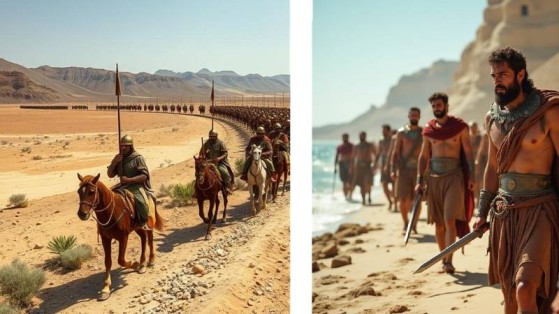
When Alexander the Great, the legendary Macedonian conqueror, returned from his victorious campaign in India in 325 BCE, he made a decision that would become one of the most infamous episodes of his military career: to march his army through the Gedrosian Desert, a treacherous expanse in what is now southern Balochistan.
While Alexander’s conquests in Persia, Egypt, and India are often celebrated for their strategic brilliance and political triumphs, it was this journey across Balochistan’s brutal terrain that nearly broke his mighty empire.
The Return from India: A Strategic Gamble
After defeating King Porus at the Battle of the Hydaspes (now the Jhelum River in Pakistan), Alexander’s weary army refused to go further east. Forced to turn back, Alexander chose an unconventional and deadly route for his return: through the arid and uncharted lands of Gedrosia (modern-day Makran region of Balochistan).
Many believe he undertook this dangerous path to outdo the Persian King Cyrus the Great, whose army had famously failed in the same desert centuries earlier.
Enduring the Gedrosian Nightmare
The Gedrosian Desert, stretching along the Makran coast, was a desolate, water-scarce, and inhospitable region with extreme temperatures and shifting sands. It lacked adequate food and water supplies and offered no respite from the heat.
According to historical accounts, Alexander led tens of thousands of troops, civilians, and animals through this wasteland. The consequences were catastrophic. Nearly three-quarters of his forces perished, succumbing to dehydration, starvation, and exhaustion.
Contemporary Greek historians such as Arrian and Plutarch describe the journey as one of the most harrowing military expeditions in history, emphasizing Alexander's unbreakable will but also criticizing his risk-laden decision.
Encounters in Balochistan
Despite the severe conditions, Alexander’s presence in Balochistan left an imprint. He is believed to have established temporary outposts, interacted with local tribes, and gathered intelligence about the geography and people of the region.
Although there are few concrete archaeological remains to mark his passage, oral traditions and ancient texts tie his name to the Makran coast and Kalat region, reinforcing the historical narrative of his fateful journey.
Legacy of the March
Alexander’s passage through Balochistan did not lead to territorial annexation or urban development in the region, but it became a cautionary tale in military history. The expedition showcased the limits of imperial ambition and the deadly cost of underestimating nature.
It also highlighted the strategic importance and rugged reality of Balochistan, a land that has challenged even the world’s most formidable empires.
A Testament to Endurance
For modern historians, Alexander’s trek through Balochistan is a fascinating blend of hubris, endurance, and tragic loss. It illustrates not just the hardships of ancient warfare but also the geopolitical significance of Balochistan as a crossroads between empires, from Persia to India.
Today, the story of Alexander in Balochistan continues to inspire documentaries, scholarly debates, and local folklore, linking the region’s harsh topography with one of history’s greatest military legends.
Disclaimer: This article is based on public sources and reports. Our aim is not to hurt the sovereignty of any nation but to present information under the values of free and fair journalism.