India’s IT Outsourcing Contracts Are Being Rewritten as Clients Demand AI-Led Productivity at Lower Cost
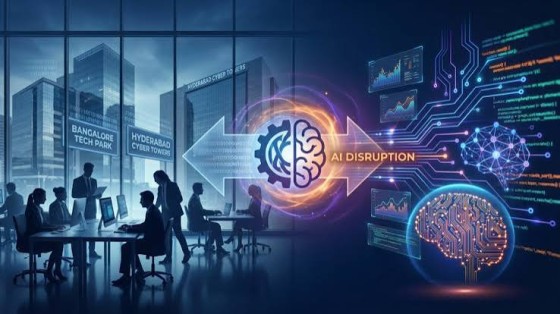
Artificial intelligence is beginning to rewrite the commercial foundations of India's IT outsourcing industry, forcing technology-services companies to move away from contracts based primarily on employee hours toward agreements that increasingly reward measurable business outcomes.
Major providers including Tata Consultancy Services, Infosys, Wipro, HCLTech and Cognizant are adapting as corporate customers argue that productivity gains from generative AI, coding agents and automation should translate directly into lower outsourcing costs.
The change threatens one of the assumptions that supported India's technology-services industry for decades: more work generally required more engineers and therefore generated more billable revenue.
AI breaks that relationship.
Software agents can increasingly write code, test applications, analyse information and automate business processes, allowing service providers to complete some assignments with fewer people.
Clients have noticed.
They increasingly want those savings reflected in contract pricing. (Reuters)
India’s $315 Billion IT Industry Faces a Commercial Reset

India's technology-services sector has grown into an industry worth roughly $315 billion by helping global corporations design, maintain and operate technology systems.
For decades, the basic outsourcing proposition was relatively straightforward.
A multinational company transferred technology work to an Indian provider.
The provider deployed teams of engineers.
The customer paid according to:
headcount,
hours worked,
or agreed project effort.
That model allowed companies such as TCS, Infosys and Wipro to build enormous workforces.
AI is now weakening the connection between headcount and output. (Reuters)
Clients Want More Work for Less Money
The central pressure comes from customers themselves.
Corporate technology leaders understand that generative AI can make software development and maintenance faster.
They therefore increasingly ask outsourcing vendors a simple question:
If your engineers are becoming more productive because of AI, why should we continue paying the same amount?
That discussion is driving what industry executives increasingly describe as AI-led deflation.
In parts of the industry where AI productivity gains are already measurable, revenue per unit of work fell roughly 5% to 15% during FY26, according to industry estimates cited by Moneycontrol. (Moneycontrol)
AI Deflation Is Becoming Real
AI deflation means customers pay less for the same amount of technology output because automation reduces the human effort required.
Consider a software-maintenance contract previously requiring 500 engineers.
If AI allows the vendor to deliver the same service using 400 engineers, the customer increasingly expects part of that productivity improvement to be passed back through lower pricing.
This creates a difficult commercial problem for IT companies.
They save money on delivery.
But customers also demand those savings.
The service provider therefore cannot simply retain the entire productivity benefit as higher profit.
Traditional Time-and-Material Contracts Are Losing Ground
The classic outsourcing model frequently uses time-and-material pricing.
The customer essentially pays for resources assigned to the project.
AI makes that structure increasingly difficult to justify.
If a coding agent can complete in one hour what previously required three hours of engineering work, billing according to human time becomes less relevant.
The commercial conversation gradually shifts toward what the customer actually receives.
Outcome-Based Pricing Is Expanding
Under an outcome-based contract, payment depends more heavily on measurable results rather than the number of engineers used.
A customer might pay according to:
transactions processed,
systems migrated,
cost savings achieved,
or another agreed business metric.
The model allows the IT provider to use any combination of people, automation and AI necessary to deliver the result.
TCS and other large providers are increasingly using or exploring such arrangements as clients push for measurable productivity. (Reuters)
AI Makes Outcome Pricing More Logical
Imagine a bank hires an IT company to reduce loan-processing time.
Under the traditional model, the bank might pay for 100 engineers.
Under an outcome model, it might instead pay according to whether processing time falls from two days to two hours.
The IT provider can then use:
human engineers,
AI agents,
automation,
or proprietary software.
What matters is the result.
This can create stronger incentives for innovation.
But Outcome Contracts Transfer More Risk to IT Vendors
Outcome-based pricing is not automatically more profitable.
It can make revenue less predictable.
If the agreed business result is not achieved, the IT provider may receive less revenue even after investing significant resources.
Disputes can also arise over whether the technology vendor actually caused the outcome.
Industry experts have warned that greater use of outcome-based structures can increase commercial and legal complexity. (The Economic Times)
Attribution Becomes Difficult
Suppose an ecommerce company's conversion rate improves after an AI project.
Did the IT vendor cause the improvement?
Or did:
better pricing,
stronger advertising,
seasonal demand,
or new products
produce the change?
Outcome contracts need carefully defined metrics.
Otherwise, both sides may disagree about whether performance targets were achieved.
Cognizant Shows How Fast the Model Is Changing
Cognizant has already moved significantly toward outcome-based commercial structures in its business-process outsourcing operations.
Approximately 45% of its new BPO contracts are now being signed using outcome-based models, according to company commentary reported in July. (Moneycontrol)
The company has also developed AI-specific commercial tools including token-based consumption models and AI rate cards.
That demonstrates how pricing itself is evolving alongside technology.
AI Consumption Could Become New Billing Unit
Traditional software services were often billed by engineer.
Cloud computing introduced consumption-based pricing based on storage or computing usage.
AI may create another commercial unit:
tokens,
agents,
or automated tasks.
A customer could eventually pay according to how much AI infrastructure or agent activity it consumes rather than the number of employees involved.
This would represent a fundamental change in the economics of outsourcing.
Coforge Already Generates Meaningful Revenue From Outcome Deals
Coforge provides another indication of how quickly the model is developing.
The company said outcome-based contracts contribute about $150 million, representing roughly 6% to 7% of its revenue run rate.
Management sees AI-led delivery as an opportunity to win work from larger incumbents while modernising legacy technology environments. (Moneycontrol)
Mid-Sized IT Companies See Opportunity
AI is not creating problems only for the largest outsourcing firms.
It is also creating openings for smaller rivals.
Persistent Systems and Coforge have been growing faster than many industry giants as clients become more willing to reconsider long-standing vendor relationships.
Reuters reported that Persistent's revenue rose about 16% and Coforge's about 33% in the latest quarter, compared with roughly 1% to 3% growth at several larger providers. (Reuters)
AI Reduces the Advantage of Massive Headcount
Large outsourcing companies traditionally possessed an obvious advantage.
They could deploy thousands of engineers quickly.
That mattered when technology services were fundamentally labour intensive.
AI can reduce the importance of workforce scale.
A smaller company with:
stronger AI tools,
specialised engineers,
and faster execution
may compete successfully against a much larger incumbent.
This changes competitive dynamics across the industry.
Rapid Pilots Can Help Smaller Firms Win
Enterprises increasingly want AI experiments deployed quickly.
A smaller vendor may be able to launch a pilot within weeks rather than navigating a large corporate delivery structure.
If that pilot works, the customer may expand the relationship.
This allows mid-sized firms to challenge long-established outsourcing contracts that previously appeared difficult to displace.
Long-Term Contracts Are Becoming Shorter
AI is also changing contract duration.
Customers worry that a five-year outsourcing agreement signed today could become economically outdated within two years if automation improves rapidly.
They therefore want greater flexibility.
Industry estimates suggest contract durations in some categories are shortening by roughly 15% to 30% annually as companies seek the ability to renegotiate more frequently. (Moneycontrol)
Clients Want Renegotiation Rights
Businesses increasingly seek the ability to:
pause projects,
re-scope work,
or reopen pricing
during the life of a contract.
The logic is understandable.
A customer does not want to remain locked into 2026 labour economics if AI can perform much of the work more cheaply in 2027.
This makes long-duration revenue less predictable for IT vendors.
Renewal Cycles Become More Competitive
Shorter contracts mean vendors need to compete for the same business more frequently.
That can increase sales costs.
It can also increase pricing pressure because the client has more opportunities to invite competing bids.
For incumbents, a contract that once remained stable for seven years may now face regular technological and commercial review.
Infosys Has Walked Away From Uneconomic Deals
The pricing pressure is becoming strong enough that companies are occasionally rejecting business.
Infosys said it had walked away from contracts that were no longer economically attractive.
This illustrates the limits of AI deflation.
Clients may demand lower prices, but service providers still need acceptable margins. (Reuters)
Tech Mahindra Has Also Shown Pricing Discipline
Indian IT companies increasingly need to decide whether winning a contract at an aggressive price creates any long-term shareholder value.
Large deals can look impressive in order-book announcements.
But a poorly priced multiyear contract can damage profitability for years.
AI uncertainty makes this calculation even harder because the future cost of delivering the work is changing rapidly.
The Industry Is Entering a Pricing Experiment
There is no single replacement for traditional outsourcing contracts.
Different companies are testing:
outcome-based pricing,
consumption pricing,
AI rate cards,
hybrid models,
and conventional fixed-price arrangements.
The winning structure may vary according to the project.
A software-development engagement may be priced differently from business-process automation or cybersecurity.
AI Rate Cards Could Become Common
A traditional IT rate card specifies prices for engineers based on:
seniority,
location,
and skill.
An AI-infused rate card can incorporate both human and digital labour.
For example, a project might involve:
one senior architect,
five software engineers,
and dozens of AI agents.
Pricing then reflects the combined delivery system rather than simply human headcount.
This is beginning to emerge across the industry. (The Economic Times)
The Pyramid Staffing Model Is Under Pressure
Indian IT services historically relied on a workforce pyramid.
A relatively small number of senior employees managed large numbers of junior engineers.
Entry-level recruits performed tasks including:
basic coding,
testing,
and support.
Those are precisely the activities most exposed to automation.
Former Infosys CFO V. Balakrishnan has argued that the traditional pyramid model is disappearing as coding agents reduce the need for large pools of junior developers. (ETCIO.com)
Entry-Level Hiring Could Change Structurally
Indian IT companies have historically recruited large numbers of university graduates every year.
That hiring model may become less necessary.
Future teams could contain fewer junior developers and relatively more:
AI engineers,
architects,
consultants,
and domain specialists.
This would fundamentally alter one of India's largest white-collar employment engines.
It Does Not Mean IT Employment Disappears
AI can automate tasks without eliminating entire technology-services businesses.
Enterprise systems remain complicated.
Companies still need experts who understand:
data,
security,
regulation,
and business processes.
The type of work changes.
The biggest question is whether new high-value roles emerge quickly enough to offset reduced demand for routine jobs.
TCS Has Already Restructured Its Workforce
TCS has been expanding the number of engineers embedded with clients to accelerate AI adoption while simultaneously restructuring parts of its workforce.
Reuters noted that TCS became the first major Indian IT services provider in the current AI cycle to announce mass layoffs, cutting more than 12,000 positions last year. (Reuters)
The development underscores how rapidly the industry's workforce model is changing.
AI Adoption Creates New Consulting Demand
The disruption also contains an opportunity.
Companies want AI.
But deploying AI inside a large enterprise is difficult.
A bank might have:
decades-old software,
hundreds of databases,
and strict compliance requirements.
Simply purchasing an AI model does not solve those problems.
Someone needs to integrate the technology.
That creates significant work for IT services firms.
Legacy Modernisation Could Become Major Growth Engine
Many enterprises still run critical systems created decades ago.
AI adoption can force these systems to be modernised.
Data needs to be cleaned.
Applications need APIs.
Cloud environments need to be built.
Security needs upgrading.
Companies such as Coforge identify legacy and cloud modernisation as major AI-related growth opportunities. (Moneycontrol)
Data Infrastructure Becomes Essential
Enterprise AI depends on enterprise data.
Many corporations have information scattered across incompatible systems.
Before AI can generate reliable results, companies need to organise:
databases,
permissions,
and governance.
This creates substantial demand for data engineering.
Indian IT firms already possess deep experience managing complex enterprise systems.
AI Governance Creates Another Service Category
Large companies also need controls around AI.
They need to know:
which models employees are using,
what data enters those models,
whether outputs are accurate,
and how decisions are audited.
AI governance can therefore become a substantial consulting and managed-services market.
Cybersecurity Demand Could Rise
AI creates new security risks.
Attackers can use AI to automate phishing or generate malicious code.
Enterprises also need to protect sensitive information used in models.
As AI adoption expands, cybersecurity spending can increase.
This gives IT services firms another potential growth category.
Agentic AI Could Automate Entire Workflows
The next stage of enterprise automation extends beyond AI assistants.
Agentic systems can perform sequences of tasks.
An AI agent might:
read an email,
update a database,
generate a report,
and initiate another workflow.
This can automate business processes previously requiring multiple employees.
For outsourcing companies, that creates both opportunity and disruption.
BPO Contracts Could Change Even Faster Than IT Services
Business-process outsourcing is especially exposed because many tasks involve repetitive digital workflows.
Customer service.
Document processing.
Back-office operations.
AI agents can increasingly automate significant portions of these activities.
Cognizant's rapid adoption of outcome-based BPO contracts suggests this part of the industry may change particularly quickly. (Moneycontrol)
Call Centres Face Direct Automation Pressure
Voice AI systems can increasingly handle routine customer interactions.
They can answer questions, process requests and escalate difficult cases to humans.
This creates obvious productivity advantages for companies.
It also threatens traditional call-centre staffing models.
India, which built a major outsourcing industry around customer-service operations, is particularly exposed to this transition.
Software Development Is Also Being Reshaped
Coding agents can now assist with:
writing software,
testing,
documentation,
and debugging.
A skilled developer can therefore produce more output.
This changes how vendors estimate project requirements.
A task that previously needed 20 programmers may require far fewer.
That directly affects revenue models based on billable engineers.
Revenue Per Employee Could Become Less Useful
Investors have historically monitored revenue per employee when evaluating IT-services companies.
AI changes the metric.
Future delivery combines:
people,
software agents,
and automated infrastructure.
Revenue may increasingly depend on the productivity of the entire system rather than the number of employees.
New metrics may become necessary.
Intellectual Property Could Become More Valuable
Companies that own reusable AI platforms can capture more value than firms relying only on employee labour.
An internal AI system can be deployed repeatedly across customers.
That allows technology services companies to scale revenue without scaling headcount proportionately.
This explains why Indian IT companies are investing heavily in proprietary platforms and acquisitions.
M&A Is Accelerating
AI capability has become a major driver of acquisitions across Indian IT services.
Companies are buying firms with specialised expertise in:
AI,
data,
engineering,
and industry-specific technology.
The objective is speed.
Acquiring an experienced team can deliver capabilities much faster than building them entirely internally.
TCS Is Hunting for AI Acquisitions
TCS has indicated it is looking for acquisitions that can strengthen AI capabilities.
This represents an important strategic shift for a company traditionally known for relying heavily on organic growth.
As technology cycles accelerate, even the industry's largest companies increasingly see M&A as a way to close capability gaps quickly. (Reuters)
Margin Pressure Will Be a Major Investor Issue
AI theoretically reduces delivery costs.
That sounds positive for margins.
But client pricing pressure can absorb much of the benefit.
The financial outcome depends on who captures productivity savings.
If IT providers retain a meaningful portion, margins could improve.
If customers negotiate away most of the savings, revenue growth could weaken.
HCLTech Has Flagged AI-Led Deflation
Industry commentary has pointed to roughly 2% to 3% annual deflation in traditional services as AI productivity improves.
That means contract values can decline even if the amount of work delivered remains stable or increases. (Business Standard)
For an industry accustomed to revenue expanding alongside workforce and customer demand, that creates a significant strategic challenge.
AI Deflation Could Remove Billions From Industry Revenue
Some estimates suggest AI-led deflation could reduce Indian IT-sector revenue by around 3% to 3.5% over FY27-FY29.
Against an industry exceeding $300 billion, even a few percentage points represent billions of dollars of potential revenue compression. (Moneycontrol)
The opportunity from new AI transformation work therefore needs to exceed the revenue being lost from cheaper traditional services.
This Is the Industry’s Central Equation
The future growth equation can be simplified:
New AI revenue must grow faster than AI destroys old outsourcing revenue.
TCS management has described a similar challenge.
So far, the company has said it has been able to offset AI-related downward revenue pressure through additional work.
The longer-term question is whether new demand can continue growing faster than deflation in existing contracts. (Reuters)
Client In-Housing Creates Another Threat
AI tools can also make it easier for companies to perform technology work internally.
A smaller in-house engineering team equipped with advanced AI may be able to complete tasks previously outsourced.
This gives clients another bargaining tool.
They can tell vendors:
lower the price,
or we may bring more work inside.
That increases competitive pressure.
IT Vendors Need to Become Transformation Partners
The traditional outsourcing proposition was often centred on cost.
Move work to India.
Use lower labour costs.
Save money.
The next model needs to offer something different.
IT companies increasingly need to help customers redesign entire business processes using AI.
That requires deeper consulting capability.
Domain Expertise Becomes More Important
AI technology itself is becoming widely available.
The differentiator may increasingly be understanding how to apply it inside a particular industry.
A bank needs specialists who understand:
credit,
compliance,
and payments.
A pharmaceutical company needs people who understand drug development and regulation.
Domain knowledge becomes increasingly valuable when generic coding is automated.
Consulting Could Move Higher Up the Value Chain
Indian IT firms have spent years attempting to become more strategic advisers rather than merely execution vendors.
AI increases the urgency.
The more routine technical work becomes automated, the more valuable business transformation and architecture expertise becomes.
This could push leading firms further toward consulting-style relationships.
Clients May Consolidate Vendors
AI could also encourage corporations to reduce the number of technology suppliers they use.
If a provider can combine:
cloud,
AI,
cybersecurity,
and business transformation,
a customer may prefer one integrated relationship.
This could benefit large diversified IT companies.
But specialist firms can still win where deep expertise matters more than scale.
Large Deals Are Not Automatically Good News
Investors often celebrate multibillion-dollar outsourcing contracts.
AI makes those announcements more difficult to interpret.
A huge deal may carry aggressive pricing and significant execution obligations.
The headline contract value therefore matters less than:
margin,
commercial structure,
and AI productivity assumptions.
Shorter Contracts Could Increase Revenue Volatility
If clients renegotiate more frequently, revenue visibility declines.
Service companies traditionally valued long contracts because they produced predictable cash flow.
AI uncertainty weakens that advantage.
Management teams may need to provide investors with more detailed information about contract structures and renewal risk.
Public-Market Valuations Could Change
Indian IT stocks historically received premium valuations because of:
predictable revenue,
high margins,
and strong cash generation.
If AI makes contract revenue less predictable, investors may apply different valuation multiples.
Companies demonstrating strong AI monetisation could command premiums.
Those relying heavily on legacy labour-based outsourcing could face discounts.
Mid-Tier Companies Could Continue Outperforming
The strongest growth may increasingly come from companies with specialised capabilities and less organisational complexity.
Persistent, Coforge and other mid-tier firms have already demonstrated their ability to win work from established incumbents.
AI can accelerate this trend by weakening the historical advantage of enormous workforces.
Scale Still Has Advantages
Large companies should not be written off.
TCS, Infosys and HCLTech possess:
major client relationships,
enormous data expertise,
and global delivery networks.
These assets remain extremely valuable.
The question is whether the companies can move quickly enough to convert scale into AI advantage rather than allowing scale to become organisational inertia.
India Still Has Important Structural Advantages
The country remains one of the world's largest pools of technology talent.
Indian IT firms possess decades of experience running mission-critical systems for global corporations.
Enterprise AI needs exactly this type of integration expertise.
The threat to the old model therefore does not automatically mean a threat to India's overall technology-services leadership.
Workforce Reskilling Becomes Critical
The skills mix, however, needs to change quickly.
Companies are training employees in:
AI engineering,
cloud,
data science,
and domain consulting.
Employees performing routine work face greater pressure.
The ability to retrain millions of technology workers will become one of the largest workforce transformations in corporate India.
Fresh Graduates Face a Different Career Market
For years, engineering graduates could enter large IT companies and learn through basic coding or testing assignments.
AI may automate many of those traditional training-ground tasks.
Employers may expect graduates to arrive with stronger:
problem-solving,
AI,
and business skills.
Universities may also need to update curricula accordingly.
India’s Employment Model Could Shift
The IT industry has played an important role in India's middle-class growth.
It created millions of formal jobs and supported urban economies including:
Bengaluru,
Hyderabad,
Chennai,
and Pune.
A shift toward smaller, higher-skilled teams could therefore have broader economic consequences.
The sector may continue growing while creating fewer jobs per dollar of revenue.
Productivity Could Ultimately Strengthen the Industry
There is another possible outcome.
If Indian IT companies become dramatically more productive, they can compete for work previously considered too expensive to outsource.
AI could expand the addressable market.
Projects that previously did not make economic sense might become viable.
This could offset some of the reduction in labour-based revenue.
Lower Prices Can Stimulate Demand
Economics often responds to falling prices with higher consumption.
If AI reduces the cost of software development, companies may build more software.
If automation makes technology transformation cheaper, smaller businesses may purchase services that were previously unaffordable.
AI deflation can therefore create new demand even as it reduces the value of individual contracts.
The Industry Could Become Larger but Less Labour Intensive
This may be the most likely structural outcome.
India's IT-services industry could continue increasing its total economic value.
But revenue may become less tightly connected to workforce size.
Growth could come increasingly from:
AI platforms,
consulting,
and outcome-based services.
That would represent a fundamentally different industry from the outsourcing model built over the previous three decades.
Conclusion
Artificial intelligence is rewriting the commercial foundations of India's IT outsourcing industry.
Corporate clients are increasingly unwilling to pay according to the number of engineers assigned to a project when AI can automate significant portions of coding, testing, support and business-process work.
That is pushing companies including TCS, Infosys, Wipro, HCLTech and Cognizant toward outcome-based pricing, shorter contract cycles, AI-specific rate cards and commercial structures that tie payments more closely to measurable productivity. (Reuters)
The shift creates a difficult paradox.
AI makes Indian technology firms more productive.
But clients want those productivity gains returned through lower prices.
The industry therefore needs to generate enough new AI transformation work to compensate for declining revenue from traditional outsourcing contracts.
At the same time, AI is changing competitive dynamics. Mid-sized firms such as Coforge and Persistent Systems can increasingly challenge larger incumbents using faster pilots, specialised expertise and more flexible pricing. (Reuters)
The workforce model is changing as well.
Large pyramids of junior engineers performing routine coding and testing are becoming harder to justify as software agents automate more basic tasks.
India's IT sector is therefore entering one of the most significant structural transitions in its history.
The old outsourcing model was built around how many people were needed to perform the work.
The emerging AI model is increasingly built around how much business value can be produced with the fewest resources.
The companies that learn how to price, deliver and monetise that productivity without giving all of its economic value back to clients are likely to define the next era of India's technology-services industry.