Can India Become a Global Electronics Manufacturing Hub Despite Component Dependence?
India's electronics output has grown sixfold in a decade and made it a smartphone-export powerhouse — but with domestic value addition stuck near 15-20% and components still largely imported, the harder test is only beginning.
By Naina, 6th July 2026
India's ambition to become a global electronics manufacturing hub faces a critical question: can it succeed despite its heavy dependence on imported components? Over the past decade, the country's electronics sector has grown roughly sixfold to around $125 billion, driven by a boom in smartphone assembly and government incentives, positioning India as a major manufacturing destination and the world's second-largest smartphone exporter. Yet much of this success rests on assembling finished products from parts sourced abroad, particularly from China, leaving domestic value addition low and the sector exposed to supply-chain risks. Whether India can move beyond assembly to build a deep, self-reliant manufacturing ecosystem, mastering components and semiconductors, will determine if it becomes a genuine global hub or remains a large-scale assembly base dependent on others.
The stakes are high. Global manufacturers, pursuing a 'China Plus One' strategy to diversify supply chains, have made India a favoured alternative, bringing investment, jobs, and exports. But the country's competitiveness is constrained by its reliance on imported components, higher costs, and gaps in research and semiconductor capabilities. Recognising this, the government has launched an ambitious policy push to localise component and chip manufacturing, the harder, deeper layers of the electronics value chain. Early signs of a shift are emerging, but the challenge is formidable. Here is an analysis of India's electronics boom, the component-dependence problem, the policy response, and whether the country can truly become a global electronics manufacturing hub.
The Growth Story
India's electronics rise has been remarkable. The sector has grown roughly sixfold over the past decade, from around $21 billion to approximately $125 billion, with electronics rising to become one of the country's largest export categories, jumping around eightfold to nearly $39 billion in a recent year. Mobile phones lead the charge, forming the largest and fastest-growing subsegment and making India the world's second-largest smartphone exporter. This surge has been powered by government initiatives, especially production-linked incentives, which attracted global giants and scaled up output, alongside the 'China Plus One' strategy that led major brands to shift portions of their supply chains to India. The momentum has drawn substantial investment and created large-scale employment, establishing India as a serious manufacturing player.
The Assembly Trap
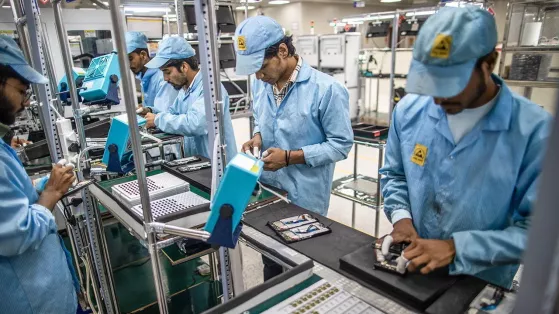
Beneath the impressive figures lies a structural limitation. For over a decade, India's electronics growth was powered largely by final assembly, putting together products from imported parts. While this scaled up output and exports impressively, domestic value addition remained stuck at around 15 to 20 percent, meaning that although India produced large volumes, much of the value accrued elsewhere, mainly in China. This assembly-led model left manufacturers exposed to supply-chain disruptions and limited the economic benefits captured within India. The core challenge is clear: producing large quantities of devices whose valuable components are made abroad does not, on its own, constitute a deep or sustainable manufacturing base. Escaping this assembly trap is central to India's hub ambitions.
The Component Dependence
Component dependence is the crux of the problem. India remains heavily reliant on imports from China, South Korea, and Taiwan for critical inputs such as printed circuit boards, sensors, advanced displays, and semiconductors. Strikingly, the country's electronic component imports have run at levels comparable to its electronics exports, underscoring how much value flows out to pay for parts. This dependence not only raises costs and lengthens lead times but also creates supply-chain and national-security vulnerabilities, particularly during geopolitical tensions or global disruptions. Crucially, as electronics assembly scales up, the demand for imported components intensifies, deepening rather than easing the dependence. Without mastering component manufacturing, India cannot sustain genuine competitiveness or resilience in electronics.
The Competitiveness Gap
Several factors undermine India's cost competitiveness. Analysts note that while India offers manufacturers an advantage of around 3 percent through subsidies and tax benefits, competitors like China provide a far larger edge, estimated at around 20 percent, leaving India relatively uncompetitive in component-led manufacturing. Structural issues compound this, including an inverted duty structure that taxes imported inputs while finished goods enter duty-free, and non-refundable taxes on certain raw materials, both of which raise domestic production costs. India also spends far less on research and development, at well under 1 percent of GDP compared with over 2 percent in leading nations, with weaker private-sector participation. These gaps in cost, taxation, and innovation constrain India's ability to compete at the component level.
The Policy Response
The government has mounted an ambitious, multi-layered response. India's strategy rests on three pillars designed to work together: production-linked incentives that created scale in finished goods, a semiconductor mission targeting upstream chip fabrication and packaging, and a components manufacturing scheme addressing the critical middle layer of parts and materials. The components scheme, backed by a multi-billion-dollar outlay offering capital subsidies and incentives, aims to localise the production of items like printed circuit boards and camera modules. It has attracted large investment commitments, with dozens of component factories under construction and many more planned. The explicit goal is to roughly double domestic value addition to 35 to 40 percent over the coming years, transforming India from an assembly hub into an integrated ecosystem.
The Semiconductor Challenge
Semiconductors represent the hardest frontier. Recognising that chips are the foundation of modern electronics, India has launched a dedicated semiconductor mission supporting fabrication plants, assembly and testing facilities, and chip design, with several major projects approved and under construction. A national roadmap targets building a substantial semiconductor value chain and developing advanced design capabilities, leveraging India's existing strength in chip design talent. However, building a full fabrication ecosystem is a multi-year, immensely capital-intensive endeavour, and results are measured in years, not months. India has made the most progress in assembly and design, but mastering advanced chip fabrication, which depends on cutting-edge technology and expertise, remains the deepest and most difficult test of its manufacturing ambitions.
The Early Reversal
Encouragingly, early signs of a structural shift are emerging. In a development few had foreseen, Indian facilities have begun exporting electronic components and sub-assemblies, with vendors in the country shipping record volumes of parts to China, once the dominant source of India's imports. This nascent two-way exchange suggests India is beginning to participate more deeply in global value chains rather than serving purely as an assembly base. Driven by global and domestic manufacturers who have built globally competitive capabilities, this reversal, though early, indicates the policy push may be starting to bear fruit. If sustained and scaled, such momentum could gradually transform India's position from a component importer toward a meaningful component producer and exporter.
The Verdict
The answer is a qualified yes, with conditions. India is already becoming a global electronics manufacturing hub in terms of scale, assembly, and exports, and the momentum is undeniable. However, becoming a deep, sustainable, high-value hub, rather than a large assembly base, depends on successfully localising components and semiconductors, the very areas where dependence runs deepest. The policy architecture to address this is comprehensive and the early reversal is promising, but the challenges of cost competitiveness, research capability, and the sheer difficulty of chip fabrication are formidable and will take years to overcome. India can become a genuine global hub despite its current component dependence, but only if it executes this transition effectively; the dependence is being addressed, not yet resolved.
The Road Ahead
India's journey toward becoming a global electronics manufacturing hub is well under way but far from complete. The coming years will be decisive, as the success of the component and semiconductor initiatives, the ability to raise domestic value addition, and improvements in cost competitiveness and research determine the outcome. Attracting global firms to co-locate with their supplier ecosystems, deepening partnerships and technology transfers, correcting structural cost disadvantages, and scaling innovation will all be critical. The transformation from an assembly base into an integrated manufacturing powerhouse is achievable, given India's scale, talent, market, and policy commitment, but it is not guaranteed. Whether India masters the components and chips it currently imports will ultimately decide if its hub ambition is fully realised. This is analysis, not investment advice.
Frequently Asked Questions
Is India already a global electronics manufacturing hub?
India has become a major electronics manufacturing destination, with the sector growing roughly sixfold in a decade to around $125 billion and the country becoming the world's second-largest smartphone exporter. However, much of this is currently assembly rather than deep manufacturing.
What is the component dependence problem?
India relies heavily on imported components like printed circuit boards, sensors, displays, and semiconductors, mainly from China, South Korea, and Taiwan. This keeps domestic value addition low, at around 15 to 20 percent, and creates cost and supply-chain vulnerabilities.
How is India trying to reduce component dependence?
Through a three-part strategy: production-linked incentives for finished goods, a semiconductor mission for chips, and a components manufacturing scheme for parts and materials, aiming to roughly double domestic value addition to 35 to 40 percent over the coming years.
What are the biggest challenges?
A cost disadvantage compared with China, an inverted duty structure, low research and development spending, and the immense difficulty and expense of building advanced semiconductor fabrication, which is a multi-year, capital-intensive undertaking.
Can India succeed despite the dependence?
India can become a genuine global hub, and is already advancing rapidly in assembly and exports, but achieving deep, high-value hub status depends on successfully localising components and chips. Early signs are promising, but the transition will take years and is not assured.