What Is an AI Center of Excellence? A Complete Guide
As organizations adopt artificial intelligence across multiple departments, they often face challenges such as duplicated efforts, inconsistent AI practices, fragmented data, and governance issues. Different teams may develop AI solutions independently, resulting in higher costs, security risks, and inconsistent business outcomes.
An AI Center of Excellence (AI CoE) helps solve these challenges by providing centralized leadership, standards, expertise, and governance for artificial intelligence initiatives across an organization.
Rather than building AI solutions itself for every department, an AI CoE establishes best practices, supports business teams, promotes innovation, manages AI risks, and helps organizations scale AI successfully.
Today, AI Centers of Excellence are increasingly found in large enterprises across banking, healthcare, manufacturing, retail, telecommunications, energy, government, and technology sectors.
What Is an AI Center of Excellence?
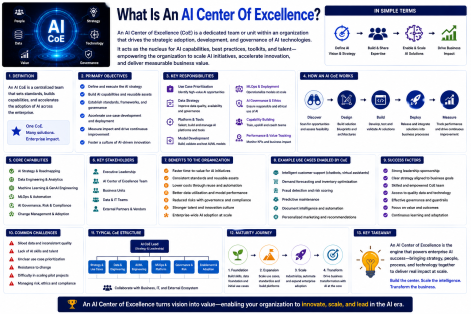
An AI Center of Excellence (AI CoE) is a dedicated team or organizational function responsible for guiding, governing, and supporting the adoption of artificial intelligence across an enterprise.
The AI CoE serves as a central hub for:
-
AI strategy
-
AI governance
-
Technical expertise
-
Best practices
-
Standards and policies
-
AI education and training
-
Project support
-
Innovation
Instead of every department creating its own AI approach, the CoE helps ensure AI initiatives follow consistent processes and align with business objectives.
How Does an AI Center of Excellence Work?
An AI Center of Excellence typically follows a structured approach.
1. Define AI Strategy
The CoE works with business leaders to identify high-value AI opportunities and develop an enterprise AI roadmap.
2. Establish Standards
The team creates common standards for:
-
AI development
-
Data quality
-
Security
-
Privacy
-
Responsible AI
-
Model deployment
-
Documentation
3. Support AI Projects
Business units receive guidance on selecting technologies, building AI solutions, and implementing best practices.
4. Govern AI Systems
The CoE monitors AI systems for:
-
Accuracy
-
Security
-
Compliance
-
Bias
-
Performance
-
Regulatory requirements
5. Drive Continuous Improvement
The organization measures business outcomes, shares lessons learned, updates standards, and promotes ongoing AI innovation.
Key Components of an AI Center of Excellence
1. AI Leadership Team
Provides strategic direction and aligns AI initiatives with business goals.
2. Data Science and AI Experts
Develop technical standards, evaluate AI models, and support implementation teams.
3. Data Governance Team
Ensures high-quality, secure, and well-managed enterprise data.
4. Responsible AI and Compliance Team
Oversees ethics, regulatory compliance, risk management, fairness, and transparency.
5. Training and Change Management
Educates employees, promotes AI literacy, and supports organizational adoption.
Key Characteristics of an AI Center of Excellence
1. Centralized Expertise
Provides organization-wide AI knowledge and technical guidance.
2. Enterprise Governance
Establishes policies for secure, responsible, and compliant AI deployment.
3. Cross-Functional Collaboration
Works with IT, legal, security, operations, HR, finance, and business teams.
4. Standardization
Promotes reusable frameworks, templates, and best practices.
5. Innovation Enablement
Helps identify, evaluate, and scale new AI opportunities.
Common Responsibilities of an AI Center of Excellence
An AI CoE commonly supports:
-
AI strategy development
-
AI governance
-
Model evaluation
-
Responsible AI implementation
-
Data governance
-
Vendor evaluation
-
AI platform selection
-
AI security reviews
-
Employee AI training
-
Project prioritization
-
Performance monitoring
-
Enterprise AI adoption
Benefits of an AI Center of Excellence
Accelerates AI Adoption
Provides a structured framework for implementing AI across the organization.
Reduces Duplicate Effort
Reusable standards and shared expertise prevent teams from solving the same problems independently.
Improves Governance
Ensures AI systems meet organizational policies and regulatory requirements.
Enhances AI Quality
Standardized development and review processes improve reliability and consistency.
Supports Long-Term Innovation
The CoE encourages experimentation while maintaining strategic alignment and operational control.
Challenges of Building an AI Center of Excellence
Organizational Change
Departments may need to adapt existing processes to align with enterprise AI standards.
Talent Requirements
Building a successful CoE requires experienced AI specialists, data professionals, and governance experts.
Balancing Innovation and Governance
Organizations must encourage experimentation while maintaining security and compliance.
Measuring Business Value
The impact of AI initiatives can be difficult to quantify without clearly defined metrics.
Continuous Evolution
AI technologies, regulations, and business priorities change rapidly, requiring ongoing updates to policies, skills, and governance practices.
AI Center of Excellence vs Traditional IT Team
| Feature | Traditional IT Team | AI Center of Excellence |
|---|---|---|
| Primary Focus | IT infrastructure and operations | Enterprise AI strategy and governance |
| Expertise | Networks, systems, applications | AI, machine learning, data science, governance |
| Project Scope | Technology support | AI innovation and adoption |
| Governance | IT policies | AI ethics, compliance, and responsible AI |
| Best For | Managing IT environments | Scaling AI across the enterprise |
Best Practices for Building an AI Center of Excellence
Align AI with Business Goals
Focus on AI initiatives that deliver measurable business value.
Develop Clear Governance
Create policies covering security, privacy, fairness, compliance, and model management.
Build Cross-Functional Teams
Include business leaders, technical experts, legal professionals, and compliance specialists.
Invest in AI Education
Provide ongoing training to improve AI literacy throughout the organization.
Measure Outcomes
Track key performance indicators (KPIs), return on investment (ROI), adoption rates, and operational improvements to evaluate success.
Future of AI Centers of Excellence
AI Centers of Excellence are expected to become increasingly important as organizations expand the use of generative AI, AI agents, enterprise copilots, retrieval-augmented generation (RAG), and autonomous workflow automation. Rather than managing isolated AI projects, future AI CoEs will coordinate enterprise-wide AI strategies while ensuring governance, security, and regulatory compliance.
Advances in AI governance platforms, model monitoring, automated compliance, and responsible AI frameworks will help CoEs oversee increasingly complex AI ecosystems. Many organizations are also expected to use AI CoEs to standardize AI platforms, manage vendor relationships, establish enterprise knowledge bases, and support multi-agent AI systems across departments.
As artificial intelligence becomes a core business capability, AI Centers of Excellence will play a vital role in helping organizations adopt AI responsibly, maximize business value, reduce operational risks, and create a sustainable foundation for long-term innovation.
Conclusion
An AI Center of Excellence is a centralized organizational team that provides leadership, governance, technical expertise, and best practices for artificial intelligence initiatives. By standardizing AI development, supporting business teams, and promoting responsible AI, an AI CoE enables organizations to scale AI more effectively.
From strategy and governance to employee training and innovation, AI Centers of Excellence help organizations build a consistent and secure approach to enterprise AI. Their role is becoming increasingly important as businesses deploy more advanced AI technologies across multiple departments.
As AI adoption continues to accelerate, an AI Center of Excellence will remain a key organizational capability for ensuring that artificial intelligence delivers measurable business value while maintaining transparency, security, and responsible governance.