What Is Agent Orchestration? A Simple Guide
As AI systems become more capable, a single AI model is often not enough to complete complex business or technical workflows. A modern AI application may need one agent to research information, another to analyze data, a third to write content, and a fourth to review the results. Managing these specialized agents efficiently requires agent orchestration.
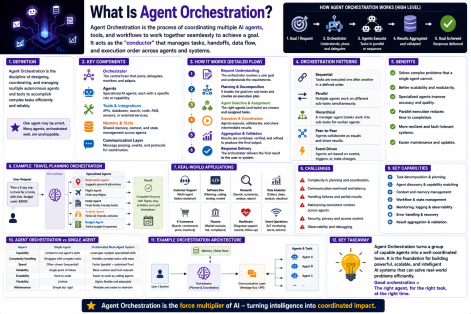
Agent orchestration is the process of coordinating multiple AI agents so they work together toward a shared objective. Instead of operating independently, the agents communicate, exchange information, divide responsibilities, and execute tasks in a structured workflow.
Agent orchestration is becoming increasingly important in enterprise AI, customer service, software development, scientific research, cybersecurity, healthcare, and business automation. Although AI agents can perform many tasks autonomously, human oversight remains essential for defining workflows, validating outputs, handling exceptions, and ensuring responsible AI deployment.
What Is Agent Orchestration?
Agent orchestration is the process of managing, coordinating, and supervising multiple AI agents so they can complete complex tasks efficiently.
An orchestration system determines:
-
Which agent performs each task
-
When agents should communicate
-
How information is shared
-
How outputs from one agent become inputs for another
-
How conflicts, errors, or failures are handled
The goal is to ensure that multiple specialized agents function as a coordinated team rather than as isolated systems.
How Does Agent Orchestration Work?
Agent orchestration follows a structured workflow.
1. Receive a Goal
A user or application submits a request.
Examples include:
-
Research a topic
-
Build software
-
Analyze financial data
-
Generate a report
-
Plan a marketing campaign
2. Break the Goal into Tasks
The orchestration system divides the overall objective into smaller, manageable tasks.
For example:
-
Gather information
-
Verify facts
-
Analyze data
-
Generate content
-
Review results
3. Assign Tasks to Specialized Agents
Each task is routed to the most appropriate AI agent.
Examples include:
-
Research agent
-
Coding agent
-
Writing agent
-
Data analysis agent
-
Quality assurance agent
4. Coordinate Communication
Agents exchange information, share intermediate results, and request assistance from one another when needed.
The orchestrator manages dependencies so tasks occur in the correct order.
5. Combine Results
The orchestration system collects outputs from all agents, resolves inconsistencies where possible, and produces the final result for the user.
Key Components of Agent Orchestration
1. AI Agents
Specialized agents responsible for performing individual tasks.
2. Orchestrator
The central coordination layer that manages workflows, task assignments, and communication.
3. Task Planner
Breaks complex objectives into smaller tasks and determines execution order.
4. Communication Layer
Allows agents to exchange information and coordinate their activities.
5. Memory and Context
Stores shared information, previous decisions, and task history so agents can work with consistent context.
Key Characteristics of Agent Orchestration
1. Workflow Coordination
Ensures multiple AI agents execute tasks in an organized sequence.
2. Specialized Collaboration
Different agents contribute expertise to different parts of a workflow.
3. Dynamic Task Allocation
Tasks can be reassigned based on workload, capability, or changing requirements.
4. Shared Context
Agents work using common information to improve consistency.
5. Scalable Automation
Additional agents can be integrated as workflows become more complex.
Common Applications of Agent Orchestration
Agent orchestration is widely used in:
-
Enterprise workflow automation
-
Customer support
-
Software development
-
Code review
-
Content creation
-
Research assistants
-
Financial analysis
-
Healthcare administration
-
Cybersecurity operations
-
Supply chain management
-
Scientific research
-
AI-powered business assistants
Benefits of Agent Orchestration
Improves Efficiency
Multiple agents work simultaneously, reducing the time required to complete complex workflows.
Enables Specialization
Each agent focuses on the tasks it performs best.
Supports Scalability
Organizations can expand AI capabilities by adding new specialized agents.
Enhances Workflow Automation
Routine processes can be coordinated with minimal manual intervention.
Improves Reliability
Structured coordination reduces duplicated work and helps ensure tasks are completed in the correct order.
Challenges of Agent Orchestration
Coordination Complexity
Managing many interacting agents becomes increasingly difficult as workflows grow.
Communication Overhead
Frequent information exchange can increase processing time and resource usage.
Error Propagation
Mistakes from one agent may affect downstream tasks if they are not detected.
Security and Governance
Organizations must manage permissions, data access, and audit trails across multiple agents.
Human Oversight Required
People remain responsible for designing workflows, monitoring performance, reviewing outputs, and intervening when necessary.
Agent Orchestration vs Multi-Agent Systems
| Feature | Multi-Agent System | Agent Orchestration |
|---|---|---|
| Primary Focus | Multiple autonomous agents | Coordinating agent workflows |
| Agent Roles | Independent or collaborative | Managed and assigned by an orchestrator |
| Workflow Management | May be decentralized | Typically coordinated through an orchestration layer |
| Communication | Agent-to-agent | Managed communication and task routing |
| Best For | Distributed intelligence | Structured AI automation and enterprise workflows |
Best Practices for Agent Orchestration
Define Clear Agent Roles
Assign each agent a specific responsibility to avoid overlap and confusion.
Maintain Shared Context
Ensure agents can access the information needed to complete their tasks consistently.
Monitor Workflow Performance
Track task completion, latency, quality, and failures throughout the workflow.
Implement Error Handling
Detect failed tasks early and reroute or retry work when appropriate.
Keep Humans in the Loop
Use human review for high-impact decisions, sensitive data, and final approval where necessary.
Future of Agent Orchestration
Agent orchestration is expected to become a core capability of enterprise AI as organizations deploy larger teams of specialized AI agents. Advances in large language models (LLMs), tool-using agents, long-term memory, planning algorithms, and autonomous reasoning are making coordinated AI workflows more capable and reliable.
Future orchestration platforms are likely to include intelligent task planning, dynamic agent selection, real-time collaboration, automated recovery from failures, and stronger governance features. These improvements will support applications in software engineering, healthcare, finance, scientific research, customer service, manufacturing, and business operations.
As artificial intelligence continues to evolve, agent orchestration will play a central role in enabling multiple AI agents to work together effectively. Combined with robust security, human oversight, and responsible AI governance, it will help organizations automate increasingly sophisticated workflows while maintaining reliability and accountability.
Conclusion
Agent orchestration is the process of coordinating multiple AI agents so they can collaborate efficiently to complete complex tasks. By assigning responsibilities, managing communication, and combining results, an orchestration system enables specialized agents to function as a unified team.
From enterprise automation and software development to research and customer support, agent orchestration is becoming an essential component of modern AI systems. It improves efficiency, scalability, and workflow management while allowing organizations to leverage the strengths of multiple specialized agents.
As AI technology advances, agent orchestration will continue to shape the future of intelligent automation by enabling collaborative, reliable, and scalable AI solutions across a wide range of industries.