What Is a Vertical AI Application? A Simple Guide
Artificial intelligence is increasingly being adopted across industries, but not every AI solution is designed for every type of business. While some AI tools can perform general-purpose tasks such as writing emails or answering questions, many organizations require AI systems built specifically for their industry, regulations, workflows, and terminology. These specialized systems are known as Vertical AI applications.
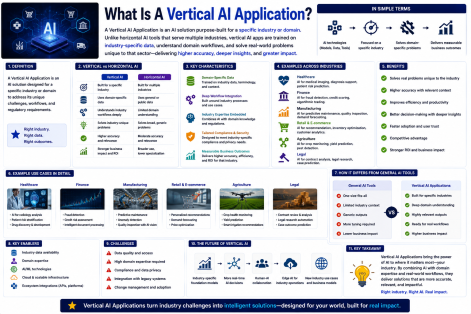
A Vertical AI application is designed to solve problems within a specific industry or business domain. Instead of offering broad capabilities for many use cases, it focuses on the unique needs of sectors such as healthcare, finance, manufacturing, legal services, retail, insurance, or construction.
By combining industry expertise with advanced AI technologies, Vertical AI applications help organizations automate specialized tasks, improve decision-making, and increase operational efficiency while supporting compliance and business-specific requirements.
What Is a Vertical AI Application?
A Vertical AI application is an artificial intelligence solution built for a particular industry, profession, or business function.
Unlike general-purpose AI, Vertical AI is trained, configured, or integrated with domain-specific knowledge, business processes, and industry regulations.
For example:
-
A healthcare AI application assists doctors with medical documentation and clinical decision support.
-
A legal AI application analyzes contracts and legal documents.
-
A financial AI application detects fraud and assesses financial risk.
-
A manufacturing AI application predicts equipment failures.
The objective is to solve specialized problems more accurately and efficiently than a generic AI system.
How Does a Vertical AI Application Work?
A Vertical AI application typically follows a structured workflow.
1. Collect Industry Data
The system gathers information from industry-specific sources such as:
-
Business databases
-
Enterprise software
-
Documents
-
Regulations
-
Industry standards
-
Operational systems
-
Customer records
2. Understand Business Context
The AI uses domain knowledge, specialized terminology, and business rules to interpret the information accurately.
Many applications combine large language models (LLMs), retrieval-augmented generation (RAG), knowledge bases, and machine learning.
3. Perform Specialized Tasks
Depending on the industry, the AI may:
-
Analyze documents
-
Detect anomalies
-
Generate reports
-
Recommend actions
-
Automate workflows
-
Predict outcomes
4. Integrate with Enterprise Systems
Vertical AI applications connect with industry software such as:
-
Electronic Health Records (EHR)
-
Customer Relationship Management (CRM)
-
Enterprise Resource Planning (ERP)
-
Financial systems
-
Manufacturing software
-
Legal management platforms
5. Support Human Decision-Making
The application provides recommendations, automation, or insights while professionals review results and make final decisions where necessary.
Key Components of a Vertical AI Application
1. AI Models
Large language models, machine learning models, or computer vision systems perform intelligent analysis.
2. Industry Knowledge Base
Stores specialized knowledge, regulations, policies, and terminology relevant to the target industry.
3. Business Workflow Integration
Connects AI capabilities with existing enterprise software and operational processes.
4. Data Management Layer
Collects, cleans, and securely manages industry-specific information.
5. Security and Compliance
Implements privacy controls, auditing, and regulatory compliance appropriate for the industry.
Key Characteristics of Vertical AI Applications
1. Industry Specialization
Designed specifically for a single sector or business function.
2. Domain Expertise
Uses industry terminology, regulations, and workflows to improve performance.
3. Workflow Integration
Works alongside existing enterprise software rather than replacing it.
4. Regulatory Awareness
Supports compliance with industry standards and legal requirements.
5. High Business Value
Focuses on solving specialized operational problems with measurable business impact.
Common Applications of Vertical AI
Vertical AI applications are widely used in:
-
Healthcare
-
Banking and financial services
-
Insurance
-
Legal services
-
Manufacturing
-
Retail and e-commerce
-
Supply chain management
-
Construction
-
Real estate
-
Agriculture
-
Education
-
Energy and utilities
-
Pharmaceuticals
-
Telecommunications
-
Cybersecurity
Benefits of Vertical AI Applications
Higher Accuracy
Industry-specific knowledge helps improve the relevance and quality of AI outputs.
Faster Business Processes
Automates repetitive tasks within specialized workflows.
Improved Compliance
Supports regulatory requirements through domain-specific rules and controls.
Better Decision Support
Provides recommendations based on industry knowledge and organizational data.
Easier Enterprise Adoption
Integrates with existing business systems and operational processes.
Challenges of Vertical AI Applications
Industry Expertise Required
Developing effective solutions requires deep knowledge of the target domain.
Data Availability
High-quality industry-specific datasets may be difficult to obtain.
Integration Complexity
Connecting AI with existing enterprise systems can be technically challenging.
Regulatory Requirements
Applications must comply with industry laws, standards, and privacy regulations.
Human Oversight Required
Professionals remain responsible for reviewing AI outputs, making critical decisions, and ensuring compliance with legal, ethical, and organizational requirements.
Vertical AI vs Horizontal AI
| Feature | Horizontal AI | Vertical AI |
|---|---|---|
| Target Users | Multiple industries | Specific industry or domain |
| Knowledge | General-purpose | Industry-specific |
| Customization | Broad | Highly specialized |
| Integration | Generic workflows | Industry software and processes |
| Best For | General productivity | Specialized business operations |
Best Practices for Building Vertical AI Applications
Understand Industry Requirements
Work closely with domain experts to identify real business problems and regulatory requirements.
Use High-Quality Industry Data
Train and validate AI using accurate, relevant, and representative information.
Integrate with Existing Systems
Connect the application with enterprise software and operational workflows.
Prioritize Security and Compliance
Protect sensitive information and meet applicable regulatory standards.
Continuously Improve Performance
Monitor accuracy, user feedback, regulatory changes, and business outcomes to refine the application over time.
Future of Vertical AI Applications
Vertical AI applications are expected to become one of the fastest-growing areas of artificial intelligence as organizations seek solutions tailored to their specific industries. Advances in large language models (LLMs), AI agents, retrieval-augmented generation (RAG), multimodal AI, and enterprise knowledge bases are enabling AI systems to better understand specialized terminology, regulations, and workflows.
Future Vertical AI platforms are likely to offer deeper integration with industry software, real-time decision support, autonomous workflow automation, and stronger compliance capabilities. Organizations will also increasingly combine Vertical AI with AI copilots and agent orchestration to automate complex, industry-specific business processes.
As artificial intelligence continues to mature, Vertical AI applications will play a central role in helping businesses improve productivity, reduce costs, enhance customer experiences, and make better decisions while addressing the unique requirements of each industry.
Conclusion
A Vertical AI application is an industry-specific artificial intelligence solution designed to solve specialized business problems using domain knowledge, enterprise data, and tailored workflows. Unlike general-purpose AI tools, Vertical AI focuses on the unique needs of a particular sector, making it more effective for specialized tasks.
From healthcare and finance to manufacturing and legal services, Vertical AI is transforming industries by improving efficiency, supporting compliance, and delivering more accurate, context-aware insights. Its ability to integrate with enterprise systems makes it a valuable component of modern digital transformation strategies.
As AI technology advances, Vertical AI applications will continue to evolve, providing organizations with increasingly intelligent, secure, and industry-focused solutions while keeping human expertise at the center of important decisions.