What Is a Recurrent Neural Network? A Simple Guide
Recurrent Neural Networks (RNNs) are a type of artificial intelligence model designed to process sequential data—information where the order of elements matters. Unlike traditional neural networks, which process each input independently, RNNs can remember information from previous inputs, making them useful for tasks involving text, speech, time-series data, and sequential patterns.
Before the rise of transformer-based models, RNNs were among the most widely used deep learning architectures for natural language processing (NLP), speech recognition, machine translation, and predictive analytics. Although newer AI models now dominate many of these applications, RNNs continue to be valuable for certain sequence-based problems and remain an important concept in machine learning.
Rather than replacing human expertise, RNNs help researchers, developers, and organizations analyze sequential information more efficiently. Human oversight remains essential to interpret results, validate predictions, and ensure responsible AI deployment.
What Is a Recurrent Neural Network?
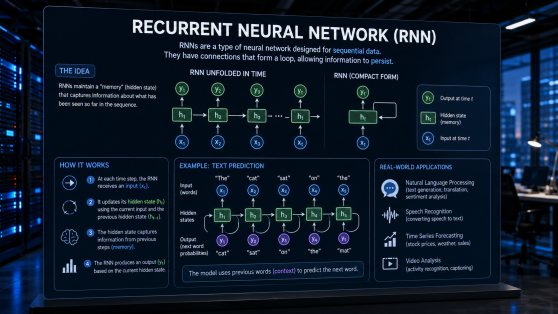
A Recurrent Neural Network (RNN) is a type of deep learning model designed to process sequential or time-dependent data by using information from previous inputs to influence future predictions.
Unlike standard neural networks, an RNN contains a feedback mechanism that allows information to flow from one step to the next. This internal memory helps the model recognize patterns across sequences instead of treating every input independently.
Because of this capability, RNNs are commonly used for tasks where context and order are important, such as language processing, speech recognition, and forecasting.
How Do Recurrent Neural Networks Work?
RNNs process data one step at a time while carrying information from earlier steps through an internal memory called the hidden state.
1. Input Sequence
The model receives sequential data such as:
-
Words in a sentence
-
Audio signals
-
Stock prices
-
Sensor readings
-
Weather data
-
User activity
Instead of processing the entire sequence at once, the RNN analyzes each element in order.
2. Hidden State
The hidden state stores information from previous inputs.
As each new input arrives, the hidden state is updated to include both the new information and the context from earlier steps.
This enables the model to recognize relationships across a sequence.
3. Output Generation
Based on the current input and the hidden state, the RNN generates an output.
Depending on the application, outputs may include:
-
Predicting the next word
-
Classifying text
-
Translating sentences
-
Forecasting future values
-
Recognizing spoken words
4. Continuous Learning
During training, the RNN adjusts its parameters using backpropagation through time (BPTT), enabling it to improve its understanding of sequential patterns over multiple training cycles.
Key Characteristics of Recurrent Neural Networks
1. Sequence Processing
RNNs are specifically designed for data where the order of information matters.
2. Memory Capability
Unlike traditional neural networks, RNNs retain information from previous steps through their hidden state.
3. Context Awareness
RNNs use earlier inputs to help interpret later inputs, making them suitable for language and time-series tasks.
4. Variable-Length Input
RNNs can process sequences of different lengths without requiring a fixed input size.
5. Flexible Applications
RNNs can be adapted for many sequential learning problems across different industries.
Common Applications of Recurrent Neural Networks
RNNs are widely used for:
-
Natural language processing (NLP)
-
Speech recognition
-
Language translation
-
Text generation
-
Sentiment analysis
-
Time-series forecasting
-
Financial prediction
-
Weather forecasting
-
Predictive maintenance
-
Handwriting recognition
-
Music generation
-
Healthcare monitoring
Benefits of Recurrent Neural Networks
Understand Sequential Data
RNNs excel at analyzing information where previous inputs influence future outputs.
Context-Based Predictions
Their memory mechanism helps improve predictions by considering earlier information in a sequence.
Flexible Input Length
RNNs can process short or long sequences without requiring a fixed number of inputs.
Broad Industry Adoption
They support applications across finance, healthcare, manufacturing, telecommunications, and language technologies.
Foundation for Modern AI Research
RNNs played a major role in advancing sequence learning and inspired later architectures such as Long Short-Term Memory (LSTM), Gated Recurrent Units (GRUs), and transformer models.
Challenges of Recurrent Neural Networks
Difficulty Learning Long-Term Dependencies
Standard RNNs often struggle to remember information across very long sequences because earlier information may gradually fade during training.
Vanishing and Exploding Gradients
Training RNNs can become difficult due to mathematical issues that affect learning over long sequences.
Slower Training
Because RNNs process data sequentially, training can be slower than architectures that support greater parallel processing.
High Computing Requirements
Large RNN models may require significant computing resources and training time.
Human Oversight
Predictions generated by RNNs should be reviewed by qualified professionals, particularly in applications involving healthcare, finance, or safety-critical systems.
Best Practices for Using Recurrent Neural Networks
Use High-Quality Sequential Data
Well-structured and representative datasets improve model performance and prediction accuracy.
Evaluate Model Performance
Test RNNs using validation datasets before deploying them in production environments.
Consider Advanced Variants
For long sequences, developers often use LSTM or GRU networks, which address many limitations of standard RNNs.
Protect Sensitive Data
Follow appropriate privacy and security practices when processing confidential sequential information.
Combine AI with Human Expertise
Treat RNNs as decision-support tools that complement professional knowledge rather than replace it.
Future of Recurrent Neural Networks
Although transformer-based architectures have become the dominant approach for many language and sequence-processing tasks, Recurrent Neural Networks continue to play an important role in education, research, and specialized applications where sequential processing is advantageous.
Future developments are likely to focus on combining RNNs with other AI architectures, improving computational efficiency, and optimizing models for edge devices, embedded systems, and real-time monitoring applications. RNN variants such as LSTMs and GRUs are expected to remain relevant for forecasting, sensor analysis, industrial automation, and certain low-resource environments.
Responsible AI development will continue emphasizing transparency, fairness, security, and human oversight. Organizations using RNNs should ensure models are regularly evaluated, updated, and used ethically.
Rather than replacing professionals, RNNs will continue supporting researchers, developers, and organizations by improving sequence analysis, forecasting, and intelligent automation.
Conclusion
Recurrent Neural Networks introduced one of the earliest and most influential methods for teaching AI systems to understand sequential information. Their ability to retain context across time made them foundational for applications such as speech recognition, language translation, forecasting, and predictive analytics.
While newer architectures have surpassed standard RNNs in many areas, they remain an important part of deep learning history and continue to serve valuable roles in specialized sequence-processing tasks.
Understanding how RNNs work also provides valuable insight into the evolution of artificial intelligence and the technologies that power many of today's advanced AI systems. When combined with human expertise and responsible AI practices, RNNs continue to support innovation across numerous industries.