What Is a Convolutional Neural Network? A Simple Guide
Convolutional Neural Networks (CNNs) are one of the most important technologies in modern artificial intelligence, especially in the field of computer vision. They enable computers to recognize, analyze, and interpret visual information such as images and videos. From facial recognition and medical imaging to self-driving cars and quality inspection in manufacturing, CNNs power many AI applications used today.
Unlike traditional image-processing methods that require manually programmed rules, CNNs automatically learn visual features directly from large datasets. This allows them to identify objects, patterns, textures, and shapes with remarkable accuracy. As a result, CNNs have become the foundation of many image recognition and visual AI systems.
Although CNNs can process visual data at high speed and scale, they are designed to assist people rather than replace human expertise. Professionals remain responsible for interpreting results, making decisions, and ensuring AI systems are used responsibly.
What Is a Convolutional Neural Network?
A Convolutional Neural Network (CNN) is a type of deep learning model specifically designed to process images, videos, and other visual data.
Instead of examining every pixel individually, a CNN learns important visual patterns such as edges, textures, shapes, and objects through multiple processing layers. As the model analyzes more images during training, it becomes better at recognizing complex visual features.
CNNs are widely used in computer vision because they can automatically extract meaningful information from images without requiring manual feature engineering.
How Do Convolutional Neural Networks Work?
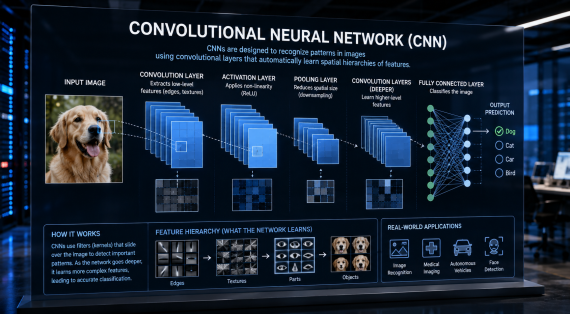
CNNs process visual information through several specialized layers that work together to identify patterns and objects.
1. Input Layer
The input layer receives an image as numerical pixel data.
Each image is converted into a matrix of pixel values that the neural network can analyze.
2. Convolution Layer
The convolution layer applies small filters (also called kernels) that scan the image to detect important visual features.
These filters help identify:
-
Edges
-
Corners
-
Lines
-
Textures
-
Shapes
-
Patterns
As training progresses, the filters automatically learn which visual features are most useful.
3. Activation Layer
After convolution, an activation function introduces non-linearity, allowing the model to recognize more complex visual relationships.
This helps CNNs distinguish between different objects even when images vary in size, lighting, or orientation.
4. Pooling Layer
Pooling reduces the size of the feature maps while preserving the most important visual information.
This makes computation more efficient and helps reduce overfitting.
Common pooling methods include:
-
Max Pooling
-
Average Pooling
5. Fully Connected Layer
The extracted visual features are combined in the fully connected layer to make the final prediction or classification.
For example, the CNN may determine whether an image contains:
-
A cat
-
A car
-
A tumor
-
A handwritten digit
-
A traffic sign
Key Characteristics of Convolutional Neural Networks
1. Automatic Feature Learning
CNNs automatically learn visual features directly from training data without requiring manual programming of image characteristics.
2. High Accuracy
CNNs achieve excellent performance on many image recognition and computer vision tasks when trained using high-quality datasets.
3. Spatial Awareness
Because CNNs preserve spatial relationships between pixels, they can recognize objects regardless of their position within an image.
4. Hierarchical Learning
Lower layers detect simple features such as edges, while deeper layers recognize increasingly complex objects and patterns.
5. Scalability
CNNs can be adapted for small image classification tasks as well as large-scale industrial computer vision systems.
Common Applications of Convolutional Neural Networks
CNNs are widely used across many industries, including:
-
Image classification
-
Object detection
-
Facial recognition
-
Medical image analysis
-
Self-driving vehicles
-
Security surveillance
-
Optical character recognition (OCR)
-
Manufacturing quality inspection
-
Satellite image analysis
-
Retail product recognition
-
Agricultural monitoring
-
Robotics vision
Benefits of Convolutional Neural Networks
Excellent Image Recognition
CNNs can accurately identify objects, people, and scenes in images and videos.
Automatic Feature Extraction
The model learns visual patterns on its own, reducing the need for manual image processing.
Fast Image Processing
Modern CNNs can analyze thousands of images quickly, making them suitable for real-time applications.
Wide Industry Adoption
CNNs support applications in healthcare, transportation, manufacturing, agriculture, retail, and security.
Continuous Improvement
CNN performance improves with larger datasets, better training methods, and advances in deep learning research.
Challenges of Convolutional Neural Networks
Large Data Requirements
CNNs generally require substantial amounts of labeled training data to achieve high accuracy.
High Computing Costs
Training deep CNN models often requires powerful GPUs and significant computational resources.
Risk of Overfitting
Models trained on limited or unbalanced datasets may perform poorly on new images.
Bias in Training Data
If training images contain biases, the CNN may produce unfair or inaccurate predictions.
Human Oversight
CNN predictions should always be reviewed by qualified professionals, especially in high-stakes fields such as healthcare and autonomous systems.
Best Practices for Using Convolutional Neural Networks
Use High-Quality Training Data
Well-labeled, diverse datasets help improve model accuracy and reliability.
Validate Model Performance
Test CNNs using separate validation datasets before deploying them in real-world applications.
Update Models Regularly
Retrain CNNs with new data to maintain accuracy as environments and data change.
Protect Data Privacy
Follow appropriate security and privacy practices when using sensitive visual data.
Combine AI with Human Expertise
Treat CNNs as decision-support tools that enhance professional work rather than replace human judgment.
Future of Convolutional Neural Networks
Convolutional Neural Networks continue to play a major role in computer vision, although they are increasingly being combined with newer AI architectures such as Vision Transformers (ViTs) and multimodal foundation models. These hybrid approaches aim to improve image understanding, efficiency, and scalability while addressing increasingly complex visual tasks.
Future CNN applications are expected to expand in healthcare diagnostics, autonomous transportation, smart manufacturing, agriculture, environmental monitoring, robotics, and augmented reality. Advances in edge computing and specialized AI hardware will also make CNN-powered systems faster and more accessible across devices.
Responsible AI development will remain essential as CNNs become more widely deployed. Researchers and organizations continue working to improve transparency, reduce bias, strengthen security, and ensure ethical use of computer vision technologies.
Rather than replacing human expertise, CNNs will continue supporting professionals by automating image analysis, improving efficiency, and enabling more informed decision-making.
Conclusion
Convolutional Neural Networks have revolutionized computer vision by enabling machines to understand and analyze visual information with remarkable accuracy. Their ability to automatically learn image features has made them one of the most widely used deep learning technologies across industries.
From healthcare and transportation to manufacturing and security, CNNs help organizations process visual data more efficiently while supporting better decisions. Their flexibility and strong performance have made them a cornerstone of modern AI applications.
As artificial intelligence continues to evolve, CNNs will remain an essential technology for image recognition and visual analysis. When combined with human expertise and responsible AI practices, they can improve productivity, support innovation, and solve increasingly complex visual challenges.