
What Are AI Model Benchmarks? How They Work, Types and Importance
AI model benchmarks are standardized evaluation methods used to measure the performance, accuracy, reasoning ability, efficiency, and overall capabilities of Artificial Intelligence models. As AI systems become more advanced, benchmarks play a crucial role in comparing different models, identifying strengths and weaknesses, and helping organizations select the right AI solution for specific tasks. From Large Language Models to computer vision and multimodal AI systems, benchmark testing has become an essential part of AI development and deployment.
What Are AI Model Benchmarks?
AI model benchmarks are standardized tests designed to evaluate how well an AI model performs on predefined tasks. They provide measurable results that help researchers, developers, and businesses compare different AI models under consistent conditions.
How AI Model Benchmarks Work
Benchmark datasets contain carefully selected questions, images, code, or other tasks. AI models complete these tasks, and their performance is measured using metrics such as accuracy, reasoning ability, response quality, speed, and efficiency.
Why AI Model Benchmarks Matter
Benchmarks help organizations make informed decisions by providing objective comparisons between AI models. They also encourage continuous improvement by highlighting areas where models perform well or require further development.
Types of AI Model Benchmarks
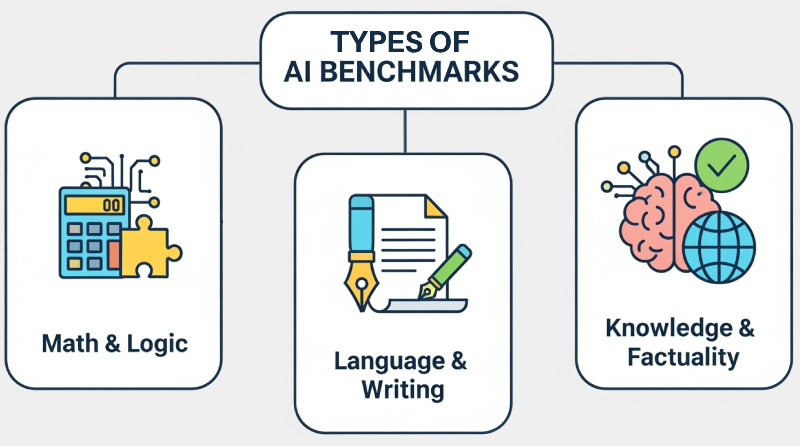
Different benchmarks evaluate different aspects of AI performance.
Language Understanding Benchmarks
These tests measure reading comprehension, reasoning, knowledge, mathematics, coding, and natural language understanding capabilities of Large Language Models.
Computer Vision Benchmarks
Computer vision benchmarks evaluate image classification, object detection, image recognition, segmentation, and visual reasoning performance.
Multimodal Benchmarks
Multimodal benchmarks assess how effectively AI models understand and combine multiple data types such as text, images, audio, and video.
Common AI Evaluation Metrics
Several metrics are commonly used to assess AI model performance.
Accuracy
Accuracy measures how often an AI model produces correct answers or predictions across benchmark tasks.
Speed and Efficiency
Performance testing also evaluates response time, computational efficiency, memory usage, and inference speed.
Reasoning and Problem-Solving
Modern benchmarks increasingly assess logical reasoning, mathematical ability, coding performance, and complex decision-making skills rather than simple factual recall.
Benefits of AI Model Benchmarks
AI benchmarks provide several important advantages.
Objective Comparison
Benchmarks allow researchers and organizations to compare multiple AI models using standardized evaluation criteria.
Better Model Selection
Businesses can identify models best suited for customer support, coding, research, content creation, healthcare, finance, or enterprise applications.
Continuous Improvement
Benchmark results help developers identify weaknesses and improve future AI model performance through training and optimization.
Challenges of AI Model Benchmarks
Despite their importance, AI benchmarks have certain limitations.
Limited Real-World Representation
Strong benchmark scores do not always guarantee excellent performance in real-world business or consumer applications.
Rapid Technological Change
As AI models improve rapidly, benchmark datasets require regular updates to remain relevant and meaningful.
Overfitting to Benchmarks
Developers may optimize models specifically for benchmark performance rather than improving broader real-world capabilities.
Future of AI Model Benchmarks
AI benchmarking is expected to become more comprehensive as future evaluations incorporate reasoning, multimodal understanding, factual reliability, safety, efficiency, and real-world task performance. New benchmark frameworks are likely to better reflect enterprise requirements, responsible AI practices, and practical deployment scenarios. As Artificial Intelligence continues to evolve, benchmarking will remain essential for measuring progress and guiding responsible AI development.
Conclusion
AI model benchmarks provide a standardized way to evaluate the capabilities and performance of Artificial Intelligence systems. By measuring accuracy, reasoning, efficiency, and task-specific performance, benchmarks help developers improve models and enable organizations to choose the most suitable AI solutions. As AI technologies continue advancing, benchmark testing will remain a critical tool for ensuring transparency, innovation, and continuous improvement across the AI industry.