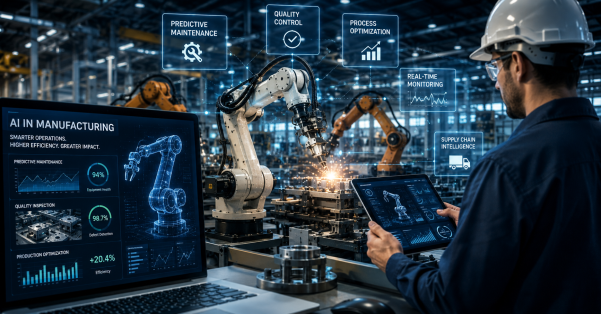
AI in Manufacturing: How Artificial Intelligence Is Transforming Smart Factories
Artificial Intelligence (AI) is revolutionizing manufacturing by improving production efficiency, reducing downtime, enhancing product quality, and optimizing supply chain operations. AI-powered systems analyze large volumes of industrial data, automate repetitive processes, predict equipment failures, and support real-time decision-making on factory floors. As manufacturers embrace Industry 4.0, AI has become a critical technology for building smarter, safer, and more efficient production environments.
What Is AI in Manufacturing?

AI in manufacturing refers to the use of Artificial Intelligence technologies to automate production processes, improve operational efficiency, optimize supply chains, and enhance product quality across manufacturing facilities.
How AI in Manufacturing Works
AI combines machine learning, computer vision, predictive analytics, robotics, Internet of Things (IoT) data, and Generative AI to monitor equipment, analyze production data, detect defects, and automate manufacturing workflows.
Why AI in Manufacturing Matters
AI enables manufacturers to increase productivity, reduce operating costs, minimize equipment downtime, improve workplace safety, and respond more quickly to changing market demands.
Key Applications of AI in Manufacturing
AI is transforming nearly every stage of the manufacturing process.
Predictive Maintenance
AI analyzes sensor data from machinery to predict equipment failures before they occur, allowing manufacturers to schedule maintenance proactively and reduce costly downtime.
Quality Control
Computer vision systems inspect products in real time, identify defects, ensure consistent quality, and reduce waste during production.
Industrial Robotics
AI-powered robots perform repetitive, hazardous, and precision-based tasks such as assembly, welding, packaging, material handling, and machine operation with greater accuracy and efficiency.
Supply Chain Optimization
Manufacturers use AI to forecast demand, optimize inventory, improve logistics, and enhance production planning across global supply chains.
Benefits of AI in Manufacturing
AI offers significant advantages for manufacturing organizations.
Increased Productivity
AI automates repetitive tasks, optimizes production schedules, and improves equipment utilization, leading to higher output and efficiency.
Reduced Costs
Predictive maintenance, quality improvements, and workflow optimization help reduce waste, downtime, and operational expenses.
Better Decision-Making
AI analyzes real-time production data and provides actionable insights that support faster and more informed operational decisions.
Challenges of AI in Manufacturing
Despite its benefits, AI implementation presents several challenges.
High Initial Investment
Deploying AI solutions often requires investment in sensors, industrial software, data infrastructure, and employee training.
System Integration
Integrating AI with existing manufacturing equipment, enterprise systems, and legacy technologies can be technically complex.
Workforce Development
Employees need training to effectively operate, manage, and collaborate with AI-powered manufacturing systems.
Future of AI in Manufacturing
AI is expected to play an even greater role in manufacturing through autonomous factories, collaborative robots (cobots), digital twins, edge AI, and advanced predictive analytics. Future manufacturing systems will continuously optimize production, reduce energy consumption, improve sustainability, and enable highly flexible, data-driven operations. As Artificial Intelligence continues to evolve, AI-powered manufacturing will become more intelligent, resilient, and competitive.
Conclusion
Artificial Intelligence is transforming manufacturing by improving efficiency, automating production processes, enhancing quality control, and enabling predictive maintenance. From industrial robotics and smart factories to supply chain optimization and real-time analytics, AI is helping manufacturers reduce costs while increasing productivity and product quality. As technology advances, AI in Manufacturing will continue to drive innovation and shape the future of industrial production.