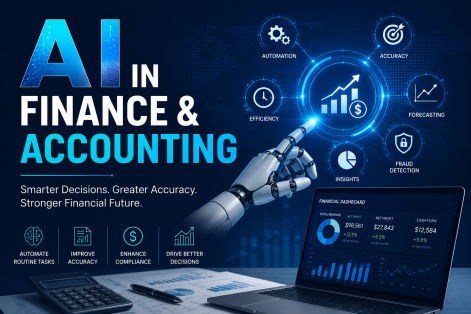
AI in Finance and Accounting: How Artificial Intelligence Is Transforming Financial Operations
Artificial Intelligence (AI) is transforming finance and accounting by automating repetitive processes, improving financial analysis, detecting fraud, and supporting faster, data-driven decision-making. From invoice processing and expense management to financial forecasting and regulatory compliance, AI enables finance professionals to work more efficiently while improving accuracy and reducing operational costs. As organizations accelerate digital transformation, AI has become a strategic technology for modern finance and accounting functions.
What Is AI in Finance and Accounting?

AI in finance and accounting refers to the use of Artificial Intelligence technologies to automate financial processes, analyze large volumes of financial data, improve forecasting, and support accounting operations.
How AI in Finance and Accounting Works
AI combines machine learning, Natural Language Processing (NLP), predictive analytics, and Generative AI to process financial transactions, identify anomalies, generate reports, forecast business performance, and automate routine accounting tasks.
Why AI in Finance and Accounting Matters
AI improves efficiency, minimizes manual errors, strengthens financial controls, and enables finance teams to focus on strategic planning and business growth instead of repetitive administrative work.
Key Applications of AI in Finance and Accounting
AI is being integrated across nearly every financial function.
Financial Reporting and Analysis
AI automates financial reporting, analyzes historical data, identifies trends, and generates insights that support informed business decisions.
Fraud Detection and Risk Management
Financial institutions and businesses use AI to monitor transactions, identify unusual activities, detect potential fraud, and strengthen risk management processes.
Accounting Automation
AI streamlines accounts payable, accounts receivable, invoice processing, expense management, reconciliations, payroll support, and bookkeeping activities.
Benefits of AI in Finance and Accounting
AI provides significant advantages for finance professionals and organizations.
Increased Accuracy
AI reduces manual data entry and calculation errors, improving the accuracy of financial records and reporting.
Faster Decision-Making
Real-time financial analytics and predictive insights help organizations respond quickly to changing business conditions and market opportunities.
Improved Operational Efficiency
By automating repetitive financial tasks, AI enables accounting teams to focus on financial strategy, planning, auditing, and advisory services.
Challenges of AI in Finance and Accounting
Despite its advantages, AI adoption presents several challenges.
Data Security
Financial information is highly sensitive, requiring strong cybersecurity measures, encryption, and access controls when implementing AI solutions.
Regulatory Compliance
Organizations must ensure AI systems comply with accounting standards, financial regulations, audit requirements, and data protection laws.
Human Oversight
AI supports financial analysis and automation, but experienced finance professionals remain essential for strategic planning, regulatory interpretation, and complex financial decision-making.
Future of AI in Finance and Accounting
AI is expected to play an increasingly important role in financial operations through advances in predictive analytics, intelligent automation, autonomous finance assistants, and real-time business intelligence. Future AI systems will automate more accounting workflows, improve financial forecasting, strengthen fraud prevention, and support faster strategic decision-making. As Artificial Intelligence continues to evolve, finance and accounting functions are expected to become more efficient, accurate, and data-driven.
Conclusion
Artificial Intelligence is reshaping finance and accounting by automating routine processes, enhancing financial analysis, improving fraud detection, and enabling smarter business decisions. From accounting automation to predictive financial planning, AI is helping organizations improve operational efficiency while reducing costs and increasing accuracy. As technology advances, AI in Finance and Accounting will continue to play a critical role in driving financial innovation, regulatory compliance, and sustainable business growth.