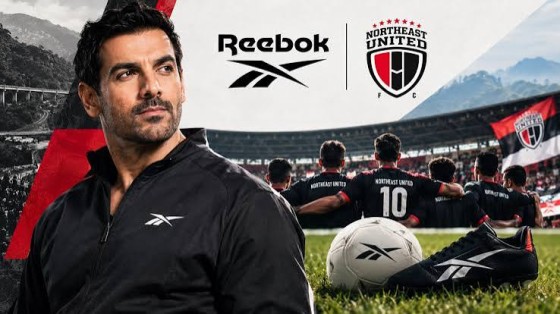
Reebok Returns to Indian Football Through NorthEast United FC Jersey Partnership
Reebok has reinforced its return to competitive football sponsorship in India through its partnership with NorthEast United FC, unveiling the club's 2026–27 season jersey as the global sportswear brand seeks to rebuild its sporting relevance and deepen its connection with younger Indian consumers.
The new kit was unveiled in Mumbai by Aryaman Vikram Birla, Director at the Aditya Birla Group and Non-Executive Director of Aditya Birla Lifestyle Brands Limited, and NorthEast United FC co-owner John Abraham.
Reebok is serving as the club's official kit and merchandise partner, extending an association that began in 2025 and placing the brand directly within one of India's most football-focused regional communities.
The 2026–27 jersey prominently incorporates eight stars representing the eight states of Northeast India, connecting the club's visual identity with the region it represents.
For Reebok, the partnership goes beyond supplying team apparel. It forms part of a wider strategy to restore the brand's credibility through competitive sport while using football to engage consumers around community, culture and athletic identity.
Reebok and NorthEast United Unveil 2026–27 Jersey

NorthEast United FC unveiled its latest Reebok kit in:
Mumbai in September 2026.
The event brought together representatives from Reebok, the Aditya Birla Group and NorthEast United FC, along with members of the club's playing squad.
The launch also included an exhibition football match that gave attendees a first look at the new kit in action.
Players associated with the unveiling included Gurmeet Singh, Buanthanglun Samte, Redeem Tlang and Lalrinzuala Lalbiaknia, among other members of the NorthEast United setup.
Partnership Marks Reebok's Renewed Football Push in India
The association represents a renewed competitive-football push for Reebok in India.
The brand has a long history in Indian sport, having previously worked across:
cricket,
football,
running,
fitness,
and athlete partnerships.
Its NorthEast United association provides a direct route back into team sport while connecting Reebok with a region where football has deep cultural importance.
Partnership Originally Began in 2025
While the latest jersey launch highlights Reebok's renewed push into Indian football, the underlying partnership is not entirely new.
Reebok first announced its strategic association with NorthEast United FC in July 2025.
The club subsequently competed in Reebok-designed colours during the 2025–26 season.
The 2026–27 jersey therefore represents the continuation and strengthening of that relationship rather than the first-ever agreement between the two organisations.
Reebok Is Official Kit and Merchandise Partner
Under the association, Reebok operates as NorthEast United FC's:
kit and merchandise partner.
That role provides considerably greater brand visibility than a conventional advertising sponsorship.
The Reebok identity appears directly on the apparel worn by players, giving the brand exposure through:
matches,
training,
club content,
photography,
social media,
and fan merchandise.
For sportswear companies, kit partnerships can create a particularly authentic connection between product and sport.
Eight Stars Represent Northeast India's Eight States
One of the central visual elements of the jersey is:
eight stars.
They represent the eight states of Northeast India:
Arunachal Pradesh,
Assam,
Manipur,
Meghalaya,
Mizoram,
Nagaland,
Sikkim,
and Tripura.
The symbolism reinforces NorthEast United FC's distinctive positioning as a club representing an entire region rather than a single city.
Regional Identity Is Central to NorthEast United FC
NorthEast United FC was founded in:
2014
and has built its identity around representing India's Northeast.
Football has an unusually strong cultural presence across several northeastern states.
The region has also produced a substantial number of players for Indian clubs and national teams.
This gives NorthEast United a community connection that is particularly valuable for a consumer brand seeking authentic engagement through sport.
Reebok Sees Football as Consumer-Engagement Platform
Reebok India has positioned football as an important way to engage:
a new generation of consumers.
The strategic logic extends beyond match-day visibility.
Football combines:
sport,
fashion,
youth culture,
music,
community,
and streetwear.
For a sportswear company, these overlapping cultural areas can create opportunities to sell products well beyond technical football apparel.
Sportswear Is Growing Within Fashion and Lifestyle
Aryaman Vikram Birla has highlighted sportswear as one of the more attractive opportunities within India's broader fashion and lifestyle market.
Consumer wardrobes have increasingly blurred the distinction between:
sportswear,
casualwear,
and fashion.
Products originally designed around athletic performance are routinely worn in everyday settings.
That trend expands the commercial opportunity for brands with credible sporting heritage.
Reebok Wants to Rebuild Relevance Through Sport
Reebok's current strategy increasingly emphasises its historical sporting identity.
The company has strong heritage across:
fitness,
basketball,
running,
training,
and football.
However, the global sportswear market is intensely competitive.
Brands need more than historical recognition to remain culturally relevant.
Active participation in sport can help Reebok demonstrate that it remains a performance-led brand rather than relying primarily on nostalgia.
NorthEast United Provides Authentic Football Connection
NorthEast United offers Reebok something difficult to create through conventional advertising:
an existing football community.
The club's supporters already have emotional connections with:
the team,
its players,
and the region.
A kit partnership allows Reebok to participate within that relationship.
If handled effectively, this can generate stronger consumer affinity than a campaign built entirely around paid media.
John Abraham Highlights Club's Ambition
NorthEast United FC co-owner John Abraham has described the Reebok partnership as an important moment for the club.
The association reflects NorthEast United's ambition to strengthen its position both:
on the pitch
and:
commercially.
A globally recognised sportswear partner can contribute to the club's brand perception while potentially improving merchandising opportunities and international visibility.
Club Has Strengthened Its Competitive Profile
NorthEast United has also strengthened its sporting credentials in recent seasons.
The club won the:
2024 Durand Cup
and followed that success by winning the competition again, establishing itself as a two-time Durand Cup champion.
Improved sporting performance can make a club substantially more valuable to sponsors.
Success increases:
media coverage,
supporter engagement,
merchandise interest,
and the visibility of commercial partners.
Sponsorship Gives Reebok Access to Northeast Market
The partnership has particular strategic value because Northeast India represents a distinctive football market.
Unlike many parts of India where cricket overwhelmingly dominates spectator sport, football enjoys deep grassroots participation and cultural relevance across the Northeast.
For Reebok, this creates an opportunity to establish brand credibility with consumers through a sport they already care about rather than attempting to manufacture interest.
Football Shirts Are Becoming Lifestyle Products
Modern football jerseys are increasingly sold as:
fashion
as well as:
sports merchandise.
Supporters wear club shirts outside stadiums as symbols of:
identity,
community,
and fandom.
This creates a direct commercial opportunity for kit manufacturers.
A successful jersey can generate sales among people who may never play competitive football themselves.
Merchandise Can Strengthen Club Economics
For NorthEast United FC, the partnership can also help develop its merchandise business.
Indian football clubs have historically generated less merchandise revenue than major clubs in mature football markets.
That leaves significant room for growth.
A recognised sportswear partner can improve:
product quality,
retail distribution,
design,
and consumer trust.
These factors can help clubs monetise their supporter bases more effectively.
Sports Partnerships Support Reebok's India Expansion
Reebok's Indian operations are being developed within the Aditya Birla fashion and lifestyle ecosystem.
The partnership with NorthEast United therefore sits within a broader effort to expand the brand's relevance in India's:
sportswear,
fitness,
and lifestyle markets.
Sports partnerships can support that strategy by giving products an authentic performance context.
Reebok's Football Strategy Extends Beyond India
The NorthEast United partnership also reflects Reebok's wider international return to football.
Globally, the brand has pursued football associations with clubs including Botafogo in Brazil and Charlton Athletic in England.
These partnerships indicate a strategy based on selecting clubs with strong:
local identities,
communities,
and football cultures.
NorthEast United fits naturally within that approach.
Community-Led Partnerships Can Differentiate Reebok
Reebok faces competitors with enormous global sponsorship portfolios.
Attempting to compete purely by signing the largest teams would require substantial investment.
A community-led approach offers an alternative.
The brand can select clubs where it has an opportunity to become a more meaningful commercial partner rather than one of many sponsors.
That strategy can produce deeper local relevance even with lower absolute global reach.
Indian Football Offers Long-Term Commercial Potential
India remains a relatively underdeveloped football market from a commercial perspective.
That creates risk, but it also creates opportunity.
If professional football participation and fandom grow over time, companies entering the ecosystem earlier can potentially build:
brand recognition,
consumer loyalty,
and commercial relationships
before sponsorship costs increase.
Reebok's partnership can therefore be viewed as a longer-term investment in the development of football culture.
Football Faces Structural Challenges in India
The commercial opportunity needs to be balanced against the challenges facing Indian football.
Domestic professional football has experienced periods of uncertainty around:
league structures,
commercial models,
broadcasting,
and club economics.
These issues can make sponsorship decisions more complicated.
However, Reebok and the Aditya Birla Group have signalled that they continue to see value in supporting the sport despite those challenges.
Brands Can Help Build Emerging Sports Ecosystems
Large consumer companies can play an important role in developing sports beyond simply buying advertising inventory.
Commercial partners provide:
funding,
products,
marketing,
distribution,
and visibility.
In developing sports markets, those resources can contribute to stronger clubs and more professional operations.
Reebok's involvement with NorthEast United therefore has potential value for both the company and the wider football ecosystem.
Club Represents More Than Match Results
For sponsors, NorthEast United's value isn't determined solely by league position.
The club represents:
regional pride,
football heritage,
and Northeast identity.
That gives it cultural assets extending beyond individual match outcomes.
Brands increasingly look for precisely these kinds of properties because emotional communities can generate deeper engagement than generic sponsorship exposure.
Jersey Design Reinforces Cultural Strategy
The eight-star design demonstrates how the partnership is attempting to connect product with identity.
Instead of creating a generic sports shirt, the jersey incorporates a visual reference to the region represented by the club.
This can strengthen its appeal as merchandise.
Supporters are not simply buying athletic apparel.
They are buying a symbol of:
regional belonging.
Digital Media Extends Sponsorship Reach
The commercial value of a jersey partnership is no longer limited to televised matches.
Every club photograph, social post, player interview and video can display the kit.
This means Reebok can receive continuous exposure through:
Instagram,
YouTube,
short-form video,
club websites,
and fan-created content.
Digital distribution makes team apparel one of the most persistent sponsorship assets in modern sport.
Young Fans Are Particularly Important
Reebok has specifically emphasised engaging a new generation of consumers.
Football offers a strong platform for this objective because younger fans frequently combine sport with:
gaming,
fashion,
social media,
music,
and creator culture.
Sportswear brands can participate across all of these environments.
The commercial opportunity therefore extends considerably beyond football boots and match jerseys.
Reebok Can Use Partnership for Retail Activation
The association can also support physical retail.
Products linked to NorthEast United can potentially be used for:
store launches,
fan events,
player appearances,
limited-edition merchandise,
and regional activations.
These initiatives can connect Reebok's sports sponsorship directly with consumer sales.
The stronger the club's supporter engagement, the more commercially useful these activations can become.
Indian Sportswear Competition Is Intensifying
Reebok's renewed sports push comes amid intense competition in India's sportswear market.
Global and domestic companies are competing for consumers across:
performance footwear,
athleisure,
training,
running,
and lifestyle apparel.
Brand heritage alone is unlikely to determine winners.
Companies need:
distribution,
product relevance,
competitive pricing,
and cultural visibility.
Sports partnerships can strengthen the final element.
Authenticity Matters in Sports Marketing
Consumers can distinguish between brands that simply advertise around sport and those with genuine participation in it.
Kit partnerships provide authenticity because the product is actually used by professional athletes.
That gives Reebok an opportunity to demonstrate performance credentials directly on the field.
For a company seeking to reinforce its sporting identity, this is strategically valuable.
Partnership Can Benefit Both Brand and Club
The commercial logic works in both directions.
Reebok gains access to:
a football audience,
regional identity,
and sporting credibility.
NorthEast United gains:
a globally recognised sportswear name,
merchandise capability,
and additional commercial visibility.
The partnership therefore creates potential value beyond a conventional sponsor-property relationship.
Conclusion
Reebok's partnership with NorthEast United FC marks a renewed push into competitive football sponsorship in India, with the sportswear brand unveiling the club's 2026–27 jersey as part of a broader strategy to strengthen its sporting relevance.
The association builds on the strategic partnership first announced in 2025, with Reebok continuing as NorthEast United's official kit and merchandise partner.
The latest jersey was unveiled in Mumbai by Aryaman Vikram Birla and John Abraham and prominently features eight stars representing the eight states of Northeast India, reinforcing the club's regional identity.
For NorthEast United FC, the association provides a globally recognised sportswear partner as the club seeks to strengthen its commercial and sporting profile. For Reebok, it offers an authentic connection to one of India's most deeply rooted football communities.
The partnership also reflects a larger commercial strategy. As sportswear increasingly overlaps with fashion and lifestyle, Reebok is using competitive sport to connect its heritage with younger consumers.
NorthEast United provides a particularly relevant platform because its value extends beyond match-day exposure to community, culture, regional pride and merchandise.
As Reebok rebuilds its presence across global football, its NorthEast United FC partnership demonstrates how the brand is using locally significant clubs to combine sporting credibility with consumer engagement in India.