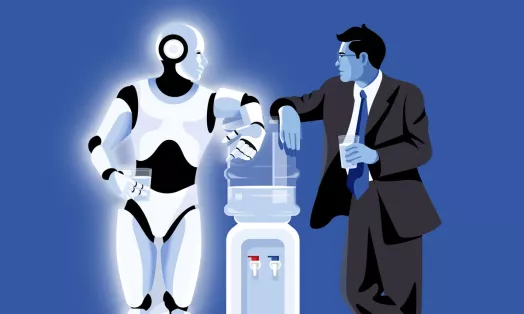
AI Co-Workers: How Humans and Machines Will Collaborate in the Future
The workplace of 2025 is no longer just a sea of desks, meetings, and emails—it’s a hybrid ecosystem of humans and intelligent machines working together. As Artificial Intelligence (AI) becomes more integrated into daily operations, the relationship between human workers and their AI counterparts is being redefined.
Rather than replacing jobs, AI is evolving into a collaborative partner, boosting productivity, automating mundane tasks, and even enhancing creativity.
Here’s how humans and AI are teaming up to reshape the future of work.
1. AI as the Ultimate Assistant
One of the most prominent ways AI is helping workers is through smart virtual assistants:
-
Scheduling meetings, sending reminders, and managing inboxes
-
Generating real-time summaries of video calls and discussions
-
Automating repetitive workflows in HR, finance, and customer support
Example: Tools like Microsoft Copilot, Google Duet AI, and Notion AI are embedded in daily tools like Word, Gmail, and Slack, transforming how professionals manage their time.
✅ Impact: Employees spend less time on admin and more time on strategic, high-value tasks.
2. Augmented Decision-Making
AI doesn't just automate—it enhances decision-making through data analysis:
-
AI systems sift through vast data sets to provide real-time insights
-
Predictive models help forecast trends, manage risks, and optimize operations
-
Managers use AI dashboards for performance tracking, supply chain insights, and customer behavior patterns
Example: In finance, AI models now detect fraud faster than human teams ever could. In marketing, AI personalizes campaigns for micro-segments instantly.
✅ Impact: Smarter decisions, reduced human error, and faster execution.
3. Creative Collaboration with AI
The myth that AI can’t be creative is being shattered in 2025.
-
Writers use AI to brainstorm content, generate drafts, and improve tone
-
Designers leverage generative AI for rapid prototyping and visual creation
-
Musicians and filmmakers collaborate with AI for sound mixing, editing, and storytelling
Example: Platforms like Adobe Firefly, Midjourney, and ChatGPT are used daily by creatives in advertising, publishing, and gaming.
✅ Impact: Humans provide context and emotion, while AI enhances speed, precision, and variety.
4. AI in Manufacturing and Engineering
The shop floor is transforming with robotic-AI hybrids:
-
AI-powered cobots (collaborative robots) work alongside technicians to assemble products
-
Maintenance crews use AI-based predictive analytics to prevent machinery failures
-
Engineers test virtual simulations (digital twins) using real-time AI feedback
Example: In automotive plants, robots and engineers co-manage production with AI-led optimization.
✅ Impact: Higher efficiency, fewer errors, and safer working conditions.
5. Personalized Learning and Upskilling with AI
In the age of rapid tech evolution, continuous learning is essential.
-
AI creates adaptive learning paths based on individual employee progress
-
Suggests micro-courses, certifications, or project simulations
-
Tracks performance to optimize employee growth
Example: Corporates use platforms like Coursera for Business, EdCast, and LinkedIn Learning with AI integrations to guide workforce development.
✅ Impact: Faster upskilling, talent retention, and workforce relevance in a dynamic market.
6. Ethical AI Collaboration and Trust
Trust between human and machine is crucial for seamless collaboration.
-
Transparent AI systems offer explainable insights and decision reasoning
-
Employees are trained in AI literacy to understand, use, and monitor AI systems effectively
-
Businesses establish AI ethics guidelines to prevent bias and ensure fairness
Example: Companies like IBM and Salesforce lead in creating responsible AI governance frameworks.
✅ Impact: A balanced, fair, and human-centric AI partnership.
7. Changing Roles, Not Replacing Humans
AI isn’t replacing people—it’s reshaping roles:
-
HR professionals now focus on employee experience and talent strategy, with AI handling payroll and compliance
-
Data analysts evolve into AI model auditors and insight translators
-
Customer support agents manage complex queries while AI handles the routine
✅ Impact: Workers move up the value chain, while machines manage the base.
Conclusion: The Human-AI Dream Team
In 2025, humans and AI aren’t in competition—they’re in cooperation. By combining human intuition, empathy, and creativity with AI’s speed, scale, and precision, we’re entering a new era of co-evolution at work.
This is not just the future of employment.
It’s the beginning of a new kind of teamwork—where machines are not just tools but trusted collaborators.