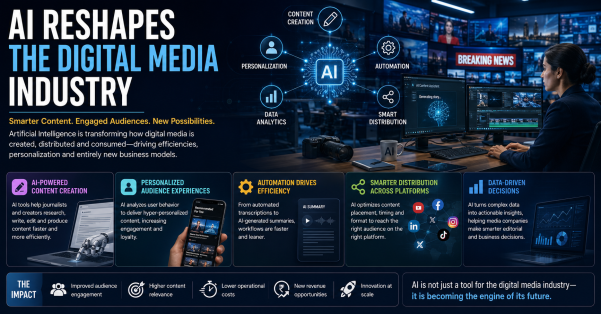
AI Reshapes the Digital Media Industry Through Automation, Personalisation, and Content Innovation
Artificial intelligence (AI) is rapidly transforming the digital media industry by changing how content is created, distributed, monetised, and consumed. Media companies, publishers, streaming platforms, advertisers, and content creators are increasingly adopting AI-powered technologies to improve efficiency, deliver personalised experiences, and strengthen audience engagement in an increasingly competitive digital landscape.
As consumer preferences continue to evolve, AI has become a strategic tool for enhancing productivity, supporting editorial workflows, improving advertising performance, and unlocking new revenue opportunities across the media ecosystem.
AI Adoption Accelerates Across Digital Media
AI is being integrated into multiple areas of the digital media value chain, including:
-
Digital publishing
-
Video streaming
-
Music streaming
-
Social media platforms
-
News media
-
Podcast production
-
Online advertising
-
Content recommendation
-
Marketing automation
-
Audience analytics
These technologies are helping organisations deliver more relevant, engaging, and data-driven digital experiences.
Key Areas Where AI Is Transforming Digital Media
Content Creation and Production
AI-powered tools assist media professionals by streamlining repetitive tasks such as content research, editing, transcription, translation, caption generation, and multimedia production. This enables creative teams to focus on storytelling, investigative reporting, and strategic content development.
Personalised Content Recommendations
Streaming services, news platforms, and social media companies use AI algorithms to analyse user behaviour and recommend articles, videos, podcasts, music, and other digital content based on individual preferences.
Advertising Optimisation
AI is improving digital advertising by enabling audience targeting, campaign optimisation, real-time bidding, customer segmentation, and performance measurement. Advertisers can deliver more relevant campaigns while improving return on investment.
Audience Analytics
Advanced analytics powered by AI help publishers understand audience behaviour, engagement trends, subscription patterns, and content performance, supporting more informed editorial and business decisions.
Content Moderation
AI systems help identify spam, misinformation, harmful content, and policy violations, allowing platforms to maintain safer digital environments while supporting scalable moderation.
Technology Driving the Transformation
Digital media companies continue investing in technologies such as:
-
Artificial intelligence
-
Machine learning
-
Natural language processing (NLP)
-
Computer vision
-
Predictive analytics
-
Recommendation engines
-
Cloud computing
-
Marketing automation
-
Speech recognition
-
Data analytics
Together, these technologies enable faster workflows, improved audience engagement, and greater operational efficiency.
Business Opportunities
AI is creating new growth opportunities across the media industry by supporting:
-
Subscription growth
-
Digital advertising revenue
-
Premium content services
-
Creator economy platforms
-
Content licensing
-
Podcast monetisation
-
Video streaming expansion
-
Audience retention
-
Multilingual content distribution
-
Automated content workflows
Media organisations are increasingly using AI to diversify revenue streams while improving customer experiences.
Benefits for Media Companies
AI offers several advantages to publishers, broadcasters, and digital platforms, including:
-
Faster content production
-
Improved operational efficiency
-
Better audience targeting
-
Personalised user experiences
-
Enhanced advertising effectiveness
-
Data-driven decision-making
-
Lower operational costs
-
Stronger customer engagement
-
Increased subscription retention
-
Scalable digital operations
These benefits are helping companies remain competitive in a rapidly evolving media environment.
Challenges and Considerations
Despite its advantages, AI adoption presents several challenges.
Content Authenticity
Media organisations must ensure that AI-assisted workflows maintain editorial standards, factual accuracy, and transparency.
Copyright and Intellectual Property
The growing use of AI raises important questions around content ownership, licensing, and protection of intellectual property.
Data Privacy
AI systems rely on large datasets, making responsible data collection, storage, and regulatory compliance essential.
Algorithmic Bias
Companies must continuously evaluate AI models to minimise bias and ensure fair, balanced, and inclusive content recommendations.
Workforce Transformation
As automation increases, media organisations are investing in employee training and digital skills to help teams work effectively alongside AI technologies.
Future Outlook
AI is expected to become even more deeply integrated into the digital media industry in the coming years.
Key trends likely to shape the future include:
-
Hyper-personalised content experiences
-
AI-powered newsroom workflows
-
Growth of multilingual digital publishing
-
Smarter advertising technologies
-
Automated video and audio production
-
Expansion of creator-focused AI tools
-
Predictive audience analytics
-
Interactive and immersive media experiences
-
Greater investment in responsible AI governance
-
Continued innovation in subscription and monetisation models
Companies that successfully combine AI capabilities with high-quality journalism, creative storytelling, and strong audience trust are expected to strengthen their competitive position in the digital media landscape.
Conclusion
Artificial intelligence is reshaping the digital media industry by improving content production, enhancing personalisation, strengthening advertising performance, and enabling smarter business decisions. As publishers, broadcasters, streaming platforms, and creators continue investing in AI-powered technologies, the industry is becoming more efficient, data-driven, and customer-focused.
While challenges related to content authenticity, copyright, privacy, and governance require careful management, the long-term outlook remains positive. Organisations that embrace responsible AI adoption while maintaining editorial integrity and audience trust are expected to lead the next phase of digital media innovation.