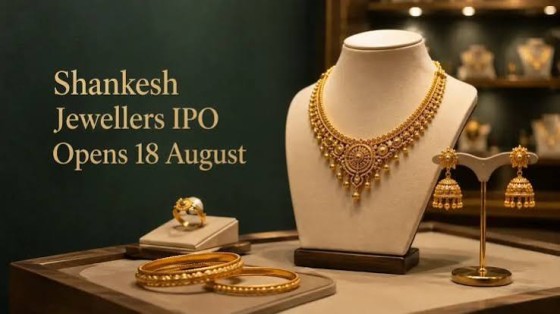
Shankesh Jewellers Opens IPO for Subscription on August 18 as India’s Primary Market Stays Active
Shankesh Jewellers has opened its initial public offering for subscription on Tuesday, August 18, 2026, joining a busy pipeline of companies tapping India's primary equity market. The Mumbai-based jewellery company will keep the public issue open through August 20, giving investors three days to submit bids. The offering comes amid sustained IPO activity in India and continued investor interest in consumer-facing businesses. For Shankesh Jewellers, the public issue represents an opportunity to access equity capital while increasing its visibility within India's large and highly fragmented jewellery market.
Shankesh Jewellers IPO Opens for Investors

The public issue officially entered its subscription period on August 18.
Subscription Window Runs Until August 20
Investors can bid for shares in the Shankesh Jewellers IPO between August 18 and August 20.
The three-day subscription period will determine demand across the investor categories applicable to the offering.
Once the issue closes, attention will shift toward finalisation of allotment and the subsequent listing process.
Subscription data during the bidding period can provide an indication of investor interest, although demand on individual days should not be viewed in isolation.
IPO subscriptions can accelerate significantly during the final day as institutional and other investors complete their bidding decisions.
IPO Arrives During Busy Primary-Market Week
Shankesh Jewellers is one of several companies accessing India's primary market during the week beginning August 17.
The calendar includes companies from multiple industries seeking several thousand crore rupees collectively.
This level of activity demonstrates that businesses continue to view public markets as an important source of growth and shareholder liquidity.
For investors, however, a crowded IPO calendar also creates competition for capital.
Each company must persuade investors that its business model, financial performance and valuation provide an attractive opportunity compared with other available offerings.
Shankesh Jewellers Operates in Jewellery Market
The company's underlying business gives investors exposure to India's large gold and jewellery ecosystem.
Company Focuses on Jewellery Operations
Shankesh Jewellers operates from Mumbai and participates in the jewellery industry, including gold jewellery.
India represents one of the world's most important jewellery markets.
Gold has both cultural and financial significance across the country.
Demand is supported by weddings, festivals, gifting and household investment.
This creates a substantial underlying market for jewellery businesses.
However, demand can fluctuate according to gold prices, consumer confidence and discretionary purchasing power.
Companies therefore need to manage inventory and working capital carefully.
Jewellery Market Remains Highly Fragmented
India's jewellery industry includes large listed retailers, regional chains, family-owned stores, wholesalers and independent jewellers.
The fragmented structure creates opportunities for organised businesses to expand.
Consumers are increasingly attentive to purity, certification, transparent pricing and brand reputation.
Organised companies can benefit from these preferences by offering consistent product quality and stronger customer assurance.
At the same time, established local jewellers often possess deep customer relationships, making the industry intensely competitive.
Gold Prices Are Important Business Variable
Jewellery companies operate in a sector where the underlying raw material can experience substantial price volatility.
Higher Gold Prices Increase Inventory Value
Gold represents a major component of jewellery production costs.
When gold prices rise, the value of inventory and working-capital requirements can increase significantly.
A business needs more money to maintain the same physical quantity of gold.
This can increase financing requirements.
Companies must therefore manage procurement and inventory carefully.
Rapid price movements can also influence consumer behaviour.
Customers may delay purchases when prices rise sharply or shift toward lighter products to maintain spending budgets.
Jewellery Demand Can Remain Resilient
Despite price volatility, Indian jewellery demand benefits from strong cultural foundations.
Wedding-related purchases can be relatively resilient because they are connected to specific occasions.
Festivals also support seasonal demand.
However, consumers can adjust the quantity or composition of purchases when gold becomes expensive.
This means jewellery businesses need flexible product portfolios capable of serving customers across different price points.
Design, craftsmanship and customisation can also help companies differentiate themselves beyond the underlying value of gold.
IPO Provides Access to Public Equity Capital
A stock-market listing can change the financial options available to a growing company.
Equity Capital Can Support Business Expansion
Companies require capital to expand operations.
Jewellery businesses can be particularly capital-intensive because inventory contains valuable precious metals.
Growth can therefore create substantial working-capital requirements.
Public equity provides an alternative to relying exclusively on debt.
Unlike loans, equity generally does not require fixed interest payments or principal repayment.
However, issuing shares dilutes existing ownership.
Management must therefore balance the benefits of additional capital against the interests of existing shareholders.
Listing Can Improve Corporate Visibility
An IPO also increases public scrutiny.
Listed companies need to provide periodic financial disclosures and comply with securities-market regulations.
This can increase transparency for investors, lenders and business partners.
A public listing can also improve brand visibility.
For consumer-oriented businesses, capital-market recognition can indirectly strengthen customer awareness.
However, the benefits come with additional compliance costs and expectations for consistent financial performance.
Investors Need to Examine Financial Performance
IPO decisions should be based on the underlying business rather than subscription momentum alone.
Revenue Growth Needs Context
Rapid revenue expansion can be attractive, but investors need to understand what drives that growth.
Jewellery revenue can increase partly because gold prices rise.
This does not necessarily mean physical sales volumes increased at the same rate.
Investors therefore need to examine volume trends, product mix and margins alongside headline revenue.
Profitability is equally important.
A company generating large sales but very narrow margins can be more vulnerable to operating disruptions.
Consistent earnings growth provides stronger evidence of business quality.
Cash Flow Matters Alongside Profit
Accounting profits do not always translate immediately into cash.
This is particularly relevant for inventory-intensive businesses.
A jewellery company may report growing profits while simultaneously using substantial cash to purchase additional inventory.
Investors should therefore evaluate operating cash flow and working-capital requirements.
Receivables also matter, particularly for businesses with wholesale or business-to-business exposure.
A company that takes too long to collect payments can face liquidity pressure even while reporting profits.
Working Capital Is Critical for Jewellery Businesses
Inventory management can have a major influence on returns.
Gold Inventory Locks Up Significant Capital
Jewellery companies need enough inventory to satisfy customers and maintain product variety.
However, every additional piece of jewellery represents capital tied up in stock.
Excess inventory reduces capital efficiency.
Insufficient inventory can lead to missed sales.
Businesses therefore need to balance availability with working-capital discipline.
Inventory turnover provides one way to evaluate this efficiency.
Companies capable of selling and replenishing inventory quickly can generate greater revenue from the same amount of capital.
Expansion Can Increase Funding Needs
Growing businesses often require additional inventory before they generate corresponding sales.
This creates a working-capital gap.
An IPO can provide capital to support expansion without increasing debt excessively.
However, investors should evaluate whether additional capital is likely to generate attractive returns.
Simply increasing inventory does not guarantee higher profitability.
Expansion needs to produce sufficient incremental sales and margins to justify the additional capital deployed.
Jewellery Sector Is Becoming More Organised
Structural changes across Indian retail have benefited organised jewellery companies.
Consumers Increasingly Value Trust
Jewellery purchases involve substantial financial value.
Consumers therefore place significant importance on purity and authenticity.
Hallmarking and greater awareness have strengthened expectations around product quality.
Organised businesses can use transparent billing, certification and standardised processes to build customer confidence.
Brand reputation becomes particularly important when companies expand beyond their original geographic markets.
Customers need confidence that quality will remain consistent across locations and transactions.
Formalisation Can Support Larger Businesses
Tax compliance, digital payments and organised retail expansion have gradually increased formalisation across India's economy.
Jewellery businesses operating within formal systems can potentially benefit.
Access to institutional capital becomes easier.
Supply chains can become more transparent.
Professional management practices can also support expansion.
However, organised players continue competing against deeply established local jewellers.
Formalisation therefore creates opportunity without eliminating competition.
Consumer Demand Remains Important to Outlook
Jewellery spending is influenced by both cultural demand and economic conditions.
Weddings Provide Structural Demand
India's wedding economy is an important driver of jewellery consumption.
Gold jewellery remains closely associated with weddings across many regions and communities.
This creates recurring demand that can support the sector across economic cycles.
However, the value of individual purchases can still change.
When gold prices rise substantially, households may reduce the weight of jewellery purchased while maintaining overall budgets.
Jewellers therefore need products across different weight and price categories.
Urban Income Growth Can Expand Market
Rising household incomes can support discretionary jewellery spending.
Urbanisation can also increase demand for branded retail experiences.
Younger consumers may prefer contemporary designs and lighter jewellery suitable for regular use rather than only traditional ceremonial products.
These changes create opportunities for companies capable of adapting product portfolios.
Digital marketing and online discovery are also becoming more important in influencing jewellery purchases even when final transactions occur offline.
Competition Remains a Major Risk
India's jewellery sector includes several powerful competitors.
Large Brands Have Scale Advantages
National jewellery chains can negotiate procurement, invest heavily in marketing and operate sophisticated supply chains.
They also possess strong brand recognition.
Smaller companies need to differentiate through design, regional knowledge, pricing or specialised customer relationships.
Rapid expansion against established competitors can become expensive.
Marketing expenditure and inventory requirements can increase before new operations reach profitability.
Investors should therefore examine whether growth plans are supported by a clear competitive advantage.
Regional Players Retain Customer Loyalty
Local jewellers remain significant competitors because jewellery purchasing often depends heavily on trust.
Families may maintain relationships with particular jewellers across generations.
This creates customer loyalty that cannot be displaced simply by opening additional stores or increasing advertising.
Successful jewellery businesses therefore need to combine professional scale with relationship-driven retailing.
Companies able to build repeat customer bases can reduce dependence on expensive new-customer acquisition.
IPO Valuation Requires Careful Assessment
A strong industry does not automatically make every public offering attractive.
Investors Should Compare Earnings Multiples
IPO valuation can be evaluated against listed peers operating in similar businesses.
Price-to-earnings ratios provide one common comparison.
However, valuation multiples need context.
A rapidly growing company may justify a higher multiple than a slower competitor.
Businesses with stronger margins, lower debt and better return ratios may also command premium valuations.
Investors should therefore compare both price and business quality.
Paying an excessive valuation can limit future returns even when the underlying company performs reasonably well.
Growth Assumptions Need to Be Realistic
IPO valuations often reflect expectations about future expansion.
Investors need to determine whether those expectations are achievable.
Expanding into new markets requires capital.
Building customer trust takes time.
Competition can limit pricing power.
Gold-price volatility can affect demand.
These variables need to be considered when assessing projected growth.
The most important question is not whether the company can become larger, but whether expansion can generate attractive returns on the additional capital invested.
Grey Market Premium Is Not Fundamental Valuation
IPO discussions frequently focus on unofficial grey-market activity.
GMP Can Change Rapidly
Grey market premium represents unofficial trading sentiment before listing.
It can indicate whether speculative demand is positive or negative.
However, it is not regulated in the same manner as exchange trading and can change quickly.
A strong grey market premium does not guarantee listing gains.
Similarly, weak grey-market activity does not necessarily mean the underlying business lacks long-term potential.
Investors should therefore avoid making decisions based solely on GMP.
Business Fundamentals Matter More Long Term
Once a company lists, its market value increasingly reflects financial performance, growth expectations and broader market conditions.
Quarterly earnings become important.
Margins and cash flows matter.
Management execution becomes visible.
The temporary excitement surrounding an IPO eventually fades.
Long-term shareholders therefore need to evaluate Shankesh Jewellers as a business rather than simply as a new stock-market listing.
India’s IPO Market Remains Active in 2026
The Shankesh Jewellers offering comes during another busy period for Indian primary markets.
Companies Continue Using Equity Markets
Businesses across industries are accessing public capital to fund growth, reduce debt and provide liquidity to existing shareholders.
Strong domestic mutual fund participation and increasing retail investor activity have helped deepen India's equity market.
Companies now have access to a substantially larger pool of domestic capital than they did a decade ago.
This has encouraged more businesses to consider public listings.
Investors Have More Choices
A large IPO pipeline creates opportunities but also requires greater selectivity.
When several companies seek capital simultaneously, investors need to compare them across sectors and valuations.
Capital allocated to one IPO cannot be deployed elsewhere at the same time.
Investors therefore need to prioritise businesses with stronger fundamentals and more reasonable pricing.
High subscription numbers should not replace independent assessment.
What Happens After Subscription Closes
The August 20 closing date will begin the next stage of the IPO process.
Share Allotment Follows Bidding
After the subscription period ends, the company and issue managers will move toward finalising share allotment.
If an investor category is oversubscribed, not every applicant will necessarily receive the quantity requested.
Allotment follows the applicable regulatory process.
Unsuccessful applicants receive the release or refund of blocked funds according to the IPO payment mechanism.
Successful bidders receive shares in their demat accounts before listing.
Market Attention Then Shifts to Listing
Once allotment is completed, investor attention will move toward the stock's market debut.
Listing performance can be influenced by subscription demand, market sentiment and investor expectations.
However, first-day performance provides only a short-term indication.
The more important test begins after listing.
Shankesh Jewellers will need to deliver financial performance consistent with the expectations built into its public-market valuation.
Conclusion
The Shankesh Jewellers IPO opening for subscription on August 18 adds another consumer-focused company to India's active 2026 primary-market calendar. Investors have until August 20 to participate in the three-day bidding window before the offering moves toward allotment and listing.
The company's exposure to India's large jewellery market provides opportunities supported by wedding demand, increasing formalisation and consumer preference for trusted jewellery businesses. At the same time, gold-price volatility, working-capital intensity, competition and valuation remain important considerations.
For investors assessing the Shankesh Jewellers IPO, subscription momentum and grey-market activity provide only part of the picture. Financial performance, cash generation, inventory efficiency, competitive positioning and the price being paid for future growth are more important to the longer-term investment case.
The offering will also provide another test of investor appetite as a crowded pipeline of Indian companies continues seeking capital from the public markets.