Indefinite Strike by Education Officers in Maharashtra Called Off After Minister’s Assurances
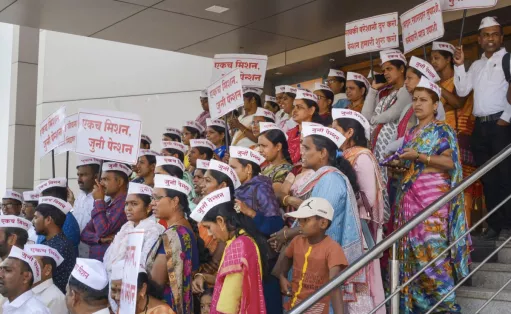
The indefinite strike by education officers across Maharashtra, which began on August 8, 2025, has officially been called off following a crucial meeting between representatives of the striking officers and School Education Minister Dada Bhuse in Mumbai. The strike, which had brought significant administrative functions in the state’s education sector to a standstill, was prompted by outrage over the arrest of several district education officers in Nagpur in connection with the ongoing Shalarth ID scam investigation.
The breakthrough came late in the evening of August 12, when Minister Bhuse gave written assurances that no innocent officers would face punitive action without proper due process. The minister further promised that all ongoing cases would be referred to a Special Investigation Team (SIT), appointed on August 7, 2025, to ensure impartial inquiry. He also assured that officers currently under suspension would be reinstated pending the outcome of the SIT’s investigation.
Background of the Shalarth ID Scam
The roots of the protest lie in the Shalarth ID scam — a complex case involving the alleged misuse of Maharashtra’s Shalarth digital payment system, which is designed to manage the salaries and service records of teachers and education department employees. Introduced in the late 2000s as part of the government’s digital governance push, Shalarth was aimed at eliminating ghost employees, ensuring timely salary disbursement, and providing transparency in payroll management.
However, in recent years, the system has been plagued by allegations of fraudulent entries, with accusations that fake employee IDs were created to siphon off public funds. Investigators claim that in certain districts, these fictitious entries involved collusion between lower-level clerks, private school administrators, and, in some cases, district education officers.
The Nagpur arrests in early August marked a significant escalation in the case, with police detaining several officers, alleging that they either facilitated the fraud or failed to prevent it. The arrests triggered widespread anger among the education officer community, many of whom argued that the detentions were carried out without proper verification of the officers’ involvement.
The Start of the Strike
On August 8, 2025, in an unprecedented show of unity, hundreds of education officers across Maharashtra began an indefinite strike. The officers’ demands centered on three main points:
-
Immediate halt to arbitrary arrests of officers without concrete evidence.
-
Formation of a neutral, high-level body to investigate the Shalarth scam instead of relying solely on police action.
-
Reinstatement of suspended officers until proven guilty.
Administrative offices in several districts were deserted as officers joined the protest. Critical operations — including teacher recruitment processes, school inspection schedules, and salary approvals — were halted. Teachers’ unions voiced concern that the standoff would delay pending approvals for staff transfers and promotions, affecting school operations just weeks after the start of the new academic year.
Escalation of Tensions
By August 10, the standoff had become a major political talking point. Opposition parties accused the government of using the police force to intimidate state employees, while ruling coalition leaders insisted that action was necessary to root out corruption.
Outside the Vidhan Bhavan in Mumbai, groups of education officers staged silent protests, carrying placards with slogans such as “Justice for Innocent Officers” and “Stop Harassment in the Name of Investigation.” In Nagpur, the epicenter of the arrests, officers refused to process any paperwork until their colleagues were released or given bail.
Education department insiders reported growing frustration among district collectors and school management committees, as stalled paperwork began affecting infrastructure funding and mid-day meal program reimbursements.
The Minister’s Intervention
Recognizing the administrative paralysis and the mounting public criticism, School Education Minister Dada Bhuse convened a high-level meeting on August 12 with representatives of the Maharashtra State Education Officers’ Association. The meeting, which lasted over four hours, included senior bureaucrats from the School Education Department, legal advisors, and the state’s Home Department officials.
According to sources present in the meeting, the education officers’ representatives presented a dossier outlining alleged procedural lapses by police during the Nagpur arrests, including failure to issue prior notices under the relevant service rules and non-adherence to guidelines set by the Department of Personnel and Training (DoPT) on handling public servants in criminal investigations.
In response, Minister Bhuse assured the delegation that:
-
Due process would be strictly followed in all future actions related to the Shalarth ID scam.
-
All cases currently under police investigation would be referred to the Special Investigation Team (SIT) formed on August 7, 2025, headed by a retired High Court judge, ensuring impartiality.
-
Suspended officers would be reinstated immediately, with the suspension orders kept in abeyance until the SIT’s findings were submitted.
-
A state-level monitoring committee would be established to oversee the SIT’s work and address grievances from education officers.
Withdrawal of the Strike
Following the meeting, the Association’s leadership held internal consultations and voted to withdraw the strike. The decision was communicated to the minister in writing, with the understanding that if any future violations of agreed procedures occurred, the officers reserved the right to resume industrial action.
By August 13 morning, district education offices reopened, and staff began clearing the backlog of files and salary approvals. In Nagpur, the return to work was marked by visible relief among school principals, many of whom had been unable to process teacher leave requests during the strike.
Political and Administrative Reactions
Chief Minister Eknath Shinde welcomed the resolution, stating that while corruption would not be tolerated, “honest officers must be protected from undue harassment.” Deputy Chief Minister Devendra Fadnavis, who also holds the Home portfolio, emphasized that the SIT’s formation reflected the government’s commitment to fairness.
Opposition leaders, however, remained skeptical. The Maharashtra Pradesh Congress Committee accused the government of bowing to pressure from officer unions while still failing to take decisive action against those responsible for the scam. Shiv Sena (UBT) leaders demanded that the SIT’s findings be made public to ensure transparency.
Teachers’ Union Perspectives
Teachers’ organizations, while relieved at the strike’s end, stressed the importance of a transparent probe. The Maharashtra Primary Teachers’ Federation issued a statement urging the SIT to complete its inquiry within a fixed timeline, warning that prolonged uncertainty would affect morale among teaching and administrative staff alike.
Some teachers privately expressed frustration that their salaries and transfer orders had been delayed, though they acknowledged that the officers had legitimate concerns about the arrests.
The Role of the Special Investigation Team
The newly appointed SIT will operate independently of the state police, with powers to summon witnesses, examine digital records from the Shalarth system, and recommend departmental as well as criminal action where warranted. Its mandate includes:
-
Reviewing all existing FIRs related to the scam.
-
Identifying systemic loopholes in the Shalarth system that allowed fraudulent IDs to be created.
-
Proposing technological safeguards to prevent future misuse.
Experts believe that the SIT’s findings could have far-reaching implications for digital governance in Maharashtra, especially as the Shalarth system is integrated with other state-level e-governance platforms.
Long-Term Implications
The strike’s resolution has temporarily restored administrative normalcy, but the underlying tensions between field-level officers and investigative agencies remain unresolved. If the SIT’s probe vindicates the arrested officers, it could lead to calls for accountability against those who ordered the arrests. Conversely, if evidence emerges against more officers, the government may face renewed demands for disciplinary action.
From a governance perspective, the episode highlights the need for clear protocols when investigating public servants, balancing anti-corruption measures with protections against arbitrary detention.
Expert Commentary
Dr. Anil Deshmukh, a former bureaucrat and governance expert, noted that the case underscored a recurring problem in Indian state administrations: “Whenever a scam emerges, there is a tendency to treat the entire officer cadre as suspect. This leads to defensive behavior, strikes, and administrative breakdowns. The solution is institutional — independent, credible investigations that command the trust of both the public and the employees.”
Legal analyst Adv. Meenal Shah added that the formation of an SIT headed by a retired judge was “a step in the right direction” but cautioned that “the credibility of this process will depend entirely on the transparency of its findings and the fairness with which both accused and whistleblowers are treated.”
Conclusion
The calling off of the indefinite strike by Maharashtra’s education officers marks the end of an intense week of administrative disruption, political wrangling, and public debate over the balance between corruption control and procedural fairness. While Minister Dada Bhuse’s assurances have defused the immediate crisis, the state’s education system now awaits the SIT’s findings to determine the long-term impact of the Shalarth ID scam on governance, accountability, and trust between the government and its officers.