JSW Group and SAIC Motor Discuss Fresh Capital for JSW MG Motor India’s Next Expansion Phase
JSW Group and China's SAIC Motor are discussing a fresh round of capital support for JSW MG Motor India as the automaker prepares to expand manufacturing beyond its currently planned capacity and accelerate its new-energy vehicle strategy. (Business Standard)
The discussions come as JSW MG Motor India invests approximately ₹3,500 crore in manufacturing capacity, localisation and new products. Vendors are expected to invest another ₹2,500 crore, taking investment associated with the current expansion programme to roughly ₹6,000 crore. (Business Standard)
The company's Halol manufacturing facility currently has capacity of approximately 110,000 vehicles annually. JSW MG plans to increase this to 160,000 units by March 2027 and 220,000 units by January 2028, while master planning allows the site to eventually reach approximately 400,000 vehicles annually. (Business Standard)
Beyond that, management has articulated a much larger ambition: eventually scaling JSW MG Motor India toward one million vehicles annually.
That scale would require substantially more capital.
JSW and SAIC Are Discussing the Next Funding Round

JSW MG Motor India Director Parth Jindal confirmed that discussions between the two principal shareholders are already underway.
JSW Group currently owns 35% of JSW MG Motor India, while SAIC Motor holds 49%.
The remaining equity is held by Indian financial institutions, dealers and employees. (Business Standard)
The existing ₹3,500 crore investment programme is being financed through a combination of debt and equity, including funds remaining from JSW's original investment.
Expansion beyond that programme will require shareholders to determine how the next round of funding should be structured.
Fresh Capital Could Support Expansion Beyond 220,000 Vehicles
The immediate objective is to move beyond the already planned annual capacity of 220,000 vehicles.
Jindal said that level would not be sufficient if MG continues receiving the market response management expects.
The company wants to scale Halol toward:
400,000 vehicles annually
before eventually targeting:
one million vehicles annually. (Business Standard)
Reaching either target would require significant additional investment in manufacturing, suppliers, technology and product development.
Halol Is Central to the Expansion Strategy
JSW MG Motor India's existing manufacturing operation is located at Halol in Gujarat.
Current annual capacity is approximately:
110,000 vehicles.
Management plans to increase that to:
160,000 vehicles by March 2027
and:
220,000 vehicles by January 2028. (Business Standard)
The company has already completed master planning that could ultimately allow Halol to produce approximately 400,000 vehicles per year.
Another Factory Is Not Immediately Required
Despite the ambitious long-term volume target, JSW MG does not currently expect to require another manufacturing location for at least the next three to four years.
Management believes Halol has sufficient expansion potential for the company's immediate growth phase.
A second manufacturing location could become relevant when volumes move beyond approximately 250,000 vehicles annually. (Business Standard)
This allows the company to extract greater utilisation from an existing manufacturing asset before committing capital to another greenfield facility.
Halol Is Already Operating Three Shifts
Production is already increasing.
The Halol facility is operating across three shifts as JSW MG attempts to raise monthly output.
Production has increased from approximately 8,000 vehicles per month several months ago to around 9,000 vehicles recently.
The company is targeting approximately 9,500 units before gradually moving toward 10,000 to 12,000 vehicles per month. (Business Standard)
Increasing utilisation is important because higher production volumes can spread fixed manufacturing costs across more vehicles.
JSW MG Targets Around 100,000 Sales in 2026
JSW MG Motor India is simultaneously pursuing aggressive sales growth.
Management expects the company to surpass approximately 95,000 vehicles during calendar year 2026 and is targeting the 100,000-unit milestone.
That compares with approximately 70,500 vehicles in 2025. (Business Standard)
Jindal said the company's ambition is to maintain annual volume growth of approximately 35% to 40%.
If that growth continues, manufacturing capacity will need to expand quickly.
New-Energy Vehicles Are Central to the Strategy
The next phase of JSW MG's growth is expected to be driven heavily by new-energy vehicles, or NEVs.
This category can include:
battery electric vehicles,
plug-in hybrid electric vehicles,
hybrid vehicles,
and extended-range electric vehicles.
Management expects NEVs eventually to represent approximately 70% to 80% of JSW MG Motor India's sales. (Business Standard)
That makes electrification central to the company's broader manufacturing and capital-allocation strategy.
ADAPT Platform Will Support Multiple Powertrains
JSW MG's future product strategy is being built around ADAPT — Advance Drive Architecture Platform Technology.
The modular architecture can support:
battery electric vehicles,
hybrid electric vehicles,
plug-in hybrid electric vehicles,
and extended-range electric vehicles. (Business Standard)
A flexible architecture can reduce the need to develop entirely separate vehicle platforms for each powertrain.
That potentially improves product-development economics.
Hector Tomahawk Begins New Product Phase
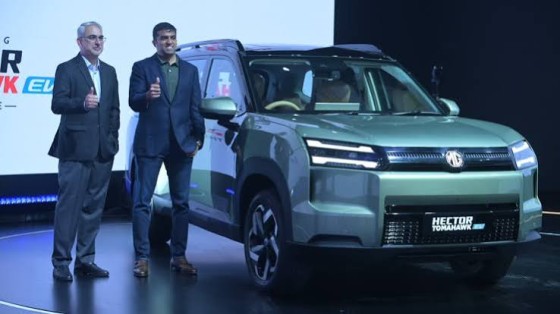
The recently introduced Hector Tomahawk is an important part of JSW MG's next-generation vehicle strategy.
The model has been launched in electric and plug-in hybrid configurations and uses the company's multi-powertrain ADAPT architecture. (The Times of India)
JSW MG intends the architecture to support multiple vehicle and powertrain combinations over the coming years.
This gives management flexibility as Indian consumers transition toward electrified vehicles at different speeds.
Plug-In Hybrids Could Expand Addressable Market
Pure electric vehicles provide low running costs but can still create concerns around:
charging infrastructure,
long-distance travel,
and charging time.
Plug-in hybrids combine an electric drivetrain with an internal-combustion engine.
This can allow customers to use electricity for many daily journeys while retaining longer-distance flexibility.
JSW MG believes multiple new-energy technologies will be necessary to expand the overall market.
Extended-Range EVs Are Also Under Evaluation
The company is also evaluating extended-range electric vehicles, or EREVs.
In an EREV, the wheels are powered by an electric motor.
A smaller internal-combustion engine acts as a generator to recharge the battery rather than directly driving the wheels.
Management has indicated that JSW MG would like to introduce the technology in India. (Business Standard)
The architecture could appeal to customers seeking an EV-style driving experience without relying entirely on charging infrastructure.
JSW MG Wants Lower Taxes for PHEVs
Taxation could significantly influence the commercial viability of new-energy technologies.
Pure electric vehicles attract a 5% GST rate, while plug-in hybrids can face significantly higher taxation depending on vehicle and engine specifications.
JSW MG has argued that differentiated taxation could make PHEVs and EREVs more affordable and accelerate consumer adoption. (The Economic Times)
The company is not necessarily asking for all technologies to receive the same treatment as pure EVs, but it wants the tax structure to better reflect their lower-emission characteristics.
Localisation Is Another Major Priority
Manufacturing expansion is being accompanied by a significant localisation programme.
JSW MG wants both the Windsor and Hector Tomahawk to reach approximately 70% localisation by the end of calendar year 2027. (Moneycontrol)
Localisation can reduce dependence on imported components.
It can also lower:
foreign-exchange exposure,
logistics costs,
and supply-chain risk.
For a company seeking much larger production volumes, those benefits become increasingly important.
Localisation Is Increasing Every Month
Management says localisation is increasing by approximately two to three percentage points each month as additional components are sourced domestically. (Moneycontrol)
The remaining difficult areas include:
battery cells,
rare-earth magnets,
and certain electronics.
These categories remain constrained because some of the required technologies and supply chains are not yet available domestically at sufficient scale.
Battery Cells Remain Major Challenge
Battery cells represent one of the largest components of an electric vehicle's cost.
JSW has previously planned a 30 GWh battery-cell manufacturing project that would have involved investment exceeding $1.3 billion.
However, the project is currently on hold because the group has not secured the required lithium-iron-phosphate cell technology partner. (Business Standard)
Technology access therefore remains a major constraint on deeper EV localisation.
JSW Has Commissioned Cell-to-Pack Facilities
Although cell manufacturing has been delayed, the group has moved ahead in other parts of the battery value chain.
JSW has commissioned cell-to-pack assembly facilities supporting:
JSW Energy's battery-storage operations,
and JSW MG Motor India. (Business Standard)
This allows the group to develop battery-pack capabilities even while individual cells continue to depend on external suppliers.
SAIC Could Play Important Technology Role
SAIC brings substantial automotive engineering and electric-vehicle expertise to the partnership.
The Chinese company has experience across:
EV platforms,
battery systems,
vehicle electronics,
and global automotive manufacturing.
JSW contributes local industrial expertise, capital relationships and understanding of India's regulatory and manufacturing environment.
The partnership therefore combines complementary capabilities.
India Is Becoming More Important to SAIC
According to Jindal, SAIC increasingly views India as a major future growth market as automotive growth matures in China and Europe. (Moneycontrol)
India offers a large vehicle market with relatively low car ownership compared with mature economies.
Rising incomes and urbanisation can expand demand substantially over the long term.
That makes India strategically important for global automakers seeking future volume growth.
Press Note 3 Changes Could Affect Fresh Investment
Fresh capital from SAIC has historically been complicated by India's Press Note 3 framework.
The rules require prior government approval for investments from entities based in countries sharing a land border with India, including China.
Jindal indicated that recent easing of restrictions could create additional avenues for SAIC to invest in the Indian venture. (Business Standard)
That makes the regulatory environment relevant to the structure of the next capital round.
Shareholding Changes Have Not Been Confirmed
Although JSW and SAIC are discussing additional funding, management has not said whether the transaction would alter their respective ownership percentages.
Jindal declined to comment on potential changes in shareholding. (Business Standard)
The immediate issue is therefore capital support rather than a confirmed ownership restructuring.
Any eventual structure will depend on shareholder negotiations and applicable regulatory approvals.
JSW’s Entry Changed MG Motor India’s Structure
JSW Group's investment created a substantially more Indianised ownership structure for MG Motor's domestic business.
The partnership brought together:
JSW's Indian industrial capabilities,
and SAIC's global automotive technology.
It also provided MG with a stronger platform for localisation and expansion.
The next capital round could deepen that partnership further.
Vendor Investment Adds Another ₹2,500 Crore
JSW MG's own ₹3,500 crore investment programme represents only part of the capital being deployed around its expansion.
Suppliers are expected to invest approximately:
₹2,500 crore.
That brings total investment associated with the programme to around:
₹6,000 crore. (Business Standard)
Vendor investment is particularly important when production volumes rise because suppliers need additional capacity of their own.
Automobile Expansion Creates Manufacturing Multiplier
A vehicle factory supports a much wider industrial ecosystem.
Suppliers provide:
steel,
electronics,
plastics,
seats,
tyres,
glass,
battery systems,
and thousands of smaller components.
Increasing production at Halol therefore creates investment requirements beyond JSW MG itself.
This is why automotive manufacturing can generate significant industrial multiplier effects.
Scale Is Critical to Automotive Profitability
Car manufacturing requires substantial fixed investment.
Plants,
tooling,
engineering,
and distribution networks
need to be funded before vehicles are sold.
Higher production allows those fixed costs to be distributed across more units.
JSW MG's push toward larger scale is therefore closely connected with its profitability ambitions.
JSW MG Expected to Target Profitability
The company is expected to move toward profitability as volumes rise and localisation improves.
Higher production can strengthen operating leverage.
Greater localisation can reduce component and logistics costs.
A richer mix of new-energy vehicles could also improve positioning in faster-growing parts of the Indian automobile market.
The combination of these factors will determine the economics of the next expansion phase.
Windsor Has Strengthened MG’s EV Position
The MG Windsor has become an important product within the company's Indian EV portfolio.
Its performance has helped demonstrate consumer demand for vehicles positioned between conventional passenger cars and premium electric offerings.
That provides management with greater confidence to invest in additional electrified products.
The challenge will be maintaining momentum as competition intensifies.
Indian EV Competition Is Increasing Rapidly
India's electric passenger-vehicle market is becoming significantly more competitive.
Domestic and international manufacturers are expanding product portfolios.
Consumers now have increasing choice across:
compact EVs,
SUVs,
and premium electric vehicles.
JSW MG therefore needs both scale and product differentiation.
Fresh capital can support those requirements.
Multi-Powertrain Strategy Reduces Technology Risk
No single powertrain may dominate every consumer segment immediately.
Some buyers are ready for pure EVs.
Others may prefer hybrids or range-extended vehicles.
Maintaining several technologies allows JSW MG to respond to different adoption patterns.
The ADAPT architecture is designed around precisely that flexibility.
Manufacturing Flexibility Can Improve Capital Efficiency
A platform capable of supporting multiple powertrains can reduce duplication.
Instead of building separate manufacturing systems for each technology, a company can share:
components,
engineering,
and production infrastructure.
This potentially improves returns on invested capital.
For JSW MG, such efficiency becomes increasingly important as the company targets much larger scale.
One Million Vehicles Is a Long-Term Ambition
The ultimate one-million-unit objective should be viewed as a long-term ambition rather than current manufacturing capacity.
The immediate milestones are substantially lower:
160,000 units,
220,000 units,
and eventually approximately 400,000 units at Halol. (Business Standard)
Moving beyond those levels would likely require additional manufacturing infrastructure and substantially greater capital.
Fresh Funding Will Determine Pace of Expansion
JSW MG has already established its near-term investment programme.
The next question is how aggressively shareholders want to fund the subsequent stage.
Capital could be required for:
capacity,
new products,
localisation,
technology,
and potentially another manufacturing facility in the longer term.
The size and structure of the next funding round will therefore influence the speed of expansion.
Conclusion
JSW Group and SAIC Motor are discussing fresh capital for JSW MG Motor India as the automaker prepares for a much larger phase of manufacturing and new-energy vehicle expansion.
The company is already investing around ₹3,500 crore, while suppliers are expected to invest another ₹2,500 crore, taking expansion-related investment to approximately ₹6,000 crore. (Business Standard)
Its Halol facility currently has annual capacity of approximately 110,000 vehicles, with plans to reach 160,000 units by March 2027 and 220,000 units by January 2028. The existing site has been planned for potential expansion to approximately 400,000 vehicles annually. (Business Standard)
Beyond that lies the far more ambitious objective of eventually reaching one million vehicles.
The expansion is being built around a broader transformation of MG's Indian product portfolio.
New-energy vehicles are expected to become the dominant part of sales, while the ADAPT architecture will allow the company to offer EVs, hybrids, PHEVs and potentially extended-range electric vehicles.
At the same time, JSW MG is targeting approximately 70% localisation for the Windsor and Hector Tomahawk by the end of 2027, helping reduce costs and strengthen the domestic supply chain. (Moneycontrol)
The next capital round will therefore be about much more than increasing factory capacity.
It will determine how aggressively JSW and SAIC are prepared to fund JSW MG Motor India's attempt to become a much larger, more localised and increasingly electrified automobile manufacturer in one of the world's most important long-term vehicle markets.