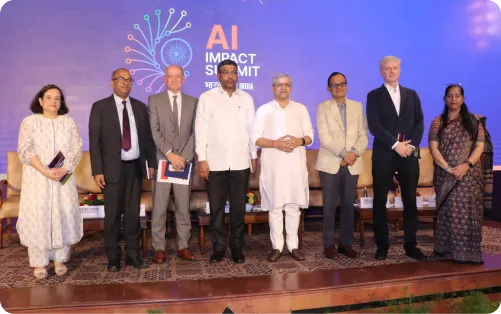
India-AI Impact Summit 2026: Charting India’s Responsible AI Future
Full Coverage | Policy, Innovation, Startups, Governance & Global Partnerships

New Delhi: The India-AI Impact Summit 2026 emerged as one of the most consequential technology gatherings of the year, bringing together policymakers, global tech leaders, startups, academia, and civil society to define the next chapter of India’s artificial intelligence journey. Against the backdrop of rapid AI adoption across industries—and rising debates on regulation, ethics, and employment—the summit positioned India not merely as a consumer of AI technologies but as a builder, regulator, and global standard-setter.
With a strong policy presence and industry participation, the summit focused on five central themes: Responsible AI governance, Digital Public Infrastructure (DPI) for AI, Skilling & Workforce Transformation, Startup & DeepTech Acceleration, and Global Collaboration.
The Context: Why India-AI Impact Summit 2026 Matters
India stands at a defining moment in its digital transformation. Over the past decade, Digital India initiatives, UPI-led financial inclusion, Aadhaar-enabled service delivery, and cloud-native governance platforms have reshaped the country’s public digital infrastructure. Now, AI is seen as the next multiplier.
The India-AI Impact Summit 2026 was convened to address pressing questions:
-
How can India balance innovation and regulation?
-
What is the roadmap for AI governance frameworks?
-
How will AI affect jobs, MSMEs, and public service delivery?
-
Can India create a sovereign AI ecosystem while staying globally integrated?
Inaugural Address: Policy with Purpose
Union Minister for Electronics & IT Ashwini Vaishnaw inaugurated the summit, emphasizing India’s commitment to building AI systems that are inclusive, transparent, and accountable.
“India will lead not just in AI adoption, but in AI trust,” the minister said, underlining that technology must enhance human capability rather than replace it.
He highlighted India’s expanding compute infrastructure, the creation of national AI datasets, and a proposed AI regulatory sandbox to support startups while ensuring safeguards.
Keynote: Ethical AI in a Democratic Society
In a special address, Minister of State for IT Rajeev Chandrasekhar discussed the importance of ethical AI aligned with democratic values. He emphasized:
-
Algorithmic transparency
-
Bias mitigation frameworks
-
Citizen data protection
-
Accountability mechanisms
India’s AI strategy, he said, must reflect constitutional principles and public interest.
Digital Public Infrastructure (DPI) 2.0: AI Layer Over India Stack
One of the summit’s most talked-about announcements was the expansion of India’s Digital Public Infrastructure to include an AI Layer—a structured ecosystem where government datasets, APIs, and consent-driven access can power startups and enterprises.
This initiative aims to:
-
Democratize access to high-quality datasets
-
Enable MSMEs to build AI-driven services
-
Reduce dependence on foreign proprietary datasets
-
Strengthen AI innovation at the grassroots level
Experts compared it to how UPI revolutionized fintech—suggesting that AI-DPI could do the same for healthcare, agriculture, logistics, and governance.
Startup Showcase: India’s AI Innovation Engine
More than 300 AI startups participated in the summit’s exhibition segment. The diversity of solutions showcased India’s evolving AI ecosystem:
Healthcare AI
-
Predictive diagnostics
-
AI-powered radiology
-
Drug discovery simulations
Agritech AI
-
Crop yield prediction
-
Soil analytics
-
Climate risk modeling
Fintech & RegTech
-
Fraud detection
-
AI compliance systems
-
Smart credit underwriting
Several startups reported signing MoUs with global investors and government departments during the summit.
Workforce & Skilling: Preparing India’s 1.4 Billion for AI
A major segment of the summit focused on workforce transformation. Industry leaders warned that while AI may automate routine tasks, it will also create demand for new skill categories.
Panel discussions identified three urgent needs:
-
AI Literacy for All
-
Advanced AI Engineering Programs
-
Reskilling for Mid-Career Professionals
The government announced expanded AI training partnerships with leading institutions, including collaborations with global technology firms and Indian institutes of higher education.
AI in Governance: Smart State, Responsive Systems
One of the summit’s core discussions revolved around AI deployment in public administration.
Use Cases Highlighted:
-
Real-time grievance redressal analytics
-
Traffic and urban planning optimization
-
AI-based fraud detection in welfare schemes
-
Smart disaster response systems
Officials stated that AI integration in governance must prioritize citizen consent, transparency, and auditability.
Regulatory Framework: Innovation Without Anarchy
India’s AI regulatory approach was a hot topic.
Unlike rigid pre-emptive bans seen in some regions, India is adopting a risk-based regulatory model—where high-risk AI systems face stricter compliance, while innovation in low-risk domains remains flexible.
Policy experts discussed:
-
AI classification frameworks
-
Liability mechanisms
-
Independent audit systems
-
Global regulatory alignment
India aims to harmonize its AI regulations with global standards while protecting national interests.
Global Participation: India’s Expanding AI Diplomacy

Delegations from the US, EU, Japan, UAE, and Singapore participated in the summit, indicating India’s rising prominence in global AI diplomacy.
Key focus areas included:
-
Cross-border AI data flow standards
-
Joint research initiatives
-
Ethical AI alignment
-
Semiconductor and compute partnerships
India positioned itself as a bridge between developed and developing nations in shaping AI governance norms.
AI and MSMEs: Democratizing Intelligence
A dedicated MSME track addressed concerns about small businesses being left behind in the AI race.
The government proposed:
-
Subsidized cloud credits
-
AI mentorship programs
-
Shared compute clusters
-
Low-cost AI SaaS platforms
Industry leaders emphasized that AI must not widen inequality but instead empower grassroots entrepreneurship.
Cybersecurity & AI: The Double-Edged Sword
Experts highlighted AI’s dual role in cybersecurity:
Advantages:
-
Threat detection automation
-
Fraud prevention
-
Real-time anomaly detection
Risks:
-
Deepfake misuse
-
AI-generated phishing attacks
-
Automated misinformation
The summit concluded that cybersecurity and AI governance must evolve simultaneously.
Investment & Economic Impact
Analysts at the summit projected that AI could contribute $500 billion to India’s GDP by 2030 if implemented effectively.
Sectors expected to benefit most:
-
Healthcare
-
Manufacturing
-
Logistics
-
Agriculture
-
Fintech
Investors signaled strong interest in India’s AI infrastructure roadmap.
Inclusion & Responsible AI
Civil society organizations raised concerns about:
-
Algorithmic bias
-
Data exclusion
-
Rural digital divide
-
Surveillance risks
The summit incorporated these perspectives, reinforcing that India’s AI growth must be inclusive.
Industry Leaders Speak
Global tech CEOs emphasized India’s:
-
Talent pool
-
Developer ecosystem
-
Policy clarity
-
Startup resilience
Many described India as the “next AI powerhouse.”
AI Infrastructure: Compute & Data Sovereignty
The government announced expanded investments in:
-
High-performance computing clusters
-
Indigenous semiconductor initiatives
-
AI research hubs
These measures aim to reduce dependence on imported AI infrastructure.
Education & Research
Universities unveiled:
-
AI research chairs
-
Industry-academia labs
-
National AI fellowships
Experts stressed the importance of open research collaboration.
Economic, Social & Ethical Balance
The summit repeatedly emphasized one core principle:
AI must enhance human dignity, not erode it.
India’s model seeks equilibrium between:
-
Growth and rights
-
Innovation and regulation
-
Speed and responsibility
India’s AI Decade Begins
The India-AI Impact Summit 2026 was more than a technology conference—it was a policy milestone. It signaled India’s readiness to lead in:
-
Responsible AI governance
-
Inclusive AI innovation
-
Digital public infrastructure
-
Global AI diplomacy
As the summit concluded, policymakers and industry leaders echoed a shared sentiment:
India’s AI journey is not about replacing humans with machines—it is about empowering 1.4 billion citizens with intelligent tools.
The real impact of the summit will be measured not in announcements, but in execution. If the roadmap outlined here translates into action, India may well define the global narrative of responsible AI in the decade ahead.
Tell me ?