By Naina, 29th May 2026
India's infrastructure transformation has emerged as the principal engine of the country's economic growth strategy, and the new policy architecture being assembled in 2026 represents one of the most consequential industrial-policy initiatives in the country's post-liberalisation history. For most of the modern history of Indian economic policy, infrastructure was treated as a recurring constraint on growth, with the chronic underinvestment in transport, power, urban and digital infrastructure repeatedly identified as the single most consequential drag on the country's economic potential. The capital deployment required to address the infrastructure deficit had historically been limited by fiscal constraints, by the operational challenges of large-scale infrastructure project execution and by the broader policy framework that had not produced the integrated planning that infrastructure development of the scale required demanded. That description has become progressively inadequate to capture the reality of 2026. The Economic Survey 2026, tabled by Union Finance Minister Nirmala Sitharaman in Parliament, has highlighted infrastructure as the principal driver of economic growth, forecasting the Indian economy will expand at between 6.8 and 7.2 percent in the financial year 2027, following an anticipated 7.4 percent growth rate in the current fiscal year. The Confederation of Indian Industry has proposed a new 150 lakh crore rupee National Infrastructure Pipeline for 2026-32, providing long-term visibility for investors and state governments. Government capital expenditure has shown remarkable growth, with a 32.4 percent increase during April to October FY2026. Between FY26 and FY30, infrastructure capital expenditure is expected to rise to between 90 and 100 trillion rupees, up 60 percent from 59 trillion rupees over FY21 and FY25.
What sits beneath these aggregate figures is a deeper transformation in how India approaches infrastructure development. The combination of the institutionalisation of integrated planning under the PM Gati Shakti initiative, the National Logistics Policy that has complemented this approach, the dramatic expansion of physical infrastructure across roads, railways, ports, airports and digital networks, the strategic shift toward private sector participation in infrastructure capex and the broader integration of infrastructure development with the Viksit Bharat 2047 vision has produced a policy architecture that addresses the historical infrastructure constraints with an operational coherence that earlier generations of Indian infrastructure policy could not achieve. The decisions being made now, in the Union Budget 2026 priorities, in the implementation of NIP 2.0, in the integrated planning under PM Gati Shakti and in the broader strategic positioning of infrastructure as the principal driver of Indian economic growth, will define the country's economic trajectory for the next generation.
The Gati Shakti Foundation
The PM Gati Shakti National Master Plan, launched on the 13th of October 2021, has emerged as the foundational framework of India's contemporary infrastructure policy. The 1.3 trillion US dollar national master plan for infrastructure has been the forerunner of systemic and effective reforms in the sector. The Economic Survey 2026 has highlighted that the institutionalisation of integrated planning under PM Gati Shakti has been a defining feature of the country's economic transition. The multimodal approach, complemented by the National Logistics Policy, has strengthened project execution, reduced transaction costs and eased congestion across the supply chain.
The operational significance of PM Gati Shakti has extended beyond the immediate infrastructure development. The initiative has provided the framework for the integrated coordination of infrastructure development across multiple ministries, multiple states and multiple categories of infrastructure, addressing the fragmented planning that had historically constrained Indian infrastructure development. All logistics and connectivity infrastructure projects entailing an investment of over 500 crore rupees are now routed through the Network Planning Group constituted under the PM Gati Shakti initiative, providing the institutional architecture that integrated infrastructure planning requires. The expansion of access to the PM Gati Shakti portal to the private sector, announced in the Union Budget 2025-26, has further extended the reach of the integrated planning framework.
The strategic significance of the integrated planning framework extends beyond the immediate operational benefits. The combination of the master plan approach, the integrated coordination across ministries and states and the broader institutionalisation of integrated planning has progressively transformed how India approaches infrastructure development. The earlier model, in which different ministries and states pursued infrastructure development independently with limited coordination, has been progressively replaced by an integrated planning model that addresses the structural inefficiencies of fragmented infrastructure development. The continued evolution of this integrated planning framework will be central to the broader trajectory of Indian infrastructure development.
The Roads and Highways Transformation
The roads and highways sector has been one of the most consequential dimensions of India's infrastructure transformation. The National Highway network has witnessed substantial expansion over the past decade, increasing from 91,287 kilometres in FY14 to 146,572 kilometres as of December 2025. Operational high-speed corridors have also scaled up dramatically, rising from approximately 550 kilometres to over 5,300 kilometres during the corresponding period. The average annual highway construction rate more than doubled between 2014 and 2025 compared with the preceding decade. The roads sector, expected to grow 5 to 6 percent year-on-year in FY26, will dominate the capex share despite a decline in total kilometres of national highways to be constructed.
The strategic shift in the roads sector has reflected the broader maturation of Indian infrastructure policy. The Economic Survey 2026 has noted that the roads and highways sector is transitioning from a focus on rapid network expansion to an intensive concentration on logistics efficiency and quality. The development of high-speed corridors and multimodal integration, key components of PM Gati Shakti, is enhancing capacity and reliability for freight movement. This infrastructure-led impetus is considered fundamental to the reduction of overall logistics costs. The pipeline of wider four and six-lane highways, six and eight-lane expressways and high-speed corridor projects has driven the continued expansion of the roads sector.
The broader strategic significance of the roads transformation has been substantial. The combination of the expanded national highway network, the operational high-speed corridors and the broader integration of road infrastructure with the broader logistics system has progressively addressed one of the most consequential constraints on Indian economic activity. The reduction in logistics costs, the broader improvement in freight movement efficiency and the cumulative impact on the operational economics of Indian industry have all reflected the broader contribution of the roads infrastructure to the country's economic growth. The continued expansion and quality improvement of the roads infrastructure will continue to be one of the most consequential dimensions of the broader Indian infrastructure transformation.
The Railway Modernisation
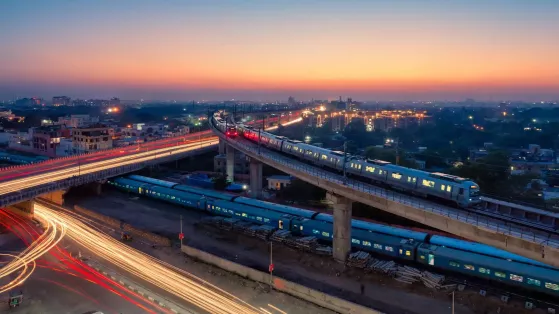
The Indian Railways modernisation has emerged as one of the most consequential dimensions of the broader infrastructure transformation. Under the Union Budget 2025-26, the government allocated a record capital expenditure of 2,65,200 crore rupees for railways, reflecting the strategic significance of rail infrastructure to the broader Indian economy. The railway network's focus on dedicated freight corridors, new economic rail corridors including those for energy, mineral and cement movement, port connectivity and the broader range of rail infrastructure has reshaped the operational dynamics of Indian rail transport.
The dedicated freight corridors have been one of the most consequential dimensions of the railway transformation. The Eastern and Western Dedicated Freight Corridors have progressively become operational, providing dedicated rail infrastructure for freight movement that has been separated from the passenger rail network. The implications for freight movement efficiency, for the broader logistics economics of Indian industry and for the cumulative competitiveness of Indian exports have been substantial. The continued expansion of the dedicated freight corridor network, alongside the new economic rail corridors that connect specific industrial and economic clusters, has reshaped the operational architecture of Indian rail freight.
The broader railway modernisation has extended beyond the freight corridors. The high-speed rail network development, the redevelopment of railway stations, the modernisation of rolling stock and the broader range of railway infrastructure improvements have collectively transformed the operational capability of Indian Railways. The combination of the freight infrastructure improvements, the passenger service enhancements and the broader modernisation of railway operations has positioned Indian Railways as one of the most consequential dimensions of the country's broader infrastructure transformation. The continued investment in railway modernisation will continue to be central to the broader Indian infrastructure trajectory.
The NIP 2.0 Proposition
The proposed second version of the National Infrastructure Pipeline, NIP 2.0, represents one of the most ambitious infrastructure planning initiatives in Indian history. The Confederation of Indian Industry has proposed an investment commitment of 150 lakh crore rupees over the next five years through NIP 2.0, for the 2026-32 period, with a clear list of shovel-ready projects, including public-private partnership projects, to provide multi-year certainty to investors, developers and states. The proposal builds on the first National Infrastructure Pipeline, launched in 2019 for a five-year period from FY2019-20 to FY2024-25 with an outlay of 100 lakh crore rupees.
The strategic significance of NIP 2.0 extends beyond the immediate capital deployment. The provision of multi-year certainty to investors, developers and state governments addresses one of the most consequential constraints on private-sector participation in Indian infrastructure development. The combination of long-term visibility into the infrastructure pipeline, the clear identification of shovel-ready projects and the broader strategic positioning of NIP 2.0 has the potential to substantially expand private-sector participation in Indian infrastructure development. The implementation of NIP 2.0, including the broader institutional architecture required to deliver on the ambitious scale of the proposal, will be one of the most consequential dimensions of Indian infrastructure policy through the rest of the present decade.
The complementary proposals from industry bodies have reflected the broader strategic positioning of infrastructure development. The CII has called for a 12 percent increase in central capital expenditure for 2026-27, alongside a 10 percent increase in capital expenditure support to states. The proposal for the institutionalisation of a Capital Expenditure Efficiency Framework to prioritise high-impact projects, track physical and financial progress and evaluate outcomes based on productivity and regional spillovers has reflected the broader emphasis on the operational effectiveness of infrastructure investment. The combination of the expanded capital deployment, the improved project selection and execution and the broader maturation of infrastructure planning will be central to the broader infrastructure transformation.
The Private Sector Pivot
One of the most consequential dimensions of the broader infrastructure transformation has been the strategic pivot toward private-sector participation in infrastructure capex. India's infrastructure sector stands at a pivotal juncture, shaped by a renewed emphasis on crowding in private investment in infrastructure following several years of strong budgetary support from the central government. During FY21-25, central and state capex formed 90 percent of the overall infrastructure capex, reflecting the broader pattern in which government capital deployment dominated infrastructure investment. The shift toward private-sector participation represents one of the most consequential strategic pivots in Indian infrastructure policy.
The expectations for the next five-year period have been distinctive. Between FY26 and FY30, infrastructure capex is expected to rise to between 90 and 100 trillion rupees, up 60 percent from 59 trillion rupees over FY21 and FY25, with the private sector expected to dominate the capex on the back of favourable amendments by the government on development models. The strategic significance of this shift extends beyond the immediate capital deployment. The combination of the favourable government amendments to development models, the broader establishment of the infrastructure pipeline that provides multi-year visibility to private investors and the rising sophistication of Indian private-sector infrastructure capability has positioned private participation to dominate the next phase of Indian infrastructure development.
The strategic logic of the private sector pivot has been compelling. The scale of the infrastructure investment required for the broader Indian economic transformation, estimated at 90 to 100 trillion rupees between FY26 and FY30, exceeds the fiscal capacity of central and state governments alone. The combination of the rising private-sector capability in infrastructure development, the broader maturation of public-private partnership models and the strategic positioning of private capital has produced conditions in which private participation has become essential to the broader infrastructure transformation. The continued evolution of the public-private partnership framework, the broader development of infrastructure investment vehicles and the rising integration of private capital into Indian infrastructure development will be central to the broader infrastructure trajectory.
The Sectoral Coverage
The breadth of India's infrastructure transformation has extended across multiple sectoral dimensions. Beyond roads and railways, the broader infrastructure transformation has encompassed ports through the Sagarmala programme, airports through the Regional Connectivity Scheme-UDAN, urban infrastructure through the Smart Cities Mission and AMRUT, digital infrastructure through BharatNet, water infrastructure through the Jal Jeevan Mission, rural connectivity through PMGSY Phase IV connecting 25,000 rural habitations and the broader range of infrastructure categories. The combination of these sectoral programmes has produced infrastructure development that addresses the broad range of categories that comprehensive economic infrastructure requires.
The energy infrastructure transformation has been particularly consequential. The government's target to increase the share of natural gas in India's energy mix from the current 6.7 percent to 15 percent by 2030 has reflected the broader strategic positioning of energy infrastructure within the broader infrastructure transformation. The development of pipeline infrastructure, the expansion of regasification capability and the broader development of the gas value chain have all supported this strategic transition. The parallel transformation of the renewable energy infrastructure, with India having crossed 50 percent of installed electric power capacity from non-fossil sources in June 2025 and five years ahead of the 2030 target, has reflected the broader integration of energy infrastructure transformation with the country's energy transition.
The multimodal logistics parks have emerged as one of the most consequential dimensions of the broader logistics infrastructure transformation. Multimodal Logistics Parks at 15 prioritised locations are being developed with a total investment of approximately 22,000 crore rupees. The combination of these parks, the dedicated freight corridors, the expanded port infrastructure and the broader integration of multimodal logistics has progressively transformed the Indian logistics architecture. The implications for the broader competitiveness of Indian industry, for the operational economics of Indian exports and for the cumulative integration of Indian operations into global supply chains have been substantial.
The State-Level Expansion
The state-level dimension of India's infrastructure transformation has been one of the most consequential developments. State governments have collectively expanded their capital outlays significantly, with state capex reaching approximately 8.7 lakh crore rupees in 2024, marking an increase of 2.5 times since 2015. The combination of central government capex, the broader state-level capital outlays and the rising integration of state-level infrastructure development with the broader national infrastructure framework has produced a multi-level infrastructure development architecture that earlier generations of Indian infrastructure policy could not have approached.
The competitive dimension among Indian states has been particularly consequential. The broader competition among Indian states to attract investment, to develop infrastructure that supports economic activity and to position themselves as destinations for industrial and service sector expansion has produced state-level infrastructure development that complements the broader national infrastructure framework. The combination of the state-level infrastructure investment, the broader policy frameworks supporting industrial development and the rising integration of state-level activity with the broader national infrastructure planning has produced an infrastructure development trajectory that operates across multiple levels of government simultaneously.
The Union Budget 2025-26 special interest-free loans to states for capital expenditure, amounting to 1.5 lakh crore rupees, have provided additional financial support for state-level infrastructure development. The combination of the central government support, the broader state-level capital outlays and the rising integration of state-level activity with the broader national infrastructure planning has produced a multi-level infrastructure development architecture that addresses the geographic breadth of the Indian economy. The continued evolution of state-level infrastructure development, supported by the broader national policy framework, will continue to shape the broader Indian infrastructure transformation.
The Northeast and Rural Focus
The infrastructure development of the northeastern region and rural areas has been one of the most consequential dimensions of the broader infrastructure transformation. The Ministry of Development of North-Eastern Region has sanctioned 90 projects with a total cost of approximately 3,417.68 crore rupees under the North-East Special Infrastructure Development Scheme during the past three financial years and the ongoing FY25. The combination of the dedicated focus on northeastern infrastructure development, the broader integration of the region with the national infrastructure framework and the strategic positioning of the region in the broader Indian economic geography has progressively addressed the historical infrastructure gaps in the region.
The rural infrastructure development has been equally consequential. The Pradhan Mantri Gram Sadak Yojana Phase IV, aimed at providing connectivity to 25,000 rural habitations, has reflected the continued focus on rural infrastructure development. The broader Jal Jeevan Mission, the rural electrification programmes and the broader range of rural infrastructure development initiatives have addressed the infrastructure needs of rural India. The combination of rural connectivity, water infrastructure, energy infrastructure and the broader range of rural infrastructure has progressively addressed the infrastructure gaps that have historically constrained rural economic activity.
The strategic significance of the rural and northeastern focus extends beyond the immediate infrastructure development. The integration of these geographies into the broader national economic activity, the expansion of opportunity for the populations in these regions and the broader balance of economic development across the country have all been supported by the dedicated focus on these regions. The continued development of rural and northeastern infrastructure will continue to be central to the broader balance of Indian economic development.
The Risks and the Frictions
Several risks warrant clear recognition. The first is the execution dimension. The ambitious scale of the broader infrastructure transformation, encompassing 90 to 100 trillion rupees of infrastructure investment between FY26 and FY30, requires execution capability at scales that earlier generations of Indian infrastructure development have not consistently achieved. The combination of project complexity, the operational challenges of large-scale infrastructure execution and the broader institutional capability required to deliver on the ambitious scale of the broader transformation has produced execution risks that the broader policy framework must address. The institutionalisation of the Capital Expenditure Efficiency Framework, the broader improvement in project selection and execution and the rising sophistication of Indian infrastructure project management has begun to address these risks.
The second risk is the financing dimension. The scale of the infrastructure investment required exceeds the fiscal capacity of central and state governments alone, requiring substantial private-sector participation. The risk that private-sector participation may not materialise at the scales required, that the financing terms may not support the ambitious investment pipeline or that the broader capital market dynamics may shift unfavourably has been a significant consideration. The continued development of infrastructure investment vehicles, the broader maturation of public-private partnership frameworks and the rising integration of Indian infrastructure investment with global capital markets has progressively addressed this financing challenge.
The third risk is the regulatory and approval dimension. The complex regulatory environment governing Indian infrastructure development, including environmental approvals, land acquisition, the broader range of permits and the integration with state-level approvals, has historically produced delays that have constrained infrastructure delivery. The continued evolution of the regulatory framework, including the broader streamlining of approval processes and the integration of regulatory coordination through PM Gati Shakti, has begun to address this challenge. The continued evolution of the regulatory environment will be central to the operational efficiency of the broader infrastructure transformation.
The fourth risk is the global-economic dimension. India's infrastructure transformation is unfolding against the backdrop of global economic headwinds, including United States tariffs on Indian goods, broader trade dynamics and the cumulative challenges of the global economic environment. The risk that global economic conditions could affect the broader infrastructure investment trajectory, that international capital availability could shift or that the broader economic environment could produce constraints on Indian infrastructure development has been a significant consideration. The Indian policy emphasis on infrastructure spending as a counter-cyclical growth driver, even in the face of global headwinds, has reflected the broader strategic positioning of infrastructure as central to maintaining Indian economic momentum through varying external conditions.
The Direction of Travel
India's new infrastructure policies represent one of the most consequential industrial-policy initiatives in the country's post-liberalisation history. The combination of the institutionalisation of integrated planning under PM Gati Shakti, the National Logistics Policy, the dramatic expansion of physical infrastructure across multiple categories, the strategic shift toward private sector participation in infrastructure capex, the proposed 150 lakh crore rupee National Infrastructure Pipeline 2.0 and the broader integration of infrastructure development with the Viksit Bharat 2047 vision has produced a policy architecture that addresses the historical infrastructure constraints with operational coherence that earlier generations of Indian infrastructure policy could not achieve.
The Economic Survey 2026 has highlighted infrastructure as the principal driver of economic growth, with the forecast 6.8 to 7.2 percent growth in FY27 supported substantially by the continued infrastructure investment. The combination of the 32.4 percent capital expenditure growth in April to October FY2026, the broader projection of 90 to 100 trillion rupees of infrastructure investment between FY26 and FY30 and the cumulative impact of the broader infrastructure transformation has positioned infrastructure as the principal engine of Indian economic growth through the rest of the present decade. The strategic significance of this positioning, given the broader importance of infrastructure to the country's economic development, has been substantial.
The longer-term implications extend beyond the immediate growth contribution. The infrastructure transformation is progressively addressing the structural constraints that have historically limited Indian economic activity. The reduction in logistics costs, the broader improvement in freight movement efficiency, the cumulative competitiveness benefits for Indian industry, the expansion of opportunity across the geographic breadth of the country and the integration of Indian infrastructure with the broader global supply chains have all reflected the broader contribution of the infrastructure transformation to the Indian economy. The continued expansion of these benefits, as the infrastructure pipeline progressively materialises through the rest of the present decade, will reshape the operational architecture of the Indian economy.
The decisions being made now, in the Union Budget 2026 priorities, in the implementation of NIP 2.0, in the integrated planning under PM Gati Shakti, in the strategic positioning of private capital for infrastructure investment and in the broader institutional architecture supporting Indian infrastructure development, will define the country's economic trajectory for the next generation. The infrastructure transformation is no longer a theoretical aspiration. It has become the operational reality of contemporary Indian economic policy. The transformation has begun. The structural change is real. The implications, for Indian economic growth, for the broader competitiveness of Indian industry, for the cumulative integration of India into global economic activity and for the broader trajectory of the country's economic development toward the Viksit Bharat 2047 vision, will continue to develop through the rest of the present decade and beyond.
India's new infrastructure policies have emerged as the principal mechanism through which the country addresses its long-standing infrastructure constraints, supports its ambitious economic growth targets and positions itself for the broader transformation toward developed-nation status. The companies, the sectors, the states and the broader institutional architecture that engage most effectively with this infrastructure transformation will be the principal beneficiaries. The work of delivering on the ambitious infrastructure pipeline continues, and the next chapter of Indian economic development is being written, in real time, in the highway corridors under construction, in the freight rail infrastructure being commissioned, in the multimodal logistics parks being developed and in the broader infrastructure transformation that has become the principal engine of contemporary Indian economic growth. The infrastructure transformation represents one of the most consequential industrial-policy initiatives in modern Indian history, and its continued execution will reshape the broader trajectory of Indian economic development for the generation to come.