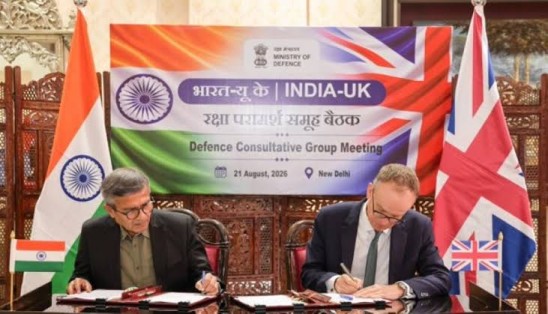
India and UK Move to Sign Agreement for Joint Development of Naval Electric Propulsion Systems
India and the United Kingdom are moving toward signing an Inter-Governmental Agreement for the joint development of advanced electric propulsion systems for four planned Landing Platform Docks of the Indian Navy, deepening bilateral defence cooperation in one of the most technically demanding areas of modern warship construction.
British officials have indicated that the agreement is expected to be signed shortly.
The programme centres on Integrated Full Electric Propulsion, or IFEP, a naval architecture in which electrical power generated onboard is used both to propel the ship and support its wider electrical systems.
The four Landing Platform Docks are planned to be built at an Indian shipyard and are envisaged with full-electric propulsion architecture.
The proposed agreement represents the next step in a partnership that began with an India-UK Electric Propulsion Capability Partnership and was strengthened through a formal Statement of Intent signed by the two defence ministries in Portsmouth in November 2024.
For India, the strategic objective extends beyond acquiring propulsion equipment.
The programme is intended to support co-design, co-development, co-production and the creation of indigenous capability in advanced naval propulsion technology.
India and UK Are Preparing an Inter-Governmental Agreement

The two governments are expected to formalise their naval propulsion partnership through an:
Inter-Governmental Agreement, or IGA.
The agreement will focus on the development of Integrated Full Electric Propulsion technology for future Indian Navy platforms.
British officials have said the agreement is expected to be signed very soon.
The final signing would move cooperation beyond the earlier framework stage toward a more structured development programme.
Four Indian Navy Landing Platform Docks Are Central to the Plan
The initial application is expected to involve:
four Landing Platform Docks.
LPDs are large amphibious warfare ships designed to transport:
troops,
vehicles,
equipment,
helicopters,
and landing craft.
They can support military operations far from conventional ports while also performing humanitarian assistance and disaster-relief missions.
Because they are large naval platforms, they require substantial propulsion and electrical power.
The Four LPDs Are Planned to Be Built in India
The Indian Navy's planned Landing Platform Docks are envisaged to be constructed at an:
Indian shipyard.
That makes the propulsion partnership directly relevant to India's broader defence-manufacturing strategy.
Rather than purchasing completed ships overseas, India wants to build the platforms domestically while progressively developing the technologies used inside them.
This can strengthen local capability across:
ship design,
system integration,
manufacturing,
testing,
and lifecycle support.
What Is Integrated Full Electric Propulsion?
Integrated Full Electric Propulsion fundamentally changes how a warship uses onboard power.
In a conventional mechanical propulsion system, the ship's gas turbines or diesel engines can connect mechanically to the propeller shafts.
In a full-electric architecture, power-generation equipment produces electricity.
That electricity can then be distributed to:
electric propulsion motors,
combat systems,
sensors,
communications equipment,
and other shipboard loads.
The propulsion motors ultimately turn the propellers.
The Same Power Network Can Support the Entire Ship
This integration is important.
Instead of maintaining completely separate power arrangements for propulsion and other systems, the ship can manage electricity through a more unified architecture.
Power can be allocated according to operational requirements.
That provides greater flexibility as naval vessels become increasingly dependent on high-power electronic systems.
Future Warships Need Much More Electricity
Modern naval platforms contain increasingly sophisticated technology.
These can include:
advanced radars,
electronic warfare systems,
communications networks,
combat-management systems,
and large computing environments.
Future vessels may require even more electricity for next-generation sensors and weapons.
A ship designed around integrated electric propulsion can therefore provide greater power-management flexibility.
Full Electric Propulsion Can Support Future Technology Upgrades
Warships typically remain in service for decades.
Systems installed when a ship is commissioned may be replaced several times during its operational life.
A flexible electrical architecture can make it easier to accommodate future equipment that requires significantly more power.
This can improve long-term platform adaptability.
Electric Propulsion Can Improve Layout Flexibility
Mechanical propulsion systems often require engines, gearboxes and shafts to be arranged in relatively specific configurations.
Electric architectures can provide naval designers with greater flexibility.
Power-generation equipment does not necessarily need to be mechanically aligned with the propeller shaft.
Electric cables can transmit power across the ship.
This can provide more freedom in internal design.
Reduced Mechanical Complexity Can Offer Advantages
Electric propulsion can remove or reduce some conventional mechanical components.
Depending on the architecture, this can simplify certain parts of the drivetrain.
Potential benefits can include:
lower vibration,
greater flexibility,
and easier integration of distributed power-generation equipment.
Actual performance depends on the final naval design.
Acoustic Performance Matters for Warships
Noise can be strategically important at sea.
Mechanical vibration can travel through a vessel and into the surrounding water.
Quieter propulsion arrangements can make ships harder to detect acoustically.
Electric motors can provide advantages in this area when properly engineered.
For naval platforms, lower acoustic signatures can therefore have operational significance.
The Agreement Builds on a 2024 Statement of Intent
India and the UK already established a formal framework for cooperation in this area.
On November 28, 2024, their defence ministries signed a:
Statement of Intent on Cooperation on Design and Development of Electric Propulsion Systems for the Indian Navy.
The agreement was reached during the third meeting of the India-UK Electric Propulsion Capability Partnership Joint Working Group in Portsmouth.
The 2024 Framework Explicitly Covered Co-Development
The Statement of Intent was designed to support:
co-design,
co-creation,
and co-production
of electric propulsion capability for future Indian naval ships.
It specifically identified planned Landing Platform Docks as platforms envisaged with Full Electric Propulsion Systems.
The forthcoming IGA therefore represents a continuation of an established bilateral programme rather than an entirely new initiative.
Cooperation Began Even Earlier
The Electric Propulsion Capability Partnership traces its origins to India-UK defence cooperation announced in 2022.
The two countries established a Joint Working Group to encourage:
military cooperation,
industrial collaboration,
and technology development
in maritime electric propulsion.
The partnership has gradually moved from high-level policy discussions toward technical requirements and industrial implementation.
Technical Requirements Have Already Been Discussed
Earlier working-group meetings addressed issues including:
technical requirements,
factory acceptance testing,
maintenance,
manning philosophy,
and system integration.
These details are critical because naval propulsion is not simply a matter of purchasing an electric motor.
The system must integrate reliably with:
power generation,
distribution,
automation,
propulsion motors,
and the wider ship architecture.
GE Vernova Is Expected to Participate
British officials have indicated that GE Vernova will be involved in the programme.
Its Power Conversion business has significant experience in integrated electric propulsion.
The company has supplied related technology to advanced naval platforms internationally.
Its experience includes propulsion systems used across Royal Navy and US Navy vessels.
BHEL Is GE Vernova’s Indian Partner
In India, GE's Power Conversion business has partnered with:
Bharat Heavy Electricals Limited, or BHEL.
The companies previously signed a memorandum of understanding aimed at developing Integrated Full Electric Propulsion systems for the Indian Navy.
BHEL brings substantial domestic engineering and manufacturing capability.
The combination is intended to support localisation rather than simple equipment import.
India Is Developing a Land-Based Testing Facility
A particularly important element of the programme is the creation of India's first maritime land-based testing facility for Integrated Full Electric Propulsion technology.
The facility is intended to allow propulsion architecture to be integrated and tested before installation onboard naval vessels.
This is strategically important because discovering problems on land is far easier and less expensive than identifying them after a ship has been built.
Land Testing Reduces Programme Risk
A modern naval propulsion system contains many interconnected components.
These can include:
generators,
power converters,
electric motors,
control systems,
and protection equipment.
Testing the entire architecture on land allows engineers to assess how those components behave together under realistic loads.
Faults can be identified before installation at sea.
Domestic Testing Builds Engineering Knowledge
The value of a testing facility extends beyond one procurement programme.
Indian engineers can gain experience in:
system integration,
performance validation,
fault diagnosis,
and lifecycle development.
That knowledge can then potentially support future naval programmes.
The objective is therefore to create a lasting national capability.
Technology Sovereignty Is Important for Naval Platforms
Propulsion systems are among the most critical technologies on any warship.
A vessel unable to generate or manage propulsion power cannot perform its mission.
Dependence on foreign suppliers can therefore create long-term strategic constraints involving:
spare parts,
software,
maintenance,
and upgrades.
India increasingly wants greater control over these systems.
Indigenous Capability Does Not Require Total Isolation
Modern defence programmes frequently involve international cooperation.
Technology sovereignty does not necessarily mean every component must initially be designed entirely within one country.
A more practical strategy can involve:
joint development,
technology absorption,
domestic production,
and progressive localisation.
The India-UK programme appears designed around that model.
Co-Development Is Different From Licensed Production
Licensed manufacturing allows a domestic company to build a foreign-designed product under permission.
Co-development goes further.
Indian engineers participate in creating and integrating the technology.
That can generate deeper intellectual and engineering capability.
For India, this difference is strategically important.
India Wants to Move Up the Defence Technology Value Chain
India has historically imported many sophisticated defence systems.
Its current policy increasingly aims to move through several stages:
import,
licensed manufacture,
localisation,
joint development,
and eventually indigenous design.
Advanced propulsion is one of the technologies where that transition is particularly challenging.
The India-UK programme could help accelerate it.
The UK Brings Extensive Electric Propulsion Experience
The Royal Navy has used increasingly sophisticated electric propulsion architectures across multiple generations of ships.
British experience spans platforms including:
Type 23 frigates,
Type 45 destroyers,
amphibious ships,
and Queen Elizabeth-class aircraft carriers.
That accumulated engineering knowledge is one of the central reasons the UK is an attractive technology partner.
Queen Elizabeth-Class Carriers Demonstrate Scale
The Queen Elizabeth-class aircraft carriers are among the largest warships operated by the Royal Navy.
Their integrated electric propulsion architecture demonstrates that electric propulsion can be used at extremely large naval scale.
Lessons from such programmes can contribute to designing reliable systems for future Indian platforms.
The final Indian architecture, however, will need to be designed for Indian Navy requirements.
Indian LPDs Will Have Different Missions
Landing Platform Docks are not aircraft carriers.
Their design priorities differ.
An LPD needs to support:
troop movement,
vehicle deployment,
helicopter operations,
and amphibious missions.
Its propulsion system therefore needs to fit a different operational profile.
Technology cooperation must ultimately be adapted rather than simply copied.
LPDs Can Support Amphibious Operations
Landing Platform Docks are designed to project forces from sea to shore.
They can carry landing craft within a large internal dock.
Troops and vehicles can then move from the ship toward a coastline without requiring conventional port infrastructure.
This provides military flexibility during amphibious operations.
Helicopter Operations Increase Their Utility
LPDs can also support helicopters from large flight decks.
Depending on final configuration, these aircraft can perform:
troop transport,
medical evacuation,
surveillance,
and logistics.
This makes an LPD a highly versatile platform.
Disaster Relief Is Another Major Role
Large amphibious ships can also become valuable during natural disasters.
They can carry:
food,
water,
medical supplies,
vehicles,
and helicopters.
They can generate substantial electrical power and provide temporary command-and-control infrastructure.
For a country with extensive Indian Ocean responsibilities, that capability can be strategically useful.
India Wants a Larger Blue-Water Navy
The Indian Navy's modernisation programme is increasingly oriented toward sustained operations across the wider Indian Ocean.
India's maritime interests extend across:
trade routes,
energy supplies,
and regional security.
Larger amphibious vessels can support operations over greater distances and provide additional strategic flexibility.
The Navy Is Targeting a Much Larger Fleet
India has articulated ambitions to develop a substantially larger naval force by 2047.
More ships mean greater demand for:
engines,
propulsion systems,
radars,
weapons,
and shipbuilding capacity.
Creating indigenous propulsion expertise now could therefore support a much larger market over the coming decades.
Naval Shipbuilding Creates Large Industrial Multipliers
A warship is effectively a floating industrial ecosystem.
It incorporates:
steel,
electronics,
electrical systems,
software,
weapons,
communications,
and mechanical engineering.
Building ships domestically therefore supports a wide supplier network.
Propulsion localisation can deepen that industrial multiplier.
Indian Shipyards Could Gain New Capability
The planned LPDs are expected to be built domestically.
That gives Indian shipyards an opportunity to integrate advanced electric propulsion during construction.
System integration knowledge is especially valuable.
A shipyard that successfully delivers one advanced electric platform can potentially use that capability in future vessel programmes.
BHEL Could Gain Strategic Maritime Role
BHEL is traditionally associated with:
power-generation equipment,
industrial systems,
and heavy engineering.
Participation in advanced naval propulsion expands its role within India's defence ecosystem.
Its expertise in large electrical machinery can be relevant to high-power maritime systems.
A successful programme could create additional defence opportunities.
Indian Suppliers Could Enter the Value Chain
Beyond BHEL, localisation could create opportunities for domestic manufacturers supplying:
electrical equipment,
cables,
control systems,
power electronics,
and mechanical components.
Naval certification standards are demanding.
But suppliers that qualify can build valuable capabilities potentially applicable to future programmes.
Power Electronics Will Be Critical
Full-electric propulsion requires sophisticated power-management technology.
Large amounts of electrical energy need to be:
generated,
converted,
distributed,
and controlled.
Power electronics determine how efficiently that happens.
This makes technologies such as converters and drives strategically important.
Reliability Requirements Are Extreme
Commercial equipment can sometimes tolerate downtime.
Warships cannot.
Naval propulsion must operate reliably in demanding conditions involving:
vibration,
humidity,
temperature changes,
and combat environments.
Systems also need redundancy so that a single failure does not disable the vessel.
Testing standards are therefore exceptionally demanding.
Cybersecurity Also Matters
Modern propulsion systems are increasingly controlled by software.
That creates cyber-security considerations.
Access needs to be tightly controlled.
Control systems need protection against:
intrusion,
tampering,
and malicious software.
Domestic expertise can provide greater control over cyber architecture and long-term security updates.
Software Sovereignty Will Become More Important
As naval platforms become increasingly digital, propulsion is no longer purely mechanical engineering.
Software manages:
power distribution,
automation,
and diagnostics.
Countries therefore increasingly view source-code access and software control as strategic issues.
Joint development can potentially provide India with deeper knowledge than traditional imported systems.
Electric Propulsion Can Improve Energy Management
A unified electrical system can allocate power dynamically.
During normal cruising, electricity can be distributed efficiently according to demand.
During high-power operations, the ship can prioritise critical systems.
This flexibility becomes increasingly useful as naval electronics consume more energy.
Future Directed-Energy Weapons Could Increase Power Demand
Next-generation warships may eventually use extremely power-intensive systems such as:
directed-energy weapons,
advanced electronic warfare,
or high-energy sensors.
Not all planned Indian LPDs will necessarily receive such systems.
But designing large electrical capacity provides additional upgrade flexibility over a vessel's multi-decade service life.
Naval Propulsion Is a Strategic Technology Worldwide
Major navies carefully control propulsion expertise.
Technology influences:
range,
speed,
noise,
and survivability.
It also affects the ability to integrate future weapons and sensors.
India's focus on electric propulsion therefore places it within a wider global shift toward increasingly power-intensive naval platforms.
Agreement Fits India-UK Vision 2035
India and the UK have identified the Electric Propulsion Capability Partnership as a priority programme under their wider strategic relationship.
The India-UK Vision 2035 framework explicitly highlights advanced defence technology cooperation, including:
electric propulsion,
complex weapons,
and jet-engine technologies.
The forthcoming IGA would translate part of that strategic framework into a concrete naval programme.
Defence Relationship Is Shifting Toward Technology Collaboration
Historically, defence relationships often revolved around:
buyer,
seller,
and finished equipment.
India increasingly wants partnerships based on:
joint engineering,
local manufacturing,
and intellectual capability.
The UK is similarly positioning itself as a technology and industrial partner.
The propulsion programme reflects that shift.
A Separate Missile Agreement Is Also Expected
British officials have also indicated that India and the UK are moving toward another agreement involving Lightweight Multirole Missiles for the Indian Army.
That is a separate programme from the naval propulsion agreement.
Together, however, the two negotiations demonstrate a broader strengthening of bilateral defence cooperation.
India Could Become Major Customer for British Defence Industry
India's defence-modernisation requirements are among the largest globally.
The UK has significant capabilities across:
propulsion,
engines,
missiles,
and naval systems.
If bilateral programmes increasingly include Indian production and technology participation, the commercial relationship could expand substantially.
UK Industry Also Gains Long-Term Opportunity
For British defence and engineering companies, India represents more than a one-time equipment market.
Its expanding naval fleet could create long-term demand for:
technology,
components,
engineering services,
and lifecycle support.
A successful propulsion partnership could therefore establish relationships lasting decades.
India Will Still Need Strong Domestic Programme Management
International cooperation cannot substitute for domestic execution.
India will need to coordinate:
the Navy,
shipyards,
BHEL,
technology partners,
and suppliers.
Large defence programmes can become delayed when system requirements change or responsibilities are unclear.
Strong programme management will therefore be essential.
Cost Control Will Matter
Advanced propulsion systems can be expensive.
The four LPDs themselves are expected to be very large defence acquisitions.
Adding a new propulsion architecture can increase:
development,
testing,
and integration costs.
India will therefore need to balance technological ambition with affordability.
Technology Transfer Must Translate Into Capability
Defence agreements frequently use terms such as localisation and technology transfer.
The real test is what domestic industry can independently do afterward.
Success should eventually mean Indian organisations can:
maintain,
upgrade,
diagnose,
and further develop
the technology.
Without that, localisation remains superficial.
The Land-Based Test Facility Could Be the Most Lasting Asset
Ships may eventually retire.
Engineering infrastructure can support multiple generations of platforms.
A domestic IFEP testing facility could therefore become one of the programme's most important long-term outcomes.
It could support:
future design,
training,
integration,
and research.
That makes the project strategically broader than four ships alone.
Future Indian Warships Could Use Related Technology
If the LPD programme proves successful, electric propulsion capability could potentially influence other future naval designs.
These might include larger surface combatants or support platforms.
Any such expansion would depend on individual ship requirements.
But developing the underlying capability gives India more design options.
Conclusion
India and the United Kingdom are moving toward signing an Inter-Governmental Agreement for the joint development of Integrated Full Electric Propulsion technology for four planned Indian Navy Landing Platform Docks.
The agreement would build directly on the Electric Propulsion Capability Partnership and the 2024 Statement of Intent that established a framework for co-design, co-creation and co-production of advanced naval propulsion systems.
The four LPDs are expected to be built at an Indian shipyard and are envisaged with full-electric propulsion architecture.
British industrial expertise, including GE Vernova's electric-propulsion capabilities, is expected to combine with Indian engineering through partners including BHEL. A land-based testing facility planned in India would allow the full propulsion architecture to be integrated and validated before installation onboard future ships.
The strategic significance extends far beyond four naval platforms.
Integrated electric propulsion will become increasingly important as warships require more power for sensors, electronic warfare, computing and future weapons.
For India, developing domestic expertise in this field can reduce dependence on imported naval technology while strengthening its shipbuilding and power-electronics ecosystem.
The programme also demonstrates how the India-UK defence relationship is changing—from conventional equipment procurement toward joint development of strategically important technologies that India ultimately wants to design, manufacture, test and support within its own defence-industrial base.