India and Belgium Deepen Defence-Industrial Cooperation With New MoUs and Commercial Contracts
India and Belgium have significantly expanded their defence and industrial partnership through a new series of memorandums of understanding and commercial agreements aimed at combining Belgian defence technology with Indian manufacturing scale, engineering capability and supply-chain capacity.
The agreements were advanced during Belgian Prime Minister Bart De Wever's official visit to India from September 2 to September 4, 2026, accompanied by Belgium's Minister of Defence and Foreign Trade Theo Francken and a sizeable business and defence-industry delegation.
The September 3 engagements in New Delhi included bilateral defence talks, an India-Belgium Defence CEOs Roundtable and business-to-business meetings involving companies from both countries.
The emerging partnership spans areas including rocket systems, weapons, ammunition manufacturing, electro-optics, autonomous and robotic systems, protection technologies and maritime mine-countermeasure capabilities.
Among the most significant industrial developments is a partnership involving Kalyani Strategic Systems and Thales Belgium that is expected to establish manufacturing capability for 70-mm rocket systems in India, with the first fully assembled Indian-made rocket targeted for early 2027.
The wider set of agreements signals an important evolution in India-Belgium defence relations from conventional government-to-government engagement toward deeper commercial, technological and manufacturing integration.
Rajnath Singh Holds Defence Talks With Theo Francken

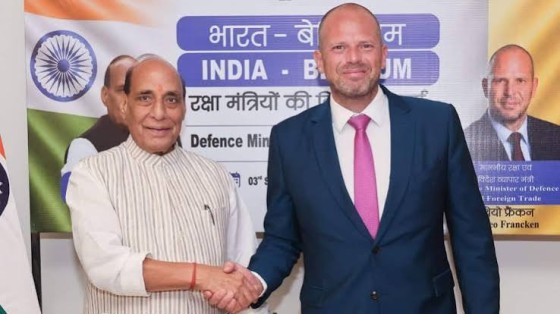
Defence Minister Rajnath Singh met Belgian Defence and Foreign Trade Minister Theo Francken in New Delhi on September 3.
The two sides reviewed the broader spectrum of:
defence cooperation,
industrial partnerships,
military engagement,
regional security,
and future capability development.
India and Belgium agreed to expand bilateral defence relations through:
structured defence cooperation dialogue,
high-level visits,
training,
and:
capacity building.
The talks also addressed regional peace and security, including opportunities for greater cooperation in the Indo-Pacific.
Maritime Security Emerges as Important Cooperation Area
Maritime security is becoming an important part of the bilateral defence agenda.
India and Belgium acknowledged the need for stronger collaboration in the Indo-Pacific, where maritime trade routes, subsea infrastructure and naval security have become increasingly important strategic concerns.
Potential areas of cooperation include:
mine countermeasures,
autonomous maritime systems,
underwater robotics,
critical infrastructure protection,
and associated technologies.
Belgian industry has specialised capabilities in several of these fields, while India is rapidly expanding domestic naval manufacturing and maritime-security requirements.
India-Belgium Defence CEOs Roundtable Expands Industry Engagement
The government-level discussions were complemented by an India-Belgium Defence CEOs Roundtable and B2B meetings held in New Delhi on September 3.
The event brought together representatives from:
Belgian defence companies,
Indian manufacturers,
the Confederation of Indian Industry,
and the Society of Indian Defence Manufacturers.
India's Minister of State for Defence Sanjay Seth and Belgium's Theo Francken participated in the industry engagement.
The roundtable was designed to move bilateral defence cooperation beyond dialogue toward concrete industrial relationships.
Multiple Defence MoUs Exchanged
Several agreements were exchanged during the industry meetings.
The partnerships included arrangements involving:
Society of Indian Defence Manufacturers and Belgian Security & Defence Industry;
Larsen & Toubro and Exail Robotics;
Kalyani Strategic Systems and FN Herstal;
Tembo Classic Engineering and Lachaussée;
India Optel and OIP;
Krishna Industries and Pitagone;
DGVK Enterprises and Sol1;
and:
Kalyani Strategic Systems with Thales Belgium and Thales India.
Together, these agreements cover a broad cross-section of modern defence manufacturing.
Kalyani Strategic Systems and Thales Expand Rocket Partnership
One of the highest-profile agreements involves Kalyani Strategic Systems Limited and Thales.
The companies are developing an advanced industrial capability in India for:
70-mm rocket systems.
Thales' Belgian operations bring specialised rocket-system technology, while Kalyani Strategic Systems provides Indian manufacturing, testing and industrial capability.
The partnership is expected to create a local production ecosystem rather than relying solely on imports of finished systems.
First Fully Assembled Indian Rocket Targeted for Early 2027
The first 70-mm rocket produced entirely through the new Indian manufacturing arrangement is expected:
in early 2027.
That timeline gives the agreement a concrete industrial objective.
The rocket systems can potentially be deployed from:
airborne platforms,
ground systems,
and naval platforms.
Such systems can support missions against a range of targets, including certain unmanned aerial threats.
Local production could improve supply security while reducing dependence on imported finished munitions.
Rocket Manufacturing Reflects Shift Toward Localisation
The Thales-Kalyani partnership illustrates the direction of India's broader defence-industrial policy.
India increasingly seeks international partnerships that involve:
technology transfer,
local manufacturing,
testing,
engineering,
and supply-chain development.
The objective is not simply to purchase foreign equipment.
Instead, India wants foreign defence companies to integrate with domestic manufacturing ecosystems.
That can create longer-term industrial capability and reduce vulnerability to disruptions in overseas supply chains.
FN Herstal Partnership Expands Small-Arms Cooperation
Kalyani Strategic Systems has also entered an agreement with Belgian weapons manufacturer FN Herstal.
Belgium has a long-established industrial base in small arms and related defence technologies.
The partnership creates scope for combining Belgian weapons expertise with India's growing defence-manufacturing capability.
Small arms remain essential equipment across:
armed forces,
special forces,
paramilitary organisations,
and security agencies.
Domestic manufacturing can improve sustainment, maintenance and long-term ammunition availability.
L&T and Exail Target Advanced Robotics and Maritime Systems
Larsen & Toubro's agreement with Exail Robotics is another strategically important development.
Exail has capabilities in areas including:
autonomous systems,
robotics,
navigation,
and maritime technologies.
These technologies are increasingly relevant to modern naval warfare.
Uncrewed platforms can perform missions such as:
reconnaissance,
hydrographic surveying,
mine detection,
mine neutralisation,
and underwater inspection.
Such systems can reduce risk to personnel while increasing persistent maritime surveillance.
Mine Countermeasures Are Increasingly Important
Naval mines remain a significant maritime-security threat.
They can disrupt:
ports,
shipping lanes,
naval operations,
and commercial trade
at relatively low cost.
Modern mine-countermeasure systems increasingly rely on:
autonomous underwater vehicles,
uncrewed surface vessels,
advanced sonar,
and robotic neutralisation systems.
Cooperation between Indian and Belgian companies could help India strengthen capabilities in this specialised field.
India Optel and OIP Expand Electro-Optics Cooperation
India Optel Limited has signed an agreement with Belgian company OIP.
Electro-optical systems are critical components across modern military platforms.
They can include:
thermal imaging,
targeting systems,
surveillance equipment,
night-vision technology,
and optical sensors.
These technologies are used across:
armoured vehicles,
artillery systems,
infantry equipment,
naval platforms,
and surveillance networks.
Local collaboration could strengthen India's domestic supply of advanced sensing technologies.
Tembo Classic Engineering and Lachaussée Sign Agreement
Another industrial partnership involves India's Tembo Classic Engineering and Belgium's Lachaussée.
Lachaussée has expertise related to ammunition-production machinery and industrial systems.
A partnership in this field could support India's efforts to expand domestic ammunition manufacturing.
Recent geopolitical conflicts have highlighted the strategic importance of maintaining adequate ammunition production capacity.
Countries are increasingly reassessing stockpiles and domestic manufacturing resilience.
Krishna Industries Partners With Pitagone
Krishna Industries has also entered an agreement with Belgian company Pitagone.
Pitagone develops security and protection solutions, including systems designed to protect sensitive sites and infrastructure.
Modern defence-industrial cooperation increasingly extends beyond conventional weapons.
Protection of:
military installations,
airports,
energy infrastructure,
government facilities,
and public spaces
has become an important security priority.
The partnership adds another capability area to the India-Belgium industrial portfolio.
DGVK Enterprises and Sol1 Add Another Technology Partnership
DGVK Enterprises Private Limited and Belgian company Sol1 BV were also among the companies exchanging agreements during the roundtable.
The inclusion of multiple smaller and specialised companies is significant.
Defence-industrial ecosystems depend not only on large prime contractors but also on:
specialist suppliers,
technology companies,
component manufacturers,
and engineering firms.
Creating direct B2B relationships can deepen industrial cooperation beyond a small number of large government contracts.
Industry Bodies Sign Cooperation Pact
The Society of Indian Defence Manufacturers and Belgian Security & Defence Industry also entered a cooperation arrangement.
Industry-association agreements can support future partnerships by creating structured channels for:
company introductions,
technology discussions,
trade delegations,
joint ventures,
and market access.
This can be particularly useful for smaller companies that may lack established international networks.
Over time, industry-level engagement can generate additional commercial agreements beyond those announced during the current visit.
Belgian Delegation Includes Around 15 Defence Companies
Belgium's defence-industry participation was substantial.
Around 15 Belgian defence companies accompanied the high-level delegation.
The scale of representation demonstrates Belgium's commercial interest in India's expanding defence market.
India has become increasingly attractive to international defence companies because of:
large procurement requirements,
rising defence budgets,
domestic manufacturing incentives,
and growing export ambitions.
Foreign companies increasingly view India not only as a buyer but also as a manufacturing and engineering base.
India Highlights Defence FDI Framework
During the CEOs Roundtable, India highlighted its liberalised foreign-investment framework for defence manufacturing.
Foreign direct investment in defence is permitted up to:
74% under the automatic route
and potentially:
100% through the government route
in eligible cases.
This framework is designed to encourage foreign companies to establish deeper industrial operations in India.
For European defence manufacturers, the ability to participate directly in Indian manufacturing can make local partnerships commercially more attractive.
Defence Industrial Corridors Offer Manufacturing Ecosystems
India also promoted its defence-industrial corridors.
Established corridors in:
Uttar Pradesh
and:
Tamil Nadu
provide infrastructure and policy support for defence manufacturers.
The government has additionally indicated plans for further industrial ecosystems in other regions.
Defence corridors are intended to create clusters where:
large manufacturers,
component suppliers,
research organisations,
and logistics providers
can operate close to one another.
Such clustering can reduce production costs and strengthen domestic supply chains.
India Wants Co-Development, Not Just Imports
A central message during the discussions was India's interest in:
co-development
and:
co-production.
This is strategically different from conventional defence procurement.
Under an import-based model, India purchases completed equipment from overseas.
Under co-production, part or all of the manufacturing shifts to India.
Co-development goes further by involving Indian companies in:
design,
engineering,
research,
testing,
and intellectual property creation.
This can build long-term technological capability rather than simply manufacturing foreign designs.
Belgium Brings Specialised Defence Technologies
Belgium does not have the scale of the world's largest defence exporters, but it possesses specialised expertise across several areas.
These include:
small arms,
ammunition technologies,
rockets,
electro-optics,
robotics,
maritime systems,
and security technologies.
This makes Belgium a potentially complementary partner for India.
Indian manufacturers can contribute:
industrial scale,
engineering talent,
cost competitiveness,
and large domestic demand.
Belgian companies can contribute specialised technologies and established intellectual property.
Partnership Could Support European Supply Security
The relationship may also benefit Belgium and the broader European defence market.
European countries have been increasing defence spending and rebuilding ammunition and equipment inventories.
Production capacity has become a strategic issue.
Manufacturing partnerships in India could potentially create additional supply-chain resilience.
If Indian facilities eventually qualify for global production, they could serve:
domestic requirements,
European customers,
and third-country export markets,
subject to applicable regulations and export controls.
India’s Defence Manufacturing Base Is Expanding
India has spent much of the past decade attempting to increase domestic defence production.
The policy push has encouraged both:
state-owned defence companies
and
private manufacturers.
Indian companies now participate in sectors including:
artillery,
armoured vehicles,
missiles,
rockets,
aircraft components,
warships,
electronics,
and drones.
International partnerships remain important because many advanced technologies require specialised expertise accumulated over decades.
Private Companies Are Becoming More Important
The latest Belgium agreements also illustrate the increasing role of private Indian manufacturers.
Companies such as:
Larsen & Toubro
and
Kalyani Strategic Systems
have become increasingly important participants in India's defence ecosystem.
Private-sector involvement can increase:
competition,
manufacturing capacity,
innovation,
and export potential.
It also creates more potential partners for foreign defence companies seeking an Indian industrial presence.
Zorawar Light Tank Highlights Existing Technology Links
Prime Minister Narendra Modi also highlighted the Zorawar light tank while discussing the growing India-Belgium partnership.
The programme illustrates how foreign technologies can be incorporated into Indian-designed defence platforms while maintaining domestic system integration.
The Zorawar was developed in India for demanding high-altitude operating environments.
Its inclusion in bilateral discussions reinforced the broader emphasis on combining international technology with Indian defence engineering.
Structured Military Cooperation Is Also Expanding
Industrial cooperation is only one element of the relationship.
India and Belgium are also strengthening direct military engagement.
Areas under discussion include:
training,
officer exchanges,
seminars,
capacity building,
and high-level visits.
These activities can improve mutual understanding between the two armed forces.
Military-to-military relationships also help identify practical areas where industrial cooperation may address shared capability requirements.
Belgian Defence College Plans India Engagement
Belgium's defence establishment is also looking to deepen institutional interaction with India.
A study visit by the Belgian Defence College has been discussed for:
2027.
Such exchanges are useful for future military leaders because they provide direct exposure to:
strategic priorities,
military doctrine,
industrial capabilities,
and regional security environments.
They can help establish relationships that continue throughout officers' careers.
Indo-Pacific Security Gives Partnership Strategic Relevance
Belgium is geographically distant from the Indo-Pacific, but European interest in the region has increased.
The Indo-Pacific contains critical:
shipping routes,
trade corridors,
technology supply chains,
and energy flows.
Disruption in the region can therefore have direct economic consequences for Europe.
India occupies a central geographic position within the Indian Ocean, making it an important security partner for European countries seeking greater Indo-Pacific engagement.
Maritime Infrastructure Protection Is Growing Priority
Undersea infrastructure has become particularly important.
Modern economies depend on:
submarine communications cables,
energy infrastructure,
pipelines,
ports,
and shipping routes.
Damage to these systems can have major economic and security consequences.
Autonomous underwater systems and advanced sensors can help countries monitor and protect maritime infrastructure.
Belgian technological expertise in this area could align closely with India's expanding maritime-security requirements.
Commercial Contracts Matter More Than Diplomatic Statements
The significance of the September agreements lies partly in their commercial orientation.
Defence relationships can remain largely symbolic when they are limited to statements of intent.
Commercial contracts create:
investment,
production timelines,
employment,
technology integration,
and supply commitments.
The addition of company-level agreements suggests that India-Belgium defence cooperation is moving toward more measurable industrial outcomes.
Successful Execution Will Determine Long-Term Impact
The signing of an MoU does not guarantee that a major production programme will ultimately emerge.
Defence projects can face challenges involving:
technical qualification,
procurement approvals,
pricing,
technology transfer,
export controls,
and production economics.
The real test will therefore be whether the announced partnerships progress into:
operational factories,
qualified products,
commercial orders,
and sustained production.
The early-2027 target for India's first fully assembled 70-mm rocket provides one important execution milestone.
Defence Exports Could Become Longer-Term Opportunity
India increasingly wants domestic defence manufacturing to serve both Indian requirements and export markets.
International partnerships can support that ambition.
Products developed jointly with established European companies may gain easier access to:
global supply chains,
international certification,
and third-country customers.
Exports can also improve factory utilisation.
A production line dependent entirely on domestic orders may operate intermittently.
Access to international demand can create more consistent manufacturing volumes.
Local Production Can Improve Wartime Resilience
Domestic defence manufacturing has strategic value beyond economics.
During conflicts or geopolitical crises, international supply chains can become disrupted.
Countries may impose:
export restrictions,
licensing delays,
or prioritisation of domestic military requirements.
Local manufacturing reduces dependence on overseas delivery of finished systems.
It can also simplify maintenance and spare-parts availability.
The emphasis on Indian production therefore reflects national-security considerations as much as industrial policy.
Partnership Comes as India Expands Defence Diplomacy
The Belgium agreements coincide with India's release of the RAKSHA defence-diplomacy framework.
The 10-year roadmap sets out India's approach toward deeper global defence partnerships.
Its priorities include:
strategic cooperation,
capacity building,
joint exercises,
and promoting indigenous defence exports.
The India-Belgium engagements fit closely with this direction.
Rather than treating defence diplomacy and defence manufacturing as separate areas, India increasingly connects security partnerships with industrial collaboration.
Belgium Sees Economic Opportunity in Indian Market
For Belgium, stronger defence ties also have a commercial dimension.
India is one of the world's largest defence markets.
Belgian companies participating in localisation programmes could gain access to significant long-term demand.
Industrial partnerships could also support:
jobs,
exports,
technology development,
and manufacturing scale
for Belgian companies.
The relationship is therefore intended to deliver economic benefits alongside strategic cooperation.
India-Belgium Partnership Extends Beyond Defence
The defence agreements form part of a much broader expansion in bilateral relations during Prime Minister Bart De Wever's visit.
India and Belgium have also discussed cooperation in areas including:
semiconductors,
critical minerals,
renewable energy,
trade,
investment,
and maritime affairs.
The combination reflects the increasingly interconnected nature of economic and strategic policy.
Technologies such as semiconductors and critical minerals are important not only for civilian industries but also for advanced defence systems.
Conclusion
India and Belgium's latest defence agreements mark a significant move toward a more industrially integrated security partnership built around co-development, co-production and direct company-to-company cooperation.
The September 3 engagements produced multiple MoUs connecting Indian companies with Belgian technology providers across 70-mm rockets, small arms, ammunition-production systems, electro-optics, autonomous robotics, maritime technologies and security equipment.
The partnership between Kalyani Strategic Systems and Thales is among the most advanced examples, with the first fully assembled 70-mm rocket in India targeted for early 2027.
At the government level, Defence Minister Rajnath Singh and Belgian Defence and Foreign Trade Minister Theo Francken also agreed to strengthen defence dialogue, high-level engagement, training and capacity building while expanding cooperation in maritime security.
For India, the strategy is consistent with its effort to move from defence imports toward domestic manufacturing, technology absorption and eventually exports.
For Belgium, India's industrial scale and expanding defence market create opportunities for its specialised manufacturers to develop a larger international production footprint.
The long-term significance of the partnership will depend on whether the newly signed agreements progress from MoUs into sustained manufacturing programmes, operational capabilities and commercial orders. If they do, India-Belgium defence ties could evolve into a meaningful European-Indian industrial partnership across several strategically important technologies.