Government to Introduce Bharat NCAP 2.0 From October 2027 With Expanded Vehicle-Safety Assessments
The Indian government will introduce Bharat New Car Assessment Programme 2.0 from October 2027, significantly expanding the country's vehicle-safety rating framework beyond conventional crash protection to assess how cars prevent accidents, protect vulnerable road users and support occupants after a collision.
Union Minister for Road Transport and Highways Nitin Gadkari confirmed the implementation timeline while addressing the 66th Annual Convention of the Society of Indian Automobile Manufacturers on September 3, 2026.
The second phase is designed to evaluate what the government describes as the:
entire crash chain.
Instead of concentrating predominantly on occupant protection during a collision, Bharat NCAP 2.0 is expected to evaluate safety across areas including:
safe driving,
crash avoidance,
crash protection,
vulnerable road-user protection,
and:
post-crash safety.
The Ministry of Road Transport and Highways has already developed a proposed framework through AIS-197 Revision 1, which sets out a substantially broader 100-point assessment system.
If implemented substantially in line with the draft, Bharat NCAP 2.0 will represent one of the biggest changes to India's independent vehicle-safety assessment system since Bharat NCAP was introduced in October 2023.
Bharat NCAP 2.0 to Take Effect From October 2027

Gadkari said the government is moving ahead with the second version of Bharat NCAP and intends the new framework to become effective:
from October 2027.
The timing corresponds with the conclusion of the first phase of Bharat NCAP.
The current framework became effective on:
October 1, 2023
and remains valid until:
September 30, 2027.
Bharat NCAP 2.0 is therefore intended to provide the next generation of India's vehicle-safety assessment system rather than operate as a separate parallel programme.
Government Wants to Evaluate Entire Crash Chain
The central philosophy behind Bharat NCAP 2.0 is broader than simply measuring what happens when a vehicle crashes.
The government wants the programme to assess the safety process from:
preventing an accident
through:
protecting people during the collision
and finally:
supporting rescue and care after the crash.
This represents a major conceptual shift.
Traditional crash testing concentrates heavily on how effectively a vehicle's structure, airbags and restraint systems protect occupants after impact.
Modern vehicle-safety programmes increasingly assess whether technology can prevent the collision from occurring in the first place.
Five Safety Areas Form Foundation of Proposed Framework
The draft AIS-197 Revision 1 framework divides vehicle assessment into five major verticals:
Safe Driving
Accident Avoidance
Crash Protection
Vulnerable Road User Protection
Post-Crash Safety
Together, these categories create a much broader picture of vehicle safety than a conventional crash-test score.
A vehicle could therefore require more than a strong passenger compartment and airbags to achieve the highest rating.
Its active-safety technologies, pedestrian protection and post-collision systems could also influence the result.
Proposed Bharat NCAP 2.0 Uses 100-Point System
The draft framework proposes evaluating vehicles on a:
100-point scale.
The proposed allocation is:
-
Crash Protection — 55 points
-
Vulnerable Road User Protection — 20 points
-
Safe Driving — 10 points
-
Accident Avoidance — 10 points
-
Post-Crash Safety — 5 points
Crash protection remains the largest component.
However, 45% of the proposed score would come from areas beyond conventional occupant crash protection.
That would significantly change how manufacturers need to engineer vehicles for high Bharat NCAP ratings.
Crash Protection Remains Largest Component
Crash protection accounts for:
55 points
under the proposed framework.
This ensures that structural crashworthiness remains fundamental.
A car with sophisticated driver-assistance technology cannot compensate completely for poor occupant protection.
The assessment is expected to consider how well vehicles protect both:
adult occupants
and:
child occupants
across different collision scenarios.
The expanded testing programme is intended to expose vehicles to a wider variety of impacts than the current system.
Five Crash Evaluations Are Proposed
Bharat NCAP 2.0's draft crash-protection framework proposes five major crash evaluations.
These include:
64 kmph offset frontal impact
50 kmph full-width frontal impact
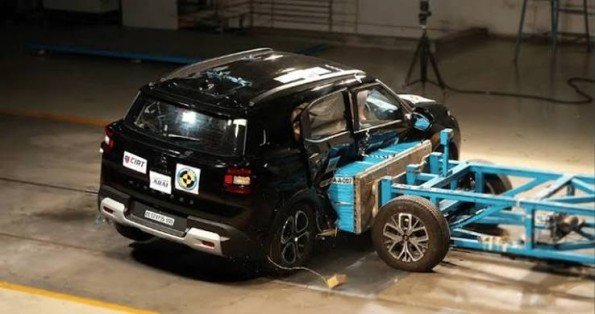
50 kmph mobile lateral barrier impact
32 kmph oblique pole side impact
and:
50 kmph mobile rigid rear impact.
The addition of more impact configurations is intended to provide a broader understanding of how a vehicle performs in different real-world crash scenarios.
Full-Width Frontal Crash Test Would Be Added
One major addition is a:
50 kmph full-width frontal impact test.
A full-width test loads a vehicle and its restraint systems differently from an offset frontal collision.
It can provide additional information about:
seat belts,
airbags,
occupant restraint,
and injury risk.
Using multiple frontal-impact configurations allows safety engineers to evaluate how effectively a vehicle protects occupants across different types of crashes.
Rear-Impact Testing Would Expand Assessment
The proposed framework also includes a:
50 kmph mobile rigid rear-impact test.
Rear collisions can produce different injury patterns from frontal crashes.
Seat design, head restraints and vehicle structure can influence occupant protection.
Including rear-impact assessment would broaden Bharat NCAP beyond its existing crash configurations and bring the programme closer to comprehensive international safety-rating methodologies.
Oblique Pole Impact Test Proposed at 32 kmph
The revised framework proposes a:
32 kmph oblique pole side-impact test.
Side impacts are particularly challenging because there is much less physical space between occupants and the external object than in a frontal collision.
Side airbags, curtain airbags and structural reinforcement therefore become especially important.
The proposed test is intended to assess protection in severe side-impact scenarios involving narrow objects such as poles.
Pedestrian Safety Becomes Major Rating Component
One of the most significant changes is the introduction of dedicated:
Vulnerable Road User Protection.
This category carries:
20 points
under the proposed system.
It expands the safety discussion beyond the people sitting inside the vehicle.
Pedestrians and other vulnerable road users face significant injury risks when struck by vehicles.
Vehicle design can influence the severity of those injuries.
Bonnet and Bumper Design Could Affect Ratings
Pedestrian-protection testing can assess how different parts of a vehicle behave when they strike a person.
The draft framework includes assessments involving:
adult headforms,
child headforms,
and:
legforms.
Areas including the:
bonnet,
windshield region,
and bumper
can therefore become important to a vehicle's safety score.
Manufacturers may need to engineer exterior structures to absorb impact energy more effectively.
Autonomous Emergency Braking Can Improve Pedestrian Protection
Technology can also prevent pedestrian collisions.
The proposed framework provides scope to evaluate Autonomous Emergency Braking, or AEB, in vulnerable-road-user scenarios.
AEB systems use sensors such as:
cameras,
radar,
or other detection technologies
to identify potential collisions.
If the driver does not react quickly enough, the vehicle can automatically apply the brakes.
The effectiveness of such systems could increasingly influence safety ratings.
Crash Avoidance Becomes Dedicated Assessment Category
Bharat NCAP 2.0 proposes assigning:
10 points
to accident or crash avoidance.
This category evaluates technology designed to stop an accident from happening.
Potential systems considered under the proposed framework include:
Electronic Stability Control,
Forward Collision Warning,
Lane Departure Warning,
Blind Spot Detection,
driver attention or drowsiness detection,
Hill Hold Assist,
and Autonomous Emergency Braking.
This is an important transition from passive safety toward:
active safety.
Electronic Stability Control Becomes Critical
Electronic Stability Control, or ESC, is designed to help drivers maintain control when a vehicle begins to lose directional stability.
The system can selectively apply braking to individual wheels and adjust power to help stabilise the vehicle.
Under the Bharat NCAP 2.0 draft, ESC becomes particularly important.
Vehicles seeking a star rating would need to meet specified ESC requirements.
That would encourage manufacturers to make the technology widely available rather than reserving it for expensive variants.
Curtain Airbags Become Important for Rating Eligibility
The proposed framework also places greater emphasis on:
curtain airbags.
Curtain airbags deploy along the side windows and can help protect occupants' heads during:
side impacts
and certain rollover-related situations.
Under the draft Bharat NCAP 2.0 structure, vehicles would need curtain-airbag protection meeting specified requirements to qualify for a star rating.
This could accelerate the standardisation of six-airbag configurations across more segments of the Indian passenger-vehicle market.
Base Variants Become Particularly Important
The draft proposes testing:
base variants
of eligible models.
This has important implications for consumers.
Automakers sometimes offer sophisticated safety equipment only on expensive higher trims.
Testing the base version places greater pressure on manufacturers to provide essential safety technologies across the model range.
A high rating would therefore become more representative of the vehicle accessible to entry-level customers.
Safe Driving Features Receive Separate Score
The proposed framework allocates:
10 points
to Safe Driving.
This category is intended to assess technologies and systems that support safer everyday operation before an emergency develops.
Modern cars increasingly contain digital systems that can:
warn drivers,
monitor behaviour,
identify hazards,
and provide information.
These systems can complement conventional mechanical safety engineering.
ADAS Will Become Increasingly Relevant
Advanced Driver Assistance Systems are expected to play a larger role under Bharat NCAP 2.0.
ADAS can include technologies such as:
automatic emergency braking,
lane warnings,
forward-collision alerts,
blind-spot detection,
and driver-monitoring functions.
The inclusion of active-safety assessment could encourage manufacturers to accelerate ADAS deployment in India.
However, the systems must also work reliably in India's complex road environment.
Indian Road Conditions Present Unique ADAS Challenge
India presents a particularly demanding environment for driver-assistance technology.
Vehicles may encounter:
pedestrians,
two-wheelers,
cycles,
animals,
mixed-speed traffic,
irregular lane discipline,
and highly variable road conditions.
ADAS calibrated primarily for more predictable traffic environments may not always behave optimally under these conditions.
Testing and validating systems specifically for Indian roads will therefore be essential.
The government has indicated that new technologies developed both internationally and by Indian startups could be considered under the programme.
Post-Crash Safety Becomes Formal Assessment
Bharat NCAP 2.0 proposes assigning:
5 points
to Post-Crash Safety.
This category examines what happens:
after the collision has occurred.
Surviving the initial impact is only one part of crash safety.
Occupants may still face danger from:
fire,
electric shock,
jammed doors,
inaccessible seat-belt buckles,
or delayed emergency response.
Post-crash design can influence whether occupants can be rescued quickly.
Rescue Accessibility Could Affect Vehicle Scores
The proposed assessment can consider issues such as:
door opening,
seat-belt buckle accessibility,
and evacuation.
Emergency responders need to access occupants after serious crashes.
Vehicle deformation should not make rescue unnecessarily difficult.
For occupants who can leave the vehicle themselves, doors and restraints should remain operable wherever possible.
These factors become especially important when fire or other post-collision hazards are present.
Electric-Vehicle Safety Is Increasingly Important
The growth of electric vehicles adds another dimension to post-crash safety.
EVs contain:
high-voltage batteries,
power electronics,
and electrical systems
that require specialised crash protection.
After a severe collision, systems must minimise risks involving:
electrical shock,
battery damage,
and thermal events.
A comprehensive NCAP framework therefore needs to evolve alongside the rapid electrification of India's passenger-vehicle market.
Emergency Calling Could Become Part of Safety Evaluation
Modern vehicles can automatically contact emergency services after detecting a serious collision.
Such systems can transmit information that may help emergency responders reach occupants more quickly.
Post-crash communication is increasingly recognised internationally as part of the broader vehicle-safety chain.
As connected-car technology expands in India, emergency-response capabilities could become more relevant to future NCAP ratings.
Five-Star Threshold Proposed at 70 Points Initially
The Bharat NCAP 2.0 draft proposes a progressively tougher rating structure.
For the period from:
2027 to 2029,
a vehicle would require at least:
70 points out of 100
to qualify for a five-star rating, subject to minimum performance requirements across the individual assessment areas.
The intention is to prevent manufacturers from achieving the highest rating by excelling in only one category while performing poorly elsewhere.
Five-Star Requirement Could Rise to 80 Points
From:
2029 to 2031,
the proposed five-star threshold rises to:
80 points.
This staged approach is significant.
Instead of allowing the industry to optimise around one fixed benchmark indefinitely, the safety standard becomes progressively more demanding.
Manufacturers would need to continue improving technology and engineering to maintain top ratings.
This mirrors the broader philosophy of international NCAP programmes, where rating requirements evolve as safety technology advances.
Zero Score in a Safety Vertical Could Block Five Stars
Under the proposed framework, a vehicle would not be able to achieve a five-star rating if it records:
zero in any assessment vertical.
This encourages balanced safety performance.
A structurally strong vehicle with no meaningful accident-avoidance capability, for example, could face limitations in achieving the maximum rating.
Similarly, strong active-safety technology would not compensate for unacceptable crash protection.
The principle is straightforward:
a genuinely safe vehicle must perform across the complete safety chain.
Bharat NCAP Remains a Voluntary Programme
Bharat NCAP is fundamentally a:
voluntary vehicle-assessment programme
monitored by the Ministry of Road Transport and Highways.
It is distinct from mandatory vehicle regulations.
A vehicle must comply with India's legal homologation and safety requirements before it can be sold.
Bharat NCAP then provides an additional consumer-facing assessment designed to compare relative safety performance.
This distinction is important.
A lower Bharat NCAP rating does not automatically mean a vehicle is illegal to sell.
It indicates how the model performs against the programme's additional safety benchmarks.
Star Ratings Give Consumers Simple Comparison
One of Bharat NCAP's main purposes is to convert complicated engineering data into an easily understood:
star rating.
Most consumers cannot independently analyse:
crash-test dummy measurements,
structural deformation,
sensor performance,
or restraint loads.
A star system makes comparison easier.
Safety ratings can therefore influence purchasing decisions alongside:
price,
fuel economy,
features,
design,
and performance.
As consumers become more safety-conscious, NCAP scores can become an important competitive factor.
More Than 30 Models From 11 Companies Certified
Gadkari said Bharat NCAP has already certified:
more than 30 vehicle models
from:
11 companies.
The figure demonstrates growing participation since the programme began in October 2023.
Indian manufacturers increasingly promote Bharat NCAP ratings as part of vehicle marketing.
High scores can strengthen consumer confidence and differentiate models in competitive segments.
This creates a commercial incentive for automakers to invest in safety beyond minimum regulatory requirements.
Bharat NCAP Has Reduced Testing Costs
Another important benefit highlighted by the government is lower testing cost.
Gadkari said international NCAP testing could cost approximately:
₹2.5 crore per model.
Testing through Bharat NCAP costs around:
₹60 lakh.
That represents a reduction of approximately:
75%.
Lower testing costs make independent safety assessment more accessible to manufacturers.
This is particularly relevant as India's passenger-vehicle industry includes a growing number of models and powertrain configurations.
Domestic Testing Can Reduce Certification Time
Conducting safety assessment in India also reduces dependence on overseas testing infrastructure.
International testing can involve:
vehicle transportation,
foreign laboratory scheduling,
logistics,
and additional administrative costs.
A mature domestic NCAP ecosystem can shorten development and certification cycles.
It can also strengthen India's automotive testing and engineering infrastructure.
Gadkari indicated that the lower cost has even encouraged some foreign companies to send vehicles to India for testing.
Bharat NCAP Can Strengthen Indian Vehicle Exports
Vehicle safety standards are increasingly important in global markets.
Indian manufacturers are expanding exports across:
Asia,
Africa,
Latin America,
the Middle East,
and other regions.
A credible domestic safety-assessment system can strengthen confidence in Indian-engineered vehicles.
If Bharat NCAP continues aligning with advanced international methodologies, Indian manufacturers may also be able to use domestic safety engineering more effectively across export programmes.
Safety Is Becoming Competitive Differentiator in India
For many years, Indian passenger-car competition focused heavily on:
price,
mileage,
maintenance costs,
and features.
Safety has become increasingly prominent.
Consumers now routinely discuss:
airbag count,
vehicle structure,
ESC,
ADAS,
and NCAP ratings.
Manufacturers have responded by making safety a central part of product positioning.
Bharat NCAP 2.0 could accelerate that shift by making the rating system substantially more demanding.
Automakers May Need to Redesign Entry-Level Vehicles
The impact could be particularly important for affordable vehicles.
Adding technologies such as:
curtain airbags,
ESC,
advanced sensors,
and stronger pedestrian-protection structures
can increase vehicle cost.
Manufacturers will therefore face an engineering challenge:
improving safety while preserving affordability.
This is especially important in India, where price remains a major factor in purchasing decisions.
Scale, localisation and domestic component manufacturing could help reduce the cost of advanced safety technologies.
Auto-Component Industry Could Benefit
The transition also creates opportunities for India's automotive-component sector.
Greater adoption of advanced safety systems can increase demand for:
radar sensors,
cameras,
electronic control units,
airbag modules,
seat-belt systems,
braking electronics,
driver-monitoring equipment,
and specialised software.
Localising these technologies could reduce costs while strengthening India's automotive electronics ecosystem.
Bharat NCAP 2.0 could therefore have industrial implications beyond vehicle manufacturers themselves.
Indian Startups Could Participate in Safety Technology
Gadkari specifically highlighted technologies being developed by:
Indian startups
as well as global companies.
This creates potential opportunities for domestic technology businesses working in:
computer vision,
radar,
artificial intelligence,
driver monitoring,
vehicle connectivity,
and emergency response.
As software becomes more important to vehicle safety, automotive innovation is no longer limited to traditional component manufacturers.
Technology companies can increasingly participate in the safety value chain.
Manufacturers Invited to Suggest Improvements
The government has also invited automobile manufacturers to provide recommendations for the next-generation framework.
Gadkari encouraged companies to share:
technical experience,
research,
international best practices,
and potential improvements.
Industry consultation is particularly important because vehicle-safety technology is evolving rapidly.
A testing framework that becomes too rigid can quickly fall behind technological development.
Regular collaboration between regulators, testing organisations and manufacturers can help keep Bharat NCAP relevant.
Bharat NCAP 2.0 Moves India Closer to Global Safety Methodologies
The proposed changes broadly reflect the evolution already seen across mature international vehicle-safety programmes.
Modern NCAP systems increasingly examine more than crash survival.
They consider:
crash prevention,
pedestrian and cyclist protection,
driver assistance,
occupant monitoring,
and rescue after accidents.
India's proposed five-vertical framework follows the same broader philosophy while adapting the assessment system to domestic conditions.
This could improve comparability between Indian and international safety expectations over time.
Final Standards Could Evolve Before October 2027
The AIS-197 Revision 1 framework provides the technical direction for Bharat NCAP 2.0.
However, implementation is still more than a year away.
The final requirements could therefore evolve as the government incorporates:
industry feedback,
testing experience,
new technologies,
and changes in international safety practices.
Consumers and manufacturers should consequently distinguish between:
the confirmed October 2027 rollout
and:
individual technical provisions currently contained in the proposed framework.
The overall direction is clear even if some detailed requirements are refined before implementation.
Conclusion
The government's decision to introduce Bharat NCAP 2.0 from October 2027 represents a major expansion of India's vehicle-safety rating framework from conventional crashworthiness toward assessment of the entire crash chain.
The next-generation programme is expected to evaluate vehicles across Safe Driving, Accident Avoidance, Crash Protection, Vulnerable Road User Protection and Post-Crash Safety, creating a substantially broader measure of real-world safety.
Under the proposed AIS-197 Revision 1 framework, vehicles would be evaluated on a 100-point scale, with 55 points allocated to crash protection, 20 to vulnerable-road-user protection, 10 each to safe driving and accident avoidance, and five to post-crash safety.
The draft also proposes additional crash configurations, stronger pedestrian-protection assessments, greater emphasis on ESC and curtain airbags, active-safety technologies such as AEB and progressively tougher thresholds for achieving five-star ratings.
Bharat NCAP has already certified more than 30 models from 11 manufacturers, while the government says domestic testing costs around ₹60 lakh per model compared with approximately ₹2.5 crore under international programmes.
Bharat NCAP 2.0 now seeks to build on that foundation.
For automakers, achieving top safety ratings will increasingly require a combination of strong vehicle structures, sophisticated restraint systems, pedestrian-friendly design, active crash-prevention technology and effective post-collision protection.
For consumers, the result should be a more comprehensive rating that answers a broader question than whether a car can protect its occupants during an accident:
how effectively can the vehicle prevent the crash, protect everyone involved and support survival after impact?