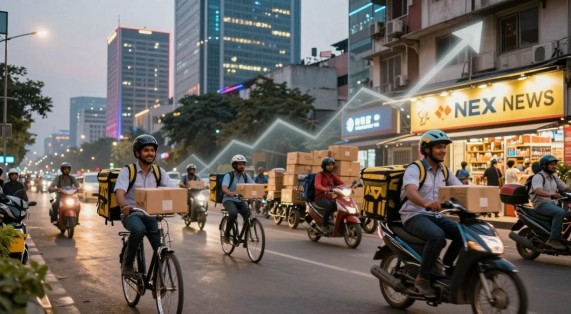
The rapid growth of quick commerce in India is transforming the logistics landscape. With the rise of e-commerce, the demand for fast and reliable delivery services has increased significantly.
Projections indicate that parcel volumes in India are expected to surge to over 10 billion by FY25. This growth is driven by the increasing adoption of online shopping and the need for speedy deliveries.
Key Takeaways
- The Indian logistics sector is witnessing a significant transformation due to the growth of e-commerce.
- Parcel volumes are projected to exceed 10 billion by FY25.
- The demand for fast and reliable delivery services is on the rise.
- Quick commerce is driving the growth of the logistics industry.
- E-commerce companies are investing heavily in logistics infrastructure.
The Rise of Quick Commerce in India
The rapid growth of quick commerce in India is transforming the retail industry. This shift is driven by consumers' increasing demand for speedy and convenient deliveries.
From Niche to Necessity: The Evolution of Fast Delivery
Quick commerce has evolved from a niche service to a necessity in India's e-commerce landscape. Initially, it catered to the urban population, but now it's expanding to tier 2 and tier 3 cities. The convenience offered by quick commerce platforms has redefined consumer expectations.
With the rise of mobile apps and digital payments, ordering groceries, food, and other essentials has become a seamless experience. This evolution is driven by the need for faster deliveries, often within 10-15 minutes.
Key Players Driving the Quick Commerce Revolution
The quick commerce revolution in India is driven by several key players. These companies are investing heavily in technology and logistics to provide faster and more reliable services.
Zepto, Blinkit, and Swiggy Instamart
Zepto and Blinkit are leading the charge with their extensive networks and quick delivery options. Swiggy Instamart is also a significant player, leveraging Swiggy's existing food delivery infrastructure to expand its grocery delivery services.
BigBasket, Dunzo, and Other Contenders
BigBasket and Dunzo are other major contenders in the quick commerce space. They offer a wide range of products and are focusing on improving their delivery times and customer service.
| Company | Delivery Time | Coverage Area |
|---|---|---|
| Zepto | 10-15 minutes | Tier 1 & 2 cities |
| Blinkit | 10-15 minutes | Tier 1 cities |
| Swiggy Instamart | 15-30 minutes | Tier 1 & 2 cities |
| BigBasket | Same-day delivery | Tier 1 & 2 cities |
| Dunzo | 30-60 minutes | Tier 1 cities |
Quick Commerce Goes Mainstream; India Parcel Volumes to Hit 10B+ in FY25
India's quick commerce sector is on the cusp of a significant transformation, with parcel volumes projected to exceed 10 billion by FY25. This growth is a testament to the evolving consumer behavior and the rapid expansion of e-commerce in the country.
Current Market Size and Growth Trajectory
The current market size of India's quick commerce sector is substantial, with a growth trajectory that is nothing short of remarkable. The sector has witnessed significant year-on-year growth, driven by increasing demand for fast and reliable delivery services.
Year-on-Year Growth Statistics
The year-on-year growth statistics for India's quick commerce sector are impressive, with parcel volumes increasing by over 50% in the last fiscal year alone.
| Fiscal Year | Parcel Volume (in millions) | Growth Rate (%) |
|---|---|---|
| 2022 | 2,500 | 30 |
| 2023 | 3,750 | 50 |
| 2024 | 6,000 | 60 |
Urban vs. Rural Adoption Rates
While urban areas continue to lead in terms of adoption rates, rural areas are rapidly catching up, driven by improving logistics infrastructure and increasing internet penetration.
- Urban areas: 70% of the total parcel volume
- Rural areas: 30% of the total parcel volume, growing at a rate of 20% YoY
Factors Driving the 10B+ Parcel Volume Projection
Several factors are driving the projection of 10 billion+ parcel volumes by FY25, including smartphone penetration, digital payments, and post-pandemic consumer behavior.
Smartphone Penetration and Digital Payments
The increasing penetration of smartphones and the adoption of digital payments have been instrumental in driving the growth of e-commerce and quick commerce in India.
The pandemic has led to a significant shift in consumer behavior, with a growing preference for online shopping and fast delivery. This trend is expected to continue, driving the growth of quick commerce in India.
The Technological Infrastructure Behind 10-Minute Deliveries
Technological infrastructure plays a crucial role in enabling 10-minute deliveries, a hallmark of India's quick commerce industry. The ability to deliver products rapidly is not just about logistical efficiency but also about leveraging advanced technology to streamline the entire process.
Dark Stores and Micro-Warehousing Networks
Dark stores and micro-warehousing networks form the backbone of quick commerce operations. These strategically located warehouses are designed to store inventory that can be quickly dispatched to customers.
Strategic Location Planning
The success of dark stores and micro-warehouses hinges on strategic location planning. By locating these warehouses in densely populated areas, quick commerce companies can significantly reduce delivery times.
Inventory Management Systems
Effective inventory management systems are crucial for maintaining the right stock levels in dark stores and micro-warehouses. Advanced algorithms help predict demand and ensure that popular items are always in stock.
AI and Machine Learning in Delivery Optimization
AI and machine learning are revolutionizing the quick commerce landscape by optimizing delivery routes and predicting demand.
Route Optimization Algorithms
Route optimization algorithms use real-time data to determine the most efficient delivery routes, reducing delivery times and operational costs.
Demand Prediction Models
Demand prediction models analyze historical data and current trends to forecast demand, enabling quick commerce companies to prepare accordingly and maintain high service levels.
By integrating these technological advancements, India's quick commerce industry is poised to continue its rapid growth, enhancing the online shopping India experience.
Supply Chain Advancements Enabling Rapid Delivery
As quick commerce goes mainstream in India, supply chain efficiencies are playing a crucial role. The ability to deliver products within 10 minutes is not just a logistical feat but a result of sophisticated supply chain advancements.
Last-Mile Delivery Innovations
Last-mile delivery is a critical component of quick commerce. Innovations in this area are significantly enhancing the speed and efficiency of deliveries.
Electric Vehicles and Sustainable Transport
The adoption of electric vehicles (EVs) is gaining momentum in India's urban areas. Companies are increasingly using EVs for last-mile deliveries, reducing carbon emissions and operational costs.
Hyperlocal Fulfillment Models
Hyperlocal fulfillment models involve setting up micro-warehouses or dark stores in densely populated areas. This strategy enables rapid order fulfillment and reduces delivery times.
Warehouse Automation and Robotics
Warehouse automation is another key area driving the efficiency of quick commerce. The integration of robotics and advanced technologies is streamlining operations.
Picking and Packing Technologies
Advanced picking and packing technologies, such as robotic pickers and automated packaging systems, are significantly reducing the time taken to process orders.
IoT Applications in Inventory Management
The Internet of Things (IoT) is being used to enhance inventory management. IoT devices provide real-time data on inventory levels, enabling more accurate demand forecasting and reducing stockouts.
| Supply Chain Advancement | Description | Impact on Quick Commerce |
|---|---|---|
| Electric Vehicles | Adoption of EVs for last-mile deliveries | Reduced carbon emissions and operational costs |
| Hyperlocal Fulfillment | Micro-warehouses in densely populated areas | Rapid order fulfillment and reduced delivery times |
| Warehouse Automation | Integration of robotics and advanced technologies | Streamlined operations and increased efficiency |
E-Commerce Growth Trends Accelerating Quick Commerce
The rapid growth of e-commerce in India is significantly accelerating the quick commerce sector. This growth is driven by increasing consumer demand for faster and more convenient delivery options. As a result, the quick commerce market is expanding rapidly, with several key players emerging to meet this demand.
India's E-Commerce Market Size and Projections
India's e-commerce market has been growing steadily, with a projected value of $150 billion by FY25. This growth is driven by increasing internet penetration, rising smartphone adoption, and a growing middle class.
Category-Wise Growth Analysis
The e-commerce market in India is witnessing significant growth across various categories, including electronics, fashion, and groceries. The grocery category, in particular, is expected to drive growth in the quick commerce segment.
Tier 2 and Tier 3 City Expansion
The expansion of e-commerce into tier 2 and tier 3 cities is also contributing to the growth of quick commerce. These cities offer significant opportunities for e-commerce companies to tap into the growing demand for online shopping.
Integration of Quick Commerce with Traditional E-Commerce
The integration of quick commerce with traditional e-commerce is becoming increasingly important. This integration enables businesses to offer a seamless shopping experience across different channels.
Omnichannel Strategies
Omnichannel strategies are crucial for businesses looking to integrate quick commerce with traditional e-commerce. By providing a consistent shopping experience across online and offline channels, businesses can improve customer retention and loyalty.
Customer Retention Metrics
Customer retention metrics, such as customer satisfaction and repeat purchase rates, are essential for measuring the success of omnichannel strategies. By analyzing these metrics, businesses can identify areas for improvement and optimize their strategies accordingly.
Economic Impact of Quick Commerce on India's Retail Landscape
The rapid growth of quick commerce in India is transforming the retail landscape in profound ways, with significant economic implications.
Job Creation and Gig Economy Expansion
Quick commerce has led to a surge in job creation, particularly in the gig economy. This shift has provided employment opportunities for thousands of delivery personnel and warehouse staff.
Employment Statistics and Projections
According to recent statistics, the gig economy in India is expected to grow by 20% annually, driven largely by the quick commerce sector.
Skill Development Requirements
As the gig economy expands, there is a growing need for skill development programs to enhance the capabilities of delivery personnel and other gig workers.
Disruption of Traditional Retail Models
The rise of quick commerce has disrupted traditional retail models, forcing Kirana stores and other local retailers to adapt to the changing landscape.
Kirana Stores Adaptation Strategies
Kirana stores are adopting various strategies, including partnering with quick commerce players and enhancing their own delivery capabilities.
Collaborative Models Between Quick Commerce and Local Retailers
Collaborative models are emerging, where quick commerce companies partner with local retailers to expand their product offerings and enhance delivery efficiency.
Key Benefits of Quick Commerce
- Increased convenience for consumers
- Job creation in the gig economy
- Enhanced efficiency in delivery logistics

The economic impact of quick commerce in India is multifaceted, driving growth, creating jobs, and transforming traditional retail models.
Challenges and Growing Pains in the Quick Commerce Sector
The rapid growth of quick commerce in India is not without its challenges, including operational hurdles and sustainability concerns. As the sector continues to expand, it faces numerous logistical complexities and infrastructural limitations.
Operational Hurdles and Logistical Complexities
The quick commerce sector in India is grappling with several operational challenges. Two significant issues are infrastructure limitations and traffic congestion.
Infrastructure Limitations
Inadequate infrastructure in many Indian cities hampers the efficiency of quick commerce operations. This includes insufficient warehousing facilities and poor road conditions.
Traffic Congestion and Urban Mobility Issues
Traffic congestion in major Indian cities poses a significant challenge to quick commerce delivery services. Delays due to traffic can impact the promise of quick deliveries.
Sustainability Concerns and Environmental Impact
The environmental impact of quick commerce is another significant concern. The carbon footprint of quick deliveries and packaging waste are two major issues.
Carbon Footprint of Quick Deliveries
The rapid delivery model results in increased carbon emissions due to the frequent use of vehicles for last-mile delivery. Companies are exploring electric vehicles and optimized routing to reduce this impact.
Packaging Waste and Reduction Initiatives
Quick commerce often results in excessive packaging waste. Companies are adopting sustainable packaging solutions and encouraging customers to opt for minimal packaging.
| Challenge | Impact | Potential Solution |
|---|---|---|
| Infrastructure Limitations | Inefficient logistics | Invest in warehousing and logistics infrastructure |
| Traffic Congestion | Delayed deliveries | Optimize delivery routes and use real-time traffic updates |
| Carbon Footprint | Environmental impact | Adopt electric or hybrid vehicles |
| Packaging Waste | Environmental pollution | Use sustainable packaging materials and minimal packaging |
Investment Trends and Funding Landscape in Indian Quick Commerce
The funding landscape for Indian quick commerce is becoming increasingly vibrant, with major funding rounds and investor confidence on the rise. As the sector continues to expand rapidly, it is attracting significant investments from both domestic and international investors.
Major Funding Rounds and Investor Confidence
The Indian quick commerce market has witnessed several major funding rounds in recent times, reflecting the growing confidence of investors in its potential. Some of the key trends in this space include:
- Domestic vs. International Investment: Both domestic and international investors are actively participating in funding rounds, with a notable presence of global venture capital firms.
- Recent Mergers and Acquisitions: The sector has seen a surge in mergers and acquisitions, as companies look to consolidate their positions and expand their market share.
Domestic vs. International Investment
The influx of international investment has been particularly noteworthy, with global investors recognizing the potential of India's quick commerce market. Domestic investors, on the other hand, are also playing a crucial role in supporting local startups.
Recent Mergers and Acquisitions
Mergers and acquisitions have become a key strategy for companies looking to strengthen their market presence. These deals are not only enhancing operational efficiencies but also expanding the reach of quick commerce services.
Valuation Metrics and Future Investment Outlook
As the quick commerce sector continues to evolve, valuation metrics are becoming increasingly important for investors. Key considerations include:
- Profitability Challenges and Unit Economics: Companies are focusing on achieving profitability by optimizing their unit economics, including delivery costs and customer acquisition expenses.
- Investor Expectations for FY25 and Beyond: Investors are expecting significant growth from quick commerce companies in the coming years, driven by continued investment in technology and infrastructure.
Profitability Challenges and Unit Economics
Achieving profitability remains a challenge for many quick commerce companies, which are working to optimize their operational efficiencies and reduce costs.
Investor Expectations for FY25 and Beyond
Investors are optimistic about the future prospects of the quick commerce sector, with expectations of continued growth and expansion. The focus will be on companies that can demonstrate strong unit economics and a clear path to profitability.

Conclusion: The Transformative Power of Quick Commerce on India's Economy
India's quick commerce sector is revolutionizing the retail landscape, driven by rapid e-commerce growth in India. The surge in demand for instant deliveries has led to a significant increase in india parcel volumes, with projections indicating a rise to over 10 billion parcels in FY25.
As quick commerce continues to transform the way Indians shop, it is also having a profound impact on the country's logistics and supply chain infrastructure. The growth of this sector is creating new opportunities for businesses, driving innovation, and enhancing customer convenience.
With major players investing heavily in technological infrastructure, including dark stores and AI-powered delivery optimization, the industry is poised for sustained growth. As india parcel volumes continue to rise, the e-commerce growth india trend is expected to persist, driving further expansion in the quick commerce sector.