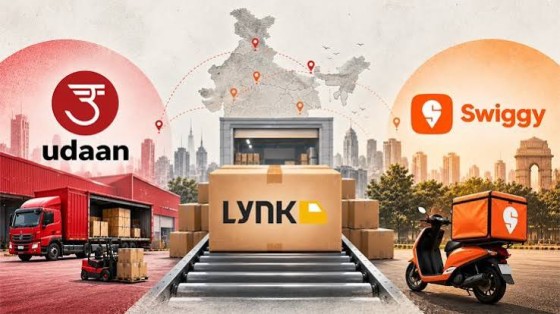
Udaan to Acquire Swiggy-Owned LYNK Logistics for ₹500 Crore as Swiggy Takes About 3.2% Stake in Udaan
B2B commerce platform Udaan has agreed to acquire Swiggy-owned LYNK Logistics for ₹500 crore in an all-stock transaction, strengthening its retail-distribution network while giving Swiggy an eventual stake of about 3.2% in Udaan's parent company.
Under the transaction, Udaan parent Trustroot Internet Private Limited will issue preference shares to Swiggy in exchange for LYNK, giving the food-delivery and quick-commerce company an approximately 2.8% stake in Udaan.
Swiggy will separately invest another:
₹75 crore
in primary equity in Trustroot Internet.
That additional investment will give Swiggy approximately:
0.4% more ownership,
taking its total stake in Udaan to around:
3.2%.
The acquisition, announced on September 7, 2026, values LYNK at approximately ₹500 crore and is expected to strengthen Udaan's access to consumer brands, retailers and distribution infrastructure across several major Indian cities.
The transaction is subject to customary closing conditions and regulatory approvals.
Udaan Agrees to Buy LYNK for ₹500 Crore

Udaan will acquire:
LYNK Logistics Limited
from Swiggy in a transaction valued at:
₹500 crore.
Rather than paying Swiggy entirely in cash, the deal will be settled through:
preference shares in Trustroot Internet,
the parent entity of Udaan.
This structure allows Udaan to preserve cash while giving Swiggy continued economic exposure to the B2B commerce business.
Swiggy Will Receive About 2.8% Stake Through Share Swap
As consideration for LYNK, Swiggy will receive approximately:
2.8% equity in Udaan.
The stake will arise through the issuance of preference shares by Trustroot Internet.
That makes Swiggy not simply a seller exiting LYNK but also a shareholder in the enlarged Udaan platform.
The structure aligns part of Swiggy's return with Udaan's future growth and eventual public-market performance.
Additional ₹75 Crore Investment Raises Stake to 3.2%
Swiggy will also make a separate:
₹75 crore primary investment
in Trustroot Internet.
That investment is expected to provide another:
approximately 0.4% stake.
Combined with the 2.8% received through the LYNK transaction, Swiggy's eventual ownership will be around:
3.2%.
The structure suggests Swiggy sees strategic or financial value in retaining exposure to India's B2B retail-distribution opportunity even as it divests direct ownership of LYNK.
Deal Implies Udaan Valuation of Around $1.9 Billion
The transaction structure points to a valuation for Udaan of approximately:
$1.9 billion.
That provides another private-market valuation reference for the company as it works toward:
profitability
and:
longer-term IPO readiness.
Udaan was once valued substantially higher during the peak of India's startup funding cycle.
Like many venture-backed companies, it has since restructured its capital base and shifted its focus toward more sustainable unit economics.
Acquisition Is Expected to Close by October
The transaction remains subject to:
customary closing conditions
and:
applicable regulatory approvals.
The deal is expected to be completed by approximately:
October 22, 2026.
Until those conditions are satisfied, LYNK will remain part of Swiggy.
The completion process will also involve transferring ownership, integrating operations and implementing the agreed equity issuance.
LYNK Is a Technology-Led Retail Distribution Platform
LYNK operates in:
B2B retail distribution.
It connects consumer brands with retail outlets and uses technology to manage:
ordering,
inventory,
distribution,
and retailer servicing.
The company is particularly active in fast-moving consumer goods and other high-frequency retail categories.
Its network gives manufacturers and brands another route to reach neighbourhood retailers without relying entirely on conventional multilayered distribution systems.
LYNK Serves More Than 100,000 Retail Stores
LYNK's network includes more than:
100,000 retail stores.
That retailer base is strategically attractive to Udaan.
B2B commerce becomes more valuable as network density increases.
A larger retailer network allows the platform to distribute more products through the same logistics and sales infrastructure.
It also gives brands access to more stores through a single distribution partner.
Four Cities Generate About 75% of LYNK Revenue
LYNK's business is concentrated in several major urban markets.
Approximately:
75% of its revenue
comes from:
Bengaluru,
Hyderabad,
Chennai,
and Kolkata.
These markets complement Udaan's cluster-led operating strategy.
Rather than spreading resources evenly across the entire country, Udaan has increasingly focused on building deeper operations within selected high-volume markets.
LYNK adds density in precisely this type of urban cluster.
LYNK Generated ₹668 Crore Revenue in FY26
LYNK recorded revenue of approximately:
₹668 crore in FY26.
That gives Udaan an additional operating business of meaningful scale.
The revenue contribution is important, but the strategic value extends beyond sales.
Udaan is also acquiring:
retailer relationships,
brand partnerships,
distribution infrastructure,
technology,
and operating capabilities.
The combination could therefore create both revenue and cost synergies.
Swiggy Acquired LYNK in 2023
Swiggy acquired LYNK in:
July 2023.
The transaction was part of Swiggy's effort to expand beyond:
food delivery
and:
quick commerce
into broader retail distribution.
LYNK gave Swiggy access to a technology-enabled network connecting brands with local retailers.
Three years later, Swiggy is transferring that business to Udaan while retaining indirect exposure through its new equity stake.
Deal Allows Swiggy to Exit Direct Retail Distribution
For Swiggy, the transaction represents a strategic simplification.
Its core growth priorities increasingly centre on businesses such as:
food delivery,
quick commerce,
and adjacent consumer services.
Operating a standalone B2B retail-distribution business requires a different model involving:
working capital,
inventory movement,
retailer servicing,
and brand distribution.
Selling LYNK allows Swiggy to move away from direct operational ownership of this business.
Swiggy Still Retains Exposure Through Udaan Stake
Importantly, Swiggy isn't eliminating its economic exposure entirely.
Its approximately:
3.2% eventual Udaan stake
means it can continue participating in potential value creation within the B2B commerce market.
This creates a different risk profile.
Instead of operating LYNK directly, Swiggy becomes a minority shareholder in a company that specialises in B2B commerce and retail distribution.
That can reduce operating complexity while preserving strategic upside.
Udaan Gains Complementary Distribution Capabilities
For Udaan, the acquisition strengthens its core operating model.
The company connects:
brands,
manufacturers,
wholesalers,
and retailers
through a technology-led B2B commerce platform.
LYNK adds established distribution capabilities and retailer relationships.
Combining the two networks could improve Udaan's ability to:
reach stores,
increase product availability,
and strengthen brand partnerships.
Brand Relationships Are a Key Asset
One of LYNK's most valuable assets is its network of:
consumer-brand relationships.
Large FMCG and consumer companies need reliable distribution across thousands of stores.
A B2B platform that can provide:
ordering,
distribution,
inventory visibility,
and retailer access
becomes more useful as its network grows.
Adding LYNK's brand relationships could therefore increase both transaction volume and negotiating leverage for Udaan.
Acquisition Expands Retailer Network
Udaan has spent years building a network of small retailers across India.
LYNK expands that reach further.
A broader network creates potential advantages through:
higher order density,
better logistics utilisation,
more product variety,
and stronger data on local demand.
These factors can improve unit economics when properly integrated.
They can also make the platform more valuable to brands looking for efficient distribution.
Udaan Is Moving Toward a More Focused Operating Model
The deal comes after Udaan spent several years restructuring its business.
During the earlier startup-growth phase, the company expanded aggressively across:
categories,
cities,
credit,
logistics,
and other services.
It later reduced costs and narrowed its focus as funding conditions changed.
The current strategy places greater emphasis on:
profitable clusters,
stronger margins,
capital efficiency,
and disciplined growth.
The LYNK acquisition fits that more targeted approach.
Revenue Has Grown at About 25% CAGR
Udaan says its revenue grew at approximately:
25% compound annual growth
between the fourth quarter of calendar 2023 and the first quarter of calendar 2026.
The growth occurred while the company was simultaneously working to improve profitability.
That combination is important.
Private-market and future public-market investors increasingly expect startups to demonstrate that revenue growth can coexist with improving unit economics.
Contribution Margin Improved by Nearly 500 Basis Points
Udaan has also reported an improvement of almost:
500 basis points
in contribution margin over the same broader turnaround period.
Contribution margin measures how much revenue remains after certain variable operating costs.
Improvement suggests the company is becoming more efficient in areas such as:
pricing,
procurement,
logistics,
and category mix.
Higher contribution margins provide a stronger foundation for eventual EBITDA profitability.
EBITDA Burn Has Fallen About 70%
One of Udaan's most significant financial improvements has been the reduction in:
EBITDA burn.
The company says its EBITDA burn has declined approximately:
70%
over the past 10 quarters.
This indicates a major shift from the cash-intensive growth model that characterised its earlier years.
Lower burn can extend financial runway and make the company more attractive to IPO investors.
Bengaluru Has Reached EBITDA Profitability
Udaan says its largest operating market:
Bengaluru
has achieved EBITDA profitability.
This is strategically important because it demonstrates that the company's cluster model can potentially generate positive economics at sufficient scale.
The challenge is reproducing that performance across additional cities.
LYNK's strong presence in Bengaluru and other major metros could help increase density in markets where Udaan already operates.
Cluster Density Can Improve B2B Economics
Retail distribution economics are strongly influenced by:
density.
If delivery vehicles serve many retailers within a compact area, the cost per order falls.
Sales and fulfilment teams can also cover more stores efficiently.
Low-density expansion creates the opposite problem: longer routes, smaller loads and higher service costs.
Udaan's focus on clusters is therefore intended to maximise economic efficiency.
LYNK's concentrated network fits this strategy.
Private Labels Are Becoming More Important
Udaan is also expanding:
private-label products.
Its private labels now account for approximately:
15%–25% of staples sales
across operating cities.
Private labels can improve margins because the platform controls more of the economics between sourcing and retail sale.
They can also increase differentiation from competing B2B distributors.
A larger retailer network following the LYNK acquisition gives Udaan more outlets through which to distribute these products.
Staples Are Particularly Suitable for Private Labels
Staples include high-frequency categories such as:
flour,
rice,
pulses,
sugar,
and other grocery essentials.
Retailers purchase these products repeatedly.
That creates recurring demand and allows a B2B platform to build scale.
If Udaan can supply competitively priced private-label products with reliable quality, it can potentially generate higher margins than from simply distributing third-party brands.
LYNK Network Could Accelerate Private-Label Distribution
The LYNK acquisition could give Udaan a larger route-to-market for its private labels.
Stores already served through LYNK can potentially become customers for additional Udaan categories.
This creates cross-selling opportunities.
Udaan could use the combined network to offer retailers:
national brands,
regional products,
and private labels
through a broader catalogue.
That could raise the amount of business generated per retailer.
Udaan Recently Completed $160 Million Recapitalisation
The transaction follows a significant balance-sheet restructuring.
Udaan recently completed approximately:
$160 million of recapitalisation.
The exercise included:
fresh equity,
new debt,
and debt-to-equity conversion.
Investors involved included:
Lightspeed Venture Partners,
M&G Investments,
and Moonstone Capital.
The recapitalisation strengthened the company's financial position before the LYNK acquisition.
Recapitalisation Included About $45 Million of Private Credit
The financing package also included approximately:
$45 million of private credit.
The debt was provided by a global investment management firm.
Private credit has become an increasingly important source of funding for mature startups that need capital but want to avoid excessive equity dilution.
For Udaan, the financing adds liquidity while the company continues moving toward profitability.
Balance-Sheet Repair Supports Acquisition Strategy
A stronger balance sheet gives Udaan more flexibility to pursue acquisitions.
The LYNK transaction itself is largely equity-funded, limiting immediate cash requirements.
However, integrating an acquired business still requires:
technology investment,
working capital,
employee integration,
and operational restructuring.
The recent recapitalisation provides additional capacity to absorb those costs.
LYNK Is Udaan's Second Major Distribution Acquisition
The LYNK deal follows Udaan's acquisition of:
ShopKirana
in 2025.
ShopKirana also operated within India's technology-enabled retail distribution ecosystem.
These deals indicate that Udaan is increasingly using acquisitions to consolidate capabilities within B2B commerce.
Rather than building every city and retailer network internally, it can acquire platforms with established relationships and infrastructure.
Consolidation Could Reshape B2B Commerce
India's B2B commerce market has attracted substantial investment over the past decade.
Multiple startups attempted to digitise:
wholesale ordering,
distribution,
credit,
and logistics
for small retailers.
The market has proved difficult because margins are thin and working-capital requirements can be high.
As funding has become more disciplined, consolidation has become increasingly logical.
Larger platforms can acquire smaller networks to create greater scale.
Traditional Distribution Remains Highly Fragmented
India's retail-distribution system remains highly fragmented.
Millions of neighbourhood stores purchase goods through networks of:
distributors,
sub-distributors,
wholesalers,
and sales agents.
Technology platforms attempt to simplify this process by allowing retailers to place orders digitally.
They can also provide brands with better data on:
sales,
inventory,
and retailer demand.
However, physical fulfilment remains critical.
This is why logistics and distribution capabilities such as LYNK's are strategically valuable.
B2B Commerce Requires More Than an App
Early e-commerce narratives sometimes framed B2B digitisation primarily as a software opportunity.
In reality, retail distribution requires substantial physical execution.
A successful platform must manage:
warehouses,
inventory,
delivery fleets,
sales relationships,
credit,
and returns.
Technology improves efficiency but doesn't eliminate these requirements.
The Udaan-LYNK transaction reflects this reality by combining digital infrastructure with physical retail-distribution capabilities.
Retailers Benefit From Larger Product Assortment
For neighbourhood retailers, a larger B2B platform can provide access to:
more brands,
more categories,
competitive pricing,
and consolidated ordering.
Instead of dealing separately with many suppliers, a retailer can potentially source a larger portion of inventory through one platform.
This can reduce procurement complexity.
However, retailers remain highly price-sensitive, meaning the platform must maintain competitive economics.
Brands Benefit From Wider Distribution
Consumer brands also gain from broader digital distribution.
Smaller or newer brands may struggle to build traditional distributor networks across multiple cities.
A B2B platform can provide rapid access to thousands of stores.
Large established brands can use the same platform to improve:
sales visibility,
distribution efficiency,
and retailer engagement.
Combining Udaan and LYNK could therefore strengthen the platform's attractiveness to both emerging and established brands.
Data Is an Increasingly Important Advantage
Digital ordering creates data that traditional distribution often lacks.
A platform can analyse:
which products sell,
where demand is rising,
how often retailers reorder,
and which price points perform best.
That data can improve:
procurement,
inventory planning,
pricing,
and private-label development.
A larger combined retailer network gives Udaan a broader dataset on consumption patterns.
Swiggy Could Become a Strategic Partner Beyond Equity
The transaction may also create future commercial opportunities between:
Swiggy
and:
Udaan.
The companies have not announced a detailed commercial partnership alongside the acquisition.
However, Swiggy's new shareholder position could make collaboration more likely in areas where their businesses overlap.
Potential opportunities could include:
sourcing,
distribution,
merchant relationships,
or other supply-chain services.
Any such collaboration would depend on separate commercial agreements.
Swiggy Is Focusing Capital on Core Consumer Businesses
Swiggy's decision to divest LYNK also reflects a broader capital-allocation question.
Its consumer businesses require substantial investment.
Quick commerce in particular involves spending on:
dark stores,
inventory,
technology,
delivery infrastructure,
and customer acquisition.
Exiting a non-core B2B distribution operation can allow management to direct greater attention toward areas it considers strategically more important.
The Udaan stake preserves upside without requiring Swiggy to operate LYNK directly.
Quick Commerce Is Swiggy’s Larger Strategic Priority
Swiggy's Instamart business has become a major competitive battleground.
The company competes with:
Blinkit,
Zepto,
and other rapid-delivery platforms.
Quick commerce requires significant capital because companies are building dense networks of local fulfilment centres.
That makes portfolio prioritisation increasingly important.
Selling LYNK simplifies Swiggy's business structure as competition in its core markets intensifies.
Deal Creates a Cleaner Structure for Both Companies
The transaction can therefore be viewed as a strategic fit for both sides.
Udaan receives a business closely aligned with its core competency:
B2B distribution.
Swiggy reduces exposure to an operating model that sits outside its main consumer platform.
At the same time, Swiggy retains financial exposure through equity ownership.
This type of structure can create value when an asset is more strategically useful to the buyer than to the seller.
Udaan Is Preparing for Long-Term Public-Market Readiness
Udaan has explicitly linked its recent financial improvements to:
long-term public-market readiness.
The company hasn't announced a final IPO date.
However, its actions increasingly resemble those of a late-stage startup preparing for eventual listing.
Those actions include:
reducing losses,
improving margins,
strengthening the balance sheet,
consolidating operations,
and adding scale through targeted acquisitions.
Acquisition Could Strengthen IPO Narrative
The LYNK acquisition could improve Udaan's future IPO story if integration succeeds.
Investors could see:
larger revenue,
greater retailer reach,
stronger distribution,
and improved brand relationships.
However, acquisitions also introduce integration risk.
Udaan will need to demonstrate that LYNK can be combined without reversing recent progress on:
cost control
and:
profitability.
Public investors are likely to focus heavily on that balance.
Integration Will Be the Next Major Test
Completing the transaction is only the first step.
Udaan must then integrate:
teams,
technology,
retailer accounts,
brand relationships,
warehouses,
distribution routes,
and financial systems.
Poor integration could create duplicated costs or operational disruption.
Successful integration could generate:
higher density,
better logistics utilisation,
more retailer cross-selling,
and stronger margins.
The quality of execution will therefore determine the actual economic value of the deal.
Deal Signals Continued B2B Market Consolidation
The transaction also suggests India's eB2B sector is entering a more mature phase.
The earlier period was characterised by:
rapid funding,
aggressive customer acquisition,
and multiple competing platforms.
The current phase is increasingly focused on:
scale,
unit economics,
consolidation,
and profitability.
Businesses with stronger balance sheets and deeper networks are likely to become natural consolidators.
Udaan is positioning itself as one of them.
Conclusion
Udaan has agreed to acquire Swiggy-owned LYNK Logistics for ₹500 crore in an all-stock transaction that will significantly expand its B2B retail-distribution capabilities while turning Swiggy into a minority shareholder in the company.
Trustroot Internet, Udaan's parent, will issue preference shares giving Swiggy approximately 2.8% ownership in exchange for LYNK. Swiggy will separately invest ₹75 crore in fresh equity for another approximately 0.4% stake, taking its eventual holding to around 3.2%.
LYNK brings a network serving more than 100,000 retail stores, established brand relationships and strong operations in Bengaluru, Hyderabad, Chennai and Kolkata, which together generate around 75% of its revenue. The business reported approximately ₹668 crore of revenue in FY26.
For Udaan, the acquisition fits a strategy centred on denser distribution clusters, higher-margin private labels, improving contribution margins and long-term IPO readiness. The company has reported roughly 25% revenue CAGR over its recent turnaround period, a nearly 500-basis-point improvement in contribution margin and about a 70% reduction in EBITDA burn.
For Swiggy, the structure provides an exit from direct B2B retail distribution while preserving exposure to the sector through Udaan equity.
The strategic logic is therefore straightforward: LYNK moves to an owner whose core business is B2B distribution, while Swiggy converts a non-core operating asset into a minority financial stake in a larger specialist platform.