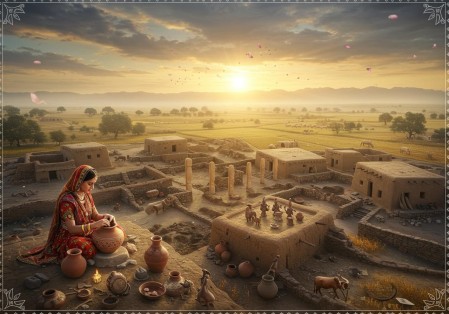
Mehrgarh Civilization: One of the Earliest Known Farming Settlements in South Asia
Long before the rise of the Indus Valley Civilization or the emergence of ancient cities like Mohenjo-daro and Harappa, there existed a thriving Neolithic settlement in what is now Balochistan, Pakistan. This was Mehrgarh—a site that has reshaped our understanding of early human civilization in South Asia.
Dating back to around 7000 BCE, Mehrgarh is considered one of the earliest known centers of agriculture and village life in the world. Located near the Bolan Pass on the Kacchi Plain, this site offers remarkable insight into humanity’s transition from nomadic hunter-gatherers to settled farmers and artisans.
Unearthing the Origins of Civilization
Mehrgarh was first discovered in 1974 by French archaeologists Jean-François Jarrige and Catherine Jarrige. Since then, excavations have revealed a sprawling settlement that spanned various phases of development, from primitive mud-brick structures to complex storage facilities and burial sites.
The earliest inhabitants of Mehrgarh cultivated wheat and barley, domesticated animals such as sheep, goats, and cattle, and created pottery and tools. They lived in mud-brick houses and practiced burial rituals, with grave goods like ornaments and figurines—clear signs of cultural sophistication.
A Precursor to the Indus Valley Civilization
Mehrgarh is often referred to as a precursor to the Indus Valley Civilization, which flourished nearly 2,000 years later. The cultural and technological advancements seen in Mehrgarh—including irrigation techniques, bead-making, and metallurgy—laid the foundations for what would later become one of the world’s earliest urban societies.
In fact, many practices first seen in Mehrgarh continued into the Harappan period, including the use of standardized weights, elaborate crafts, and long-distance trade.
Agriculture and Technological Innovation
One of the most important contributions of the Mehrgarh Civilization was the domestication of plants and animals. The people of Mehrgarh were among the first in the region to farm systematically, shifting human society from subsistence foraging to planned food production.
Artifacts such as grinding stones, sickles, and granaries suggest a well-established agricultural economy. The discovery of copper tools and early evidence of dentistry—where drilled molars were found in skeletons—further demonstrates the site's technological innovation.
Cultural and Artistic Legacy
Mehrgarh also displayed a rich artistic tradition. Terracotta figurines of women, believed to be fertility goddesses, point to spiritual or religious practices. Beads made from semi-precious stones and shell bangles reveal both craftsmanship and the possibility of early trade networks.
Decline and Historical Significance
By around 2600 BCE, the site saw a gradual decline, as populations moved eastward toward the plains of the Indus River, contributing to the rise of more complex urban centers. Though abandoned, Mehrgarh’s legacy lived on through its influence on South Asian civilization.
Today, it stands as a vital archaeological site that rewrites our understanding of early life on the Indian subcontinent.
Why Mehrgarh Matters Today
In the context of modern-day Balochistan, Mehrgarh serves as a powerful reminder of the region’s historical and cultural significance. It highlights how this underrepresented province was once a cradle of innovation and human progress—contrary to its current image of underdevelopment and conflict.
As global attention grows on ancient civilizations and their environmental, social, and technological impacts, Mehrgarh deserves recognition not just as a chapter in South Asian history, but as a pioneering beacon in the story of humankind.
Disclaimer: This article is based on public sources and reports. Our aim is not to hurt the sovereignty of any nation but to present information under the values of free and fair journalism.