Indian IT Stocks Under Pressure After Accenture Outlook Triggers Sector Sell-Off
Nifty IT slid nearly 6% and over ₹1.35 lakh crore in value vanished after Accenture trimmed its FY26 forecast — reviving fears over AI and slowing tech spending.
By Naina, 23rd June 2026
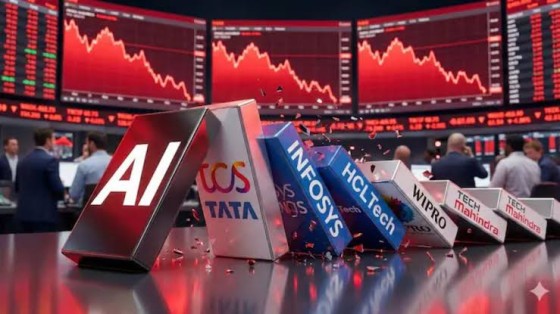
Indian IT stocks came under heavy pressure on 19 June 2026 after Accenture, the global bellwether for technology services, cut its full-year revenue outlook and reignited fears about weakening demand. The Nifty IT index fell close to 6 percent, the worst-performing sectoral index of the day, while more than ₹1.35 lakh crore in market value was wiped from major IT stocks, including Infosys, TCS, and HCLTech, in a single session. The drop dragged the broader market lower, with the Sensex falling more than 700 points and the Nifty slipping below the 24,000 mark. The trigger sat thousands of miles away, in a guidance cut from a company that shares many of the same global clients.
The reaction underlined how closely Indian IT stocks track Accenture's commentary. Because Accenture serves many of the same global clients as Infosys, TCS, HCLTech, Wipro, and Tech Mahindra, its commentary offers an early view of enterprise technology budgets, outsourcing demand, and discretionary spending across North America and Europe, the largest markets for Indian software exporters. When it signals caution, investors assume the same pressures will reach Mumbai-listed exporters within quarters.
The Accenture Trigger
Accenture cut its revenue growth guidance for the financial year ending August 2026 to between 3 and 4 percent in local currency, trimming the upper end of its earlier range. The forecast reflected concerns that global enterprises, mostly in the US, may remain cautious on discretionary technology spending, a major driver for Indian IT service firms. Third-quarter revenue still rose 6 percent year on year to $18.72 billion, while the company booked $19.32 billion of new orders, down 2 percent from a year earlier. Accenture's own shares fell by over 17 percent after the earnings release.
The Market Reaction
The selloff in India was swift and broad. The Nifty IT index tanked 6 percent, the worst-performing sectoral index of the day, and the weakness spilled into the wider market. Indian technology companies listed in the US also came under pressure, with Infosys ADRs sliding close to 10 percent. The single-session wipeout of more than ₹1.35 lakh crore across the major names showed how quickly sentiment turned once a global peer flagged softer demand.
The Stocks That Fell Hardest
Infosys led the selloff with a drop of about 7.6 percent, while TCS fell 5.46 percent to ₹2,082.9, HCLTech declined 4.31 percent to ₹1,111.7, Tech Mahindra slumped 4.41 percent to ₹1,383.9, and Wipro fell 3.38 percent to ₹176.66. Infosys closed at ₹1,051.40, a steep 6.75 percent decline, with trading volumes surging past 45 million shares and signalling strong institutional activity on the downside.
The Demand Worry
At the heart of the selloff is a fear that global clients are slowing discretionary technology spending. Companies are prioritising cost-saving and managed-services projects over higher-margin consulting work, weighing on growth expectations across the sector. North America and Europe, where most of the exporters' revenue originates, have stayed cautious on new project starts. Accenture's guidance gave that worry fresh, hard numbers.
The AI Disruption Paradox
A second, structural concern runs underneath the cyclical one. For years the Indian IT sector has grown by providing large teams for coding, testing, and application maintenance under a billable-hours model, and investors worry that AI is fundamentally changing this dynamic. Demand for generative-AI projects remains strong, but the pace of monetisation is slower than expected. Analysts call it the AI disruption paradox: clients are spending on AI, yet much of that budget flows to AI platforms and internal teams rather than traditional service providers.
The Global Capability Centre Shift
The rise of Global Capability Centres adds another layer of pressure. Many multinationals are choosing to build their own technology teams in India rather than hiring external IT service providers, while AI vendors increasingly offer solutions that compete directly with traditional outsourcing. These captive centres capture work that once went to firms like Infosys and Wipro, eroding a long-standing source of growth.
The Valuation Question
Brokerages are turning more cautious on valuations. Citi said it remains cautious on the Indian IT sector, noting that the Nifty IT index trades around 16 times one-year forward earnings while Accenture trades at 10 times, with macro uncertainty raising near-term challenges. Some analysts argue that current valuations no longer reflect the underlying growth profile of large-cap IT companies as single-digit revenue expansion becomes the norm.
The Pockets of Resilience
Not every corner of the sector faces the same threat. Analysts point to engineering and R&D firms such as Tata Technologies and Tata Elxsi as more resilient, because their work is tied to physical products, hardware, and manufacturing, where AI is used to build new products rather than replace existing services. Infosys also showed that its operational performance did not fully reflect its share-price weakness, reporting FY26 revenue of $20.16 billion and 3.1 percent constant-currency growth.
The Direction of Travel
The Accenture-led selloff has reset expectations ahead of the Indian IT earnings season, when investors will look for signs of stabilising demand and clearer AI revenue. The near-term picture stays cautious: discretionary budgets are tight, AI is reshaping the work, and valuations are under review. Whether Indian IT stocks recover will depend less on any single quarter and more on how quickly the majors turn AI demand into durable, high-value revenue. For now, the sector enters the months ahead on the back foot.
Frequently Asked Questions
Why did Indian IT stocks fall after Accenture's results?
Accenture cut its FY26 revenue growth forecast and flagged cautious enterprise spending. Because it serves many of the same global clients as Indian exporters, investors treated its outlook as an early warning for the sector and sold off Infosys, TCS, and peers.
How much did the Nifty IT index drop?
The Nifty IT index fell close to 6 percent on 19 June 2026, the worst-performing sectoral index that day, while major IT companies lost more than ₹1.35 lakh crore in combined market value.
Which Indian IT stock fell the most?
Infosys led the losses, falling around 7 percent to close near ₹1,051 and acting as the biggest drag on the Nifty 50. TCS, HCLTech, Tech Mahindra, and Wipro also declined.
What is the AI disruption paradox?
It describes a situation where enterprises spend heavily on AI, yet much of that money goes to AI platforms and in-house teams rather than traditional IT service providers, limiting revenue gains for outsourcing firms even as overall tech spending rises.
Are all Indian IT companies equally affected?
No. Engineering and R&D-focused firms such as Tata Technologies and Tata Elxsi are seen as more resilient, since their work is tied to physical products and manufacturing rather than the billable-hours services most exposed to AI automation