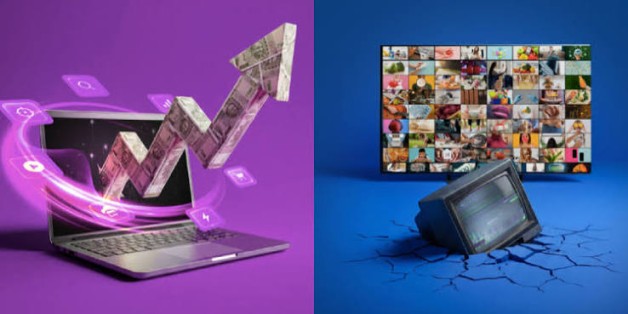
India’s ₹1 Lakh Crore Digital-Media Opportunity Accelerates as Advertising and Consumption Shift Online
India's digital-media industry has crossed the ₹1 lakh crore revenue threshold and is projected to expand rapidly through 2028 as advertising budgets, subscriptions and consumer attention increasingly migrate toward online platforms, creating a structural shift across the country's media and entertainment economy.
Digital-media revenue reached approximately:
₹1.11 lakh crore in CY2025.
ICICI Securities expects the market to grow at a compound annual growth rate of around:
14%
to reach approximately:
₹1.64 lakh crore by CY2028.
The expansion comes as digital advertising strengthens its position as the dominant advertising medium in India.
Digital accounted for approximately:
63% of India's advertising market in CY2025,
up from:
56% in CY2024.
Digital subscriptions are also scaling rapidly.
Subscription revenue across:
video,
audio,
and digital news
increased by nearly:
60%
to approximately:
₹16,300 crore in 2025.
Meanwhile, India's traditional linear television business is facing pressure.
Television revenue is projected to decline from approximately:
₹61,700 crore in CY2025
to:
₹53,500 crore by CY2028.
The divergence signals a fundamental change in where Indians spend:
their attention,
their subscription money,
and where advertisers allocate marketing budgets.
Digital Media Crosses ₹1 Lakh Crore for First Time

India's digital-media segment crossed the:
₹1 lakh crore
revenue threshold during 2025.
FICCI-EY estimates also placed digital media above ₹1 lakh crore, making it the:
largest segment of India's media and entertainment industry.
The milestone reflects years of growth across:
digital advertising,
online video,
social media,
search,
digital news,
music,
subscriptions,
and other internet-based media.
Digital is no longer simply an additional distribution channel for India's media companies.
It has become the industry's largest economic engine.
Digital Media Revenue Reaches Around ₹1.11 Lakh Crore
ICICI Securities estimates India's digital-media revenue at approximately:
₹1.11 lakh crore in CY2025.
It expects the segment to reach:
₹1.64 lakh crore by CY2028.
That represents an expected compound annual growth rate of approximately:
14%.
If that trajectory materialises, digital media would add more than:
₹50,000 crore
of annual revenue within three years.
The expansion is being driven by several overlapping trends rather than a single platform.
Digital Advertising Is Main Growth Engine
The largest contributor is:
digital advertising.
According to FICCI-EY estimates, digital advertising increased approximately:
26%
in 2025 to:
₹94,700 crore.
It accounted for close to:
two-thirds of total advertising revenues.
This makes digital advertising central not only to internet companies but to the economics of India's entire media industry.
Brands increasingly allocate money toward channels where consumers spend more time and where campaign performance can be:
measured,
targeted,
and optimised.
Digital Captured Around 63% of Advertising Market
ICICI Securities estimates digital advertising represented approximately:
63% of India's total advertising market in CY2025.
A year earlier, the figure was approximately:
56%.
That seven-percentage-point increase in a single year illustrates the speed of the transition.
Advertising budgets are increasingly flowing toward:
social platforms,
search,
online video,
OTT,
connected television,
retail media,
and programmatic channels.
The movement is occurring across both:
large national brands
and:
smaller businesses.
India’s Overall Advertising Market Is Expanding Too
Digital growth is not solely the result of money being taken from traditional media.
India's overall advertising economy is also expanding.
Rising consumer spending,
new businesses,
e-commerce,
digital payments,
and greater competition for customers
are increasing marketing demand.
This means digital platforms can gain market share while the total advertising pool continues to grow.
The result is a particularly powerful combination:
market expansion plus share gains.
Consumer Attention Is Moving Online
Advertising follows:
attention.
Indian consumers increasingly spend their media time across:
smartphones,
streaming applications,
social networks,
YouTube,
connected televisions,
and other digital platforms.
That changes the economics of media.
If audiences spend more time online, advertisers have greater incentive to follow them.
This creates more advertising revenue for digital platforms, which can then invest in:
content,
technology,
and distribution.
Smartphone Adoption Created the Foundation
India's digital-media transformation would not have occurred without mass smartphone adoption.
CRISIL Intelligence estimated that India's smartphone user base increased from approximately:
500 million in 2019
to:
700 million in 2024.
That created an enormous addressable audience for:
streaming,
social media,
digital news,
gaming,
music,
and e-commerce.
For hundreds of millions of consumers, the smartphone has effectively become the primary:
media device.
Cheap Mobile Data Changed Consumption Economics
Affordable mobile data has been equally important.
India has historically offered some of the world's lowest mobile-data prices.
Cheap connectivity reduced the economic barrier to consuming:
video,
music,
social media,
and live streaming.
That was particularly important for video because video requires substantially more data than:
text
or:
static images.
Affordable bandwidth therefore enabled India to become a massive mobile-video market.
Screen Time Has Increased
CRISIL estimated average daily screen time had risen to more than:
five hours per day
from approximately:
four hours in 2019.
OTT and social-media platforms accounted for around:
60%
of that screen time.
This creates an enormous pool of consumer attention that advertisers can monetise.
The battle for India's media market is therefore increasingly a battle for:
daily screen time.
Short-Form Video Has Changed Media Behaviour
One of the most important changes has been the rise of:
short-form video.
Consumers can now move through dozens of pieces of content within minutes.
This has changed:
discovery,
entertainment,
news consumption,
and advertising.
Short-form platforms have also reduced the barrier to becoming a creator.
A person no longer needs a television studio or production company to reach millions of viewers.
A smartphone can be sufficient.
Social Media Takes Larger Share of Digital Advertising
Social media has consequently increased its share of digital advertising.
CRISIL estimated that social platforms accounted for approximately:
40–45%
of digital advertising spending by FY2025.
In FY2020, the comparable share was approximately:
31–33%.
The expansion has been supported by:
creator-led content,
short-form video,
and increasingly sophisticated advertising tools.
Social platforms have evolved from communication networks into major:
media-distribution systems.
YouTube Has Also Gained Advertising Share
YouTube's position has strengthened significantly.
CRISIL estimated its share of Indian digital advertising increased to around:
20–22%
by FY2025.
The platform benefits from:
massive reach,
free ad-supported content,
smartphone availability,
connected-TV adoption,
and a vast creator ecosystem.
It also spans content ranging from:
seconds-long Shorts
to:
multi-hour live broadcasts.
That gives advertisers access to multiple formats within one platform.
Search Is Losing Relative Share
Search remains an important digital-advertising channel.
However, its relative share has declined as the ecosystem becomes more diversified.
In FY2020, search accounted for approximately:
40–42%
of digital advertising spending.
CRISIL estimated that its share subsequently declined by around:
five to six percentage points.
Consumers increasingly discover products through:
social content,
creators,
video,
marketplaces,
and recommendations
rather than beginning every purchase journey with a search query.
Creator Economy Is Reshaping Brand Marketing
The rise of creators has created an entirely new advertising layer.
Brands can now work with:
national celebrities,
large influencers,
specialist creators,
and micro-influencers.
This allows marketing to become more:
targeted,
personal,
and community-driven.
A beauty brand can collaborate with beauty creators.
A technology company can work with technology reviewers.
A financial-services company can target audiences through finance educators.
This segmentation was difficult to achieve through traditional mass media.
FMCG Companies Have Shifted Budgets Rapidly
The change is visible among India's largest consumer advertisers.
CRISIL estimated that FMCG companies were allocating approximately:
55–60% of their advertising budgets to digital
by FY2025.
In FY2020, the figure was only around:
30%.
That is a significant structural shift because fast-moving consumer-goods companies have historically been among the largest buyers of:
television advertising.
Their movement toward digital demonstrates how mainstream online marketing has become.
Automakers Are Increasing Digital Spending
Automobile companies have followed a similar path.
CRISIL estimated digital represented around:
35–40%
of automobile advertising budgets in FY2025.
That compares with approximately:
15–20% in FY2020.
Digital channels allow automakers to target consumers based on:
location,
vehicle interest,
income proxies,
search behaviour,
and purchase intent.
They can also connect advertising directly to:
dealer enquiries
and:
test-drive bookings.
E-Commerce Is Naturally Digital-First
For e-commerce businesses, digital channels can represent up to:
60% of advertising expenditure.
The logic is straightforward.
The advertisement and transaction occur within the same digital environment.
A user can:
see an advertisement,
click it,
visit a product page,
and complete a purchase
within minutes.
That makes campaign measurement significantly easier than in many traditional media formats.
E-Commerce Advertising Is Becoming Its Own Category
E-commerce platforms are not only advertisers.
They are increasingly:
advertising platforms themselves.
Brands pay marketplaces and commerce applications for:
sponsored listings,
search placement,
display advertising,
and personalised promotions.
FICCI-EY estimated e-commerce and point-of-sale advertising increased approximately:
50%
to around:
₹22,000 crore in 2025.
This is creating another large advertising market within India's digital economy.
Retail Media Could Become Major Growth Engine
Retail media sits close to the point of purchase.
That gives it valuable commercial data.
A marketplace knows:
what a consumer searched for,
what products were viewed,
what was purchased,
and often:
when another purchase may occur.
Advertisers can therefore target customers with high purchase intent.
This makes retail media attractive for brands seeking measurable:
sales outcomes
rather than only awareness.
Programmatic Advertising Is Expanding Rapidly
Another major structural shift is:
programmatic advertising.
Programmatic technology automates the process of:
buying,
selling,
placing,
and optimising
advertising inventory.
Instead of manually negotiating every campaign placement, software can make decisions in:
real time.
This improves:
speed,
targeting,
and scalability.
Programmatic Share Reaches Around 42%
ICICI Securities estimates programmatic advertising accounted for approximately:
42%
of India's digital-advertising market in CY2025.
That represents around:
₹30,000 crore.
In CY2016, programmatic represented only approximately:
10%.
The brokerage expects the market to reach approximately:
₹42,400 crore by CY2027.
That growth creates opportunities for:
advertising-technology companies,
cloud platforms,
data companies,
and media-technology providers.
AI Is Making Advertising More Automated
Artificial intelligence is accelerating this transition.
AI can help advertisers determine:
which audience to target,
which creative to display,
how much to bid,
when to show an advertisement,
and which campaign is producing the best return.
Generative AI can also create:
multiple advertising variations
at relatively low cost.
This means advertising is becoming increasingly:
automated,
personalised,
and performance driven.
Connected TV Is Blurring Television and Digital
One of the most important developments is:
connected television, or CTV.
A connected television allows viewers to consume internet-delivered content on a conventional television screen.
This includes:
OTT services,
YouTube,
and other streaming platforms.
The screen may look like traditional television.
But the underlying distribution and advertising technology is:
digital.
Weekly Active CTV Households Reached 40 Million
ICICI Securities estimates India's weekly active connected-TV households increased from:
30 million in CY2024
to:
40 million in CY2025.
It expects the figure to reach approximately:
67 million by CY2028.
Other industry estimates using different methodologies have placed the broader connected-TV universe even higher.
Regardless of measurement differences, the direction is clear:
connected television is expanding rapidly.
CTV Changes Meaning of Television Advertising
Historically, television advertising was purchased primarily based on:
channels,
programmes,
time slots,
and broad audience demographics.
Connected TV introduces digital capabilities such as:
audience targeting,
measurement,
and programmatic buying.
This allows advertisers to combine the impact of:
a large television screen
with:
digital targeting.
Over time, the distinction between:
television advertising
and:
digital-video advertising
could become increasingly blurred.
Linear Television Is Under Pressure
The rise of digital media is occurring alongside weakness in:
linear television.
ICICI Securities estimates television revenue declined approximately:
9% in CY2025.
Television advertising revenue fell around:
10%,
while subscription revenue declined approximately:
8%.
The industry also lost roughly:
11 million pay-TV households.
This creates a difficult economic environment for traditional broadcasters and distribution companies.
Television Revenue Could Fall to ₹53,500 Crore
ICICI Securities expects television revenue to decline at approximately:
5% CAGR
between CY2025 and CY2028.
Revenue could fall from:
₹61,700 crore
to approximately:
₹53,500 crore.
This does not mean television viewing disappears.
Instead, viewing increasingly shifts from:
linear distribution
toward:
internet-connected screens.
Media companies therefore need to monetise audiences across both environments.
India Remains a Multi-Screen Market
Traditional media is not disappearing overnight.
Television still reaches hundreds of millions of Indians every week.
FICCI-EY estimated linear television retained approximately:
745 million weekly viewers
in 2025.
India is therefore becoming a:
multi-screen market.
Consumers may watch:
television,
smartphones,
connected TVs,
cinema,
and social video
during the same week.
The commercial challenge is understanding how attention moves between those screens.
Digital Subscriptions Jump Nearly 60%
Advertising is not the only source of digital growth.
Consumer payments are also increasing.
Combined subscription revenue across:
video,
audio,
and digital news
increased nearly:
60%
in 2025 to approximately:
₹16,300 crore.
That indicates a growing willingness among Indian consumers to pay for:
premium digital content.
Historically, India's digital ecosystem was heavily dependent on:
free,
advertising-supported models.
Subscriptions are now becoming more meaningful.
Paid Video Subscriptions Reach 216 Million
FICCI-EY estimated paid video subscriptions reached approximately:
216 million
in 2025.
This does not necessarily represent 216 million unique households or individuals because consumers can subscribe to:
multiple services.
Nevertheless, the figure demonstrates the scale of India's paid streaming economy.
Sports,
films,
series,
and premium entertainment
remain major subscription drivers.
Paid Music Subscriptions Grow 37%
Paid music subscriptions also increased.
FICCI-EY estimated the number of paid music subscriptions grew approximately:
37%
to:
14.4 million
in 2025.
Music remains heavily supported by free advertising-funded consumption.
But growth in paid users shows that at least part of the market is willing to pay for:
ad-free listening,
higher-quality audio,
offline access,
and other premium features.
Sports Can Accelerate Paid Streaming
Premium sports rights are becoming increasingly important to:
digital subscriptions.
Live sport creates:
urgency.
Unlike a film or series, viewers often want to watch a match:
in real time.
That makes sports valuable for both:
subscriber acquisition
and:
advertising.
India's enormous cricket audience makes this particularly important.
Major sporting events can bring hundreds of millions of viewers onto digital platforms within short periods.
Films Are Returning to Theatrical-First Windows
Digital growth does not necessarily mean every form of traditional entertainment declines.
ICICI Securities identifies the return of:
theatrical-first film releases
as one emerging trend.
Streaming platforms have become more disciplined about:
content acquisition
and:
release windows.
Successful theatrical performance can help establish:
audience awareness
before a film moves to streaming.
The relationship between cinema and digital is therefore becoming more complementary.
Audio Storytelling Is Emerging
Another growth area is:
audio storytelling.
Digital platforms have created new formats around:
audio series,
fiction,
podcasts,
and spoken entertainment.
Audio has relatively low consumption friction because users can listen while:
travelling,
working,
exercising,
or performing other activities.
India's linguistic diversity also creates opportunities for:
regional-language audio content.
Microdramas Could Create Mobile-First Category
Short-form scripted entertainment is another emerging format.
Microdramas
typically consist of short episodes designed primarily for:
mobile consumption.
The format has expanded rapidly in parts of Asia and is attracting greater interest in India.
It combines elements of:
television serials,
short-form social video,
and mobile entertainment.
If monetisation develops successfully, microdramas could create another digital-content category.
Regional Languages Expand Addressable Audience
India's digital-media opportunity cannot be understood only through:
English
and:
Hindi.
Hundreds of millions of consumers prefer content in:
Tamil,
Telugu,
Bengali,
Marathi,
Kannada,
Malayalam,
Punjabi,
Gujarati,
and other languages.
Digital distribution removes many of the geographic constraints associated with traditional media.
A regional creator can potentially reach:
global diaspora audiences
as easily as domestic viewers.
Creator-Led Content Reduces Production Barriers
Traditional television and film production require substantial:
capital,
distribution,
and institutional infrastructure.
Digital platforms dramatically lower those barriers.
A creator can produce content with:
a smartphone,
basic editing software,
and an internet connection.
This has created an enormous supply of:
independent media.
The result is a fragmented but highly dynamic content ecosystem.
Advertising Can Reach Smaller Niches
Traditional mass media works best when advertisers want to reach:
very large audiences.
Digital media can monetise much smaller groups.
A business selling:
specialised fitness products,
financial software,
premium cosmetics,
or local services
can target users with specific interests.
This expands the number of businesses capable of using sophisticated advertising.
SMEs Could Become Major Digital-Ad Buyers
Small and medium-sized enterprises represent an important future growth engine.
Digital advertising allows smaller businesses to begin campaigns with:
relatively modest budgets.
They can target:
specific cities,
neighbourhoods,
interests,
and customer groups.
Performance can be measured quickly.
That makes advertising accessible to businesses that could never afford national:
television
or:
print campaigns.
Digital Media Is More Measurable
Measurement is one of digital advertising's strongest advantages.
Advertisers can track metrics such as:
impressions,
clicks,
video completion,
app installations,
leads,
and purchases.
This makes it easier to connect marketing spending with:
business outcomes.
Traditional media can provide enormous reach but often with less precise attribution.
That difference is pushing more performance-oriented advertising online.
Measurement Is Still Imperfect
Digital advertising is not perfectly measurable.
Challenges include:
cross-device attribution,
privacy restrictions,
walled gardens,
fraud,
and inconsistent measurement standards.
A consumer may see an advertisement on one device and purchase on another.
Platforms may also use different definitions for:
views,
reach,
and engagement.
The industry therefore still needs better independent measurement.
Privacy Is Reshaping Advertising Technology
Greater digital targeting also creates concerns around:
consumer privacy.
India's evolving data-protection framework is increasing expectations around:
consent,
data collection,
and responsible processing.
Advertisers and platforms will need to rely more heavily on:
first-party data,
privacy-preserving technologies,
and contextual targeting.
The digital-advertising market can continue growing while becoming more regulated.
First-Party Data Becomes More Valuable
First-party data is information a company collects directly from:
its customers
or:
users.
Retailers,
streaming platforms,
banks,
telecom companies,
and e-commerce businesses
can possess large amounts of such data.
As third-party tracking becomes more constrained, this direct customer information becomes strategically valuable.
That is one reason retail media and commerce advertising are expanding rapidly.
Cloud Technology Is Changing Media Operations
The digital-media opportunity extends beyond advertising platforms.
Media companies increasingly move:
content management,
broadcast operations,
distribution,
and monetisation
to the cloud.
Cloud infrastructure allows broadcasters to launch channels and services without maintaining the same level of:
physical broadcast hardware.
This creates a growing market for:
media-technology companies.
Amagi Is Positioned Around Cloud Broadcasting
Against this backdrop, ICICI Securities has initiated coverage of:
Amagi Media Labs
with a Buy rating.
The brokerage set a target price of:
₹700
against a reference price of:
₹563.
Amagi provides cloud-based infrastructure that helps broadcasters:
create,
distribute,
and monetise
video channels.
ICICI Securities estimates only around:
10%
of global media operations currently run on cloud infrastructure.
That leaves significant room for migration.
Cloud Migration Could Lower Technology Costs
ICICI Securities estimates moving from on-premise media infrastructure to Amagi's cloud platform could reduce clients' technology costs by approximately:
30–50%.
Cloud-based operations can also improve:
flexibility,
scalability,
and deployment speed.
A broadcaster can potentially launch new channels or feeds without building an entirely new physical broadcast stack.
This is particularly useful as media distribution becomes more fragmented across:
regions,
devices,
and streaming services.
AI Can Automate Media Operations
AI is also being incorporated into:
content scheduling,
reframing,
advertising optimisation,
and localisation.
For example, a piece of horizontal television content may need to be reformatted for:
vertical mobile screens.
AI can automate parts of that process.
Similarly, advertising inventory can be optimised based on:
audience
and:
performance data.
This can reduce operational costs while increasing monetisation.
Prime Focus Could Benefit From Rising VFX Spending
ICICI Securities has also initiated coverage on:
Prime Focus
with a Buy rating and target price of:
₹375
against a reference price of:
₹307.
The investment thesis is partly based on increasing:
visual-effects spending.
The brokerage estimates VFX can now account for approximately:
20–40% of the budgets of major films,
compared with:
5–20% historically.
This reflects the growing technological intensity of entertainment production.
DNEG Has Around $1 Billion Order Book
Prime Focus subsidiary:
DNEG
had an order book of approximately:
$1 billion
as of March 2026.
Around:
60%
was contracted,
while approximately:
40%
represented a highly visible pipeline.
More than:
90%
of revenue comes from recurring customers.
This gives the company exposure not only to India's media market but to:
global film
and:
streaming production.
AI Is Also Entering Content Production
Prime Focus is also expanding through:
Brahma AI.
The business is developing technologies around:
digital humans,
voice localisation,
and visual localisation.
AI could materially change the economics of:
dubbing,
post-production,
visual effects,
and content adaptation.
For India's media-production industry, this creates both:
an opportunity
and:
a disruption risk.
India Could Become Larger Global Production Hub
India already has a large pool of:
animators,
VFX artists,
software engineers,
and post-production professionals.
As global media production becomes more technology intensive, India could capture more work.
Global capability centres may also expand into:
content operations,
media technology,
and creative services.
This creates another layer of opportunity beyond domestic advertising and consumption.
Foreign Platforms Capture Significant Digital Ad Value
India's digital-media boom also presents a strategic challenge.
A significant share of digital advertising flows to global platforms.
CRISIL has highlighted that much of the spending on:
social media
and:
search
ultimately goes to foreign-owned companies.
That means rapid growth in India's digital consumption does not automatically translate into equivalent value capture by:
Indian media companies.
Domestic Platforms Need Stronger Monetisation
For Indian media businesses, the challenge is therefore not simply:
building audiences.
They must also monetise those audiences effectively.
Potential revenue models include:
advertising,
subscriptions,
commerce,
licensing,
events,
and creator partnerships.
Companies that depend entirely on third-party distribution may struggle to retain enough economic value.
Owning:
consumer relationships
and:
first-party data
can become increasingly important.
Traditional Media Companies Are Becoming Digital Companies
India's established:
television networks,
newspapers,
radio companies,
and film studios
are responding by expanding digital operations.
Many now operate:
streaming services,
websites,
apps,
social channels,
podcasts,
and creator businesses.
The boundary between:
traditional media
and:
digital media
is therefore becoming less meaningful.
The industry's future is increasingly:
multi-platform.
India’s M&E Industry Reached ₹2.78 Lakh Crore
The broader media and entertainment industry reached approximately:
₹2.78 lakh crore in 2025,
according to FICCI-EY.
That represented approximately:
9% year-on-year growth.
Digital media, advertising and live experiences were among the principal growth drivers.
The overall sector is projected to reach approximately:
₹3.30 lakh crore by 2028.
Digital is expected to account for an increasingly large portion of that expansion.
New Media Could Exceed Half of Industry Revenue
FICCI-EY expects:
new media
to contribute more than:
50%
of total Indian media and entertainment revenue by 2028.
That would represent a fundamental rebalancing of the industry.
For decades, India's media economics were dominated by:
television,
print,
films,
and radio.
The next era will be increasingly shaped by:
digital advertising,
streaming,
connected television,
online creators,
commerce media,
and technology-enabled content.
₹1 Lakh Crore Is a Milestone, Not the End Point
The importance of the ₹1 lakh crore threshold is therefore symbolic as well as financial.
It marks the point where digital media has become:
too large to be treated as a secondary media channel.
But the market is still developing.
Connected-TV penetration remains below its long-term potential.
Paid digital subscriptions are still relatively young.
Programmatic advertising continues to expand.
Retail media is scaling.
AI is beginning to change both advertising and content production.
The next phase could therefore be larger than the one that produced the first ₹1 lakh crore.
Conclusion
India's digital-media market crossing ₹1 lakh crore marks a structural turning point for the country's media and advertising economy, with online platforms increasingly capturing both consumer attention and commercial spending.
Digital-media revenue reached approximately ₹1.11 lakh crore in CY2025, and ICICI Securities expects it to expand at around 14% CAGR to ₹1.64 lakh crore by CY2028.
Digital advertising is the principal engine of that growth. It accounted for approximately 63% of India's advertising market in 2025, while FICCI-EY estimated digital advertising revenue increased 26% to ₹94,700 crore.
At the same time, digital subscriptions increased nearly 60% to ₹16,300 crore, connected-TV households continued to expand, programmatic advertising reached roughly ₹30,000 crore, and social, video, creator-led and commerce advertising gained share.
The contrast with linear television is becoming increasingly visible. Television revenue is projected to decline from approximately ₹61,700 crore in CY2025 to ₹53,500 crore by CY2028, even as television screens themselves remain important through connected streaming.
The opportunity now extends far beyond media companies.
It encompasses advertising technology, cloud broadcasting, VFX, AI-powered content production, retail media, creators, connected TV, streaming, digital subscriptions and global content services.
India is therefore not simply moving from traditional media to digital media.
It is developing a new media economy in which content, advertising, commerce, software and data increasingly operate within the same digital ecosystem.