China’s LandSpace Successfully Lands Reusable Rocket Booster in New Challenge to SpaceX
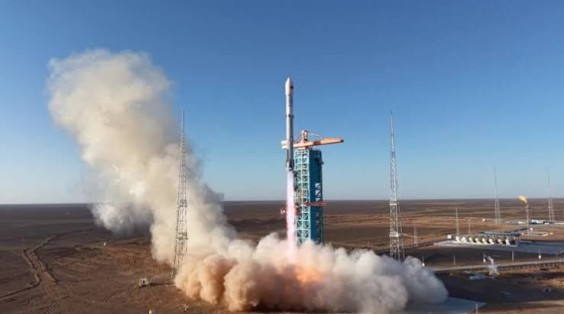
Chinese commercial launch company LandSpace has successfully recovered the first stage of its Zhuque-3 rocket, marking a major breakthrough in China’s efforts to master reusable orbital-launch technology and narrow the technological gap with US leaders SpaceX and Blue Origin.
The stainless-steel, methane-fuelled Zhuque-3 completed a controlled powered descent and landed vertically on deployable legs in Gansu province after launching from northwestern China. The achievement makes LandSpace the first Chinese private launch company to complete a ground-based, leg-assisted recovery of an orbital-class booster, following an unsuccessful recovery attempt during Zhuque-3’s maiden orbital mission in December 2025. (Reuters)
The milestone could significantly strengthen LandSpace’s commercial position as China accelerates development of reusable rockets capable of reducing launch costs and supporting much larger satellite constellations.
LandSpace Successfully Recovers Zhuque-3 First Stage

The successful landing represents a decisive technical milestone for one of China’s most closely watched private aerospace companies.
Zhuque-3 Lands Hundreds of Kilometres Downrange
The 66.1-metre Zhuque-3 lifted off from northwestern China before its first stage separated and returned toward Earth.
The booster subsequently completed a controlled descent and landed roughly 390 kilometres from the launch location in Gansu province. (Reuters)
Unlike parachute or net-based recovery techniques, Zhuque-3 uses powered descent and deployable landing legs.
This approach closely resembles the recovery architecture that SpaceX has used to transform the economics of its Falcon 9 launch system.
Successful recovery is essential because the most expensive portion of the launch vehicle can potentially be inspected, refurbished and flown again rather than discarded after every mission.
Second Attempt Delivers Major Breakthrough
LandSpace previously attempted to recover Zhuque-3’s first stage during the rocket’s maiden orbital flight in December 2025.
The rocket successfully reached orbit, but the booster experienced abnormal combustion during the final phase of descent and failed to land safely. (Reuters)
That mission nevertheless generated extensive flight data covering atmospheric re-entry, guidance, grid-fin control and landing operations.
The successful second attempt shows that LandSpace was able to convert information from the earlier failure into improvements significant enough to complete the recovery.
Zhuque-3 Uses Methane and Liquid Oxygen
LandSpace has built its reusable launch strategy around methane propulsion.
Methane Offers Potential Reusability Advantages
Zhuque-3 uses liquid methane and liquid oxygen rather than the kerosene commonly used by several older launch systems.
Methane can burn more cleanly than kerosene, potentially reducing carbon deposits inside engines.
That characteristic is particularly useful for reusable rockets because engines need to operate repeatedly with limited refurbishment.
Reducing contamination and maintenance requirements can shorten the turnaround period between flights.
LandSpace has already demonstrated considerable expertise with methane propulsion, becoming the first company globally to place a methane-fuelled rocket into orbit with Zhuque-2 in 2023. (LandSpace)
Stainless-Steel Construction Supports Reusability
Zhuque-3 uses a stainless-steel structure.
The material can provide advantages involving durability, manufacturing economics and resistance to extreme temperature conditions.
SpaceX has also adopted stainless steel for its much larger Starship system.
Material selection alone does not determine whether a rocket can be reused economically, but durability becomes increasingly important when hardware needs to survive multiple launches and re-entries.
LandSpace Plans to Fly Booster Up to 20 Times
Recovering a rocket is only the first stage of building a genuinely reusable launch business.
Reflight Is the Commercial Test
LandSpace has designed Zhuque-3’s first stage for as many as 20 flights, and the company plans to reuse the recovered booster within approximately six months. (Reuters)
That planned reflight will be commercially more significant than the landing alone.
A booster that lands successfully but requires extensive rebuilding provides limited economic advantage.
True reusability requires rapid inspection, refurbishment and relaunch.
The company will therefore need to examine engines, tanks, landing systems, thermal protection and structural components before deciding how much hardware can remain unchanged for another mission.
Turnaround Time Determines Economics
SpaceX’s competitive advantage comes not merely from recovering Falcon 9 boosters but from repeatedly flying them.
Every successful reflight spreads the manufacturing cost of the booster across multiple missions.
If LandSpace can achieve a similar operating model, the cost per launch could decline substantially.
That would make the company more competitive for commercial satellite contracts and government missions.
Zhuque-3 Targets Growing Satellite Market
Reusable rockets are particularly valuable when launch demand is high.
Rocket Can Carry More Than 14 Tonnes to Low Earth Orbit
Zhuque-3 is designed to transport approximately 14.2 tonnes to low Earth orbit when operating with booster recovery, according to current specifications reported around the latest mission. (Reuters)
That gives the rocket sufficient capacity to address satellite constellations and other substantial commercial payloads.
Its capability remains below SpaceX’s Falcon 9, which can carry roughly 22.8 tonnes to low Earth orbit in expendable configuration.
However, payload capacity alone does not determine commercial competitiveness.
Launch price, reliability, schedule availability and frequency can be equally important to satellite customers.
China Needs Reusable Rockets for Satellite Constellations
China’s expanding satellite ambitions create a powerful domestic market for reusable launch vehicles.
Mega-Constellations Require Frequent Launches
Large broadband constellations can involve thousands of satellites.
Putting these networks into orbit requires repeated launches over several years.
Traditional expendable rockets require a new first stage for every mission.
That increases manufacturing requirements and costs.
Reusable boosters can potentially allow launch providers to increase flight frequency without building an entirely new rocket for every mission.
This is one reason reusable technology has become strategically important to China’s commercial space programme.
SpaceX Demonstrated the Model With Starlink
SpaceX’s Falcon 9 and Starlink businesses illustrate the connection between reusable launch systems and satellite constellations.
Frequent Falcon 9 reuse allows SpaceX to launch large batches of Starlink satellites at a pace difficult for conventional expendable launch providers to match.
China wants comparable capabilities as it develops its own large communications constellations.
Domestic reusable rockets such as Zhuque-3 could therefore become critical infrastructure for the country’s wider space ambitions.
LandSpace Emerges as Major Chinese Space Startup
China’s commercial space industry has expanded rapidly during the past decade.
Company Was Founded in 2015
LandSpace was established in 2015 and focuses on liquid-fuel rocket engines and commercial launch vehicles. (LandSpace)
The company has become one of the highest-profile private launch providers in China because of its early commitment to methane propulsion and reusable launch architecture.
Unlike state-owned aerospace organisations that historically dominated China’s launch industry, LandSpace represents a new generation of commercially oriented companies competing for launch contracts and private capital.
Success Strengthens IPO Story
LandSpace is pursuing an initial public offering on Shanghai’s STAR Market that could raise around $1.11 billion, with the company targeting profitability by 2029. (Reuters)
A successful reusable-booster landing could materially strengthen the company’s technology credentials with prospective investors.
Rocket development requires extremely large amounts of capital.
Public-market funding could help finance additional launch vehicles, manufacturing capacity and reusable-flight testing.
China’s Reusable Rocket Programme Accelerates
LandSpace is part of a wider national effort rather than an isolated project.
Long March Programme Has Also Advanced Recovery
China successfully recovered a Long March-10B rocket stage at sea in July 2026 using a net-capture system. (AP News)
The LandSpace landing represents a different technological approach.
Instead of being captured by a large offshore recovery system, Zhuque-3 performs a powered vertical landing on its own legs.
China now has experience with more than one recovery architecture, reflecting the scale of national investment in reusable launch systems.
Multiple Private Companies Are Developing Reusable Rockets
Other Chinese commercial aerospace companies are also working on reusable vehicles.
The intense development pipeline creates internal competition.
Some companies are pursuing Falcon 9-style kerosene rockets.
Others are developing methane systems.
The first companies capable of demonstrating repeated, reliable launches could secure major positions in China’s emerging commercial launch market.
SpaceX Remains Far Ahead in Operational Reuse
LandSpace’s achievement is significant, but the competitive gap with SpaceX remains substantial.
Falcon 9 Has Completed Hundreds of Recoveries
SpaceX began successfully landing Falcon 9 first stages in 2015 and has since accumulated hundreds of booster recoveries and reflights. (Reuters)
Some Falcon 9 boosters have flown many missions.
That operational history gives SpaceX enormous data on engine wear, structural fatigue and refurbishment.
LandSpace has now demonstrated that its recovery architecture works.
It still needs to prove that it can repeat the process reliably across many launches.
Reliability Is More Important Than One Landing
Commercial satellite operators care intensely about mission reliability.
A launch failure can destroy payloads worth hundreds of millions of dollars.
Insurance costs also depend on historical launch performance.
LandSpace therefore needs a growing record of successful orbital missions before it can compete for the highest-value global commercial contracts.
Blue Origin Is Another Reusable Launch Competitor
LandSpace’s achievement also places the Chinese company alongside Blue Origin in the emerging reusable heavy-launch market.
Reuse Is Spreading Beyond SpaceX
Blue Origin has long reused its suborbital New Shepard boosters and has also advanced recovery and reuse of the orbital-class New Glenn first stage. (Reuters)
This demonstrates that reusable launch technology is no longer unique to SpaceX.
The competitive question is increasingly shifting from whether a company can land a booster to how cheaply and frequently it can reuse one.
That transition could eventually reshape commercial launch pricing globally.
Reusability Can Lower Satellite Launch Costs
Launch expense remains one of the largest barriers to putting infrastructure into orbit.
First Stage Represents Major Hardware Investment
The first stage contains multiple rocket engines, fuel tanks, guidance hardware and other expensive systems.
Discarding this equipment after one mission requires manufacturers to reproduce it for every launch.
Recovering and reusing the booster changes this model.
The initial manufacturing cost remains substantial, but it can be distributed across multiple missions.
The greater the number of reliable reflights, the lower the effective hardware cost per launch can become.
High Launch Frequency Is Equally Important
Reusability becomes especially valuable when customers require frequent missions.
Manufacturing Bottlenecks Can Be Reduced
An expendable launch provider needs factories capable of producing complete rockets continuously.
A reusable provider can potentially use the same booster repeatedly while manufacturing fewer new first stages.
This can reduce production bottlenecks.
It can also allow launch companies to focus resources on second stages, payload integration and expanding launch-site operations.
For China’s proposed satellite constellations, these advantages could become strategically important.
Global Commercial Launch Competition Could Intensify
More capable Chinese launch providers could eventually influence international pricing.
Customers Want Multiple Launch Options
Satellite companies benefit when several providers compete.
More launch capacity can reduce waiting periods.
Competition can also put pressure on prices.
SpaceX currently occupies an unusually powerful position in the commercial launch market because of Falcon 9’s combination of reliability, frequency and cost.
If Chinese reusable rockets achieve comparable economics, the global launch market could become significantly more competitive.
Geopolitics May Limit International Access
Technology alone will not determine LandSpace’s addressable market.
Space Launch Is Strategically Sensitive
Launch vehicles involve technologies with potential military applications.
Governments therefore impose extensive export controls and national-security restrictions.
Western satellite operators may face political or regulatory barriers when considering Chinese launch services.
Similarly, Chinese government payloads can favour domestic providers.
The global market may consequently develop along geopolitical lines even as technical competition increases.
Domestic Chinese Demand Could Be Sufficient
LandSpace does not necessarily need unrestricted access to Western customers to build a large business.
China possesses enormous domestic demand.
Government and Commercial Missions Create Pipeline
Earth-observation satellites, communications constellations, scientific spacecraft and national programmes all require launches.
A domestic provider capable of reducing costs can therefore build substantial scale within China itself.
This market could generate enough flight volume for LandSpace to refine reusable operations and reduce turnaround times.
Recovered Booster Must Now Be Inspected
The next important technical stage begins after landing.
Engineers Need to Evaluate Hardware Condition
LandSpace must determine how well the booster survived:
launch vibration,
stage separation,
atmospheric re-entry,
engine relights,
aerodynamic loads,
and final landing.
Engine condition will be particularly important.
A successful landing does not automatically mean every engine can immediately fly again.
Detailed inspection will determine which systems require refurbishment or replacement.
Rapid Reflight Would Be Major Milestone
LandSpace plans to reuse the recovered stage within six months. (Reuters)
Meeting that objective would provide stronger evidence that Zhuque-3 can become an economically reusable launch system.
Reflight Proves More Than Recovery
The historic first landing demonstrates control.
Reflight demonstrates durability.
Repeated reflights demonstrate economics.
Each stage represents a different level of technological maturity.
LandSpace must progress through all three before Zhuque-3 can genuinely challenge Falcon 9’s operating model.
Methane Could Support Future Larger Rockets
The experience gained from Zhuque-3 can also support more ambitious launch vehicles.
Methane Is Increasingly Popular for Next-Generation Rockets
SpaceX uses methane in Starship.
Blue Origin uses methane in New Glenn’s BE-4-powered first stage.
Several Chinese launch companies are also pursuing methalox propulsion.
The fuel combination offers characteristics well suited to reusable systems.
LandSpace’s early experience therefore provides a valuable technological foundation for larger future rockets.
China’s Private Space Industry Attracts More Capital
Successful demonstrations can increase investor confidence in commercial aerospace.
Space Requires Patient Funding
Rocket businesses can spend billions before generating sustainable profits.
Testing is expensive.
Failures are common.
Revenue depends on building a record of reliability.
Investors therefore need long time horizons.
LandSpace’s recovery milestone provides tangible evidence that private Chinese companies are progressing beyond prototypes toward operationally sophisticated launch systems.
India and Other Space Markets Will Watch Closely
China’s progress has implications across Asia.
Reusable Launch Becomes Global Priority
India, Japan and Europe are also developing technologies intended to reduce launch costs through hardware recovery or reuse.
The economic logic is difficult to ignore once competitors begin demonstrating operational success.
Countries that remain dependent on expendable launch vehicles could face higher launch costs and lower flight frequency relative to reusable systems.
China's accelerating progress will therefore increase competitive pressure across the global aerospace industry.
Conclusion
LandSpace’s successful landing of the Zhuque-3 first-stage booster marks one of the most important milestones yet for China’s commercial space industry.
The methane-fuelled rocket completed a powered vertical landing using deployable legs after the company’s first recovery attempt failed in December 2025. The achievement makes LandSpace the first Chinese private company to complete this type of ground-based recovery with an orbital-class booster. (Reuters)
The next challenge is significantly harder: proving that the recovered hardware can be inspected, refurbished and flown repeatedly at commercially attractive cost.
SpaceX remains far ahead after more than a decade of Falcon 9 recovery and reuse. But LandSpace has now crossed an important technological threshold.
If Zhuque-3 can progress from successful landing to routine reflight, China will move considerably closer to possessing the high-frequency, low-cost launch infrastructure needed for large satellite constellations and a much more competitive commercial space economy.